Five-time Oscar-winning composer John Barry has died at age 77. His music includes “Born Free,” and scores for several James Bond films, with perhaps “Goldfinger” the best-remembered. He could evoke a sensual, jazzy contemporary setting, romantic classicism, an intimate romance or vast adventure.
It sounded promising, with Sam Mendes (“American Beauty”) as director and Peter Morgan (“Frost/Nixon” and “The Queen”) as writer, with Daniel Craig returning and, perhaps most intriguingly, Oscar-winner Rachel Weisz as the villain. But the status of the next James Bond movie has been shifted from on hold to canceled entirely. Has Jason Bourne done what all those bad guys could not? Has he wiped out James Bond? Have modern, shaky camera, gritty spy movies and mundane real-life spy stories like the recent arrests of deep cover Russian spies in the suburbs made it impossible for us to enjoy the glossy elegance of the Bond series after 22 films? Or can he be re-booted again, even re-Bourne? The Guardian’s film blog has a good discussion about Bond’s future prospects. On one hand, James Bond is one of the world’s great brands, with all-but-guaranteed box office sales. On the other hand, the recent entries in the series, arguably everything since Sean Connery, have been infomercials stuffed with product placement and mired in retro notions of glamor that are uncomfortably outdated.
I don’t doubt that Bond will be back. The franchise still has value. But this stumble should be an opportunity to refocus on story, not stunts, and entertainment, not product sales.
More like “The Bond Ultimatum,” this is the Bournization of Bond. He may still spend some time in a dinner jacket, but this Bond is not the cool, debonair spy who seldom misses and never questions. This Bond is almost feral. He is seldom sure but he never, ever stops.
For the first time, there is no “Bond, James Bond” introduction and no dry flirtation with the ever-reliable Miss Moneypenny. Past Bonds have seemed like infomercials because they were so overstuffed with product placement, but this version is so stripped down to essence that there is not even time for Q to demonstrate an array of new gadgets so that we can have the pleasure of anticipating each of them in action.
This is the first Bond film to be an explicit sequel, beginning where Casino Royale left off. And so, in addition to non-stop action, brilliantly staged, we get to see Bond in the process of becoming Bond. Craig’s Bond is still near-feral, rough around the edges, his fury not yet under control. In the last film, he showed himself to be damaged but capable of being vulnerable until the death and apparent betrayal of Vesper (Eva Green) left him furious and equally determined to exact revenge and to protect his heart, if not his body or his soul, from any further trauma. Yes, this time it’s personal.
The issue of betrayal arises at all levels in this movie, right from the beginning, when even allies like the Americans and the inside circle of British spies can no longer be trusted. M (Judi Dench, as tart as a Granny Smith apple) has to rely on Bond, who may be rough, edgy, furious, even brutal, but who is not conventionally corruptible.
Every era gets the Bond it deserves. Every Bond is a reflection of his times. The Cold War Bond was the last of the unabashed pre-feminism alpha males. In the run-up to the Reagan era we had the Bond of excess — overstuffed with product placement and plots so literally out of this world that Bond ended up in outer space. And now we have the Bond of the era of compromised morals and unclear alliances. This is a rebooted Bond, building to some future time when gadgets and girls and martinis may re-enter the story.
Some things are unchangeable. No “Bond, James Bond,” Miss Moneypenny, or Q, but Bond does wear a dinner jacket (beautifully) and globe-hop to an array of glamorous locations. All the better for chasing around them and blowing them up. The girl (there must always be a girl) is as bent as Bond is, also driven for revenge and willing to do or destroy anything to get it. But don’t spend any time trying to figure out what the title refers to — basically, nothing. It is the title of a James Bond short story that has no other connection to this movie.
The film is not just tough on Americans; it portrays the world as a bleak and inherently compromised place. The bad guy insists on being paid in Euros, not dollars, and the CIA is willing to sell out just about anyone for oil. But it is another, even more precious liquid that is at risk here. Bad guy Mathieu Amalric (“The Diving Bell and the Butterfly”) glowers effectively and Gemma Arterton is refreshing as Ms. (Strawberry) Fields. Her departure from the story is, as in Casino Royale, a quick visual homage to an iconic Bond image, reminding us that if our era requires a Bond more gritty and less glamorous, Craig, Dench, & Co., have delivered him.
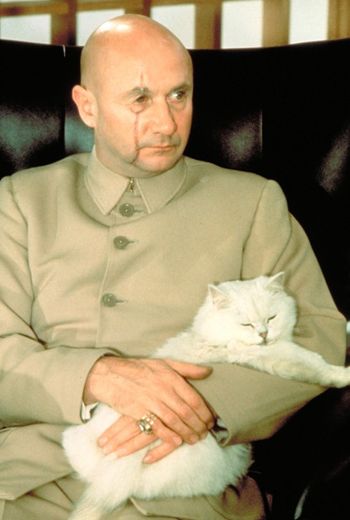
For the man who has everything, or, I should say, for the man who WANTS everything, especially TWD (total world domination), Swatch has come out with a collection of watches inspired by James Bond Villains. From General Orlov to Dr. No, from Jaws to Rosa Kleb, Baron Samedi, and even this year’s Dominic Greene, the better you know the movie the better you will appreciate the watches’ meticulous and often witty detail. Look for the tiny paw print replacing one of the numbers on the Blofeld model and the handcuff-inspired detail on the Kleb watch and the playing card design of the Le Chiffre version.