
The Legend of Tarzan

The Legend of Tarzan

Posted on June 30, 2016 at 4:15 pm

B-
Lowest Recommended Age: Middle School
MPAA Rating: Rated PG-13 for sequences of action and violence, some sensuality and brief rude dialogue
Profanity: Some racist epithets and mild language
Alcohol/ Drugs: Some social drinking
Violence/ Scariness: Extended peril and violence, characters injured and killed, some disturbing and graphic images and scary animals
Diversity Issues: Historical abuse and enslavement
Date Released to Theaters: July 1, 2016

Copyright 2016 Warner Brothers
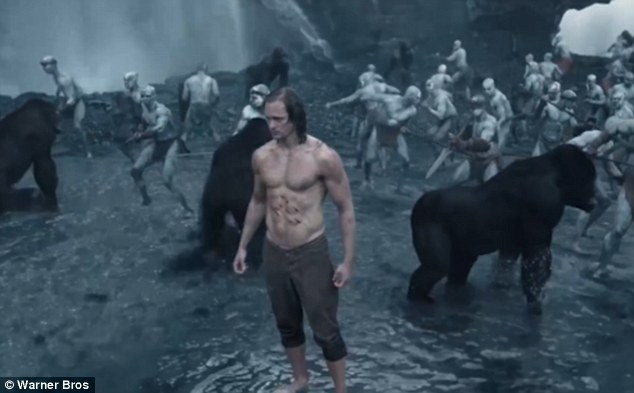
“The Legend of Tarzan” gets some things right. The swinging through the trees is exhilarating. Alexander Skarsgård (Tarzan/John) and Margot Robbie (Jane) are beautiful to look at, as is the African scenery. The CGI animals are pretty good. Thankfully, other than a few flashbacks, it avoids dwelling on the over-familiar origin story. And it is nice to see a shift from the colonialist perspective of some Tarzan stories to recognition of the real-life atrocities inflicted by Belgium’s King Leopold on the African natives, exploiting their resources and enslaving their people.

But there’s a lot the movie does not get right. It’s not terrible; it’s just oddly off, as though it was assembled by a committee that didn’t communicate with each other very well. The first problem is that Tarzan is depressed. I do not know why people seem to think that we somehow make classic literary characters more sophisticated or modern by making them depressed, but I’ve had enough of it. We’ve already had a depressed Batman and a depressed Superman this year. We don’t need a depressed Tarzan. Tarzan, now using his birth name of John Clayton, Lord Greystoke, is living in England when we first see him. Presented with an invitation to return to the Congo as the guest of King Leopold, he declines. Lifting a pinky as he sips from a porcelain teacup to demonstrate just how far he has come from running naked through the jungle, he explains simply, “It’s too hot.” He does not want to go back. But an American named George Washington Williams (played by Samuel L. Jackson and a toupee) persuades him to return, so he can investigate charges of abuse and enslavement. Jane is thrilled to return to Africa, and John reluctantly agrees to let her come along.

The invitation from the King was engineered by Leon Rom (Christoph Waltz, in his usual ultra-civil, ultra-evil mode). If he can deliver John to Chief Mbonga (a regal Djimon Hounsou) the chief will give him access to the diamond mines. When John escapes, Rom takes Jane and some of her tribal friends prisoner.

There’s an unfinished quality to the film. The tone shifts from a literally heavy-handed early image of a cruel hand wrapped in a rosary ripping a flower from its stem to some awkward and anachronistic attempts at humor (Samuel L. Jackson after a diplomatic speech: “And I thought the Civil War was long!”), and distracting random camera-swooping. But the real drag on the film’s momentum is Tarzan himself, who is so morose that the energy seeps out of the story. Reportedly, Skarsgård spent six months working out all day. He looks great, but to be honest he already looked great, and the fixation with male or female movie stars remaking their bodies for roles is barbaric. What needed the work was the script.

Parents should know that this film includes extended peril and violence, guns, spears, explosions, predator animals some disturbing images, characters injured and killed, some sexual references, and brief strong and racist language.

Family discussion: Why did John and Jane have different views about going back to Africa? How did John’s idea of honor change and why?

If you like this, try: the many other movie and television portrayals of Tarzan and the books by Edgar Rice Burroughs
Related Tags:


Action/Adventure Based on a book Movies -- format Remake
Whiskey Tango Foxtrot

Whiskey Tango Foxtrot

Posted on March 3, 2016 at 5:20 pm

Copyright 2016 Paramount

When Michiko Kakutani of the New York Times reviewed the book that inspired “Whiskey Tango Foxtrot,” the memoir of journalist Kim Barker about her days covering US military operations in Afghanistan and Pakistan, she wrote:

What’s remarkable about “The Taliban Shuffle” is that its author, Kim Barker — a reporter at ProPublica and the South Asia bureau chief for The Chicago Tribune from 2004 to 2009 — has written an account of her experiences covering Afghanistan and Pakistan that manages to be hilarious and harrowing, witty and illuminating, all at the same time.

It’s not just that Ms. Barker is adept at dramatizing her own adventures as a reporter — though she develops the chops of a veteran foreign correspondent, she depicts herself as a sort of Tina Fey character, who unexpectedly finds herself addicted to the adrenaline rush of war.

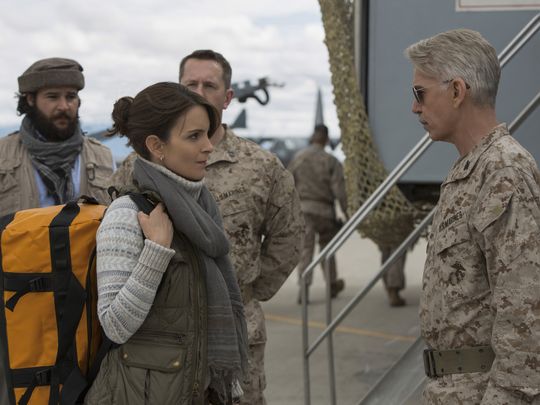
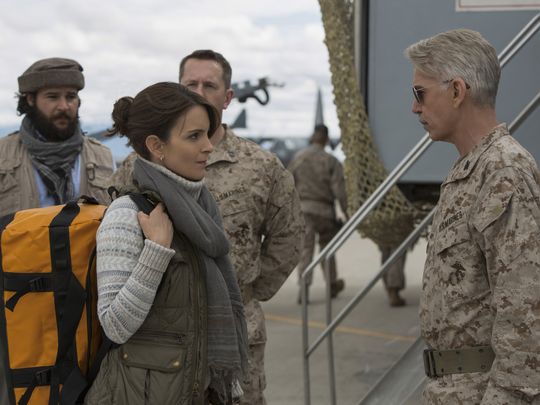
And now that book is a movie, and the role of Ms. Barker is being played by non-other than Tina Fey, who also co-produced. As always, her work is whip-smart and original. This is not Liz Lemon goes to war, it is an impressively sensitive dramatic performance.

But Barker’s story has been movie-ized, giving it the “inspired by” rather than “based on” designation, and removing the “r” from the character’s name to create some space. The real Barker was a print journalist, but making her a television correspondent to make it more cinematic. And the various love interests are fictional. It is disappointing that the movie makes the impetus for the assignment a combination of professional and romantic ennui. Barker was a dedicated journalist looking for a big story.

But much of the essence of it is the real deal, starting with Barker/Baker’s plan to spend three months in Afghanistan that turned into three years, and the ramped-up intensity of spending days embedded with the military, frantically editing the story, and then trying to obliterate memory and consciousness with some hard-core partying, only to start over again. Baker is inexperienced but dedicated and smart. She quickly impresses the cynical General (Billy Bob Thornton) who sees embedded journalists as a bother and a risk. And she quickly bonds with the other woman reporter (Margot Robbie), who shows her the ropes and asks very politely if she can sleep with Baker’s hunky security guy.

Alfred Molina is excellent, as always, as an Afghani official, though we should be past the time when European actors are cast as Middle Eastern characters. And maybe we do not need any more stories of Western characters discovering the mysteries of the other side of the world, with illuminating life lessons from exotic people. We don’t want this to be “Under the Tuscan Sun” but with war instead of sun-ripened Italian tomatoes, and it gets uncomfortably close at times. But the thoughtful script from longtime Fey collaborator Robert Carlock keeps the film from making war be just a growth experience for a reporter looking to shake up her life a bit, and the contrast between what the war does to the people trying to tell the story, knowing that the people back home just change the channel anyway give the story a sobering weight.

Parents should know that this movie has constant very strong, crude, and colorful language, drinking, drugs, smoking, wartime violence with some graphic images, characters injured and killed, sexual references and situations, and nudity.

Family discussion: What was the most important story Kim Baker reported? What did she mean when she said it “started to feel normal?”

If you like this, try: The book that inspired this film, The Taliban Shuffle, and the film “The Year of Living Dangerously”

Related Tags:


Drama Inspired by a true story Journalism War
Z for Zachariah

Z for Zachariah

Posted on August 27, 2015 at 5:31 pm

B+
Lowest Recommended Age: High School
MPAA Rating: Rated PG-13 for a scene of sexuality, partial nudity, and brief strong language
Profanity: Brief strong language
Alcohol/ Drugs: Alcohol
Violence/ Scariness: Apocalyptic themes, murder
Diversity Issues: Diverse characters (race, gender, faith)
Date Released to Theaters: August 28, 2015
Date Released to DVD: October 19, 2015
Amazon.com ASIN: B014DEGTEO

In 1959, a movie called The World, The Flesh And The Devil imagined a post-apocalyptic world with three surviving humans. In the words of the 1960’s television series, “The Mod Squad,” they could be described as “one black, one white, one blond.” Harry Belafonte, Mel Ferrer, and Inger Stevens played characters who might be the last people on earth but who still carried with them the fears, angers, and prejudices of the civilization now destroyed.

Fifty-five years later, “Z for Zachariah” is another post-apocalyptic story about a black man, a white man, and a beautiful younger woman who may be the only survivors following a catastrophic, toxic event that has poisoned the whole world, except, perhaps, for a tiny, edenic farm that appears to be free from deadly radiation. And once again, human frailty creates conflict at the most fundamental level. The themes of the 1959 film reflected post-WWII concerns like the atomic bomb and racial bigotry.

“Z for Zachariah” is based on the posthumously and pseudonymously published book, though there are significant changes.

Ann (Margo Robbie) lives on her family’s farm. She believes her family will return from their scouting expedition. And she believes that she and her dog and her farm were preserved by God. Periodically, she puts on protective gear to go into the deserted town and scavenge from the shelves of the stores. She grows food on the farm and visits the tiny church her father built to play the organ and worship.

Then John (Chiwetel Ejiofor) arrives. He is also wearing protective gear (it turns out he was one of the engineers who designed it), but foolishly removes it to bathe in a pond that has been contaminated. Ann rescues him and nurses him through radiation poisoning.

They are very different. John is a man of science and rationality. He sees that he can create hydropower through the waterfall, but only if he can use the wood from the walls of the church. Ann believes the church is what has kept her alive; John believes repurposing the planks will enable them to establish a sustainable source of food for…well, with a man and a woman, perhaps there will be more people to feed at some point. In the old world, they would never have met, and if they had, they would have had little to say to one another. But they understanding, respect, and affection are beginning to grow, and the need for connection and comfort is near desperate in both of them. And then Caleb (Chris Pine) — a character not in the book — arrives. He has something John cannot have, a community and cultural connection to Ann. He is young and handsome.

Like director Craig Zobel’s last film, “Compliance,” this is also a tense story of three people in an enclosed, isolated space finding their most profound values tested. Even in the most extreme circumstances imaginable, humans still struggle with morality, trust, honesty, power, forgiveness, and love. It is deceptively understated and quietly compelling.

Parents should know that this film features a disturbing apocalyptic setting, discussion of cataclysmic events, sexual references and situations with partial nudity, brief strong language, homicide.

Family discussion: What do Ann and John have in common? What do Ann and Caleb have in common? What happened when John and Caleb were together? What will happen next?

If you like this, try: “The World, the Flesh, and the Devil” and “On the Beach”

Related Tags:


Based on a book DVD/Blu-Ray Pick of the Week Science-Fiction
THE MOVIE MOM® is a registered trademark of Nell Minow. Use of the mark without express consent from Nell Minow constitutes trademark infringement and unfair competition in violation of federal and state laws. All material © Nell Minow 1995-2026, all rights reserved, and no use or republication is permitted without explicit permission. This site hosts Nell Minow’s Movie Mom® archive, with material that originally appeared on Yahoo! Movies, Beliefnet, and other sources. Much of her new material can be found at Rogerebert.com, Huffington Post, and WheretoWatch. Her books include The Movie Mom’s Guide to Family Movies and 101 Must-See Movie Moments, and she can be heard each week on radio stations across the country.

Website Designed by Max LaZebnik