Rated R for pervasive language, violence, and some sexual content/nudity
Profanity:
Extensive very strong and crude language
Alcohol/ Drugs:
Drinking, smoking, drugs
Violence/ Scariness:
Some violence including attack
Diversity Issues:
None
Date Released to Theaters:
December 8, 2017
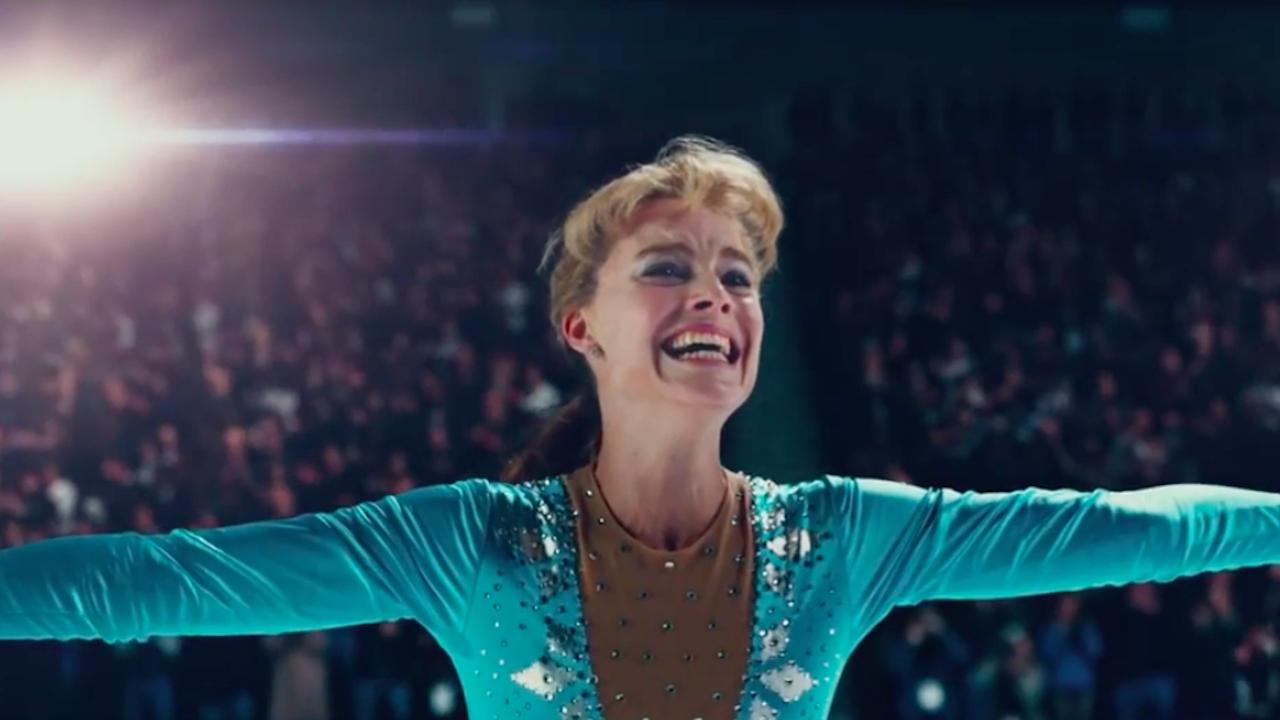
Copyright 2017 NeonIn one of “I, Tonya’s” most striking scenes, Margo Robbie as figure skating star Tonya Harding looks at herself in the mirror after applying her make-up for a competition. It is stark, garish, clown-like, and scary, less like beauty than like warpaint. Harding is trying to hide the heartbreak of her life when she is on the one place where everything is pretty and perfect, but in trying to make herself look pretty and perfect she has created a monster. That scene exemplifies the movie’s themes about public and private personas and the way they can crash into each other with terrible destructive force.
In 1994, Nancy Kerrigan, one of Harding’s rivals, was attacked by a Shane Stant (Ricky Russert), who had been hired by two of history’s most incompetent criminals, Harding’s estranged husband, Jeff Gilhooly (Sebastian Stan) and his dimwitted friend Shawn Eckhardt (Paul Walter Hauser). Though Harding was not involved or even aware of this plan, news reports of the era emphasized the contrast between ice princess Kerrigan, and blue-collar Harding. In reality, Kerrigan was also from a modest background, but her appearance and routines were more elegant and graceful, while Harding adopted a bad girl persona, calling herself the “Charles Barkley of figure skating.” The problem is that figure skating is not just about skill and technique. It is about the show, and it is about the persona. Judges and fans expect more than athletic achievement.
They expect elegance and grace on and off the rink. They want the ice princess.
Allison Janney is incendiary as Harding’s abusive mother, constantly pushing her and demeaning her, often hitting her, too. With no affection or approval at home, she was drawn to Gilhooly, the first male to pay any attention to her, and when he became abusive, that seemed normal, too.
Director Craig Gillespie (“Lars and the Real Girl”) and screenwriter Steven Rogers (“Stepmom,” “Love the Coopers”), promise us at the beginning a story “based on irony-free, wildly contradictory and totally true interviews,” and they deliver. Like “The Disaster Artist,” this film takes us behind the scenes of a real-life catastrophe based on dreams of stardom, hopeless miscalculation about their own abilities, and a distorted, media-fueled idea of reality. We may watch expecting to laugh and feel superior, but the prismatic approach, with characters speaking to us to explain their perspectives (or try to put the blame on each other) is surprisingly sympathetic, grounded, and insightful.
Parents should know that this film includes constant very strong and crude language, sexual references and situations, nudity, drinking, drugs, smoking, and violence, including domestic abuse.
Family discussion: Who was responsible for attacking Nancy Kerrigan? Why does the movie call itself “irony-free?” Do you agree that Americans “want someone to hate?”
If you like this, try: “The Positively True Adventures of the Alleged Texas Cheerleader-Murdering Mom” and “Tonya Harding: Anything to Win”
Rated PG for thematic elements, some bullying, war images and brief language
Profanity:
Brief strong language
Alcohol/ Drugs:
Alcohol
Violence/ Scariness:
Wartime violence, post-traumatic stress
Diversity Issues:
None
Date Released to Theaters:
October 13, 2017
Copyright 2017 Fox Searchlight
This telling of the story behind the creation of some of the world’s most beloved books for children is sincere and well-intentioned but what Pooh might call a bit of a muddle. The movie is not at all clear about whose perspective it is giving us or what story it is trying to tell.
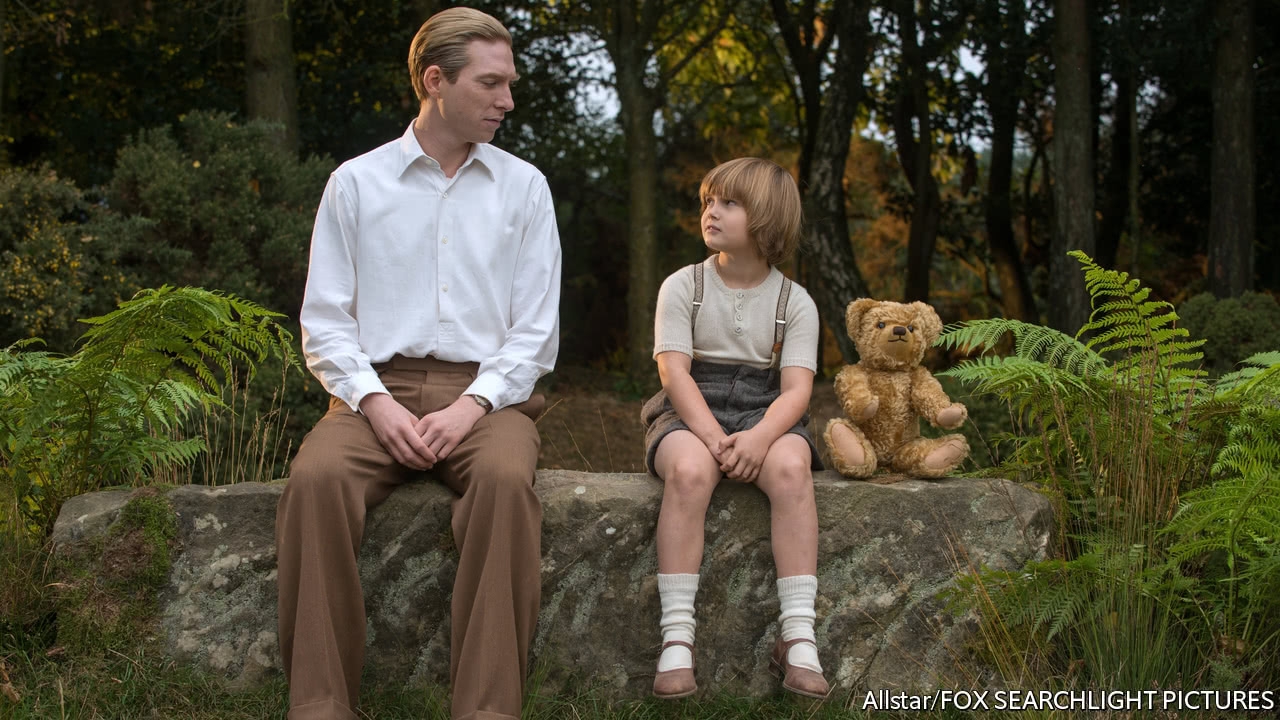
Author A.A. Milne, called Blue by his family and played by Domhnall Gleeson, was a successful playwright and humorist before the Great War, but came back badly shaken from the experience of combat and carnage. His wife Daphne (Margot Robbie) is affectionate but impatient. Neither one of them is very interested in their son, Christopher Robin (Will Tilston), who spends most of his time with his devoted nanny, Nou (Kelly Macdonald). Milne insists the family move to the country, where Daphne feels isolated from the parties and friends she enjoys. She goes back to London, saying she won’t return until Milne begins to write again, just as Nou has to take some time off to care for her mother. This leaves Milne alone with his son, called Billy Moon by the family, and for the first time they spend time together, playing in the woods with the child’s stuffed bear, named Winnie after the bear in the zoo. It is these days that inspire the two chapter books and two books of poems that have been read aloud to generations of children who have grown up and read them to their own children, plus, Disney movies and a television series (Disney now own the rights to the characters) and more books and toys.
And it is these days that are the best part of the film, especially when Milne’s friend, the illustrator Ernest Howard Shepard (Stephen Campbell Moore) comes to visit, and we see the stories Milne and Billy Moon tell melting into the sketches that are as beloved as the writing.
The problem is the rest of the movie, which is really four movies fighting with each other, none of them very good. There is the story of a shattered veteran trying to find a way to return to civilian life and work that is meaningful to him. There is the story of a man and a boy who do not realize how much they need each other discovering a common language. There is the story of enormous success that benefits one family member but at great cost to another. The stories lead to feelings of betrayal and bitterness when Billy Moon becomes famous, more famous than his father, and much more famous than his boarding school classmates. And there is the story of estrangement and partial reconciliation.
It is never clear what the point of view of the movie is, or what the point of the movie is. Is it that art can be healing and wounding at the same time? Is it that behind tales of wonder and enchantment there can be pain and bitterness? Fans of the Winnie the Pooh books may enjoy some of the classic biopic “ah, that’s where this part I loved came from” moments, but they do not provide any additional insight or depth to the work itself, not even an exploration of what the books have to say about childhood and whether they represent a child’s perspective or a parent’s. Most of all, unlike Pooh, Piglet, Kanga, Roo, and Owl, these characters are not very interested or interesting.
Parents should know that this movie includes wartime violence, PTSD, marital estrangement, sad offscreen death of a parent, apparent death of a child, and social drinking.
Family discussion: What should Blue and Daphne have done differently? Why did Christopher want to go into the army? Is “the great thing” finding something to be happy about?
Trailer: Goodbye, Christopher Robin with Margot Robbie and Domhnall Gleeson
Posted on June 15, 2017 at 3:03 pm
Margot Robbie and Domhnall Gleeson star in “Goodbye, Christopher Robin,” based on the life of author A.A. Milne, who wrote poems and stories inspired by his son’s toys, Winnie the Pooh, Tigger, Piglet, and Wol.
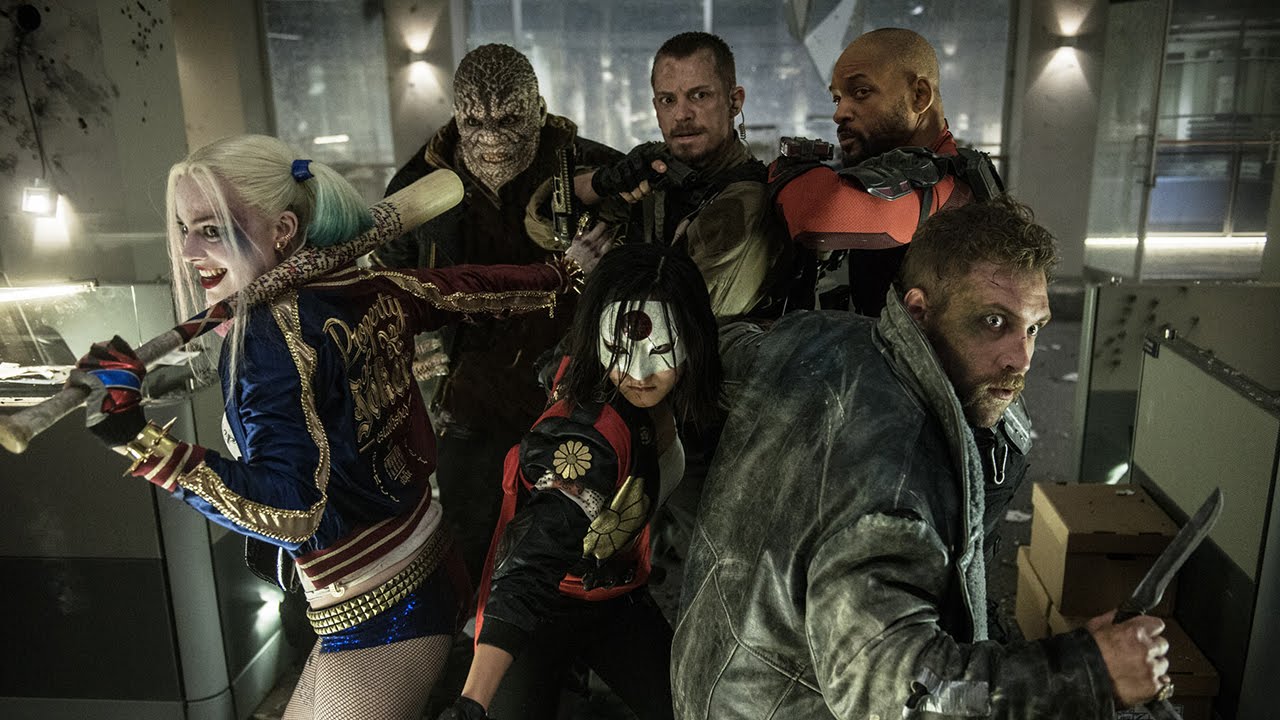
I always say that the success of a superhero movies depends on the bad guy. So, shouldn’t a movie that is all bad guys be really great? That’s the idea behind “Suicide Squad,” a sort of “Avengers” (all-star hotshots who don’t play well with others have to work together as a team to save the world) crossed with “The Dirty Dozen.” And it kind of works. On the one hand, it is an August movie, the cinematic equivalent of the shelf in the back of the grocery story with the dented cans, irregulars, and day-old bread. On the other hand, it approaches a nicely messy, authentically amateurish, form equals content vibe that suits the subject matter. If these guys made their own movie, they might overlook some of the fine points, too.
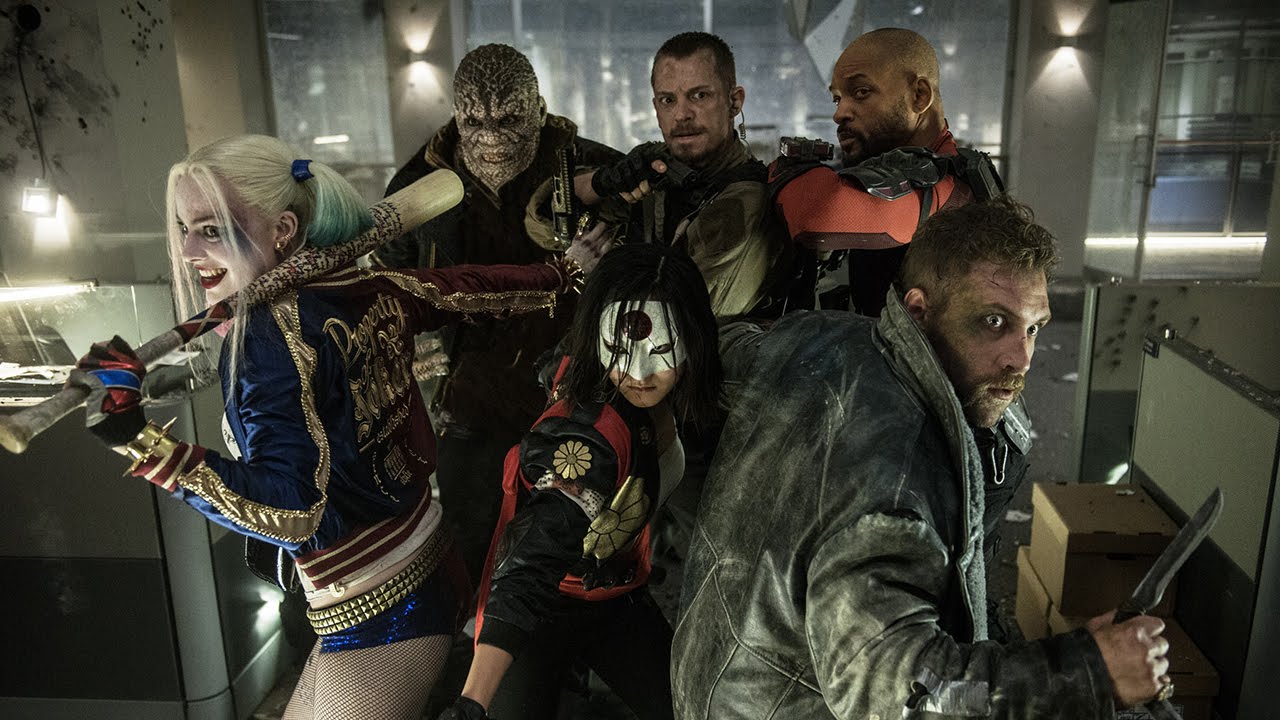
Our scrappy little band of anti-heroes live in one of those “lock them up, throw away the key, throw away the Constitution, and any record of their existence while you’re at it” sort of prisons. Will Smith plays Deadshot, an assassin with a young daughter he loves. Margot Robbie is Harley Quinn, a psychiatrist turned psychopath with the demeanor of a school girl, locked in a romantic tangle with the Joker (Jared Leto) so twisted it makes Sid and Nancy look like Dick and Jane. Somewhere behind full-face tattoos, Jay Hernandez is Diablo, a gang-banger with the power of fire. Somewhere inside a reptilian rubber suit (maybe it is CGI, but it looks like rubber) is Adewale Akinnuoye-Agbaje as Killer Croc, and I never quite figured out what he could do besides fight and swim. Jai Courtney plays the Aussie thief Boomerang. Neither one of them is intelligible.
They get a chance to escape the abuses and isolation of prison life when national security expert Amanda Waller (Viola Davis) says that their special skills make them the world’s only hope against the terrorism threat that entities with supernatural powers will pose. “The world changed when Superman flew across the sky. It changed again when he didn’t.” (Cut to super-coffin)
Waller is certain she can control them. Whether she can or not, there is no alternative. And so they are assigned to Colonel Rick Flag (Joel Kinnaman), who informs the motley crew that each of them has an explosive injected into his/her neck, and that he will not hesitate to blow their heads off if they disobey or even if they vex him. “I’m known to be vexing,” Harley Quinn pipes up helpfully, well aware that saying so she proves her point. And then it’s off to the big confrontation with some moments for (1) some bad behavior, (2) some exchanges of confidence and bonding to let us see that these guys may be bad but they have their good points and while they may have made some poor choices, they have feelings, too, (3) a few reminders that these are the bad guys, (4) some setbacks and death of a tangential character to show us how serious this is, and (5) weaknesses becoming strengths, strengths becoming weaknesses, a chance to see that some of the good guys aren’t so good and some of the bad guys aren’t so bad (and deaths are not necessarily deaths).
Here is what the movie gets right: B**** please. Margot Robbie is a huge movie star who owns this film and every moment she is on screen in “Suicide Squad” you get your money’s worth and then some. Anything else that works in the film is an extra cherry on the sundae. #imwithharley so give HQ her own movie PDQ.
Smith and Kinnaman are also excellent. Most of the best of the rest was in the trailer including one exchange which inexplicably was cut from the film. In fact, given the many evident recuts and reshoots, Warner Brothers should just have turned the footage over to whoever made the trailer and let them control the final print. The soundtrack veers into Spotify playlist mode but there are some good choices.
Here is what it gets wrong: Writer/director David Ayer, whose speciality has been military and law enforcement stories, does not understand the right tone for a comic book movie. Compare Marvel/Disney, which managed to create distinctive and right-on-the-money tones for Thor, Captain America, Iron Man, Ant-Man, Guardians of the Galaxy, and Deadpool and yet make us believe they could exist in the same universe, and made that work in the “Avengers” movies without shortchanging anyone. Second, note the reference to the evidence of reworking above. Third, note the very first thing I said. Comic book movies are all about the villain. In this case, with villains as the the good guys, they really need someone specially evil for us to root against. The villains in this film are terrible in every category, starting with the special effects, which should be primo, right, Warner Brothers? But most importantly, a movie that spends too much time introducing us to the Z-team’s backstories never provides us with the basics about the powers and threat of the bad guys so we have no way of knowing what we are hoping for (other than obliteration) from the final battle. Wait, so this and that didn’t work but this and that do? Really? And what happened to those SEALS?
It is good to see more than one female character and this film has four strong and powerful women of different races. But the gender politics of the film are less than one might wish. Both female Suicide Squad members are there because of the men they love, and the female villain is alternately weak around the man she loves and strong but not as strong as her brother. Viola Davis, as always, is sublime as a woman who may be only human but is in every way a match for anyone, superpowered or politically powered.
It’s better than “Batman vs. Superman” and “The Fantastic Four,” but it falls frustratingly short of what it could have and should have been.
NOTE: Stay through the credits for an extra scene, but you don’t have to stay after that.
Parents should know that this film includes extended sci-fi/fantasy violence with some graphic and disturbing images, torture, abuse, many characters injured and killed, skimpy costumes, sexual references, some strong language
Family discussion: Who was the worst villain in the movie? Who caused the most harm? What could “bad guys” do that the “good guys” could not?
If you like this, try: “The Avengers” and “The Dirty Dozen”
Jen Yamato on Three Awful Articles About Actresses
Posted on July 9, 2016 at 3:22 pm
There have been a lot of complaints about the Vanity Fair cover story on Margot Robbie by Rich Cohen (“Vinyl”), which reads like a parody of skeezily raphsodic profiles of beautiful women. I particularly like the takedown from Rebecca Shaw, who is, like Robbie, Australian, and so addresses Cohen’s idiotic comments about her country as well as his idiotic comments about Robbie.
Australia is America 50 years ago, sunny and slow, a throwback, which is why you go there for throwback people.
Bloody hell, calm your farm Richo. We’re America 50 years ago, so what – increasing our troops into Vietnam?…
That was the middle of a search that finally led to Alexander Skarsgård as Tarzan and Robbie as Jane. Jerry spoke of the actress in a tone he reserved for the big stars, the sure things, the Clooneys and Pitts, those whose magnitude seems old-fashioned. “When I think of Margot Robbie, a single word comes to mind,” Jerry said. “Audrey Hepburn.”
A single word: these two words. Earlier in the piece Richo said that Wolf of Wall Street defined Robbie. It “put her up with Sharon Stone in Casino and Cathy Moriarty in Raging Bull – one of Scorcese’s women.
I know I am 50 years behind all of this being one of the throwback people and all, but did you know that women don’t have to be defined by 1. being compared to other women and 2. belonging to some man or another? Astonishing stuff from here, downunder.
The piece reads like an interview in which subject and questioner had zero chemistry. But it’s an interviewer’s job to find that, or fix it, rather than go home and throw Google searches at the problem. Frankly, when I read that conclusion and it so strongly created the image of her just casually standing up and leaving, I wanted to shake her hand. Australia has a right to be offended by the finished article (and it is, from what I’ve read). So too does Margot Robbie, though I suspect she will calmly say nothing. She’s already won, honestly. She, somehow, still comes across as normal and cool even though she’s not given as much voice as she deserves.
At The Daily Beast, Jen Yamato insightfuly brings together the Rich Cohen profile of Margot Robbie with two other articles about actresses that have provoked complaints. Variety’s critic Owen Gleiberman wrote that the trailer for the new “Bridget Jones” movie made him think that Renee Zellweger “no longer looks like herself,” and thus he might not be able to enjoy the movie. (See Thelma Adams’ response, too.)
And the usually-better Wesley Morris wrote a piece titled “How I Learned to Tolerate Blake Lively.” He spends most of the article explaining that he was expecting to see Kate Hudson starring in “The Shallows,” but no, it was another lithe blonde actress from California instead. Yamato has some good advice: “One glaring (and fixable!) factor in this trend of vaguely lecherous, sketchy filmbro culture: Hire more women writers and editors to represent a more accurate diversity of opinions, analysis, context.”