The Life of Chuck

The Life of Chuck

Posted on June 15, 2025 at 12:24 pm

A-
Lowest Recommended Age: High School
MPAA Rating: Rated R for language
Profanity: Strong language
Alcohol/ Drugs: Alcohol
Violence/ Scariness: Apocalyptic themes, sad off-screen deaths including parents and grandparents, references to suicide
Diversity Issues: Diverse characters
Date Released to Theaters: June 13, 2025

When a movie begins with “Act Three,” it is an invitation to open our minds to something unusual. “The Life of Chuck” is based on a story by Stephen King, and it reflects his more mystical side. While it includes dark and tragic themes, it is a story of profound humanity, ultimately spirit-expanding.

Copyright 2035 NEON

It begins at the end in more ways than one. A teacher named Marty (Chiwetel Ejiofor) is meeting with parents who seem oddly disconnected from concerns about how their children are doing in school. The world seems to be collapsing. A major earthquake has knocked California into the ocean. The internet is shutting down. Couples who have been together are splitting up and those that have split up are getting back together. Marty’s ex, Felicia (Karen Gillan) is an exhausted nurse in a hospital where most of the arrivals are attempted suicides. And somehow, signs – billboards, skywriting, bench posters, even projected in the windows of suburban homes — are appearing everywhere thanking someone named Chuck. 

In Act Two we meet Chuck as a young boy and see him grow up. His parents were killed in an automobile accident, and he lives with his grandparents (Mark Hamill as Albie and “Ferris Bueller’s” Mia Sara as Sarah) in an old house with a padlocked room in a cupola on the top floor that he is warned never to open. He is very good at math but what he loves is dancing, and a dance class leads him to what will be one of his life’s most profound and satisfying moments, in part because after moments of doubt and fear of being judged (he is in middle school, the judgiest part of life), he finds the courage to follow his heart and take a risk. Later, as an adult, and, as we are told by narrator Nick Offerman, nine months from his death due to a still-undiagnosed brain tumor, he will have another sublime moment of dance, when he passes by a busking drummer on a break from an accounting conference.

To say much more would be to say too much; this is a film that benefits from an audience without expectations or advance guidance. But for those who have seen it and would like to know what I think it means, I have some spoiler-filled comments at the end of this review. For now, I will just point out that twice in the film teachers share a selection from Walt Whitman’s Song of Myself in their classrooms, the part that goes

Do I contradict myself?

Very well then I contradict myself,

(I am large, I contain multitudes.)

When Chuck’s teacher (played by Kate Sigel) explains this passage to him, she places her hands gently over his ears and asks what is between them. It is the multitudes within each of us, every emotion, every memory, every wish, every fear, every sublime moment, every crushing disappointment, every tiny quotidian interaction we are not even aware that we noticed. 

This movie is a labor of love from both King and writer/director Mike Flanagan, whose wife (Seigel) and son (as the youngest version of Chuck) appear as key characters. It has a transcendent, poetic humanity that should make us better appreciate our own lives and the people we value.  And take the time, at least once in a while, to dance.

Parents should know that a child’s father and pregnant mother are killed (offscreen) in a car accident and there are apocalyptic events. A central character dies and there are references to other deaths, including a suicide. Characters use strong language and there are references to pornography.

Family discussion: What multitudes are in you? Who would you want to be with if things were scary? What do we learn from Marty’s conversations with Sam and Gus? Should Chuck have listened to his grandfather’s advice? 

If you like this try: “It’s a Wonderful Life,” “The Odd Life of Timothy Green,” and “Stranger Than Fiction” 

Stop now if you don’t want spoilers.

CLUES: What does it mean that we see Sam and Gus in different time periods but they do not seem older or younger, while Chuck is played by four different actors as he goes from young childhood to middle age? Why is the Whitman poem so important? 

MY VIEW: Every character in the movie is a part of the “multitudes” that make up one person, Chuck Krantz. The thank you signs are a part of his shutting down as he dies. When we die, our stories, our memories, our relationships, the multitudes within us stop, at least in the form of being contained in one individual consciousness. What Chuck saw in the locked room represents the recognition we all have that our lives are temporary. 
Related Tags:


Based on a book Drama movie review Movies -- format Movies -- Reviews
The Wild Robot

The Wild Robot

Posted on September 25, 2024 at 5:31 pm

B +
Lowest Recommended Age: Kindergarten - 3rd Grade
MPAA Rating: Rated PG for thematic elements, action, and peril
Profanity: Some schoolyard language
Alcohol/ Drugs: None
Violence/ Scariness: Sci-ff/cartoon style violence, shooting, off-screen deaths including death of a parent and a mentor
Diversity Issues: A theme of the movie
Date Released to Theaters: September 26, 2024
Copyright 2024 Dreamworks

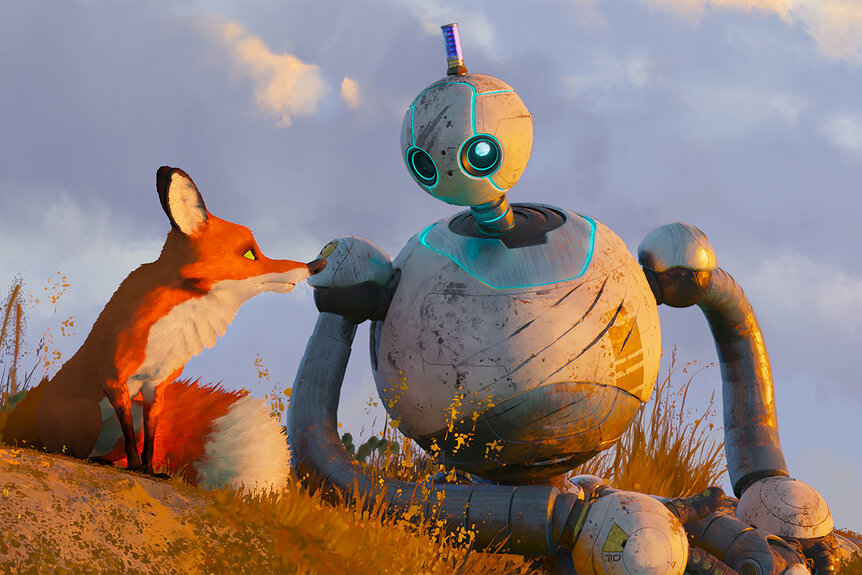
A plane delivering high-tech equipment flies into a storm and a crate falls out, landing on an island inhabited only by animals. Inside the crate is a super-intelligent, ultra-capable robot programmed to complete any task a human might require. The contrast between the natural world of the plants and animals and the metal and programming of the robot is the premise for this story, based on the book series by Peter Brown, told with humor and heart by specialist in “opposites attract” stories director Chris Sanders (“How to Train Your Dragon,” “Lilo & Stitch.”

On one side, fur, feathers, and scales. On the other side, metal and code. The robot, identified by the corporation that created it, is called ROZZUM unit 7134, is a kind of souped-up Swiss Army knife. One of the movie’s greatest pleasures is the way its infinitely adaptable parts and appendages are deployed. Nothing in the robot’s programming has prepared it for the island. But it is capable of learning and adjusting to its environment, so after failure to get a satisfying answer to questions like, “Are you my client?” and “Do you need assistance?” she (we will use that pronoun because the robot has the sweet voice of Oscar-winner Lupita Nyong’o, takes the local next step. She sits down and observes her new environment to learn how to communicate with her fellow inhabitants, which enables us to hear what they have to say, thanks to the brilliant voice work of Pedro Pascal as a fox named Fink, Bill Nighy as a goose named Longneck, Ving Rhames as a falcon named Thunderbolt, Mark Hamill as a bear named Thorn, and Catherine O’Hara, hilarious as always, as Pinktail, a mother opossum covered with her babies.

Roz (as she will ultimately be called) could hardly be more poorly fashioned for this environment. It is funny to see her expect the animals to feel rewarded when she follows her programing by giving them stickers, promotional material for the company that made her, followed by a burst of confetti, even more out of place in the lush natural world than she does. The animals at first consider her a monster.

The early scenes about their unfitness for each other leads organically to interest, understanding, respect, and ultimately a very heartwarming sense of family. A turning point is Roz’s rescue of an orphaned goose egg, left alone after an accident and stolen by Fink for a meal. Roz does not understand what it means to care for the egg, and then, when it hatches and the little gosling imprints on Roz as its mother, she has a task at last: to teach the bird to eat, swim, and fly, so that it can be ready to migrate before it gets too cold. “I do not have the programming to be a mother,” Roz says. “No one does,” Pinktail correctly observes.

Roz develops what can only be described as feelings for the little goose, named Brightbill (Kit Connor). She loses some components and breaks down a bit, from pristine and shiny to scuffed and mossy, with a prosthetic calf made from a log.Is she mirroring what she sees around her? Is she creating the programming necessary to give a child a sense of security and the knowledge he is special to someone? Or is there some way for a machine to develop a soul? Or is it just a reflection of all of the damage to her mechanics? Possibly all of the above. But it is a smaller reach than one might think from being programmed to be of service to placing meaning and purpose on that imperative.

A lot more happens, including some parent-child estrangement (adolescents!) and a lot for Brightbill to learn from his fellow geese, as well as Fink becoming less “fox-y” and all of the animals learning to help each other. The action scenes are dynamic and involving but it is the gentleness of the lessons the characters learn about kindness that will make this film an endearing family favorite.

Parents should know that there is some sci-fi-style shooting. A character is killed off-screen sacrificing himself to save others and a character’s family is discreetly killed in an accident. Another character appears to have been eaten but is not. Characters use some schoolyard language.

Family discussion: What was the most important thing Roz learned and how did she learn it? If you had a Roz, what would you ask her to do? Do you think we will have machines like that?

If you like this, try: the books, and “The Iron Giant” and “Wall-E

Related Tags:


Action/Adventure Animation Based on a book Fantasy movie review Movies -- format Movies -- Reviews Scene After the Credits Science-Fiction Talking animals
Star Wars: The Last Jedi

Star Wars: The Last Jedi

Posted on December 12, 2017 at 7:10 pm

B +
Lowest Recommended Age: Middle School
MPAA Rating: Rated PG-13 for sequences of sci-fi action and violence
Profanity: Mild language
Alcohol/ Drugs: Alcohol
Violence/ Scariness: Extended sci-fi peril and violence, characters injured and killed
Diversity Issues: None
Date Released to Theaters: December 15, 2017
Date Released to DVD: March 30, 2020

Copyright 2017 Disney

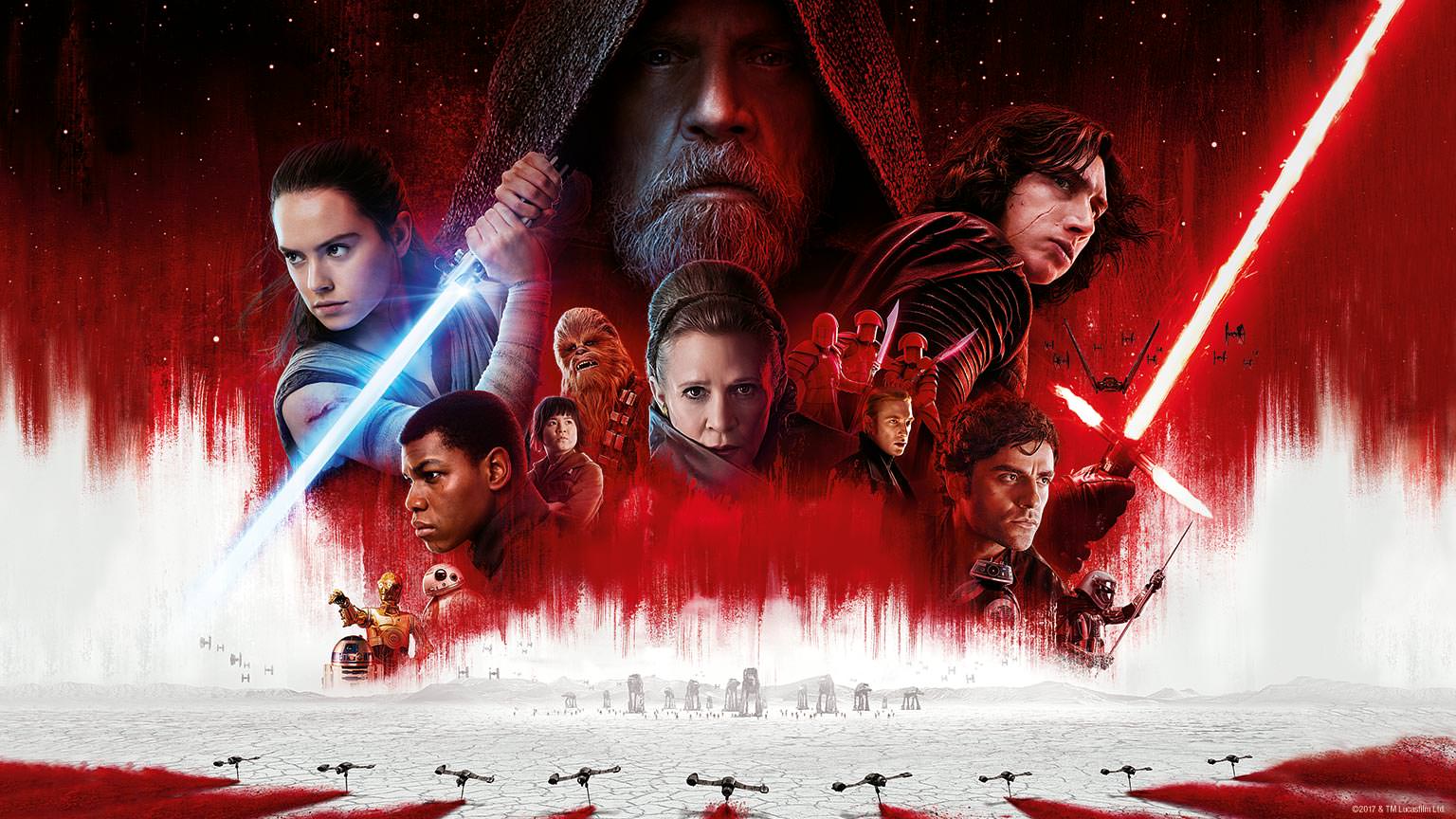
Within the first 15 minutes, I cried and laughed, and then did so again a few times, with some gasps in between. Writer/director Rian Johnson (“Brick,” “Looper”) has brought his considerable skill and obvious deep affection for the “Star Wars” universe to this latest chapter, “The Last Jedi.” I won’t make the obvious Force reference; I’ll just say that he has produced a film that longtime fans will find very satisfying, with a stunning black, white, and red color pallette, thrilling adventure, appealing new characters and worthy developments for old friends, including characters from the first movie (fourth chapter), and a cause to root for.

After the now-traditional opening crawl (basically: the rebellion is not doing very well against the First Order), we have the traditional beginning, right in the middle of the action. As with “The Force Awakens,” we see the I-even-rebel-against-rebels Poe Dameron (dashing Oscar Isaac) in his tiny X-Wing, taking on First Order General Hux (Domhnall Gleeson) with not much by way of firepower, but enormous skill and endless amounts pure pleasure in messing with him. Hux spouts off pompous, pretentious threats about how many different ways he is going to destroy the rebellion, and Poe just trolls him while the rebels gear up for their traditional-but-never-old trick of being quick and cunning instead of enormous and cumbersome.

And we’re off — in three different directions, as Johnson weaves back and forth, with gorgeously cinematic segues recalling “Lawrence of Arabia’s” match flame to the desert. Finn (John Boyega) and a new character, Rose (Kelly Marie Tran) go off in search of a code-breaker who, according to Maz (voiced by Lupita Nyong’o) is the only one who can help them get on board the place they have to go to turn off the tracking device (callback to Episode 4, where if the old man didn’t get the tractor beam out of commission it was going to be a real short trip).

Meanwhile, as we saw in the last shot of the previous chapter, Rey (Daisy Ridley) has found Luke Skywalker (a majestic Mark Hamill, evoking both the farm boy turned Jedi he was in episodes IV-VI and his mentors Obi-wan Kenobi and Yoda as well). Like Leia (Carrie Fisher) in the first film, she tells him she needs his help (R2-D2 tells him, too). But he does not want to be involved any more, as fighter or teacher. And she is being contacted by a sort of Force version of Skype, by Kylo Ren (Adam Driver). In the last film, they fought with lightsabers in the snow. In this chapter, their conflict is more subtle, more personal.

And the rebel forces led by General Leia are being pushed back, with many casualties. This is a movie where more than one character makes the ultimate sacrifice. And more than one gets a last-minute rescue.

The settings are captivating, including a pleasure planet with an elaborate casino for the galaxy’s one percenters and some important lessons about both sides-ism and Balzac’s notion that behind every great fortune is a crime. And there is a salt-based planet with animals that look like foxes made from shards of glass. Chewie makes a heart-meltingly cute new friend. Refreshingly, female and non-white characters play dominant roles on both sides. And, there is a possibility of another New Hope. The rebel forces — and the Star Wars stories — are in good hands.

Parents should know that this is a sci-fi action film with extended peril and violence and some disturbing images. Characters are injured and killed, there is some mild language, some alcohol, and a kiss.

Family discussion: Why did Ben go to the dark side? What did Finn learn from the casino planet? Why did Luke change his mind?

If you like this, try: the other “Star Wars” films and Johnson’s “Brick” and “Looper”

Related Tags:


Action/Adventure DVD/Blu-Ray movie review Movies -- format Science-Fiction Series/Sequel
THE MOVIE MOM® is a registered trademark of Nell Minow. Use of the mark without express consent from Nell Minow constitutes trademark infringement and unfair competition in violation of federal and state laws. All material © Nell Minow 1995-2026, all rights reserved, and no use or republication is permitted without explicit permission. This site hosts Nell Minow’s Movie Mom® archive, with material that originally appeared on Yahoo! Movies, Beliefnet, and other sources. Much of her new material can be found at Rogerebert.com, Huffington Post, and WheretoWatch. Her books include The Movie Mom’s Guide to Family Movies and 101 Must-See Movie Moments, and she can be heard each week on radio stations across the country.

Website Designed by Max LaZebnik