Get Out

Get Out

Posted on February 23, 2017 at 5:44 pm

Copyright Universal 2017

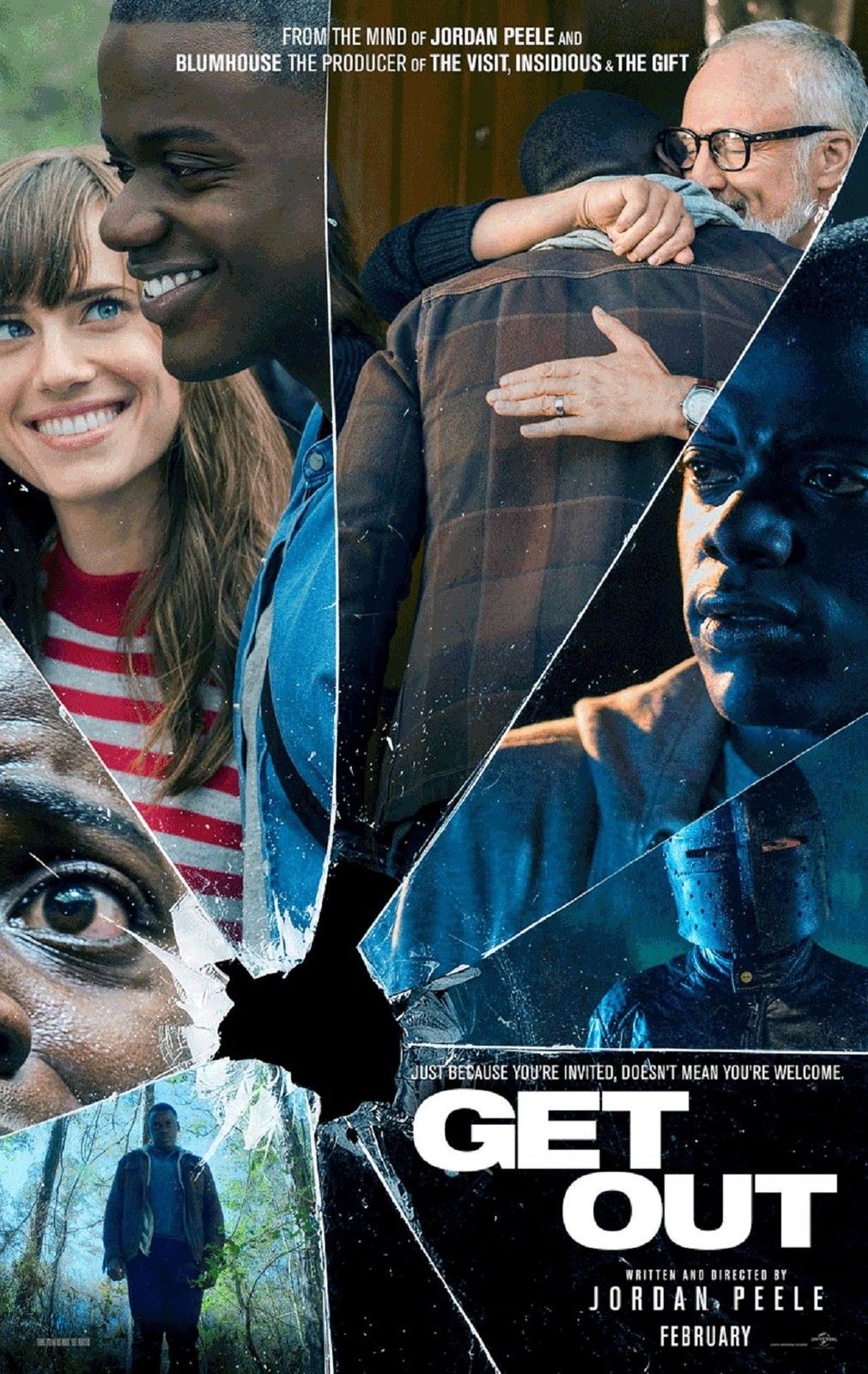
Two caveats before I begin the review: First, I am not very knowledgeable about horror films and therefore do not have the context I normally bring to evaluating a film. Second and more important, this movie has complex themes about race and privilege that I do not pretend to have authority to speak to. I strongly recommend that people who are interested in understanding this film read the perspectives of critics who are African-American or people of color, and I will post links to some of the ones I especially admire at the end of this review. With those limitations in mind, here are my thoughts on “Get Out,” in my opinion a superb film on many levels.

Writer/director Jordan Peele, like his “Key and Peele” partner Keegan-Michael Key, is biracial, which gives them both a lifelong experience with being both part of and observer of black and white culture and a lifelong fascination with code-switching, as we saw in their film “Keanu,” written by Peele. Moving from comedy to horror, Peele continues to explore the themes, giving depth and emotional power to a genre film. Unlike Quentin Tarantino, who carelessly purloins historic settings as a shortcut to the audience’s emotional investment so he can get right to the gore, Peele cannily plays the conventions of the genre and the discomfort and hostility about race off of each other.

It is one of the most terrifying prospects of ordinary life: meeting the family of the significant other. This familiarly excruciating prospect can be played for comedy (“Meet the Parents”) or drama (“Guess Who’s Coming to Dinner?”), but horror is perhaps its best fit, with room for some comedy and drama as well. The fact that Rose (“Girls” star Allison Williams) has not told her parents that her boyfriend of five months, Chris (Daniel Kaluuya), is black, adds another layer of tension. She assures him it does not matter. “They would have voted for Obama for a third time if they could!”

Kaluuya gives a star-making performance with help from cinematographer Toby Oliver, who makes this that rarest of movies, one that knows how to light African-Americans, especially those with darker skin, so that we can really see what they bring to the role. Watch his face in the early scenes as Chris navigates the fatuous pleasantries of Rose’s parents (Bradley Whitford and Catherine Keener, both excellent), and then the bro-ish thuggery of Rose’s brother, and then the condescending appraisals of the friends who all seem like they are on their way to the yacht club. We see him calibrate each of these interactions, trying to be a good sport, trying to go along, trying to make his girlfriend’s family feel comfortable with him, but starting to lose his patience. One of the film’s many shrewd understandings is the way that a lifetime of having to reassure white people that he is not going to hurt them or make them uncomfortable makes him slow to pick up on or slow to doubt himself about the creepiness of Rose’s family. An early scene, where Chris and Rose get questioned by a highway patrolman after hitting a deer is subtle but sharply drawn. And before you can say “foreshadowing,” Chris is getting a tour of the house and Rose’s dad is explaining that the basement had to be sealed off because of black mold. Hmm. And did I mention the prologue when a black guy walking down a peaceful suburban street is followed and then captured? And that the only person of color beside Chris at the party (the always-great LaKeith Stanfield) is strangely subdued and doesn’t know about fist bumps?

It would be a disservice to say any more about the plot. I won’t spoil the twists. I’ll just say that Peele knows what scares us and how to scare us and make us enjoy it, and gives us a lot to think about about some comedy as well. And that it may be that the scariest thing about the movie is the reminder that it has taken far too long to shine the correct light — literally and figuratively — on stories that should be told because they are just that good.

I recommend these reviews: Travis Hopson, Aisha Harris, Jeffrey Lyles, Kevin Sampson, Stephen Thrasher, Kareem Abdul-Jabbar, and Odie Henderson and Stephen Boone. Also, this piece on conversations with interracial couples who have seen the film.

Parents should know that this is a horror film with theme of racism and exploitation, extended peril and violence including gun, choking, and bloody, graphic, and explicit medical images and sounds, characters injured and killed, suicide, references to sad loss of a parent, some strong language including racist epithets, sexual references and a non-explicit situation, and smoking.

Family discussion: When does the story turn from insensitive to offensive to sinister? What makes Chris decide that he has to leave?

If you like this, try: “Rosemary’s Baby,” “The Wicker Man” (original version) and “The Stepford Wives”

Related Tags:


Horror Race and Diversity Thriller
A Cure for Wellness

A Cure for Wellness

Posted on February 16, 2017 at 5:54 pm

B-
Lowest Recommended Age: Preschool
MPAA Rating: Rate R for disturbing violent content and images, sexual content including an assault, graphic nudity, and language
Profanity: Very strong and crude language
Alcohol/ Drugs: Alcohol
Violence/ Scariness: Intense, graphic, and extensive peril and violence with many disturbing and graphic images, sexual assault, torture
Copyright 2016 Twentieth Century Fox

There’s jump out at you scary. And there’s something’s coming at me scary. And then there’s the slow, inexorable dread that builds inside you, and that is what director/co-writer Gore Verbinski is going for with “A Cure for Wellness.”

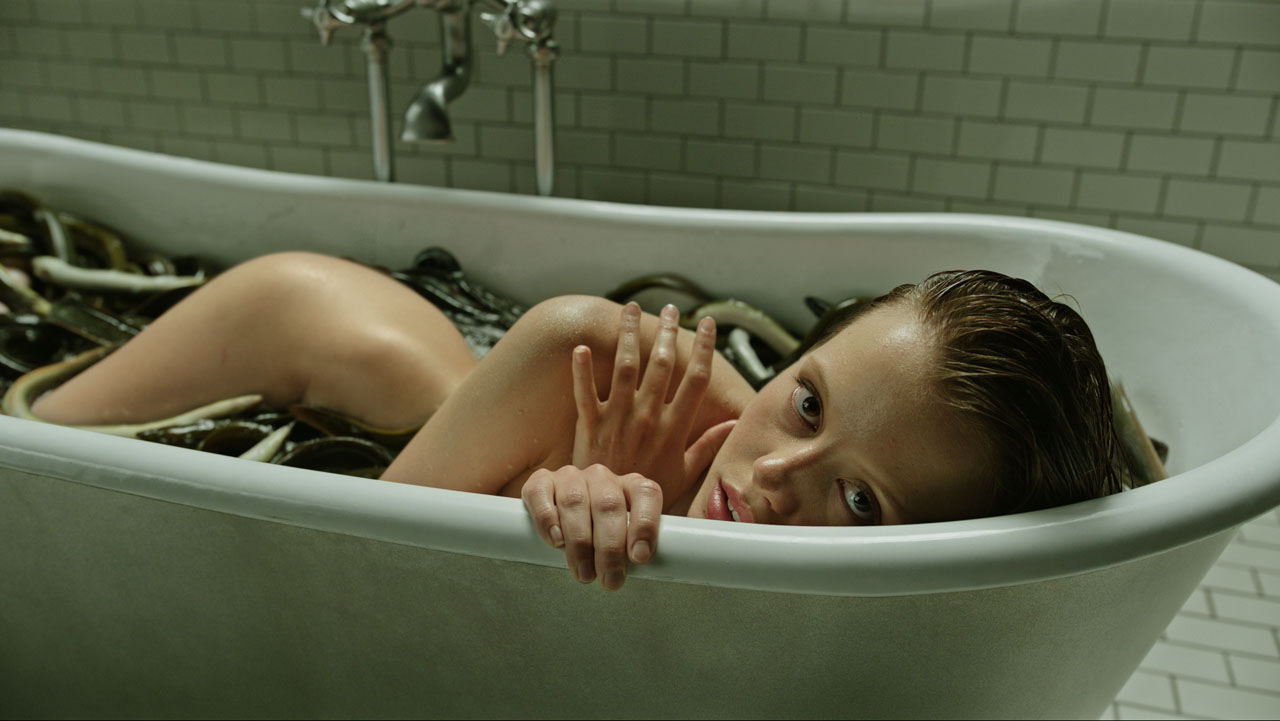
The unsettling through-the-looking-glass idea starts with the title itself. Isn’t wellness what a cure is supposed to achieve? Would a cure for wellness mean making a healthy person sick? Uh…yes. Prepare to feel your stomach drop like a bowling ball.

The best part of the movie is in exploring the world Verbinski creates, with production designer Eve Stewart, a health sanitarium where time seems to have stopped a century ago. A brief opening section establishes that it takes place now. An ambitious Wall Street trader named Lockhart (fast-rising star Dane DeHaan) has done something improper, and the bosses at his firm tell him that if he does not want to go to jail he has to retrieve Mr. Pembroke, the firm’s CEO, from a remote sanitarium so he can sign off on a big deal. Lockhart, confident of his ability to get deals done, and determined to stay out of trouble, takes the long, long drive up to the top of a mountain, to a facility somewhere between the Overlook Hotel in “The Shining,” the tuberculosis sanitorium in The Magic Mountain, and the Grand Budapest Hotel.

He briskly asks to see Pembroke and is informed that visiting hours are over. He does not pay enough attention to notice that things seem a bit…off. And when he is offered a glass of water, he does not hesitate to drink it. This, needless to say, is a mistake. He thinks he can leave and come back to see Pembroke later. This, also needless to say, is also a mistake.

Lockhart tries to find out what is going on. One might say that this is a mistake, too.

He starts to leave, but the car hits a deer and he wakes up in a hospital bed, his leg in a cast. Everyone is pleasant and rather vague, both staff and guests. But everything gets creepier and creepier, and it’s all atmosphere anyway. Don’t try to think about the story too much because it does not make a ton of sense and basically boils down to: creepy scene here, creepy scene there, REALLY creepy scene downstairs, excruciatingly creepy scene in the dentist’s chair, a not very surprising reveal.

Parents should know that this is a horror movie with extremely graphic and disturbing material and with many grisly and upsetting images including dead bodies, snakes, torture, sexual references and situations, nudity, sexual assault, incest, and very strong language.

Family discussion: What does Lockhart’s name tell us about the character? What does Hannah learn from him?

If you like this, try; “The Shining” and “Suspira”

Related Tags:


Movies -- format
Fist Fight

Fist Fight

Posted on February 16, 2017 at 5:40 pm

C
Lowest Recommended Age: Preschool
MPAA Rating: Rated R for language throughout, sexual content/nudity and drug material
Profanity: Extremely strong and crude language used by adults, teens, and a child
Alcohol/ Drugs: Drugs and drug dealing by teenager
Violence/ Scariness: Extended comic peril and violence
Diversity Issues: Diverse characters
Date Released to Theaters: February 17, 2017
Copyright 2017 Warner Brothers

Maybe it’s just here in Washington D.C., but when I saw “Fist Fight,” the biggest laugh from the audience was seeing the name of the executive producer, Steve Mnuchin, who had just been sworn in as the Trump administration’s Secretary of the Treasury. The timing of the movie, with its comic portrayal of an underfunded and wildly dysfunctional public school is uneasily, if inadvertently resonant with the times.

But mostly it is just not very funny. Five writers, including “New Girl” actor Max Greenfield, and a roster of more than a dozen producers, including the two stars, Ice Cube and Charlie Day, could not come up with anything more original than anatomical graffiti, a teacher who takes drugs and want to have sex with students, and a child performing a song with f- and b-words in her school talent show.

The producer/stars play Ron Strickland and Andy Campbell, teachers in a chaotic high school that is even more chaotic than usual because it is the last day before summer vacation. The senior pranks include obscene graffiti in the classroom and on the field, a drugged-up stolen race horse in the halls, the principal’s car covered with paint and left in the school foyer, and (I admit it, this was surreal and funny) a mariachi band trailing the principal for the day.

The students are openly contemptuous of the teachers. So is the administration, which is insisting on re-interviewing each of them to decide whether they will be kept on in their jobs. And poor Campbell, who just want to get along with everyone and impart to his students some of his love for words, has a wife who is about to go into a labor and a daughter who is appearing in the school talent show that afternoon. For some reason, he is performing with her, though she wants to make some last minute changes to the song. Do you think maybe the one she is springing on him has some bad language in it? Yes! Is that something that is inherently hilarious? Not in my opinion.

So, this is about two things: First is Campbell’s constant frustration at trying to do the right thing and the emasculating humiliation heaped on him by everyone when his nice-guy efforts are met with universal contempt. Second is the concept that nice-guy efforts should be met with universal contempt because what matters is the willingness and ability to beat someone up. Even the 911 operator (Kym Whitley) can only laugh when he calls for help.

The movie is filled with funny people. Unfortunately, it is bereft of funny ideas.

Parents should know that this film includes very strong language used by adults, teenagers and a child, drug humor and drug dealing by a teenager, jokes about a sexual predator, graphic sexual graffiti/humor, outrageous pranks, comic violence and peril.

Family discussion: Are Strickland and Campbell good teachers? What do they like about teaching?

If you like this, try: “Three O’Clock High” and “Ride Along”

Related Tags:


Movies -- format
The Great Wall

The Great Wall

Posted on February 16, 2017 at 5:39 pm

B-
Lowest Recommended Age: Preschool
MPAA Rating: Rated PG-13 for sequences of fantasy action violence
Profanity: None
Alcohol/ Drugs: None
Violence/ Scariness: Extensive, intense, military and fantasy violence with scary monsters, spears, arrows, explosions, characters injured and killed
Diversity Issues: Diverse characters but some insensitive portrayals
Date Released to Theaters: February 17, 2017
Copyright Universal 2017

I get that you need a big Hollywood star to get big Hollywood money. But in “The Great Wall,” that means that Matt Damon has to save the day in ancient China, and having him share the fight with a tough female military leader (Tian Jing) who is Chinese (and very beautiful) does not reduce the quease factor.

Damon plays William, a mercenary who has fought for and against armies of several European nations, now traveling through China in search of the “black powder” they have heard is a new weapon of massive power to destroy. (Gunpowder, the first explosive, was developed by Chinese alchemists in the 9th century.) All of his group are killed except for his closest friend Tovar (Pedro Pascal) in an encounter with a mysterious beast. William kills it and keeps the claw to help find out what it was. When they are captured by an enormous army, it is the claw that keeps them from being killed. The army, a part of the Nameless Order, is stationed by the Great Wall to fight off those creatures, called Tao-Tie. They are dragon-like predators who are learning and evolving, becoming more powerful and working together to develop what can only be called strategy. The Nameless Order has to stop them before they can no longer be contained and take over China, and, after that, the world.

The six people who wrote the film include top-level screenwriters including Edward Zwick and Marshall Herskovitz (“thirtysomething,” “Nashville”), Max Brooks (“World War Z”), and Tony Gilroy (“Michael Clayton”) were not able to add any more depth than a videogame, and Matt Damon’s talent and charisma can only take his one-dimensional character so far, but the real star here is director Yimou Zhang, whose gift for visual imagery is always a pleasure to behold. In the grand tradition of Cecil B. DeMille or Busby Berkeley, his eye for epic scale, pageantry, and battle is superb. Blue-armored female soldiers leap off ledges to fight the Tao-Tie via military-grade bungee cords. Two interlopers are suddenly surrounded by a storm of red arrows, shot to keep them at the center of a perfect circle. A soldier accused of having a bow “not to the level of your skill” demonstrates what it — and he — can do with three arrows shot at once, one to adjust the trajectory of a tossed bowl and other two to pin it to a column. The film has no dialog about trust or what it means to risk your life, whether for money or for your community, no bromantic banter, and no discovery of the surprising secret to defeating the animals that comes close to the power of the endless row of faces, resolute, honorable, and determined it to whatever it takes to fight the Tao-Tie.

NOTE: Matt Damon and co-star Andy Lau both played the same character in the American and Chinese versions of the film that in the US was called “The Departed.” The Chinese version was “Infernal Affairs” and both are excellent.

Parents should know that this film includes extended military vs. monsters violence with many characters wounded and killed and disturbing images, arrows, spears, and explosions. While it features strong, brave female soldiers and officers and tries to balance the skill and courage of the Chinese and western characters, it is still disturbing to see in 2017 a movie where the indigenous people cannot solve the problem until the European arrives. You may wish to read the director’s statement on this issue.

Family discussion: Were William and Lin Mae alike? How did they earn each other’s trust?

If you like this, try: “House of the Flying Daggers” and “Curse of the Golden Flower”

Related Tags:


3D Action/Adventure Epic/Historical Fantasy Movies -- format
John Wick Chapter 2

John Wick Chapter 2

Posted on February 9, 2017 at 5:25 pm

Copyright 2017 Summit

A little bit of a spoiler alert here: this time the dog does not die. Other than that, “John Wick Chapter 2” is pretty much what you saw in the first “John Wick.” Once again, this is a movie about a good guy who happens to be an assassin, going after the bad guy assassins, in an assassin demimondaine with cool details but mostly a lot of assassining. Director Chad Stahelski, a martial arts instructor turned stuntman in films like “The Crow” and “The Matrix” makes these films from a stuntman perspective. The intricately choreographed stunts are shot like a Fred Astaire dance number. That means the camera sits relatively still and lets the action tell the story rather than tricking it all up with quick cuts and fancy angles. And the stunt settings are imaginative, including ancient Roman catacombs and an art installation that is like a super-sized funhouse mirror display.

In the first film, retired assassin John Wick (Keanu Reeves) is mourning the death of his wife, the woman for whom he quit being a paid killer so they could live happily ever after together. She had arranged for an adorable puppy to be delivered to him after her death. The spoiled, hot-headed son of a crime boss kills Wick’s dog and takes his car, so Wick gets out a sledgehammer to smash up the cement he laid down metaphorically and literally over his arsenal and stockpile of gold coins, the preferred currency for Assassin World. Some 70 kills later, including the son and his dad, the movie ended.

Chapter 2 has Wick getting his car back, and when we see him laying down that cement again, we know it’s time for the doorbell to ring.

It turns out you don’t get to retire twice. An old colleague shows up with a marker. And, as hotel for assassins proprietor Winston (Ian McShane) helpfully reminds us, there are only two unbreakable rules in Assassin World: no spilling blood in the Assassin Hotel chain known as Continental (we’ll overlook that tussle with Ms. Perkins in the first film), and all markers must be paid. Santino (Riccardo Scamarcio) wants Wick to kill his sister, Gianna (Claudia Gerini), so he can take her place on the Assassin World ruling council. Wick says no. Santino burns his house down.

No time to stop to dig up the arsenal again. Lucky for us, as this means some of the film’s highlights, when Wick meets with his weapons “sommelier” (“Spy’s” Peter Serafinowicz) and his tailors, expert in the art of exquisite fit and bulletproof fabric. Then it’s off to the catacombs for a rather unexpected encounter with Gianna, followed by an Assassin World APB when Santino offers a $7 million reward for killing John Wick.

So, basically another FPS game, as everyone comes after Wick, including Common and Ruby Rose, and he goes after everyone. There has to be a Chapter 3, right?

The details are stylish and a lot of fun, especially Lance Reddick’s imperturbable concierge, a room full of 1940’s-style plugboard and vacuum tube female operators handing out assassination assignments, Rose’s acrobatics and her sign-language threats (she does not speak), and everyone’s exotic tattoos. (Wick’s, usually translated as “Fortune Favors the Bold” is really more like “It is only the strong that the Goddess Fortuna comes to save.”) It is delightful to see Reeves paired again (briefly) with his “Matrix” sensei, Laurence Fishburne, here presiding over an intelligence network of apparently homeless people. It nicely balances the gory images to keep us in a world where we are relieved that the local cop (the always welcome Thomas Sadoski) appreciates that all this killing has nothing to do with the normal rules. Contrary to Winston, in this world there is only one rule: don’t get in the way of entertainment, and this movie obeys.

Parents should know that this film includes constant strong and very gory violence with guns, knives, fights, suicide, many characters injured and killed, many disturbing images, very strong language, and briefs nudity.

Family discussion: Why are the two rules important? Should there be any others?

If you like this, try: the first “John Wick” and “Shoot ‘em Up”

Related Tags:


Action/Adventure Series/Sequel
THE MOVIE MOM® is a registered trademark of Nell Minow. Use of the mark without express consent from Nell Minow constitutes trademark infringement and unfair competition in violation of federal and state laws. All material © Nell Minow 1995-2026, all rights reserved, and no use or republication is permitted without explicit permission. This site hosts Nell Minow’s Movie Mom® archive, with material that originally appeared on Yahoo! Movies, Beliefnet, and other sources. Much of her new material can be found at Rogerebert.com, Huffington Post, and WheretoWatch. Her books include The Movie Mom’s Guide to Family Movies and 101 Must-See Movie Moments, and she can be heard each week on radio stations across the country.

Website Designed by Max LaZebnik