Table 19

Table 19

Posted on March 2, 2017 at 5:59 pm

B +
Lowest Recommended Age: High School
MPAA Rating: Rated PG-13 for thematic elements, sexual content, drug use, language and some brief nudity
Profanity: Some strong and crude language
Alcohol/ Drugs: Drinking and marijuana
Violence/ Scariness: Comic peril, no one hurt, medical issues
Diversity Issues: Diverse characters
Date Released to Theaters: March 3, 2017
Date Released to DVD: June 13, 2017
Amazon.com ASIN: B06XYSX6KQ
Copyright Fox Searchlight 2017

I know. They hate the term. But it is impossible to talk about Mark and Jay Duplass (as writers, anyway, aside from their work as actors, directors, and producers) without the dreaded term “mumblecore,” which was applied to their early microbudget work because of the improvisational, shaggy-dog, millennial-ness of their work. Traces of that remain in “Table 19,” cross-bred with a more conventional romantic comedy, and it turns out to be a welcome blend of sweet and sour. This is not the usual Jennifer/Jessica with a quippy best friend, a meet cute, and a makeover.

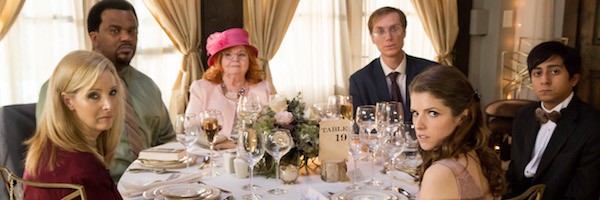
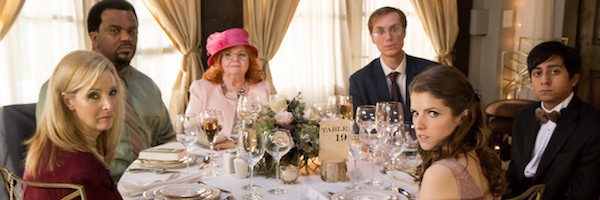
We’ve all seen that placecard and most of us have been seated by it: the table for leftover wedding guests who aren’t the family or close friends of either bride or groom but somehow had to be included. Eloise (Anna Kendrick) provides the fellow denizens of the dreaded Table 19 with the inside scoop. Back just a few months earlier, when she and the bride, her oldest friend, were planning everything together, Table 19 was for the people who did not fit in anywhere else, the people who had to be invited but who the hosts were hoping would not make it, still sending a gift from the registry.

The characters may be third-tier in the minds of their hosts, but they are played by top tier comic talent. Lisa Kudrow and Craig Robinson play a married couple who have fallen into a marital death spiral of bickering that makes them miserable and humiliated, but they cannot seem to find their way out of it. Stephen Merchant is a cousin of the groom who seems unfamiliar with social interactions of any kind. “The Grand Budapest Hotel’s” Tony Revolori is a teenager with raging hormones but no idea of how to talk to girls. June Squibb plays the bride’s first nanny.

And then there is Eloise, once a maid of honor and dating the bride’s brother/best man (Wyatt Russell), but, since they broke up two months earlier, stuck at Table 19, on the other side of the ballroom, near the restrooms.  We know she almost didn’t come; she even started to burn the invitation. But for some reason, she was determined to be there, and there she is, on the wedding table island of misfit toys. A mysterious and handsome man appears and he has an English accent and a way with an aphorism. Could he be her Prince Charming?

Very able performers make up for some story shortcomings, including a too-neat resolution that I’m guessing was recut after test screenings. Kendrick is as always a marvel of precision, heart, and comic timing, so every time things start to go off kilter, we know she will get us safely home.

Parents should know that this film includes some strong language and comic mayhem, brief comic nudity, drinking and tipsiness, marijuana, and sexual references including adultery and pregnancy.

Family discussion: Why did Eloise go to the wedding? How did sitting at Table 19 make it possible for her to acknowledge her feelings? What’s your funniest family gathering experience?

If you like this, try: “Rocket Science” with the same director and star

Related Tags:


Comedy DVD/Blu-Ray Romance
The Shack

The Shack

Posted on March 2, 2017 at 5:57 pm

B
Lowest Recommended Age: Middle School
MPAA Rating: Rated PG-13 for thematic material including some violence
Profanity: Mild language
Alcohol/ Drugs: Alcoholic parent
Violence/ Scariness: Tragic murder of a child, domestic and child abuse, gun, possible attempted suicide
Diversity Issues: Diverse characters
Date Released to Theaters: March 3, 2017
Copyright Summit 2017

“The Shack,” based on the best-seller by William P.Young seeks to provide comfort and healing for those struggling with a terrible loss and with something even worse — the fear that tragedy has no purpose and the doubt that pain engenders about whether life makes sense. Can there be meaning in a world of senseless tragedy, where the innocent suffer? The book‘s subtitle is Where Tragedy Confronts Eternity, and it is somewhere between a parable, a fantasy, and a story about a man devastated by grief who spends a week in a shack in the woods, talking to God.

While some people, including some Christians, will find the theology of this story questionable, it presents an accessible and comforting notion of God’s love and the healing power of forgiveness.

Sam Worthington plays Mackenzie, a loving husband and father of three children who still struggles with his memories of his abusive father, a man of “calloused hand, rigid rules” and alcoholism. “Pain has a way of twisting us up inside and making us do the unthinkable,” and “the secrets we keep have a way of clawing themselves up to the surface.” (It is not clear exactly what the most painful secrets are but it seems possible he murdered his abusive dad?)

Mack takes his children on a camping trip, where his youngest daughter Missy is kidnapped and brutally murdered while he is rescuing his son, trapped under an overturned canoe. Mac, who had always been surprised and touched by Missy’s simple faith in a God she felt close enough to that she referred to Him as Papa, is shattered by guilt and grief. Even though he sees the pressure it puts on his family, he cannot break out of his isolation.

When his family is away, Mack finds a note in his mailbox, though there are no footprints in the snow. The note is signed “Papa” and it invites him to come to the woods, to the very shack where Missy’s bloody dress was found.  Although he dreads returning to the place of his crushing pain, he goes, and it is there he meets the Trinity. God, known as Elousia, I Am, or Papa, is in the form of an African-American woman who was a kind neighbor in his childhood and who wears Ma Griffe, the perfume he mother loved (Oscar-winner Octavia Spencer). She says he will be most open to her in the form of a mother, and apparently one who loves Neil Young.

God’s Son is in the form of a young carpenter who can walk on water and run on it, too (Avraham Aviv Alush), and the Spirit is known as Sarayu (Sumire Matsubara).  

They live in a Kinkade-like Eden, filled with warmth, light, nature, good food, and laughter.  Very gently, they guide him to an understanding that God’s love does not mean freedom from pain, but a sharing of that pain that can help him forgive and help make his spirit whole.

Some believers will dismiss this as “comfort food Christianity.” The Son actually says that religion is too much work. “I don’t want slaves; I want friends,” and he himself is “not exactly a Christian.” Papa tells him, “I can work incredible goodness out of unspeakable tragedy, but that does not mean I orchestrate the tragedies.”

But its idea that God loves us enough to reach out to every one of us in our the way we are best able to understand is genuinely touching. The insights Sam reaches about forgiveness and healing could be arrived at via psychotherapy or a number of other ways, but for this man — and this audience, the message is meaningful and touching, and a good reminder that patience and forgiveness are always worth making time for, and that every act of kindness changes the universe.

Parents should know that this movie concerns the brutal kidnapping and murder of a child, with images of her bloodied dress and dead body, a gun and possible attempted suicide, as well as depictions of wife and child abuse and alcoholism.

Family discussion: Why is it important to learn to forgive, even when the transgression is evil?  How did each member of the Trinity teach Mack a different lesson?

If you like this, try: “What Dreams May Come” and “Henry Poole is Here”

Related Tags:


Based on a book Drama Movies -- format Spiritual films
Before I Fall

Before I Fall

Posted on March 2, 2017 at 5:53 pm

B
Lowest Recommended Age: Middle School
MPAA Rating: Rated PG-13 for mature thematic content involving drinking, sexuality, bullying, some violent images, and language - all involving teens
Profanity: Some strong and crude language
Alcohol/ Drugs: Teen drinking
Violence/ Scariness: Fatal accident, suicide
Diversity Issues: None
Date Released to Theaters: March 3, 2017

Copyright 2017 Open Road
Who would not like to go back in time to correct a mistake? Can you correct a mistake without making it worse?

Lauren Oliver’s debut novel Before I Fall is a bittersweet “Groundhog Day” story about a pretty, popular high school senior named Sam (“Everybody Wants Some!!’s” Zoey Deutch) who lives her last day over and over until she figures out why.

Sam wakes up on “Cupid Day” (her school’s version of Valentine’s Day), happy, confident, and looking forward to the day ahead. Her best friend Lindsay (“Paper Towns'” Halston Sage) is picking her up and at school she is expecting her boyfriend Rob to have red roses delivered to her in class. And that evening, she and Rob have planned to have sex for the first time. Everything seems to be coming together just as she wants it.

She barely acknowledges her parents (yes, that is “Flashdance’s” Jennifer Beals as her mother) as she flies out the door. When her little sister runs after Sam with her gloves, instead of thanking her, Sam barks, “Don’t touch my things!” Lindsay picks up their other two friends, and the movie really captures the wild swings between professing total love and devotion and mildly trashing and topping each other that is teengirlspeak.

At school, the lesson is about the Greek myth of Sisyphus, condemned to keep pushing a huge rock up a hill, never getting it over the top before it rolls back down. But no one is really paying attention and the class is interrupted by the delivery of the Cupid’s Day roses. She receives the red roses Rob sent her — after she reminded him — with a note that is more jaunty than romantic. And then there is a special rose from an old friend, who tells her he is having a party that night. She barely acknowledges him. And she does not even notice a sad and angry girl named Juliet (Elena Kampouris) intently working on a charcoal drawing until they are all in the cafeteria, when Lindsay taunts her. “Remind me why we hate Juliet?” Sam asks, but does not really pay attention to the answer. She is more bored by it than ashamed of it.

She does end up at the party, where Rob gets sloppy drunk and Juliet confronts the girls who have been mean to her, including Sam. Later that night, they learn that Juliet has committed suicide. And then Sam wakes up and it is Cupid Day all over again.

At first, she is frustrated and angry at reliving the same day over and over and over. She exploits the freedom from consequences but it is not fun; it is empty. Finally, she begins to pay attention to the people around her and begins to understand what she has to do.

Deutch ably handles her most challenging role so far, showing us Sam’s thoughtfulness, even in her most self-absorbed moments. The small details of her different approaches to each day keep us aware of exactly where she is on her path to greater understanding. Each day may seem the same to Sam, but for us Deutch makes them different as she passes through denial, anger, bargaining, depression, and acceptance. She makes us share her sense of loss, but also her understanding as a reminder of a time she was a hero makes her willing to locate that in herself once more.

Parents should know that this movie includes teen drinking, bullying, strong language including crude sexual references, suicide, and a fatal accident.

Family discussion: If you could live today over again, what would you change? Why didn’t Sam pay attention to Kent and Juliet before? Who is your hero? Whose hero are you?

If you like this, try: “If I Stay,” “About Time,” and “Restless”

Related Tags:


Based on a book Drama Movies -- format Stories about Teens
The Sense of an Ending

The Sense of an Ending

Posted on February 27, 2017 at 8:27 am

B +
Lowest Recommended Age: Preschool
MPAA Rating: Rated PG-13 for thematic elements, a violent image, sexuality and brief strong language
Profanity: Some strong language
Alcohol/ Drugs: Alcohol
Violence/ Scariness: Suicides
Diversity Issues: None
Date Released to Theaters: March 10, 2017
Copyright CBS Films 2016

Life is messy. Stories are our way of cleaning it up to help us try to make sense of it. Some of those stories are in books or movies, but most of those stories are just the editing each of us does all the time in telling ourselves and others who we are. Whether it is explaining to a traffic cop why you should not get a ticket or the difference between the “how we met” story of a couple who are still together and one who has split up, or living in a version of Lake Woebegone, “where all the children are above average,” all of us burnish the truth a little to make ourselves feel better and look better.

Julian Barnes’ award-winning novel The Sense of an Ending is the story of a older man who has to rethink the stories he has told himself and realign his understanding of his life. On screen, the delicacy of the performances stands in for the lyricism of his prose.

Tony Webster (Jim Broadbent) is semi-retired, the owner of a store that sells vintage cameras, and kind of semi-married, with a warm, companionable relationship with his lawyer ex-wife, Margaret (Harriet Walter, with a voice like a dry martini). Their daughter Susie (“Downton Abbey’s” Michelle Dockery) loves her dad, but finds him exasperating. She is pregnant, and says that her child will call him “Mudge,” for curmudgeon.

The camera store is significant. The vintage cameras are superbly crafted and in some ways better than digital cameras, but they are expensive and complicated and considered obsolete by most people. Tony identifies with the underappreciated quality of the instruments of precision and gets some satisfaction with being out of step with modern technology and mores.

But his romanticized view of the past is put into sharper focus (those cameras again) when he gets a letter about a bequest from a woman he had not seen since he was in his 20’s, when he was dating a woman named Veronica, and visited her family. After he and Veronica broke up, she dated his close friend Adrian, who later committed suicide. Now Veronica’s mother has left him Adrian’s journal, but that raises many questions: Why did she want him to have it? Where did she get it?

And where is it?  Her letter says it is enclosed, but it is not. Tony could let it go, but he stubbornly insists on seeing what it is, without considering where it might lead.

We go back in time, the moments and even the gestures mirroring the present as Tony explores the past and reconsiders many of his most fundamental assumptions about how he has lived his life. Veronica (now played with quiet fury by Charlotte Rampling) will not let him to have the journal. Instead she gives him something else, a letter that will make Tony confront one of his most painful and shameful experiences and open up to his ex-wife as he never has before.

The honesty of story’s portrayal of the foolish and selfish mistakes we make and the hurt they can inflict on people around us is tempered by the film’s tenderness toward its characters and the sensitivity of the performances, especially Broadbent and Walter. It judges them less than Tony is pushed to judge himself, and that is why it is so touching.

Parents should know that this movie includes two suicides, some violence, strong language, sexual references and a situation, and tense confrontations.

Family discussion: Why did Victoria’s mother want Tony to have Adrian’s journal?  Why was Tony wrong about Victoria’s brother?  Why did he forget about the letter?

If you like this, try: “The Remains of the Day”

Related Tags:


Based on a book Drama Movies -- format
Rock Dog

Rock Dog

Posted on February 23, 2017 at 5:50 pm

B
Lowest Recommended Age: Preschool
MPAA Rating: Rated PG for action and language
Profanity: Some schoolyard language
Alcohol/ Drugs: None
Violence/ Scariness: Action-style cartoon peril, chases, predators, no one hurt
Diversity Issues: A metaphorical theme of the movie
Date Released to Theaters: February 24, 2017
Copyright Lionsgate 2016

The second movie in three months featuring cartoon animals singing pop songs is “Rock Dog,” based on a Chinese graphic novel.

Luke Wilson provides the voice for Bodi, a sheepdog in Tibet, raised by his martinet father Khampa (J.K. Simmons). Bodi is never able to muster the “Kung Fu Panda” style mystic power his father tries to teach him as a part of the elaborate defense system he has put in place to protect the sheep from the Mafia-type wolves (led by Lewis Black as Linnux). At one time the community had two passions, making music and making wool. But after an attack by wolves, the instruments have all been locked away so that there will be no distractions from civil defense.

When a radio literally drops from the sky (an airplane loses some of its cargo), Bodi realizes his true purpose. He is not a watchdog — he is a musician.

Inspired by the music of rock star Angus Scattergood (Eddie Izzard), he decides to leave the mountain to follow in his footsteps: he will find a band in the legendary Rock ‘n’ Roll Park and play music no matter who tries to stop him. “Play your guts out and never stop, even when your dad tells you to stop, don’t stop.” He realizes that this is “the answer to my life,” and soon he is making music for delighted new fans.

Khampa reluctantly agrees to let Bodi go, but makes him promise he will return if he does not succeed. In the big city, he finds the Rock ‘n’ Roll Park, where he encounters a bully (Matt Dillon) who sends him to Scattergood’s booby-trapped fortress of a house as a prank.

Scattergood is desperately trying to come up with the new song his record label is demanding, but he is so isolated that he has run out of ideas, like Dana Carvey playing “Choppin’ Broccoli.”

There are some charming details (the sheep’s pub is called the Warp and Weft and serves shots of wheatgrass), and its international production team is reflected in its settings, like the Japan-inspired Rock ‘n’ Roll park, where Bodi and the bully have a shred-off. Bodi is a likeable hero and it is fun to see his cheery optimism paired with the burned-out, cynical Angus. Like the music they create, it is pleasantly entertaining.

Parents should know that this movie has cartoon action-style peril and violence, including predators, chases, fire, and some pratfalls, although no one is hurt. There is also some schoolyard language.

Family discussion: Why was it so hard for Angus to write a song? Why did he think he did not want to see anyone? How did Bodi know that music was his destiny?

If you like this, try: “Surf’s Up”

Related Tags:


Animation Movies -- format Musical Talking animals
THE MOVIE MOM® is a registered trademark of Nell Minow. Use of the mark without express consent from Nell Minow constitutes trademark infringement and unfair competition in violation of federal and state laws. All material © Nell Minow 1995-2026, all rights reserved, and no use or republication is permitted without explicit permission. This site hosts Nell Minow’s Movie Mom® archive, with material that originally appeared on Yahoo! Movies, Beliefnet, and other sources. Much of her new material can be found at Rogerebert.com, Huffington Post, and WheretoWatch. Her books include The Movie Mom’s Guide to Family Movies and 101 Must-See Movie Moments, and she can be heard each week on radio stations across the country.

Website Designed by Max LaZebnik