The Boss Baby

The Boss Baby

Posted on March 30, 2017 at 5:50 pm

B +
Lowest Recommended Age: Kindergarten - 3rd Grade
MPAA Rating: Rated PG for some mild rude humor
Profanity: Some schoolyard language
Alcohol/ Drugs: "Formula" that keeps babies from growing up
Violence/ Scariness: Cartoon-style action peril and violence, no one hurt
Diversity Issues: None
Date Released to Theaters: March 31, 2017
Date Released to DVD: July 25, 2017
Copyright Dreamworks 2017

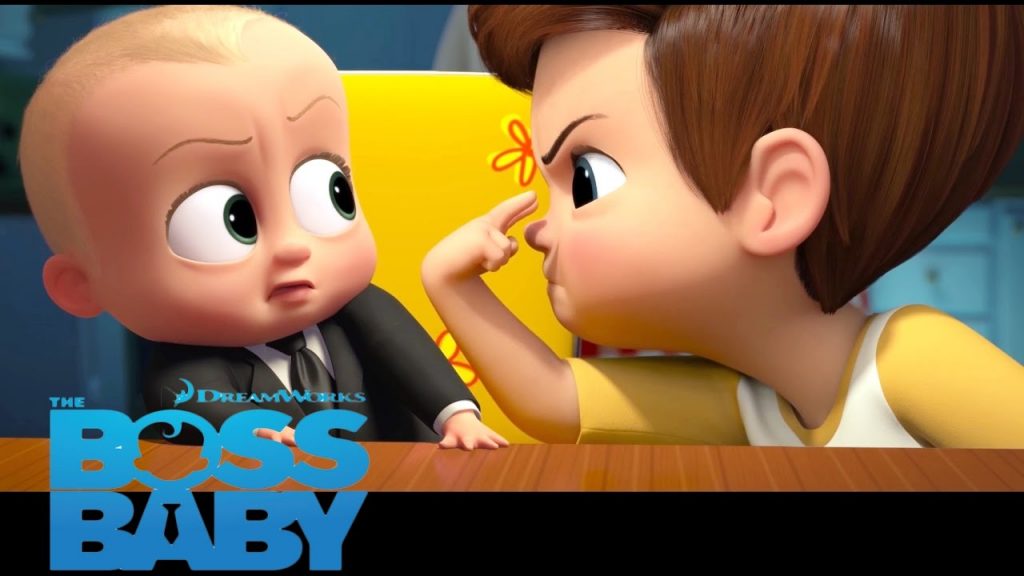
Yes, sure, babies are adorable and it is wonderful fun to nibble their toes and kiss the backs of their necks. But let’s be honest. They are also tiny tyrants. Who decides when it is time to eat and sleep? It is not the adults in the household. And who is no longer the top priority in the home anymore? The older child! (Let me state for the record that my two younger sisters are lovely people and I couldn’t be luckier to have them as siblings, but those first few months are tough.)

“The Boss Baby,” inspired by the Marla Frazee book, takes these ideas hilariously to the extreme with a baby who is literally the boss.  He arrives complete with suit, tie, Rolex, briefcase, and the ultra-adult voice of Alec Baldwin. This is deeply disturbing for Tim (Miles Bakshi, grandson of animation pioneer Ralph Bakshi), whose previously blissful life of undiluted devotion from his mom (Lisa Kudrow) and dad (Jimmy Kimmel) is destroyed by this demanding creature and it seems that only Tim really understands what a monster he is.

Somehow, Mom and Dad, a sweet couple who both work for a pet food company, can only see the baby’s cute little face and have no idea that the baby is really a spy, even though “if things weren’t to his immediate satisfaction, he had a fit.”  They are so numb from sleep deprivation and so captivated by what looks to them like an infant that they never suspect there is anything unusual going on.  But Tim overhears the Boss Baby talking to his office — and then the Boss Baby blandly tosses some money his way and asks for some sushi: “I’d kill for a spicy tuna roll.”

Once Tim learns that the baby will return to his office after his mission is complete, he and the baby join forces to take on the real villain of the story — I will not spoil his very funny nefarious plan.

Director Tom McGrath says that this film is a tribute and apology to his older brother, because like all younger siblings, he was for a time the “boss baby.”  He gives the story a pleasantly retro look, setting, and soundtrack, evocative of old-school cartoons and an era before everyone was mesmerized by devices. It is surprisingly funny and even more surprisingly sweet. Tim is a great kid, brave, smart, and wonderfully imaginative, and it is nice to see a movie for children that is about something other than following your dreams or learning to be confident. It’s about visceral feelings everyone will recognize — worrying that there is not enough love to go around, jealousy, competitiveness. And it is also about feelings we should recognize but too often overlook: the importance of imagination and the pleasures of being a kid.

NOTE: Stay all the way through the credits for an extra scene!

Parents should know that there is cartoon-style peril and violence along with some potty humor and schoolyard language.  The theme of the movie centers on issues of sibling rivalry.

Family discussion:  Why wasn’t the Boss Baby sent to earth as a regular baby? What are the best and worst parts of having a sibling?

If you like this, try: the “Madagascar” films, from the same director

Related Tags:


Animation Based on a book DVD/Blu-Ray Pick of the Week Scene After the Credits Stories About Kids
The Zookeeper’s Wife

The Zookeeper’s Wife

Posted on March 30, 2017 at 3:47 pm

B +
Lowest Recommended Age: Preschool
MPAA Rating: Rated PG-13 for thematic elements, disturbing images, violence, brief sexuality, nudity and smoking
Profanity: Some strong and bigoted language
Alcohol/ Drugs: Drinking, smoking
Violence/ Scariness: Wartime and holocaust violence involving humans and animals, characters injured and killed, rape of a young girl (off-camera), sexual abuse
Diversity Issues: A theme of the movie
Date Released to Theaters: March 30, 2017
Copyright Scion Films 2017

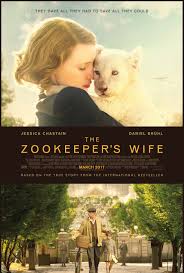
Jessica Chastain is luminous in the real-life story of Antonina Zabinski, a Warsaw zookeeper, who, with her husband and son, saved the lives of Jews during the Holocaust. Director Niki Caro (“Whale Rider”) brings her love of the natural world and her gift for telling stories of courage and triumph over bigotry to give us a timely reminder that the direst circumstances can inspire the greatest acts of courage and generosity. It also reminds us that there are still new stories to be discovered, even in a period of history that has inspired hundreds of films and thousands of books.

The movie opens on scenes of Edenic paradise. Antonina looks lovingly at her sleeping son — and at the baby lions sleeping beside him. She leans over and holds his foot, but it is the lion cubs she nuzzles. We then see her opening the zoo for the day, riding her bicycle through the magnificent Belle Epoque zoo, with the young camel loping along behind her, lovingly greeting each of the creatures. We will later learn that she is a refugee from Russia, and her childhood hardships left her more willing to trust animals than people. Animals trust her, too. Her skill at “whispering” even the most frightened and frightening wild thing will prove essential once Germany invades Poland.

Antonina is married to Jan (the Belgian actor Johan Heldenbergh), and the zoo is in every way their home. They live on the premises, but it is more than that. There is no distinction between the rooms they live in and the rest of the zoo. Animals wander in and out of the house and Antonina feels that the animals are her treasured guests — that is the term she uses.

And then Germany invades Poland, and the zoo is destroyed. A German zookeeper, Lutz Heck (Daniel Brühl of “Rush” and “Captain America: Civil War”) offers to take the best of the surviving animals to his zoo in Berlin, promising to care for them and return them after the war. Later, as an officer in the German army, he returns to shoot the animals left behind. The Jews of Warsaw are moved into the Warsaw ghetto. Antonina and Jan figure out a way to smuggle some of them out of the ghetto, and soon they are living in underground cages once used to house animals. Once again, Antonina refers to them as her guests, and each night, after the patrol has gone home, she has music and serves food on elegant trays to remind them that there is still civilization in the midst of madness and kindness and courage in the midst of brutality and terror.

It would be easy to mistake the gentleness of Caro’s approach as not sufficiently harrowing to convey the horrors of the Holocaust, especially after the Oscar-winning “Son of Saul.” But that would be wrong. Caro, who made a film about sexual predation in “North Country,” understands that an unwanted touch of a hand or coming a few millimeters too close can feel soul-destroying, especially when it is misunderstood by someone whose trust and respect mean everything. She understands that a drawing, a bunny, a chance to create, a moment of sympathy can begin to heal a ravaged heart, and she presents Antonina’s story with as much grace and humanity as Antonina showed her guests.

Parents should know that this movie takes place during WWII and the Holocaust, and there are disturbing and violent images including scenes of bombing, the Warsaw uprising, and execution of Jews. A young girl is raped (off-screen) and a woman faces a sexual predator. There is some bigoted language and human and animal characters are injured and killed.

Family discussion: How did Antonina’s love of animals help her in taking care of her “guests?” Why was it important to her to treat her “guests” to gracious entertainment in the evenings? What should she have said to her husband about Heck?

If you like this, try: the book by Diane Ackerman

Related Tags:


Based on a book Based on a true story Drama Epic/Historical Movies -- format War
Saban’s Power Rangers

Saban’s Power Rangers

Posted on March 23, 2017 at 5:28 pm

C
Lowest Recommended Age: Middle School
MPAA Rating: Rated PG-13 for sequences of sci-fi violence, action and destruction, language, and for some crude humor
Profanity: Brief strong language
Alcohol/ Drugs: Teen drinking
Violence/ Scariness: Extended sci-fi peril and violence, some disturbing images, explosions, characters injured and killed
Diversity Issues: Diverse characters
Date Released to Theaters: March 24, 2017
Date Released to DVD: June 26, 2017
Amazon.com ASIN: B0727PMH49

power rangersWhy why why why why make the popular series for children into a PG-13 movie? Why emphasize that decision in the very first scene with a crude joke about bovine body parts? Why drag the origin story on for an hour so we don’t get to the good stuff about the powers of the Power Rangers until the movie is half over?

These were among the questions I pondered between glances at my watch as I slogged through “Saban’s Power Rangers,” a big-budget theatrical version of the television series created by Haim Saban (originally “Mighty Morphin Power Rangers”), based on the Japanese Super Sentai show about teen superheroes (and using some of its footage).

Our soon-to-be heroes meet in “Breakfast Club”-style detention. There is the handsome quarterback (Dacre Montgomery as Jason), the cheerleader kicked off the squad (Naomi Scott as Kimberly), the self-described crazy loner who cares tenderly for his sick mother (Ludi Lin as Zack), the nerdy guy on the autism spectrum (RJ Cyler as Billy), and the sullen new girl (Becky G. as Trini).

The blah-blah: an ancient civilization perished fighting Rita Repulsa (Elizabeth Banks), a rogue former Power Ranger who wants to destroy everything. Tens of thousands of years later, our merry band of misfits all happen upon the same power-granting “coins” of different colors (but apparently all the same powers) and learn that their job is to continue the fight, as Rita returns. Their challenge, as she gains her powers from chomping on jewelry and pulling the fillings out of the teeth of homeless people (she feeds on gold), is to learn to use their powers and work as a team (with the only white male Power Ranger as the leader), figuring out how to morph (manifest their primary color-coordinated armor/uniforms) and learning about Rita and her army of rock creatures. They also have access to some very cool Morphin Power Rangers weapon vehicles, but we don’t get enough time to really enjoy them.

Rita’s challenge is to find a last missing infinity stone, I mean crystal, hiding (I am not making this up) in a Krispy Kreme store. I’m not sure if I was the marketing department of Krispy Kreme that I would chose this form of product placement, but, to be fair, they do say the name a lot and a character does stop mid-chaotic fight for the future of the universe to eat a donut. And the Teenage Mutant Ninja Turtles already have pizza on lockdown.

This uncomfortable mixture of teen angst (Sexting! Disappointing parents!) and cartoonish violence only comes alive when Banks is on screen, clearly having way too much fun swanning around as the embodiment of evil. Bryan Cranston is wasted as an Oz-like talking head and Bill Hader does not have enough to do as a cute little android sensei. The teens are bland and forgettable. The final action sequence departs from the series’ tradition of covering the actors’ faces with the costume (making it easy for them to switch out performers who left or asked for too much money). We see their faces, but it is still hard to remember which one is who.

Long-time fans will get a kick out of glimpsing some of the original stars, hearing a bit of the show’s theme song, and a couple of inside references. But that doesn’t make up for a Power Rangers film that is sadly lacking in any narrative or emotional energy.

Parents should know that this film includes extended sci-fi peril and violence with characters injured and killed, explosions, guns, a character impaled, some disturbing images, brief strong language, teen drinking, and crude sexual humor.

Family discussion: Why was it difficult for the Power Rangers to learn how to morph? Why were the Power Rangers all kids who had gotten into trouble?

If you like this, try: the television series and the “Transformers” movies

Related Tags:


Based on a television show DVD/Blu-Ray Stories about Teens Superhero
Beauty and the Beast

Beauty and the Beast

Posted on March 16, 2017 at 5:55 pm

A-
Lowest Recommended Age: Preschool
MPAA Rating: Rated PG for some action, violence, peril and frightening images
Profanity: None
Alcohol/ Drugs: None
Violence/ Scariness: Fairy tale peril and violence, wolves, mob, guns
Diversity Issues: Very subtle suggestion that a character might be gay, tolerance a metaphorical theme of the film
Date Released to Theaters: March 17, 2017
Copyright Disney 2017

Disney’s live action remake of one of its most beloved animated fairy tales is every bit as enchanting as we could hope, gently updating and expanding the story to give the characters more depth and appeal and filling it with movie magic.

In a prologue, we see that the Beast was once a handsome but vain and selfish prince who cared only about beauty. An enchantress cursed him to become a beast, the courtiers all turned into furniture, serving pieces, and accessories. If the Beast cannot find a way to love and be loved before the last petal falls from the enchanted rose, they will never return to human form. The Beast has given up. He is angry, hurt, and terrified that he is unlovable, as Stevens shows us with just his voice, posture, and piercing blue eyes.

Emma Watson, best known as Hermione in the Harry Potter films, plays Belle, introduced in the opening musical number as a bit of an outsider in her small “provincial” French village. She loves to read, but seems to have read everything on the one shelf of books in the town. Belle is not concerned with her looks, and Watson is encouragingly messy, with locks of hair falling around her face and sturdy boots instead of the animated version’s flats. We can see that she truly loves to learn and has an independent, adventurous spirit.

Belle adores her father (Kevin Kline as Maurice), an artist turned repairman, and she is an inventor herself, creating a washing machine that can do the laundry while she reads. Gaston (a terrific Luke Evans, clearly enjoying the way Gaston enjoys being Gaston) is an arrogant soldier who wants to marry Belle because she is beautiful and because she is the only girl in town who does not think he is dreamy. “She hasn’t made a fool of herself just to gain my favor.” Like the prince who turned into a beast, Gaston judges people only on how they look and how they respond to him.

Away from home, Maurice is chased by wolves and ends up seeking shelter at the Beast’s mysterious enchanted castle where the candelabra and teacup can talk. As he leaves, he picks a rose for Belle and the Beast (Dan Stevens of “Downton Abbey”) furiously captures him. Belle tries to rescue her father but ends up taking his place as the Beast’s prisoner.

But in this “tale as old as time,” we know that Belle and Beast will begin as “barely even friends, then somebody bends, unexpectedly,” and it is genuinely touching to see how it unfolds. With additional songs from original composer Alan Menken (with lyrics from Tim Rice, along with some lyrics written by the late Howard Ashman for the original film that were not used), some backstory about both Belle and the Prince, and a more thoughtful portrayal of the development of their relationship. I was especially glad to see that their shared love of books played an important part in their connection.

The storyline is unexpectedly resonant with contemporary challenges, with the greatest threat from an angry mob suspicious of anything unfamiliar and easily spurred to violence. We get to see a bit more of the enchantress behind the curse as well.

The two moments fans of the original film will count on are the “Beauty and the Beast” waltz in the ballroom (now sung by Emma Thompson as Mrs. Potts) and the musical extravaganza “Be Our Guest” (now sung by Ewan McGregor as Lumiere), and both are gorgeously, joyously stunning, but the moments that stay with us are the sensitive performances and the tenderness of the relationships.

Parents should know that this film includes cartoon/fantasy peril and violence, wolves, a monster, a curse, some scary images, and a subtle reference to a gay crush.

Family discussion: What did the Beast learn from his enchantment? Why is Gaston so selfish? What do Belle and the Beast discover that they have in common?

If you like this, try: the animated original and the live action “Jungle Book” and “Cinderella”

Related Tags:


Based on a book Date movie Fantasy For the Whole Family Movies -- format Musical Remake Romance
Logan

Logan

Posted on March 2, 2017 at 6:00 pm

C
Lowest Recommended Age: Mature High Schooler
MPAA Rating: Rated R for strong brutal violence and language throughout, and for brief nudity
Profanity: Very strong language
Alcohol/ Drugs: Drinking and drunkenness
Violence/ Scariness: Very intense and graphic peril and violence with many disturbing and bloody images, many characters injured and killed
Diversity Issues: A theme of the movie
Date Released to Theaters: March 3, 2017

Copyright Fox 2017
Copyright 20th Century Fox 2017
A lot of Wolverine fans love the elegaic final chapter, “Logan,” but I do not. Perhaps if you are deep in the weeds of the MCU, you will see meaning and closure in “Logan,” but for me, even as a Comic-Con-attending fangirl, it was slow and depressing, and not in a good way.

Wolverine fans know that he is a loner, only intermittently joining forces with the X-Men, and his stories often show the influence of classic western sagas. “Logan” is set in the west, and its dry, dusty terrain fits the somber tone of the story. Logan/Wolverine is old and tired. His legendary powers of healing are slowing, and so is he. He and Caliban (Stephen Merchant, looking like Uncle Fester in “The Addams Family”) are caring for Professor Xavier, who is also losing his powers and near the end of his life. The time of the X-Men seems to be ending, too. No new mutants have appeared.

Or, so everyone thought. Logan is threatened by Pierce (Boyd Holbrook), who says he is looking for a woman who is looking for Logan. And she finds him, and offers to pay Logan a lot of money to transport a little girl to the Canadian border. He does not want to do it, but he needs the money to take care of Professor X, and when the woman is murdered, he feels that he has no choice.

Professor X, who struggles with dementia, keeps insisting that the girl has some special qualities, but Logan refuses to believe him…until the tough guys show up and she dispatches them with some very familiar-looking adamantine claws that pop out from her knuckles. Time for a road trip, including an encounter with a sweet farm family and with many perils and threats along the way.

The action is well-staged, though brutal even by comic book movie standards. Jackman and Stewart are always watchable, but the story drags (the movie is well over two hours), and we know where it’s going at every step. One big plot point has to do with Logan’s belief that the story in the comic books cannot be true. He may be persuaded otherwise, but we never are.

Parents should know that this film includes constant and very graphic comic-book/sci-fi peril and violence with many disturbing images and many characters injured and killed, and brief non-sexual nudity.

Family discussion: How does this movie show the influence of classic westerns? Why does Caliban stay loyal?

If you like this, try: the previous Wolverine and X-Men films

Related Tags:


Comic book/Comic Strip/Graphic Novel Movies -- format Science-Fiction Series/Sequel
THE MOVIE MOM® is a registered trademark of Nell Minow. Use of the mark without express consent from Nell Minow constitutes trademark infringement and unfair competition in violation of federal and state laws. All material © Nell Minow 1995-2026, all rights reserved, and no use or republication is permitted without explicit permission. This site hosts Nell Minow’s Movie Mom® archive, with material that originally appeared on Yahoo! Movies, Beliefnet, and other sources. Much of her new material can be found at Rogerebert.com, Huffington Post, and WheretoWatch. Her books include The Movie Mom’s Guide to Family Movies and 101 Must-See Movie Moments, and she can be heard each week on radio stations across the country.

Website Designed by Max LaZebnik