Eddie the Eagle

Eddie the Eagle

Posted on February 25, 2016 at 5:28 pm
Copyright 2016 20th Century Fox

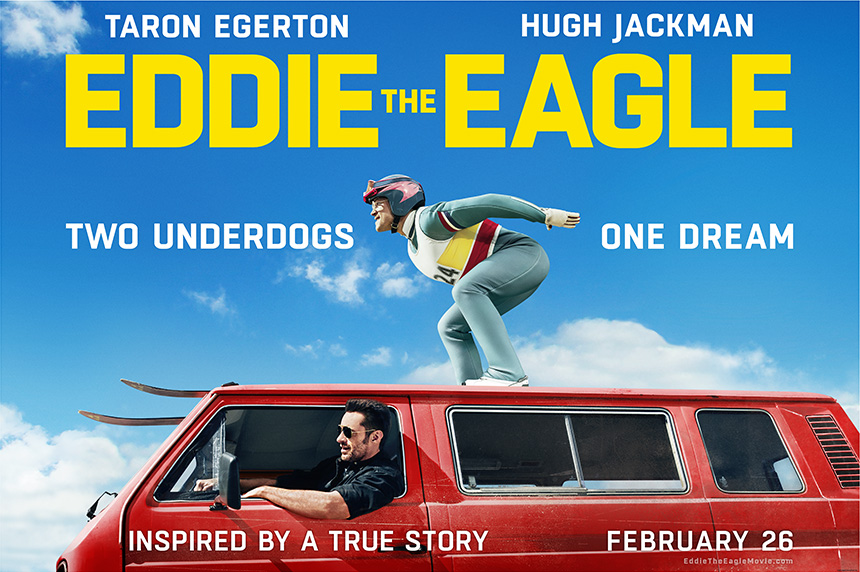
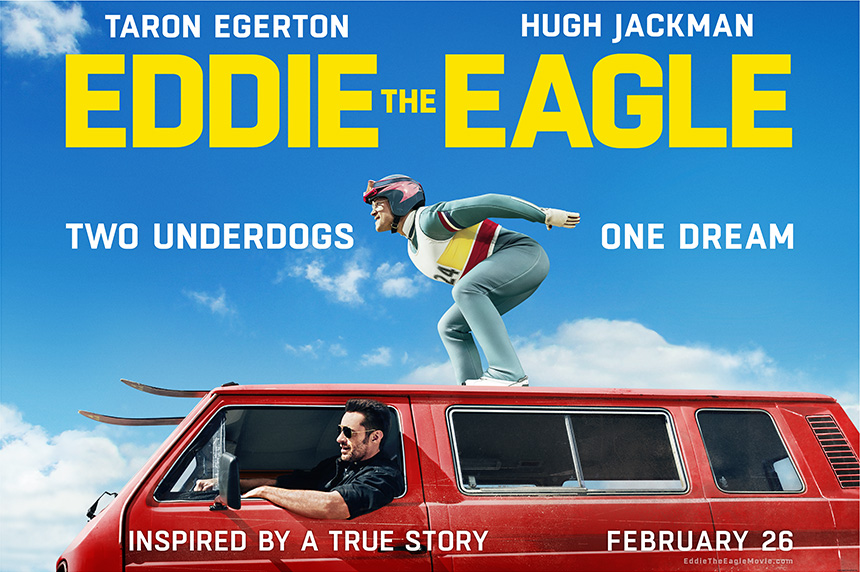
There are heroes who inspire us because they win, showing indomitable determination and courage, like Jesse Owens in Race. And then there are heroes who inspire us when they lose. They also have indomitable determination and courage. They just do not have any talent. But they go farther than anyone thinks they can. Think of “Rudy,” or “Cool Runnings,” or even the original “Rocky” movie. And now add Eddie the Eagle. He was a sickly boy with a dream of competing in the Olympics. When he was bumped from the British ski team, partly for being clumsy and lower class (at least in this film), he switches to ski jumping. There is one advantage: Great Britain does not have a ski jump team and has not competed in the event in 60 years. The rules had not been updated since then, so, unbelievably, anyone who competed successfully (meaning jumped without falling) could qualify. And since no one else was trying, all Eddie had to do was enter one competition and land on his feet.

The bad news was that he had to land on his feet after skiing down a 70 meter slide.

The real Eddie won hearts with his unpretentiousness and enthusiasm, the nickname dubbed in response to his waving his arms in glee and relief after making it down from the jump in one piece. He was refreshing in an era of product-izd athletes groomed from elementary school for endorsement deals and “Up Close and Personal” segments. At the end of the Games, he was the only athlete mentioned in the final speach, singled out for “soaring like an eagle.”

So it is too bad that the movie does something the real Eddie never did — it cheats. It does not trust the real story or the audience. So with the excuse of an “inspired by” credit rather than a “based on” implication of sticking closer to reality, it insists on amping up the ante with schmaltzy/cutesy made-up characters and events. Hugh Jackman brings tons of charm to the fictitious character of an angry, bitter guy who was once on the American ski jump team but got booted for drinking, women, and a bad attitude. Of course he will be inspired by Eddie’s unsullied determination and good attitude. Taron Egerton (“Kingsman: The Secret Service” and the forthcoming “Robin Hood: Origins”) makes Eddie believably awkward, but the character is nearly infantilized, limited to such a narrow range of qualities and emotions. The big showpiece athletic feat is amped up as well, when just the actual fact of climbing up 30 stories and sliding down it on two little sticks should be plenty.

Parents should know that this film includes illness and sport-related peril and injury, some sexual references, brief non-sexual nudity, smoking, alcohol abuse, and some strong language.

Family discussion: What made Eddie’s goals for himself reasonable ones? Why did Bronson decide to help him? How did helping Eddie change the way Bronson thought about himself?

If you like this, try: “Cool Runnings” and “Rudy”
Related Tags:


Biography Inspired by a true story Sports
Race

Race

Posted on February 18, 2016 at 5:56 pm

B+
Lowest Recommended Age: Middle School
MPAA Rating: Rated PG-13 for thematic elements and language
Profanity: Racist and anti-Semitic language
Alcohol/ Drugs: Drinking, smoking
Violence/ Scariness: frank portrayal of racism and anti-Semitism in the 1930’s, including some scenes of violence
Diversity Issues: A theme of the movie
Date Released to Theaters: February 19, 2016
Date Released to DVD: May 30, 2016
Amazon.com ASIN: B01BTDOSFY
Copyright 2016 Focus Features

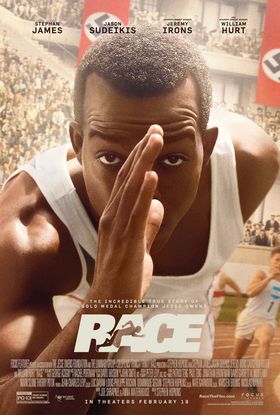
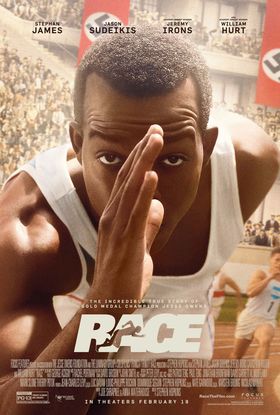
When Adolf Hitler wanted to send the world his message of German/Aryan supremacy at the 1936 Berlin Olympics, African-American runner Jesse Owens won four gold medals. It was the first time that Olympic events were seen everywhere via the films made by Nazi propagandist Leni Riefenstahl, and what they saw was a black man from America who was the fastest runner in the world.

Owens, who had previously broken three world records at one sporting event, was one of the greatest athletes of the 20th century. “Race” tells the story of his time at Ohio State, his relationship with his coach, Larry Snyder (Jason Sudeikis, excellent in his first dramatic role), his relationship with Ruth (Shanice Banton), the mother of his child and later his wife, and his astonishing four gold medals in the Olympics, including one event where he was a last-minute substitute.

Owens is played by Stephan James (“Selma”) in a star-making performance. And director Stephen Hopkins and writers Joe Shrapnel and Anna Waterhouse do an exceptional job of putting Owens and the Olympics in the context of the era’s racial and geopolitical conflicts. This is a film that grapples thoughtfully and in a nuanced manner with morality and compromise in many different categories. Throughout, there are fascinating twists, as characters must evaluate complex ethical dilemmas or discover unexpected moments of grace and honor. When Owens arrives in Berlin, he asks to be directed to the dorm rooms for black athletes only to be told there aren’t any. For the first time in his life, he stays in an integrated dorm and it is in Nazi-era Berlin.

Avery Brundage (Jeremy Irons) must negotiate with the Germans to ensure that basis human rights will be respected at the Olympics; if not, he tells Joseph Goebbels(Barnaby Metschurat), the US team will not compete. The Nazis agree to his terms, but they are determined to tell their story their way and will use whatever threats or prizes they can to do so. Riefenstahl, an extraordinary filmmaker who was brought in by Hitler to document the supremacy of the Germans, understood what her job was but in her own way insisted on maintaining some integrity as an artist. And Owens himself faces a wrenching choice when the NAACP asks him not to go to the Games to protest Hitler’s abuses. What is the best way to send that message, to stay home, or to force Hitler to watch Owens prove wrong Hitler’s claims of Aryan superiority?

This is rich, complex, and compelling drama and a fitting tribute to a great athlete and a great American. Plus, it is entertaining and supremely satisfying to see him run — and win.

Parents should know that this movie includes a frank portrayal of racism and anti-Semitism in the 1930’s, including some scenes of violence and bigoted language, sexual references and non-explicit situations, and drinking and smoking.

Family discussion: What are the best reasons for Owens not to go to the Olympics? Do you agree with his decision? How were the conflicts faced by Owens and Riefenstahl similar?

If you like this try: Owens’ book, Jesse: The Man Who Outran Hitler, and the American Experience documentary about Owens

Related Tags:


Based on a true story Biography DVD/Blu-Ray Pick of the Week Race and Diversity Sports
Risen

Risen

Posted on February 18, 2016 at 5:38 pm

B
Lowest Recommended Age: Middle School
MPAA Rating: Rated PG-13 for Biblical violence including some disturbing images
Profanity: None
Alcohol/ Drugs: Alcohol
Violence/ Scariness: Battle, swords, crucifixion, characters injured and killed, some graphic and disturbing images
Diversity Issues: A theme of the movie
Date Released to Theaters: February 19, 2016
Date Released to DVD: May 23, 2016
Amazon.com ASIN: B01BZ4DOGQ

Copyright 2016 Sony Pictures
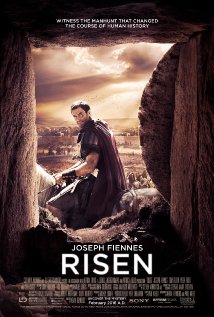
“Risen” is a sober, reverent story of Clavius (Joseph Fiennes), a Roman soldier ordered to witness the crucifixion of Jesus and prevent his body from being stolen. When the rock placed in front of the tomb and sealed by Clavius is moved and the tomb is empty, Pilate (Peter Firth) is worried that the Jesus’ followers will use this disappearance as proof of His divinity, so he sends Clavius to investigate. His journey will take him to Galilee, and what he sees there will transform everything he thinks he knows.

Fiennes brings Clavius to life with a vivid, thoughtful, sensitive performance, showing us the depth of his loyalty and sense of honor. The way he walks, stands, and rides communicates a lifetime of battles fought and won. He is a man confident in his strength and very aware of the brutality on both sides. At first, he is governed by duty, which we see in the opening battle scenes, in his prompt appearance before Pilate following the battle, not even taking time to clean up, in his acquiescence to taking on a new aide (“Harry Potter’s” Tom Felton, excellent as Lucius) who has not come up through the ranks because his father is Pilate’s friend.

We see that he might have made a different decision about how to respond to the Sanhedrin’s concerns about Jesus, but he follows the orders and makes sure that Jesus is dead and that the tomb is sealed. And we see him speak to his own gods placing a tribute on the shrine to ensure that his prayers are heard.

One of the film’s most powerful sections is an almost “Law & Order” scene with Clavius interrogating witnesses to try to figure out what happened to the body in the tomb. Each encounter tells us something different about Clavius and, indirectly, about the impact that Jesus (called Yeshuah) has had on his followers.

The cinematography by Lorenzo Senatore is beautiful, lending dignity to the story, and Cliff Curtis, a superbly talented performer of Maori heritage who is famously able to play a remarkably wide range of ethnicitys makes a warm, appealing Jesus, kind, compassionate, and a little mysterious. But the focus of the story is wisely on the (fictional) Roman, who is the stand-in for the audience as a witness to the resurrection.

Parents should know that this film includes Biblical-era violence including battle scenes, torture, and crucifixions, with characters injured and killed and disturbing and briefly graphic images.

Family discussion: When did Clavius first begin to believe and why?

If you like this, try: “The Robe,” “Spartacus,” and “Ben-Hur”

Related Tags:


Drama Epic/Historical Movies -- format Spiritual films
How to be Single

How to be Single

Posted on February 11, 2016 at 5:40 pm

Drew Barrymore — you know I love you but how does your Flower Films production company produce a film about female friendship and empowerment that barely passes the Bechdel test? how to be single

And did we really need a thinly disguised remake of “He’s Just Not That Into You?” I know it’s Valentine’s Day and the time feels right for a girls’ night out movie, but despite its entertaining moments, I’d go for “Star Wars” again over this.

Now, on to the entertaining moments. This is one of those “three girls looking for love” or “three girls looking for love or its close equivalent” stories with cute guys, cute clothes, cute apartments, cute problems, and cute pop songs on the soundtrack. Yes, get ready for “Worth It.” Again. It’s the new “I Feel Good.”

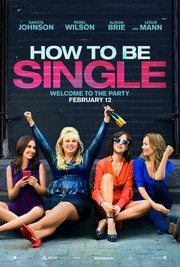
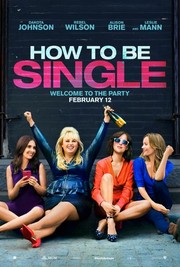
Alice (adorable Dakota Johnson) breaks up with her college boyfriend Josh (Nicholas Braun). She loves him, but they’ve been together four years and she does not know who she really is anymore. She needs to be on her own for a while, she tells him. It’s not a break-up; it’s just a break. Her new friend Robin (Rebel Wilson doing her usual shtick) reminds her that “Hey, Season Three Ross, there’s no such thing as being on a break.” Robin encourages her to drink, dance, and have meaningless sex with a cute bartender named Tom (Anders Holm of “The Intern”) who is the master of the one-night stand.

Alice has an older sister, Meg (Leslie Mann), an obstetrician who wants to have a baby. And then there is Lucy (Alison Brie), who lives above Tom’s bar and goes there to use his wi-fi to scroll through endless dating site profiles and complain about how DIFFICULT it is to find a presentable man who will COMMIT. This entire section is pretty much ripped off from the Justin Long/Ginnifer Goodwin part of “He’s Just Not That Into You” by the same screenwriters.

Johnson and Brie are adorable, and up-and-comer Jake Lacy (“Carol,” “Obvious Child”) is very appealing as one of Alice’s co-workers who likes Meg. But it is disappointing that it claims to be about the importance of taking responsibility for your own life and your own dreams, and apparently it is written by and very loosely based on a novel by women who are capable in jobs they find satisfying. But Alice seems to have no interest in her job as a paralegal and is as clueless about what it takes to be a professional as she is about even the most basic of daily tasks. She literally cannot dress herself. And learning to do so is portrayed as a major life achievement. Her romance with a handsome widower (an underused Damon Wayans, Jr.) makes little sense and her BFF relationship with Robin makes even less. In fact, there isn’t one relationship in the movie that makes us think they could have an actual conversation or even have much fun together.

“How to be Single” is more like a series of skits at a sorority slumber party than a story with characters. If Alice, Robin, Meg, and Lucy went out for a girls’ night at the movies, they’d choose something else.

Parents should know that this film includes very strong sexual content with many casual encounters, explicit sexual humor and sexual situations, and brief nudity, very strong and crude language, drinking and drugs.

Family discussion: What was the most important lesson Alice learned from each of the men she dated? Why did she listen to Robin?

If you like this, try: “He’s Just Not That Into You,” “Bridget Jones’ Diary,” and “Think Like a Man”

Related Tags:


Comedy Romance
Zoolander 2

Zoolander 2

Posted on February 11, 2016 at 5:22 pm

B-
Lowest Recommended Age: Mature High Schooler
MPAA Rating: Rated PG-13 for crude and sexual content, a scene of exaggerated violence, and brief strong language
Profanity: Brief strong language, crude references
Alcohol/ Drugs: None
Violence/ Scariness: Mostly comic peril and violence, characters injured and killed, some disturbing images, assault weapons, knives, explosions, building collapse
Diversity Issues: None
Date Released to Theaters: February 12, 2016
Date Released to DVD: May 23, 2106
Amazon.com ASIN: B018IDVB6W

Copyright 2016 Paramount

Kind of like fashion itself, we don’t really care whether “Zoolander 2” is any good. We go because it is silly fun.

The original Zoolander, released in 2001 just after the attacks on 9/11, was based on shorts Ben Stiller created for the VH1 fashion awards. It was moderately successful on release but has become a big hit on DVD/Blu-ray and an enduring cultural touchstone. It’s the kind of movie that is best watched at home, with friends who know exactly where the punchlines and star cameos come in, or while sick in bed recovering from the flu when you’re not quite up for binge-watching something that requires more than half your attention.

I suspect the same will happen with this 15-years-later sequel, again directed by Stiller, who stars as the dimwitted supermodel of the title and co-wrote with Justin Theroux, Nicholas Stoller, and John Hamburg. The script relies heavily on the audience’s affection for and knowledge of the first, with more winking references to the original than attempts to be funny about the current state of fashion and the industry.

In the first film, Derek Zoolander plans to build a book-shaped center called The Derek Zoolander Center for Kids Who Can’t Read Good and Who Wanna Learn to Do Other Stuff Good Too. After that film ended, we are told through clips from television news shows (Katie Couric, Jane Pauley, and Jim Lehrer are among the first of an avalanche of what-is he/she-doing-in-this-movie celebrity cameos) that after it was built the building immediately collapsed, killing Zoolander’s wife (Stiller’s real-life spouse, Christine Taylor) and injuring Derek’s rival-turned BFF, Hansel (Owen Wilson).

Partly because he was so distraught, but mostly because he is an idiot, Derek was unable to take care of his son, Derek Jr., and he was taken away by Child Protective Services. Derek announced at a press conference that he was retiring from modeling to become “a hermit crab.” Hansel, his face scarred from his injury, also retreated from the world, to live in the desert (well, Malibu) with an 11-person assortment of consorts he refers to affectionately as his orgy.

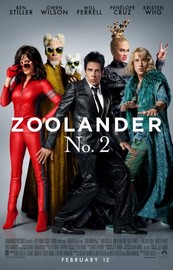
But then a nefarious villain is killing pop stars, who die with what appears to be Derek’s famous Blue Steel look on their faces. When Justin Bieber is killed (with time for an Instagram filters joke), Interpol’s fashion division, led by a former swimsuit model (eternal beauty Penelope Cruz) decides that they need Derek’s help to solve the crime.

There’s a lot of fan service here, which can seem stale to those who know the first movie well. But as a lukewarm fan of the earlier film, I found myself being a lukewarm fan of this one, too. The dumb jokes (both those about being dumb and those that actually are dumb) and grotesqueries are no funnier but no less funny. The storyline (Will Derek be reunited with his son? Will Hansel be a father to his various upcoming babies? Will Will Ferrell’s Mugatu destroy whatever it is he is planning to destroy?) is weak, but it is a hoot to see the fashion dream team (even Anna Wintour!) playing themselves with such good humor. In fashion terms, it’s a cheap knock-off, but sometimes that’s all you need.

Parents should know that this film includes very strong content for a PG-13 including very crude sexual references and brief graphic sexual humor, mostly comic violence with characters injured and killed and some disturbing images, and brief strong language.

Family discussion: What are the most important messages we receive from the fashion industry? If they make a “Zoolander 3,” what celebrities would you like to see included?

If you like this, try: the first “Zoolander”

Related Tags:


Comedy Movies -- format Series/Sequel
THE MOVIE MOM® is a registered trademark of Nell Minow. Use of the mark without express consent from Nell Minow constitutes trademark infringement and unfair competition in violation of federal and state laws. All material © Nell Minow 1995-2026, all rights reserved, and no use or republication is permitted without explicit permission. This site hosts Nell Minow’s Movie Mom® archive, with material that originally appeared on Yahoo! Movies, Beliefnet, and other sources. Much of her new material can be found at Rogerebert.com, Huffington Post, and WheretoWatch. Her books include The Movie Mom’s Guide to Family Movies and 101 Must-See Movie Moments, and she can be heard each week on radio stations across the country.

Website Designed by Max LaZebnik