Cake

Posted on January 22, 2015 at 5:58 pm

B+
Lowest Recommended Age: Mature High Schooler
MPAA Rating: Rated R for language, substance abuse and brief sexuality
Profanity: Very strong and crude language
Alcohol/ Drugs: Substance abuse including pills and alcohol
Violence/ Scariness: Some violence, themes of loss and damage
Diversity Issues: Diverse characters
Date Released to Theaters: January 24, 2015
Date Released to DVD: April 20, 2015
Amazon.com ASIN: B00TY6CM7U
Copyright 2015 Cinelou Films

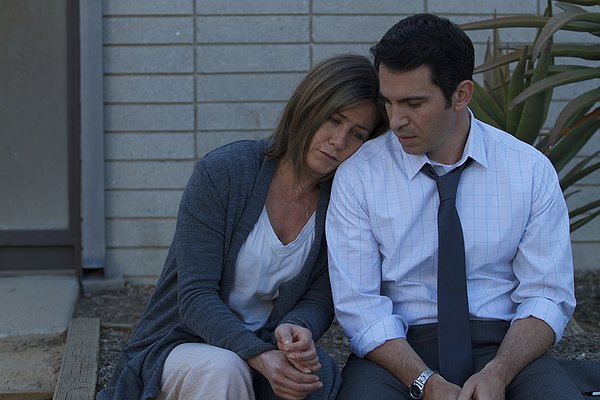
Two shrewdly-chosen elements separate this film from the typical Lifetime saga of a middle class white woman struggling to overcome a dire challenge. First is the way writer Patrick Tobin and director Daniel Barnz (the underrated “Beastly”) trust the audience, dispensing with the usual ten-minute “before” scene allowing us to fall in love with the main character before the bad thing happens. Claire (Jennifer Aniston) is already in a bad way when we meet her. The film is willing to take the risk of our not loving her, not even liking her, in part because it allows us to be drawn into the story because if America’s sweetheart Aniston is in the role, we know that this unhappy, uncooperative, woman must be worthy of our interest.

And that is the second element that elevates what could have been a soapy, formulaic story. Aniston, who also produced, gives a brave, vulnerable, nuanced, grimly humorous and deeply felt performance as Claire, a woman whose past we piece together only gradually as we also are discovering who she is now, how much she has lost, and, before she knows it herself, how much she has kept.

Claire lives in a lovely house with a pool and she has a housekeeper (Adriana Barraza, excellent as Silvana). We can see there was once more in her life but now it consists of therapy — group therapy (with Felicity Huffman as a leader not quite as sunny as she would like to seem), physical therapy (Mamie Gummer as the hydrotherapist who is losing patience), and the crucially important people who control access to the drugs (Lucy Punch as the cheerful if easily-misled keeper of the prescription pad). When finessing no longer works, Claire gets Silvana to drive her across the border to Mexico, where pharmacists are more persuadable and can also provide statues of the Virgin Mother with handy hiding places.

Claire has an ex-husband, Jason (the always-welcome Chris Messina, conveying worlds about what he and Claire once had in just a brief appearance). She has a handsome pool cleaner (just another form of drug). She has Silvana, who stays out of loyalty, pity, and limited other options. She also has Nina (a performance of great delicacy by Anna Kendrick), a fellow member of the Chronic Pain Workshop, whose sympathetic visits are problematic because she is not really there.

Nina committed suicide just before the movie starts, leaving a husband (Sam Worthington) and young son. Claire’s conversations with her are manifestations of her own dance with death, the numbness of drugged-out senses and overwhelming grief, or the ultimate choice to end it all.

We get small glimpses of who Claire once was and of how much of that she still has. When Silvana’s old friends behave like middle school Mean Girls, Claire knows exactly how to respond. With Jason and with a visitor played by William H. Macy, we see how much she has lost. Her humor can be grim, but it shows resilience. Her determination to get drugs may be focused on the wrong goal, but it shows her resolve. Aniston, who played the role with no make-up other than the scars applied to her face, shows with every grimace of pain, every attempt to contain a grimace, with movement that shows a world of understanding of physical pain, how fully she inhabits the character as Claire is learning how to return to her life.

Parents should know that this film has very strong language, some peril and violence, issues of loss and disability, substance abuse, sexual references and a sexual situation.

Family discussion: Why was Nina so important to Claire? Why did she go to see Roy?

If you like this, try: “The Good Girl,” “28 Days,” and “Inside Moves”

Related Tags:


Drama DVD/Blu-Ray Pick of the Week

The Boy Next Door

Posted on January 22, 2015 at 5:57 pm

Copyright 2015 Universal

Even by the very low standards of January movies, “The Boy Next Door” still manages to be a disappointment. It even manages to disappoint beyond the very dim expectations for director Rob Cohen, His “Alex Cross” and “Stealth” were both on my year-end worst lists and his entry in the “Fast and Furious” franchise (the first) is by far the least of the series. This dumb, thrill-less thriller, produced by star Jennifer Lopez, has no surprises, with the possible exception of how she manages to have such perfect hair and lipstick in every scene, even when she is being chased by a maniac.

Lopez plays Claire Peterson, a high school English teacher (specializing in “the classics”), living with her teenage son, Kevin (Ian Nelson), and separated from her husband, Garrett (John Corbett, who needs to raise his fees for those Walgreen ads so he can stay away from drek like this), who was sleeping with his secretary but now wants Claire to forgive him and start over.  Claire is hurt and finds it hard to trust Garrett again.  Her generic sassy best friend, Vicki (Kristin Chenoweth) wants her to date other men and have some fun.  But the blind date Vicki sets up is a disaster.  Claire is lonely and relationships seem scary and complicated.  Garrett and Kevin are off camping and she is alone.  

She gets a distress call from the hunky 19-year-old next door.  He’s great with anything mechanical and easily fixed her garage door.  But it seems that he does not know how to defrost a chicken.  Out of concern for possible botulism, which can definitely have an adverse impact on hotness, she goes over there.  Of course.  And it’s raining.  Of course.  And he tells her she is beautiful.  And starts to kiss her. And take her clothes off.  And then they engage in activities that, as she will find, are even higher-risk than undercooked chicken.

But (spoiler alert) the lip gloss stays perfect throughout.

At least the walk of shame is a short one.  She lives next door.  And she thinks she knows how to talk to teenagers.  She explains, kindly, that it was not his fault and tries impose some boundaries.  But he does not want to go along.  And we’re only 30 minutes in, so that means one third build-up to sex, two-third still ahead for him to make her feel threatened until (spoiler alert) a big, violent, confrontation.

We don’t need a lot of sophistication and subtlety from thrillers like this one.  We just need the plot to be not completely laughable, the characters not completely incomprehensibly idiotic, and the action not something we’ve seen a dozen times before.  This movie fails on all counts.  The script barely qualifies as dialogue, with exposition-heavy lines that all land with a thud except for the ones that land with a splat.  But that’s still better than what passes for wit.  Garrett has been sleeping with his secretary on business trips to San Francisco, so Vicki quips, painfully, “That gives new meaning to ‘San Francisco treat,'” which would not have qualified as movie-worthy even when those old Rice-a-Roni ads were still in heavy rotation.  And even that’s still better than what passes for suspense.  (Okay, actual spoiler alert coming here, in case anyone cares.)  When the bad guy starts monologuing to a motionless good guy we cannot see or hear, it’s a pretty safe bet that Elvis has left the building, and by Elvis I mean life.  The biggest disappointment of all?  It’s not even stupid enough to be dumb fun — with the possible exception of fan of “the classics” Claire’s delighted response to a gift from the hunk next door, a “first edition” by Homer, who lived centuries before the invention of the printing press.

Parents should know that this film includes extreme peril and violence including guns, knives, and other weapons and fire, characters injured and killed, graphic and disturbing images, very strong language, nudity and explicit sexual situations.

Family discussion: How did Claire’s blind date make her more vulnerable to Noah? How did Noah’s past affect his view of Claire’s marriage?

If you like this, try: “Firstborn” and “The Crush”

Related Tags:


Not specified

A Most Violent Year

Posted on January 15, 2015 at 5:58 pm

B+
Lowest Recommended Age: Mature High Schooler
MPAA Rating: Rated R for language and some violence
Profanity: Very strong language
Alcohol/ Drugs: Drinking, smoking
Violence/ Scariness: Crime and violence including guns, suicide
Diversity Issues: A theme of the movie
Date Released to Theaters: January 16, 2015
Date Released to DVD: April 6, 2015
Amazon.com ASIN: B00RNELG5E
Copyright A24 2014
Copyright A24 2014

After three very different movies, we know two things about writer/director J.C. Chandor. First, he is already one of today’s most original, thought-provoking directors, with a remarkably mature and insightful eye, and second, he is vitally interested in the survival instincts of characters who are under the direst of pressures. His “Margin Call” is the best take we have seen yet from Hollywood on the Wall Street meltdown, taking place in one day as a huge financial firm finds out it is on the wrong side of a bet that will bring down the entire company. It is filled with sharp, smart, character-defining dialogue that all but sizzles. His second film was “All is Lost,” an almost-wordless, one-character story with Robert Redford trying to stay alive a boat that is damaged in a collision, and an ending that viewers are still debating. And now, his third film is his first period piece, set in 1981 New York, one of the most violent years in the city’s history.

Oscar Isaac and Jessica Chastain star as Abel and Anna Morales, husband and wife and ambitious owners of a home heating oil company. The company is doing well and they have the chance to take it to the next level with the purchase of some property on the water that will reduce their delivery costs. But they are under tremendous pressure, moving into an expensive new home, on the hook to come up with the money for the land in 30 days, under investigation by a prosecutor who is equally ambitious (“Selma’s” David Oyelowo), and being pushed hard by cut-throat competition from his competitors, who harass his drivers, hijack his trucks, and steal his oil.

Like Michael Corleone, Abel wants to be strictly legitimate, but he is not there yet.

Both husband and wife are trying to move past their origins into the upper middle class. Abel is an immigrant who began as a driver for the company when it was owned by Anna’s father, a gangster.  They love each other deeply, but each is by nature mistrustful and secretive.  “You won’t like what happens if I get involved,” Anna tells Abel, and they both know he is right.  Anna and Abel may have some trust issues but Isaac and Chastain, who have been friends since they studied together at Juilliard, as actors have a fearlessness with each other that requires complete trust as actors.  Every scene they are in together crackles.

We first see Abel running through the streets.  This was when running first became popular as exercise.  But Abel is running all the time.  Isaac is always calm and reassuring in his manner, but he has a white-hot inner fury.  That is probably what drew Anna to him.  He wants it all — money, respectability, family.  And he knows that in order to get it he will have to deal with some very bad people and some very weak people and that means he might have to do some very bad things and some people might get hurt.

In his first period film, Chandor creates an atmosphere so authentic we can almost taste the smog.  He has been compared to Sidney Lumet for the gritty, layered texture of the settings and the storyline.  He is extraordinarily gifted with actors, starting with the casting.  Alessandro Nivola is superb as a highly civilized gangster who lives in a home so fortified it tells us how thin that veneer of civilization really is.  He creates a complex and fully-realized world that brings home Faulkner’s famous line: “The past isn’t dead.  It isn’t even past.”

Parents should know that this film includes very strong language, and some peril and violence including guns, suicide, and criminal activity, drinking, and smoking.

Family discussion: How would this story be different if it took place today?  Why does the film begin with Abel running?

If you like this, try: “Margin Call” and “All is Lost” from the same director

Related Tags:


Crime Drama DVD/Blu-Ray Pick of the Week

Spare Parts

Posted on January 15, 2015 at 5:58 pm

Copyright Lionsgate 2014

It really happened. Four undocumented high school kids from the poorest of communities took on the most brilliant engineering students from the country’s top colleges in a robotics competition and won. The contest results were one in a million, but once it happened, the movie version was inevitable. George Lopez produced the film and stars as the students’ reluctant coach and teacher, Fredi Cameron (based on the two real-life teacher/coaches, Allan Cameron and Fredi Lajvardi).

Unlike its robotic superstar, there is not much ingenuity in the storyline. Everything added on, especially the fictionalized backstory for Cameron, is predictable and superfluous and distracting. Lopez is an amiable presence, but these detours reveal his limits as an actor. We want to focus on the students and their robot, to see them solve problems in engineering and teamwork (which is a form of engineering, too). But too much of the running time is devoted to Cameron’s past and his possible romance with a fellow teacher, played by the always-wonderful Marisa Tomei. If she played the coach, this would have been a much better movie. Still, with a storyline like this one, it cannot help being fun to watch.

Cameron is an engineer with a PhD who tells the school’s principal (Jamie Lee Curtis, in a performance of great warmth and wit) he wants a temporary job as a substitute teacher. She notes that he has moved around a lot, but she does not have any alternatives. He agrees to coach the school’s engineering club because he is assured no one will want to join.

Oscar (Carlos PenaVega) shows up with a flier. He is an outstanding JROTC cadet and was crushed to learn that he cannot join the US Military without proof of citizenship. He thinks participating in a NASA-sponsored robotics competition will make it harder to be turned down. Cameron reluctantly agrees to help.

They assemble a team that includes the brain (David Del Rio), the kid who always gets into trouble but is a whiz at mechanics (José Julián), and the muscle (Oscar Javier Gutierrez II) — one problem they cannot engineer around is that someone has to be strong enough to lift their robot. Each has his own challenges. The brain is bullied at school. The troublemaker is under a lot of pressure to take care of his brother. The muscle has to be able to pass a tough oral exam at the competition to show that every member of the team understands the details of the robot. Oscar falls in love with a pretty classmate named Karla (sweetly played by PenaVega’s real-life wife, Alexa), but worries that his illegal status puts her at risk. All of the students are hiding from the ICE, which has already sent one of their mothers back to Mexico.

And then there is the challenge of the competition itself. Not only does this robot have to operate underwater, it has to execute an immensely complicated series of tasks in a limited time period. When the team shows up, they are so certain they will lose anyway that they decide they might as well compete with the college teams instead of the other high school teams. The night before they have to compete the robot has a disastrous leak. Their very creative and inexpensive (and hilarious) solution is one of the film’s high points.

The film’s name refers to more than the repurposed junk used to assemble the robot. Their triumph is bittersweet because their undocumented status prevents them from taking the opportunities available to those who are citizens. This film makes it clear that it is our loss, as it prevents our country from benefiting from the perseverance and skill that made an $800 robot created by kids kick the robotic butt of the $18,000 robot from MIT.

Parents should know that this film includes some teen crime including armed robbery, violence including bullying, some strong language and tense family confrontations and teen kissing.

Family discussion: What was the team’s most difficult challenge? Who was the teacher who inspired you the most and why?

If you like this, try: the book by Joshua Davis, Spare Parts: Four Undocumented Teenagers, One Ugly Robot, and the Battle for the American Dream, and films like “October Sky” and “Stand and Deliver”

Related Tags:


Based on a true story Drama High School School Stories about Teens

Inherent Vice

Posted on January 8, 2015 at 5:58 pm

B
Lowest Recommended Age: Adult
MPAA Rating: Rated R for drug use throughout, sexual content, graphic nudity, language and some violence
Profanity: Very strong, explicit, and crude language
Alcohol/ Drugs: Extensive substance abuse including drinking, smoking, and drugs, drug dealing
Violence/ Scariness: Peril and violence
Diversity Issues: Diverse characters
Date Released to Theaters: January 9, 2015
Copyright IAC films 2014

We love mystery stories because they reassure us that questions have answers and justice is possible. But some mystery stories are there to remind us that life is complicated and messy, and sometimes answers are just more questions. This is one of those stories.

Inherent Vice is a novel by the famously private author Thomas Pynchon, whose books are dense, complex, and thus rich fodder for grad students and intelligentsia. Writer/director Paul Thomas Anderson (“Boogie Nights,” “Magnolia,” “There Will Be Blood,” “The Master”) is also known for dense, complex stories, and he likes to focus on decay, corruption, and bruised innocence. They are well matched in this weed noir story, sort of Dashiell Hammett crossed with Hunter Thompson.

The original set-up is right out of a classic detective story. A beautiful woman named Shasta Fay Hepworth (Katherine Waterston) visits her ex-boyfriend, Doc (Joaquin Phoenix), some kind of hippie detective, to ask for his help. The narrator (singer Joanna Newsom), in a hypnotic, vocal fry deadpan, lets us know right away that Doc would be better off telling her to leave. But he cannot say no to Shasta or to a mystery, so he is on the case.

Shasta’s new boyfriend is a wealthy (and married) developer named Mickey Wolfman (Eric Roberts). Shasta believes that Wolfman’s wife and her boyfriend are trying to have him committed so they can get his money.  As Doc begins to look into this, he encounters many odd characters, most with their own unsolved mysteries, some of which begin to intersect with the Wolfman story or with each other or both.  And it all comes together, or doesn’t, in a haze of, yes, decay, corruption, and bruised innocence that is about the failure of the American Dream or existential chaos or the fragility of our concept of reality, or maybe just that the journey and those who accompany us along the way are more important than the destination.  Also, something about the optimism and passion for changing society of the 60’s giving way to the me-decade and passion for individual self-exploration of the 70’s.

Doc encounters a number of extremely colorful characters as he explores a series of mysteries that appear to be linked, or perhaps all part of one big mystery involving a secret and very powerful malevolent force.  The only one who seems to know what’s going on is the almost-never-seen narrator, and it’s not clear whether we’re supposed to root for the characters or laugh at them.  But as always, Anderson’s impeccable casting and music choices are captivating, and there is an amusing contrast between his attention to every detail of camera placement, editing, production design, and dialog and the convoluted storyline and druggy fog surrounding the characters.  I’m not sure what it was that I watched, but I have to admit I enjoyed watching it.

Parents should know that this film has just about everything we consider “adult content,” including constant very strong, explicit, and crude language, nudity and very explicit sexual references and situations including prostitution and adultery, drinking, drugs of all kinds and drug dealing, and violence including guns.

Family discussion: Why did Doc help Shasta? Why did he help Coy? Why is Doc a detective?

If you like this, try: “Boogie Nights” and “There Will Be Blood” by the same director and the book by Thomas Pynchon

Related Tags:


Based on a book Crime Drama Movies -- format Mystery
THE MOVIE MOM® is a registered trademark of Nell Minow. Use of the mark without express consent from Nell Minow constitutes trademark infringement and unfair competition in violation of federal and state laws. All material © Nell Minow 1995-2026, all rights reserved, and no use or republication is permitted without explicit permission. This site hosts Nell Minow’s Movie Mom® archive, with material that originally appeared on Yahoo! Movies, Beliefnet, and other sources. Much of her new material can be found at Rogerebert.com, Huffington Post, and WheretoWatch. Her books include The Movie Mom’s Guide to Family Movies and 101 Must-See Movie Moments, and she can be heard each week on radio stations across the country.

Website Designed by Max LaZebnik