Spare Parts

Posted on January 15, 2015 at 5:58 pm
Copyright Lionsgate 2014

It really happened. Four undocumented high school kids from the poorest of communities took on the most brilliant engineering students from the country’s top colleges in a robotics competition and won. The contest results were one in a million, but once it happened, the movie version was inevitable. George Lopez produced the film and stars as the students’ reluctant coach and teacher, Fredi Cameron (based on the two real-life teacher/coaches, Allan Cameron and Fredi Lajvardi).

Unlike its robotic superstar, there is not much ingenuity in the storyline. Everything added on, especially the fictionalized backstory for Cameron, is predictable and superfluous and distracting. Lopez is an amiable presence, but these detours reveal his limits as an actor. We want to focus on the students and their robot, to see them solve problems in engineering and teamwork (which is a form of engineering, too). But too much of the running time is devoted to Cameron’s past and his possible romance with a fellow teacher, played by the always-wonderful Marisa Tomei. If she played the coach, this would have been a much better movie. Still, with a storyline like this one, it cannot help being fun to watch.

Cameron is an engineer with a PhD who tells the school’s principal (Jamie Lee Curtis, in a performance of great warmth and wit) he wants a temporary job as a substitute teacher. She notes that he has moved around a lot, but she does not have any alternatives. He agrees to coach the school’s engineering club because he is assured no one will want to join.

Oscar (Carlos PenaVega) shows up with a flier. He is an outstanding JROTC cadet and was crushed to learn that he cannot join the US Military without proof of citizenship. He thinks participating in a NASA-sponsored robotics competition will make it harder to be turned down. Cameron reluctantly agrees to help.

They assemble a team that includes the brain (David Del Rio), the kid who always gets into trouble but is a whiz at mechanics (José Julián), and the muscle (Oscar Javier Gutierrez II) — one problem they cannot engineer around is that someone has to be strong enough to lift their robot. Each has his own challenges. The brain is bullied at school. The troublemaker is under a lot of pressure to take care of his brother. The muscle has to be able to pass a tough oral exam at the competition to show that every member of the team understands the details of the robot. Oscar falls in love with a pretty classmate named Karla (sweetly played by PenaVega’s real-life wife, Alexa), but worries that his illegal status puts her at risk. All of the students are hiding from the ICE, which has already sent one of their mothers back to Mexico.

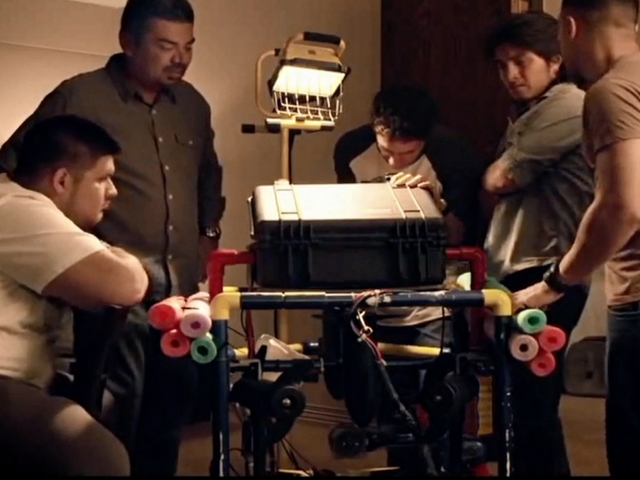
And then there is the challenge of the competition itself. Not only does this robot have to operate underwater, it has to execute an immensely complicated series of tasks in a limited time period. When the team shows up, they are so certain they will lose anyway that they decide they might as well compete with the college teams instead of the other high school teams. The night before they have to compete the robot has a disastrous leak. Their very creative and inexpensive (and hilarious) solution is one of the film’s high points.

The film’s name refers to more than the repurposed junk used to assemble the robot. Their triumph is bittersweet because their undocumented status prevents them from taking the opportunities available to those who are citizens. This film makes it clear that it is our loss, as it prevents our country from benefiting from the perseverance and skill that made an $800 robot created by kids kick the robotic butt of the $18,000 robot from MIT.

Parents should know that this film includes some teen crime including armed robbery, violence including bullying, some strong language and tense family confrontations and teen kissing.

Family discussion: What was the team’s most difficult challenge? Who was the teacher who inspired you the most and why?

If you like this, try: the book by Joshua Davis, Spare Parts: Four Undocumented Teenagers, One Ugly Robot, and the Battle for the American Dream, and films like “October Sky” and “Stand and Deliver”

Related Tags:


Based on a true story Drama High School School Stories about Teens

Inherent Vice

Posted on January 8, 2015 at 5:58 pm

B
Lowest Recommended Age: Adult
MPAA Rating: Rated R for drug use throughout, sexual content, graphic nudity, language and some violence
Profanity: Very strong, explicit, and crude language
Alcohol/ Drugs: Extensive substance abuse including drinking, smoking, and drugs, drug dealing
Violence/ Scariness: Peril and violence
Diversity Issues: Diverse characters
Date Released to Theaters: January 9, 2015
Copyright IAC films 2014

We love mystery stories because they reassure us that questions have answers and justice is possible. But some mystery stories are there to remind us that life is complicated and messy, and sometimes answers are just more questions. This is one of those stories.

Inherent Vice is a novel by the famously private author Thomas Pynchon, whose books are dense, complex, and thus rich fodder for grad students and intelligentsia. Writer/director Paul Thomas Anderson (“Boogie Nights,” “Magnolia,” “There Will Be Blood,” “The Master”) is also known for dense, complex stories, and he likes to focus on decay, corruption, and bruised innocence. They are well matched in this weed noir story, sort of Dashiell Hammett crossed with Hunter Thompson.
The original set-up is right out of a classic detective story. A beautiful woman named Shasta Fay Hepworth (Katherine Waterston) visits her ex-boyfriend, Doc (Joaquin Phoenix), some kind of hippie detective, to ask for his help. The narrator (singer Joanna Newsom), in a hypnotic, vocal fry deadpan, lets us know right away that Doc would be better off telling her to leave. But he cannot say no to Shasta or to a mystery, so he is on the case.

Shasta’s new boyfriend is a wealthy (and married) developer named Mickey Wolfman (Eric Roberts). Shasta believes that Wolfman’s wife and her boyfriend are trying to have him committed so they can get his money.  As Doc begins to look into this, he encounters many odd characters, most with their own unsolved mysteries, some of which begin to intersect with the Wolfman story or with each other or both.  And it all comes together, or doesn’t, in a haze of, yes, decay, corruption, and bruised innocence that is about the failure of the American Dream or existential chaos or the fragility of our concept of reality, or maybe just that the journey and those who accompany us along the way are more important than the destination.  Also, something about the optimism and passion for changing society of the 60’s giving way to the me-decade and passion for individual self-exploration of the 70’s.

Doc encounters a number of extremely colorful characters as he explores a series of mysteries that appear to be linked, or perhaps all part of one big mystery involving a secret and very powerful malevolent force.  The only one who seems to know what’s going on is the almost-never-seen narrator, and it’s not clear whether we’re supposed to root for the characters or laugh at them.  But as always, Anderson’s impeccable casting and music choices are captivating, and there is an amusing contrast between his attention to every detail of camera placement, editing, production design, and dialog and the convoluted storyline and druggy fog surrounding the characters.  I’m not sure what it was that I watched, but I have to admit I enjoyed watching it.

Parents should know that this film has just about everything we consider “adult content,” including constant very strong, explicit, and crude language, nudity and very explicit sexual references and situations including prostitution and adultery, drinking, drugs of all kinds and drug dealing, and violence including guns.

Family discussion: Why did Doc help Shasta? Why did he help Coy? Why is Doc a detective?

If you like this, try: “Boogie Nights” and “There Will Be Blood” by the same director and the book by Thomas Pynchon

Related Tags:


Based on a book Crime Drama Movies -- format Mystery
Selma

Selma

Posted on December 24, 2014 at 5:55 pm

A+
Lowest Recommended Age: Preschool
MPAA Rating: Rated PG-13 for disturbing thematic material including violence, a suggestive moment, and brief strong language
Profanity: Some strong and racist language
Alcohol/ Drugs: Some drinking and smoking
Violence/ Scariness: Very brutal violence including abuse and beatings by law enforcement and individuals, characters injured and killed
Diversity Issues: A theme of the movie
Date Released to Theaters: December 25, 2014
Date Released to DVD: May 4, 2015
Amazon.com ASIN: B00S1MYWBW
Copyright 2014 Cloud Eight Films

“Selma,” director Ava DuVernay’s film about Dr. Martin Luther King, Jr. and the march from Selma, Alabama to the state capital at Montgomery, to make the case for the right to vote, is superb as biography, as history, and as drama. It is one of the best movies of this year and this decade.

And somehow it has arrived just as we need it most, as Americans continue to struggle to reconcile our notions of equality. This film is a powerful reminder of the Civil Rights Movement cry that “we’re not where we want to be, we’re not where we’re going to be, but, thank God, we’re not where we were.” It is a reminder of the difference one person can make, and the inescapability of an idea whose time has come. And it should also be a powerful reminder that the voting rights people fought — and died — must be exercised to carry that dream forward.

This is a story of politics and race and history, but it is also very much the story of a man who just wanted to be “a pastor in a small college town” but found himself called to lead a movement, even though he put himself, his followers, and his family at risk. King has to try to keep his supporters together, increasingly difficult as the very progress he has made has made them impatient and independent.

British actor David Oyelowo makes Dr. King into a real person, polite and respectful but also canny and insistent in his meetings with President Lyndon Johnson (Tom Wilkinson) in the Oval Office, devoted and compassionate with the members of the movement, stirring and inspirational at the pulpit and podium, and at his most vulnerable when he is alone with his wife, Coretta Scott King (Carmen Ejogo, who played the same role in the superb “Boycott”). Even over the course of the few weeks covered by this film, we see Dr. King constantly assessing, re-evaluating, learning, and growing.

We also see that wiliest of politicians, LBJ, outmaneuvered by King, partly because he refused to give up but also because for the first time there was television coverage of what was going on and the rest of the country, 70 million viewers, were no longer able to pretend that this country was living up to its ideals of justice and equality. Even with the passage of the monumental Civil Rights Act, which required equal treatment without regard to race or gender in public accommodations and the workplace, the inability to vote imposed an insurmountable barrier to meaningful change. At the beginning of the film, we see Annie Lee Cooper carefully, deliberately filling in her application to register to vote. When the contemptuous official quizzes her on the number of county judges in the state, she is prepared with the answer. Clearly, she has tried this before and done her homework. She gives the correct number: 67. He responds, “Name them.”

“This voting thing is just going to have to wait,” Johnson explains. “You have one problem. I have a hundred and one.” He tries to persuade King that his War on Poverty is of central importance to black citizens. King understood that without the right to vote, blacks would continue to be excluded.

Everyone tries to stop him. The FBI sends tapes to Mrs. King that purport to reveal King’s affairs. There are constant threats and supporters are murdered. A church is bombed, killing Four Little Girls. The first time they try to walk to Montgomery, the 600 marchers are attacked by the police with tear gas and billy clubs wrapped in barbed wire.

But television cameras send pictures of the police brutality to 70 million viewers across the country. The images put even more pressure on Johnson, who finally brings Governor George Wallace (Tim Roth) to the Oval Office, to force some progress on the man whose inaugural address included the words, “In the name of the greatest people that have ever trod this earth, I draw the line in the dust and toss the gauntlet before the feet of tyranny, and I say segregation now, segregation tomorrow, segregation forever.”

Today we live in a world that is saturated in images and opinions, often angry ones. This film, like King’s patient but insistent voice, is a clarion call, the story of a man, a movement, and a journey that can and must continue.

Parents should know that the movie’s themes include historic depiction of virulent racism including verbal and physical attacks and murder, strong language including racist epithets, brief sexual sounds and discussion of affairs.

Family Discussion: How did Dr. King make President Johnson change his mind? How did President Johnson make George Wallace change his mind?

If you like this, try: Other films about the Civil Rights movement including “Boycott” (also featuring Carmen Ejogo as Coretta Scott King), “Separate But Equal,” and “Eyes on the Prize”

Related Tags:


Based on a true story Drama DVD/Blu-Ray Pick of the Week Epic/Historical Politics Race and Diversity

Into the Woods

Posted on December 24, 2014 at 5:55 pm

Copyright Disney Studios 2014
Copyright Walt Disney Pictures 2014

This is not a Disney movie. Oh, well, yes, it is a Disney movie in the sense that it is produced by Disney, which is the only possible explanation for the PG rating (and the slightly sweetened storyline), but this is not the happily ever after fairy tale story time we are used to from Disney. You didn’t remember that in the original version of Cinderella the mean stepsisters sliced off pieces of their feet to try to fit into the slipper the prince was using to find his true love?  That’s because it was, well, cut out of the classic Disney animated version as well as most contemporary printed versions.  But it’s back here, in a complicated, challenging retelling of classic fairy tales where having your wish granted may leave you worse off than you were before.

Parents looking for a movie for the family for the holidays need to know that this is not this year’s “Frozen.”  It is a sung-through (almost no spoken dialogue) and there are characters who are injured and killed, including parents of young children. It is a darker take on fairy tales.  The characters struggle with the consequences of their wishes and of the actions they take when they want something desperately. They lie and they steal to get what they want. And they learn that no one is all bad or all good. “Though scary is exciting, nice is different from good.”

Writer James Lapine says the idea came from a conversation with his frequent collaborator, Stephen Sondheim, who wanted his next project to be about a quest. Lapine wanted to write something about fairy tales.  And so “Into the Woods” became that project, a mash-up of many different classic fairy tales with a witch, and giants, and a dark place where the paths are not clear, a place for people who are yearning for something and willing to take some risks.  “I wish,” they all sing as the movie begins.  Cinderella, with her evil stepmother (Christine Baranski) and mean girl stepsisters, wishes to go to the festival held by the royal family.  The baker (James Corden) and his wife (Emily Blunt) wish for a child.  A boy named Jack (Daniel Huttlestone, who has a voice like a bell), wishes his milky-white cow would give milk and his mother (Tracy Ullman) wishes they had money so they could have enough to eat.  And a girl in a red riding hood (the very gifted Lilla Crawford) wants some bread to take to her grandmother (and some pastries for herself).

And there’s a witch (Meryl Streep) who wishes for something, too.  She tells the baker and his wife that she will remove the curse that is keeping them from having a child if they will bring her four things: a cow white as milk, hair gold as corn, a cape red as blood, and a slipper pure as gold.  The problem is that all of these items are essential props in other stories.  If the baker and his wife take them, then Jack will not have a cow to trade for magic beans, Rapunzel will not have hair to let down so her prince can climb the tower, Red Riding Hood will not be able to go to her grandmother’s house, and Cinderella’s prince will not be able to find her.  What happens to wishes when they cancel each other out? When one person’s wish is another’s nightmare? And when the handsome prince explains that he was raised to be Charming, but not necessarily Sincere? Is there any good in being good?

The characters explore themes of innocence, and the competing urges to protect children by keeping them from knowing about the dangers of the world and to protect them by making sure they understand those dangers. “How do you say it will all be all right/When you know that it might not be true?”

Even the witch tries to protect her (stolen) daughter from the scary world outside her tower. But children do not listen. They will grow up and want to leave, even if it means learning “secrets I never wanted to know,” as Red Riding Hood sings thoughtfully, after she is rescued from the belly of the wolf. On the other hand “children will listen,” sometimes when we don’t want them to, so we need to be careful in setting a good example and in taking care of them. And somehow, it is in taking care of them we become most fully ourselves. “Fairy tales understood us before we understood them,” we are told. This exploration of fairy tale themes shows us that they still understand us better than we understand ourselves.

Parents should know that this film includes fairy tale/fantasy peril and violence with some characters injured and killed (including two parents of children), some disturbing images and troubling situations, mild sexual references and non-explicit situations with some kissing.

Family Discussion:  What is your favorite fairy tale and why?  In the song where everyone blames someone else, who is right?

If you like this, try:  Revisionist fairy tales “Ella Enchanted,” “Stardust,” and “Ever After” and, for more from Sondheim, Six by Sondheim and Sondheim: The Birthday Concert

Related Tags:


Based on a book Based on a play Fantasy Musical

Unbroken

Posted on December 24, 2014 at 5:49 pm

A-
Lowest Recommended Age: Mature High Schooler
MPAA Rating: Rated PG-13 for war violence including intense sequences of brutality, and for brief language
Profanity: Some strong and offensive/abusive language
Alcohol/ Drugs: None
Violence/ Scariness: Intense wartime peril and violence, characters injured, abused, and killed, some disturbing images, parent strikes a child with a belt
Diversity Issues: A theme of the movie
Date Released to Theaters: December 25, 2014
Date Released to DVD: March 23, 2015
Amazon.com ASIN: B00HLTDC9O
Copyright 2014 Universal Pictures

Oscar-winning actress Angelina Jolie breaks into the top ranks of American directors with “Unbroken,” showing an exceptional understanding not just of actors, but of tone, scale, and letting the camera tell the story. Working with the magnificent cinematography of Roger Deakins (“True Grit,” “Skyfall”), she adopts a classical style well-suited to the WWII setting, but every choice is careful, thoughtful, and powerful.

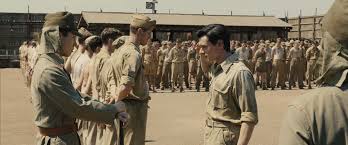
Based on the best-seller by Laura Hillenbrand, this is the story of Louis Zamperini, the son of Italian immigrants. He was a rebellious kid who became an Olympic athlete. His bomber plane crashed over the Pacific, and he survived for 47 days at sea, before being captured with one surviving crewmate, by the Japanese. In the prison camp, he was singled out for horrific abuse and repeatedly beaten.

The screenplay by the famously off-beat Joel and Ethan Coen is straightforward, direct, and sincere, keeping the focus on the war years, with the incidents from Zamperini’s past brought it primarily to show us how he relies on his memories to keep going. “Nobody’s chasing me,” he tells his brother who is urging him to run faster as he trains for a race. “I’m chasing you,” his brother tells him.

That internalized sense of mission helps him hold onto the idea of his own power as the brutal Japanese captors try to take everything away from him.

The opening scene puts us in the sky, and Jolie superbly evokes the thrill and the terror of flying on a bombing mission in aircraft that seem barely past the era of the Wright brothers. The crash scene is vertiginously disorienting. Jack O’Connell plays Zamperini with an effortless masculinity, understanding that it has nothing to do with macho posturing, just an imperishable sense of integrity, courage, and honor. O’Connell, Finn Witrock (“Noah”), and Domhnall Gleeson (“About Time”) perfectly capture the rhythms of an experienced crew, some amiable wisecracks and bravado to recognize the perilousness of their situation, but always focused, on task, and always, always, putting the team first.

We become so attached that it is sharply painful to see the characters experience such deprivation and abusive treatment. Japanese pop star Miyavi (real name Takamasa Ishihara) plays the sadistic Mutsushiro Watanabe, known as Bird. He knows of Zamperini’s celebrity as an athlete and sees that he is a symbol to the other prisoners.

If the Bird can break Zamperini, it will crush the morale of the whole camp. So, he singles Zamperini out for beatings and mind games. But Zamperini knows that “we beat them by making it to the end of the war alive.” He simply will not give up, and defining his own sense of what it means to win allows him to maintain a sense of control that is his most powerful weapon.

It is gorgeously filmed, superbly acted, and directed with great sensitivity and compassion, but the real impact of the film comes at the end, when we learn through a few simple titles, what happened to Zamperini after the war. Even Jolie recognizes that there is nothing she can put on screen to match the real-life footage of Zamperini, back in Japan at four days before his 81st birthday, running with the Olympic torch.

Parents should know that this movie includes very intense and disturbing wartime peril and violence, with a plane crash, an extended period lost at sea, and grueling prison camp abuse, and some strong language including racist epithets. School-age bullies harass and punch a character and a parent beats a child with a belt.

Family Discussion: What was the toughest challenge for Louis? Why didn’t he give up? Why did he forgive his captors?

If you like this, try: the book, Unbroken: A World War II Story of Survival, Resilience, and Redemption, and Zamperini’s own book, Don’t Give Up, Don’t Give In: Lessons from an Extraordinary Life, along with the films Stalag 17 and The Great Escape, also based on real-life WWII stories of American prisoners of war.

Related Tags:


Action/Adventure Based on a book Based on a true story Drama DVD/Blu-Ray Pick of the Week Sports War
THE MOVIE MOM® is a registered trademark of Nell Minow. Use of the mark without express consent from Nell Minow constitutes trademark infringement and unfair competition in violation of federal and state laws. All material © Nell Minow 1995-2026, all rights reserved, and no use or republication is permitted without explicit permission. This site hosts Nell Minow’s Movie Mom® archive, with material that originally appeared on Yahoo! Movies, Beliefnet, and other sources. Much of her new material can be found at Rogerebert.com, Huffington Post, and WheretoWatch. Her books include The Movie Mom’s Guide to Family Movies and 101 Must-See Movie Moments, and she can be heard each week on radio stations across the country.

Website Designed by Max LaZebnik