The Unknown Known

Posted on April 3, 2014 at 5:59 pm

B+
Lowest Recommended Age: Middle School
MPAA Rating: Rated PG-13 for some disturbing images and brief nudity
Profanity: Mild language
Alcohol/ Drugs: None
Violence/ Scariness: Wartime violence, terrorism,
Diversity Issues: A theme of the movie
Date Released to Theaters: April 3, 2014
© 2014 Radius/TWC
© 2014 Radius/TWC

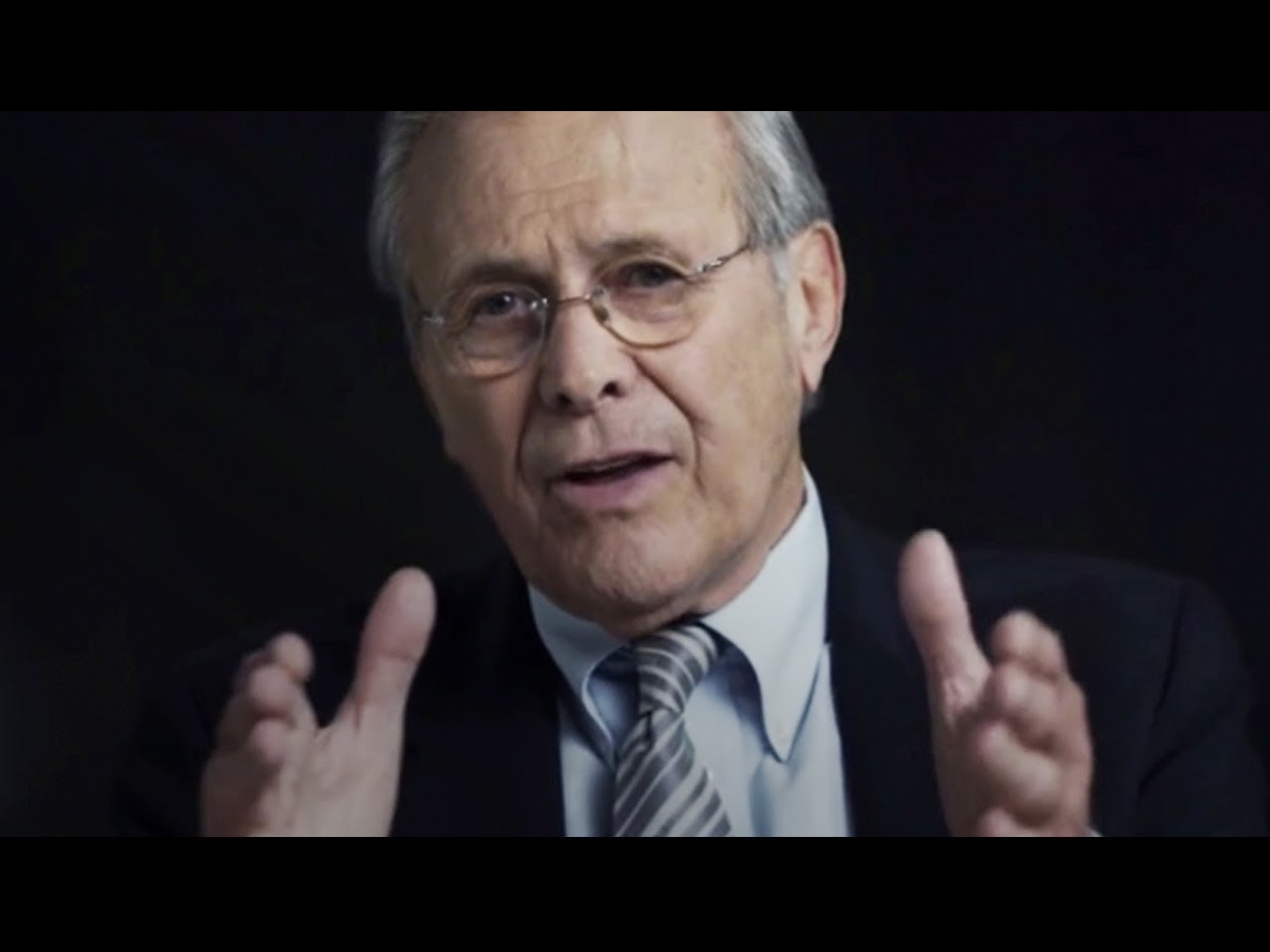
Errol Morris turns his famous “interrotron” camera on two-time Secretary of Defense Donald Rumsfeld for something between a bookend and a counterpoint to his Oscar-winning The Fog of War: Eleven Lessons from the Life of Robert S. McNamara. But this SecDef (as they say in the Pentagon) is not here to confess or apologize even in part, as McNamara did.

He says, in the movie’s final exchange, that he is not sure why he agreed to submit to more than 30 hours of what must have felt more like the cross-examination in “A Few Good Men” or even a detainee interrogation than the back-and-forth press briefings Rumsfeld conducted during the early days of the wars in Iraq and Afghanistan. We see many clips from those celebrated exchanges, at the time referred to as the best show in Washington, and still undeniably entertaining. Rumsfeld’s good humor and confidence were bracing and reassuring at a time when everything seemed to be what he would call an unknown unknown. Like Jack Nicholson in “A Few Good Men” he does not think we can handle the truth. He may be right.

He’s not here to explain.  What he is here to do is to repeat the same version of the story, despite the fact that the audience has had the benefit of making some of those unknowns more known.

Rumsfeld’s constant memos, perhaps 20,000 by his count over his final term at Defense, were called “snowflakes” by the staff, based on their color and frequency. It must have seemed like an avalanche. Morris shows us long shelves of folders filled with snowflakes. He has Rumsfeld read some portions aloud, beginning with his famous taxonomy of information. There were known knowns, things we know and know to be true. There were known unknowns, things we do not know and wish we did. There were unknown knowns, things we do not realize that we know. And unknown unknowns, things we don’t know and don’t know that we need to know. Yes.

But what we do with those categories is the tough part, especially when assigning facts. The boxes and labels are nice and neat. The things we do and do not know are not. Rumsfeld often seems Wittgensteinian when he calls for dictionary definitions or makes a distinction between a Pentagon term and standard English. But definitions are not answers.

“Pearl Harbor was a failure of imagination,” Rumsfeld says. So, we gather, was 9/11. Vietnam was “the inevitable ugly ending of an unsuccessful effort.” How do we not make that mistake again? How do we destroy terrorists without a Hydra effect, creating two more for every one we cut down? We might think those answers are known unknowns. But Rumsfeld does not have the luxury of waiting to be sure.

He tells us he found out the US was going to invade Iraq when he was called into a meeting with then-Vice President Dick Cheney (Rumsfeld’s former assistant in the Nixon White House), along with Saudi Ambassador Prince Bandar. And that he never read the Justice Department legal memos about “enhanced interrogation.” He insists that he never said and the American people never thought there was a connection between Saddam Hussein and the 9/11 attacks. Cut to tape of the press conference where he called Saddam a liar for denying there was a connection.

Rumsfeld is aware of the inherent conflicts. He cheerfully acknowledges the inconsistency between two principles: Belief in the inevitability of conflict can be one of its causes. And if you wish for peace, prepare for war. Plus: all generalizations are false, including this one. He sounds like a zen master, but a jolly one. His good humor can be disconcerting, but not chilling. At the time, it was reassuring to us and undeniably disconcerting to our enemies. Rumsfeld often seems exceptionally forthright, as when he calmly discusses his two offers to resign following the revelations of abuse at Abu Ghraib.  Would you rather have someone in that job who is grim?

His demeanor comes across today as oddly disengaged.  He tears up once, telling about a visit to a gravely injured soldier who was not expected to live, but who did.  There are no stories about those who did not.

Morris sometimes overdoes it, with a celestial choir and a snow globe of the Washington Monument as repeated commentary/symbols. Repeated sped-up shots of traffic in Washington, obviously far after the events being discussed, add little.

One can’t help thinking that part of what draws Morris to this story is his own belief in the capacity for absolute truth, in its way as limited as Rumsfeld’s belief that he can tie down the unknown unknowns tightly enough to support a military strategy.  Or disinfect a morally compromised decision.  But then, how many decisions in wartime or in time of terrorism are not morally compromised?  There are unknown knowns, and unknown unknowns, and there are also political and historical quagmires.

Parents should know that this film has disturbing subject matter and some graphic images of the victims of “enhanced interrogation” and abuse.

Family discussion: Once you have created the categories of “known knowns” and “known unknowns,” how do you know when you have enough information to decide? What qualities should one have to serve as Secretary of Defense? What surprised you about this version of the story and why?

If you like this, try: The Fog of War, No End in Sight, also by Morris, and Taxi To the Dark Side

Related Tags:


Documentary Movies -- format Politics War

Anita: Speaking Truth to Power

Posted on April 3, 2014 at 5:31 pm

It was a galvanizing moment.  A divisive moment.  An iconic moment.

President George H.W. Bush had just nominated Clarence Thomas to be the second black man and the first black Republican Supreme Court justice.  The Senate Judiciary Committee was conducting a confirmation hearing.  It was spirited and at times partisan, but nothing out of the ordinary.

And then a law professor from Oklahoma named Anita Hill appeared before the committee to testify that when she worked for Thomas he frequently made crude, offensive, and humiliating comments to her. While she had never filed a formal complaint and had indeed accepted a second job working for him, she said that she had to answer the committee’s investigators truthfully to allow them to make an informed decision about a lifetime appointment to the Supreme Court.

This was in 1991. Most Americans were not familiar with the rules on sexual harassment. The all-white, all-male, all-old members of the committee clearly had no clue on how to evaluate Hill’s testimony, or even how to treat her. This documentary, more than twenty years later, looks at what happened and what has and has not changed.

It begins with a 2010 phone message from Thomas’ wife, Ginni, left on Hill’s voicemail, asking her to apologize, and ending with a chirpy “Okay?” Hill is not apologizing. As she appeared 23 years ago, she is still utterly dignified and unruffled, though understandably less formal and more relaxed.

Hill is the youngest of 13 siblings, born on a farm in Oklahoma. Her parents moved there to escape a lynching. Her older siblings attended segregated schools and six of her seven brothers went into the military. Her parents told her she would have to be twice as good to get half as much as her white classmates. She was willing to be twice as good. She was class valedictorian.

The film takes us through the hearing, with the Senators’outrageous questions (“Are you a scorned woman? Are you a martyr?” asked Howell Heflin) and insulting comments (Alan K. Simpson refers to “sexual harassment crap”). She took and passed a polygraph test. Witnesses recalled her telling them about Thomas’ behavior at the time, but no corroborating witnesses with similar stores were permitted. Issues of race and gender are forthrightly explored. Law professor Charles Ogletree, who represented Hill, talks about how no other black man stood up for her. “You don’t do that to a brother,” he quotes. Implied in his decision: “You don’t do that to a sister.” Hill says, “People had a tendency to think that he had a race and I had a gender.”

“There was no way we were going to win,” Ogletree says. “It was a charade.” And yet, with much still left to do, this movie shows how much has been accomplished. Hill did not want to be a public figure and hoped to go back to her work on commercial law. She promised herself to talk about it for just two years. But “If I am not public, there will be a sense of victory over me.” She understood that sexual harassment was not about flirting or seduction but about power and control and humiliation. And it was just one part of the larger issue of gender inequality. The film shows us her work, especially with young women, to teach them what is “okay and not okay.”

It will itself serve as a teaching document to carry the story forward, not just the story of a woman objecting to demeaning treatment from her employer, but the story of a woman who told the truth with “honesty, dignity, and courage.”

Parents should know that this film includes very explicit sexual terms and references including pornography.

Family discussion: What has changed most since 1991? What has changed least? What is the best way to educate young men and women about sexual harassment?

If you like this, try: “Not For Ourselves Alone”

Related Tags:


Documentary Gender and Diversity Race and Diversity

Noah

Posted on March 27, 2014 at 8:00 pm

B+
Lowest Recommended Age: Middle School
MPAA Rating: Rated PG-13 for violence, disturbing images and brief suggestive content
Profanity: None
Alcohol/ Drugs: Drinking and drunkenness
Violence/ Scariness: Disturbing images, peril, chaos, characters injured and killed, dead bodies, violence, attacks, sexual assaults, girls sold into slavery
Diversity Issues: None
Date Released to Theaters: March 28, 2014
Date Released to DVD: July 28, 2014
Amazon.com ASIN: B00JBGWP3Y

Noah_poster“Noah” is a serious, thoughtful, reverent movie that, like its title character, wrestles with the big issues of morality, survivor guilt, and strengthening a connection to the divine.  It is also a big, grand adventure with drama and special effects.  It should satisfy believers, seekers, and those who just want an exciting story, well told.

Writer/director Darren Aronofsky (“Black Swan”) shows us a Noah (Russell Crowe) who struggles to be a good man and do as God wants. Only ten generations from Adam and Eve, he is haunted by the stories of the Fall and Cain’s murder of his brother. When he was a boy, he witnessed the murder of his own father at the hand of the brutal leader of the descendants of Cain (Ray Winstone as Tubal-Cain). Now, he tries to protect his wife, Naameh (Jennifer Connelly), and three sons from the marauders.

Noah lives lightly on the earth, gently chiding his son for picking a flower because that interfere with its work of spreading seeds. He and his family do not eat animals; they respect the innocence of all creatures, unlike Tubal-Cain who defines himself as someone who takes without regard for anything but his own urges and lust for power.

Noah is filled with an ominous sense that he is receiving omens and seeks the advice of his mystic of a grandfather, Methuselah (Sir Anthony Hopkins).   He begins to understand that he is commanded by The Creator to build an ark and collect the animals of the earth and to preserve them in the coming storm that will wipe out all of life on Earth.  He will be helped in this by The Watchers, fallen angels who were once pure light but are now punished for their mistakes by being imprisoned in enormous bodies of mud and rock.

As Auden reminds us, the grand, sweeping events of the world do not happen purely.  They occur in the midst of human lives that are messy and imperfect.  While Noah struggles to follow the will of The Creator, he has to deal with problems at home.  Ila (Emma Watson), a girl Noah and his family rescued after her entire community was slaughtered by Tubal-Cain, is loved by Noah’s son, Shem (“Romeo & Juliet’s” Douglas Booth), who loves her, too.  But due to her injuries, she cannot have children, and she does not want to keep him from being a father and creating a new generation.  Ham (Logan Lerman of “Percy Jackson”) is furious that there is no prospect of a wife and family for him.

And then there is Tubal-Cain, used to taking whatever he wants.  He will do anything to stay alive through the flood and become king of whatever the world will be afterward.   And he senses that Ham may be susceptible to joining him.

We rarely see Bible stories told with such artistry and power.  The acting is superb and the special effects are well done.  The big moments, the flood, the omens, the Watchers, the thousands of animals moving inexorably toward the ark, are all handled with meaning and import.  When Noah tells his family one of the few stories that they have in this still-new human world, the story of creation, we feel the nothingness that was before.  Story-telling itself becomes a way to shape the world and form an understanding of patterns, purpose, and meaning.

Men wind a snakeskin around their arms in the earliest of rituals and prayers and we see the flicker of what would become a daily observance for Orthodox Jews over the millennia through the present, the phylactery leather strips that men use in their morning prayers.  We are reminded that this is a time before Jesus and before Abraham, when there was no organized religion and no established set of beliefs and practices.  There is not even the word “God.”  It is just “Creator.”

The innocence and the impulse to reach out toward the heavens are very moving.  So is the way that Noah grapples with what today we might call survivor guilt or PTSD.  And he struggles to find his better angels.  Tubal-Cain is not just a man who wants to fight him; he is that part of Noah himself that is all lower urges toward flesh and power, the impulse to trap and smash and to break laws even in a world where laws have not been established.

While some viewers and some who have not even seen the film have objected to this portrayal (or, in the case of strictly Muslim groups, any portrayal of a religious figure), most should see this film as an eternal story well told in a manner that is itself a form of worship in prompting us to think more profoundly about our own choices and connections.

Parents should know that this film includes epic/Biblical violence including murder, battles, flood, some disturbing images, parent killed in front of child, character trampled to death, discussion of infanticide, some disturbing images, non-explicit sexual situation, and childbirth.

Family discussion: Why did the two groups of humans develop so differently? What should Noah have done about Na’el? Why did he separate from the family after the flood?

If you like this, try: “The Fountain” and “Pi” by the same director and Biblical-era classics like “Ben-Hur” and “The Ten Commandments”

Related Tags:


Action/Adventure Based on a book DVD/Blu-Ray Pick of the Week Epic/Historical

Sabotage

Posted on March 27, 2014 at 6:00 pm

sabotage-movie_poster-261x400“Sabotage” begins with two painful images.  A woman is being horribly tortured.  And Arnold Schwarzenegger, as the man watching it happen on video, is trying to act.

As generic as its title, “Sabotage” wastes no time or effort on such, um, expendables as character, plot, dialog, or making sense.  This is all about gut-wrenching (literally) violence, as in entrails-out corpses and sliding around in pools of blood.  It is often said of middle-grade movies that if you’ve seen the trailer, you’ve seen the film.  Not in this case.  If you’ve seen the trailer, you’ve seen a better film than the one playing in theaters.  The trailer makes it look like a story of DEA agents vs. drug cartels.  And it makes it look like a story with a plot.  Ticket buyers might want to contact the Federal Trade Commission for false advertising on both counts.

In Training Day, screenwriter David Ayer had two advantages missing here: galvanizing performance by Oscar-winner Denzel Washington and some emotional heft to the storyline, with Ethan Hawke as the audience’s entry point to the soul-destroying world of combatants in the drug wars.  Since then, the soul-destruction has come more from watching his subsequent films than from the degrading violence-for-the-sake-of-violence stories on screen.

Schwarzenegger is no Denzel Washington.  And this story has no deeper resonance.  Schwarzenegger plays Breacher, the leader of a group of badass DEA agents.  They all have tattoos and tough handles like “Pyro” and “Grinder and mad SEAL-level combat skilz.  And after they mow down a houseful of presumed bad guys (sparing the children), they say quippy things like “Cleanup on aisle 3.” (This is one of perhaps a dozen sentences in the film without the f-word.)  And of course they have the kinds of tight bonds you only get from risking death and killing bad guys together, exemplified and reinforced with visits to strip clubs and lots of high-testosteronic insults about people’s mothers and what everyone’s private parts have been doing.  Plus intrusive product placement (apparently) of PBR.  Fun for everyone!

Our merry team of marauders lifts a cool ten million from some bad guys, but then it gets lifted from them.  So now everyone suspects everyone.  As a Justice Department official warns in a typically heavy-handed exchange, trust is like virginity — once it’s gone, it’s gone for good.  Breacher’s bosses don’t trust him.  The drug dealers they stole from and the other drug dealers they’ve busted over the years want them dead.  And, because the gang never got the money, they begin to lose trust in each other.

This gets more volatile and intense as, Ten Little Indians-style, the group starts getting picked off, first the “that guy” actors whose faces look vaguely familiar, and then working up to the bigger stars, one of whom may be behind all of this.  The cop investigating the murders is Caroline (Brit Olivia Williams attempting a Georgia drawl), and her sidekick Jackson (Harold Perrineau, apparently visiting from some other, better movie and a welcome bright spot in this one).  Oh, they’re all quippy, too, but more adept.

There’s a lot of uninspired, mind-numbing, standard-issue bang bang with ludicrous turns — a corpse nailed to a ceiling, a car chase and shootout in a public place with apparently no interest whatsoever by the local police, an experienced law enforcement officer who neglects to bring back-up to a meeting sure to turn lethal, a woman who finds Schwarzenegger enthralling.  He isn’t, and neither is this movie.

Parents should know that this film includes extended and extremely explicit and graphic violence, including rape and torture, with many disturbing images, characters injured and killed, crude and explicit sexual references, nudity, strippers, constant strong and vulgar language, drinking, smoking, drug dealing and drug use, corruption and murder for hire.

Family discussion: How do the experiences of Breacher’s team make them work more effectively together? How do the same experiences divide them?

If you like this, try: “Training Day” and “Internal Affairs”

Related Tags:


Action/Adventure Crime

Divergent

Posted on March 20, 2014 at 6:00 pm

B+
Lowest Recommended Age: Middle School
MPAA Rating: Rated PG-13 for intense violence and action, thematic elements and some sensuality
Profanity: Some strong language
Alcohol/ Drugs: Mind-altering drugs
Violence/ Scariness: Intense and graphic peril and violence with many characters injured and killed, some disturbing images, guns, fighting, suicide, deaths of parents, sexual assault
Diversity Issues: Diverse characters
Date Released to Theaters: March 21, 2014
Date Released to DVD: August 4, 2014
Amazon.com ASIN: B00GQQ75QO

divergent posterAnother day, another movie based on darkly dystopic book trilogy with a brave and beautiful teenaged girl who is the only one who can save the world. This time it is Tris (Shailene Woodley), who lives in a post-apocalyptic Chicago, where the ravages of a barely-remembered but devastating war have resulted in a totalitarian society that appears benign but is brutal and corrupt.

What is left of civilization has evolved or devolved into a rigidly divided society. There are five factions each named for its sole defining characteristic. Annoyingly, some of those names are nouns and some adjectives, because none of the factions have grammar as a specialty, but they are descriptive. There is Candor (the honest), Abnegation (the selfless), Dauntless (the brave), Amity (the peaceful), and Erudite (the intelligent). The tasks of the society are assigned appropriately. Amity are the farmers. Dauntless are a combination of law enforcement and military. Abnegation care for everyone, even the factionless, and due to their tradition, culture, and ethos of putting the good of others before themselves, they are the governing body.

Each year, all the 16-year-olds are tested to determine whether they will stay in their faction of origin or are better suited for another. If they leave, they never go home again. The slogan is “Faction over blood.”

Beatrice Prior’s test shows that she is a rare “divergent,” combining the qualities of three of the factions: Abnegation, Erudite, and Dauntless.  This means that she has a unique ability to solve problems and understand issues more deeply in a way that threatens the ruling and would-be ruling powers.  She does not tell anyone and chooses Dauntless while her brother Caleb (Ansel Elgort, who will be Woodley’s romantic interest in the highly anticipated upcoming “Fault in Our Stars”), chooses Erudite.

Beatrice choses a new name for herself: Tris.  She and the other inductees are subjected to an intensive boot camp to learn to fight and prove their courage.  The top performers will stay with Dauntless.  The ones who do not make it will be factionless, which means homeless and shunned.  Part of the training includes sessions in a fear room, where the subject’s worst and most disturbing fears are revealed to themselves and to the people conducting the tests.  Tris’s test is overseen by Dauntless leader Four (hunky-but-sensitive-for-a-Dauntless Theo James).  There is a strong connection between them for reasons they do not yet understand.

Kate Winslet plays Jeanine, the calm but steely Erudite who acts as a sort of Chief Operating Officer of the entire community.  She is convinced that human nature is something to triumph over, even eliminate entirely, in order to preserve the peace, and if preserving the peace means chaos and murder, she will not hesitate because she believes it is for the greater good.  Not being Candors, the Erudites have been spreading rumors about the Abnegations to try to take over as rulers.  They cannot do it without the support of the faction with physical courage.  What is the best way to get that support?

Much of the storyline involves the series of physical and psychological tests that Tris and her fellow inductees must take, knowing that anyone who does not excel in every category will be kicked out and shunned.  It is fun to see Tris come into her own, making the most of all she has to draw from and to give to others.  She knows you do not have to be harsh to be strong, or weak to be kind.  And her divergent thinking ability enables her to evaluate options, assess probabilities, and plan strategically.  Woodley carries the most improbable of the story’s twists with sincerity and sweetness that keeps us on her side.  And it is a relief, for once, to have a YA female-led trilogy that does not depend on a love triangle to hold our interest.

Parents should know that this film includes intense and graphic peril and violence with many characters injured and killed, some disturbing images, guns, fighting, suicide, loss of parents, mind-altering drugs, some strong language, sexual assault, romantic kissing and brief discussion of waiting to have sex.

Family discussion: Which group would you pick and why? What is the significance of Four’s name? What compromises of freedom are necessary for peace?

If you like this, try: the books by Veronica Roth

Related Tags:


Action/Adventure Based on a book DVD/Blu-Ray Pick of the Week Fantasy Science-Fiction Series/Sequel Stories about Teens
THE MOVIE MOM® is a registered trademark of Nell Minow. Use of the mark without express consent from Nell Minow constitutes trademark infringement and unfair competition in violation of federal and state laws. All material © Nell Minow 1995-2026, all rights reserved, and no use or republication is permitted without explicit permission. This site hosts Nell Minow’s Movie Mom® archive, with material that originally appeared on Yahoo! Movies, Beliefnet, and other sources. Much of her new material can be found at Rogerebert.com, Huffington Post, and WheretoWatch. Her books include The Movie Mom’s Guide to Family Movies and 101 Must-See Movie Moments, and she can be heard each week on radio stations across the country.

Website Designed by Max LaZebnik