I have seldom seen the stars of a movie look as thoroughly uncomfortable as Sarah Jessica Parker and Hugh Grant in this drearily low-concept would-be comedy, “Did You Hear About the Morgans?” Parker plays Meryl Morgan, a Manhattan real estate broker so high-powered she is featured on the cover of New York Magazine, who has recently left her husband, Paul (Grant) because he cheated on her. Paul, a high-powered lawyer, has been trying to win her back with gifts and entreaties, but she is resisting.
And then they end up stuck together, unplugged from all of their various electronic devices and their supremely efficient assistants (wasting the talented Elisabeth Moss of “Mad Men”), and about as far away from Manhattan as you can get. They are sent to the small town of Ray, Wyoming by law enforcement authorities after they witness a murder to protect them from being the professional killer’s next victims. And so we’re in the land of city slickers vs the hicks as a form of extreme marital therapy. It’s all sit-, no com.
The jokes were old when “Green Acres” was new. New Yorkers can’t sleep out west because there are no sirens and car horns and they can’t breathe because the air is too clean! Isn’t it cute that people play bingo and shoot guns! (“Oh, my God, it’s Sarah Palin!” Meryl says when she sees Mary Steenburgen as a rifle-toting U.S. Marshall.) One lame stereotype after another (Meryl learns to shoot a gun and milk a cow! Paul squirts his own eyes with bear repellent! Hicks are all Republican and carnivores! Let’s bring everyone together for a dance and a rodeo!) only underscores how self-absorbed, annoying, and entirely unattractive the characters are and how much contempt the film has for its audience. Our primary motivation for wanting them to stay together is that it’s the best way to punish them for creating this awful film. Let them torture each other the way they tortured us.
“You’re good with weird,” a character tells Bella mid-way through “The Twilight Saga: New Moon.” That’s an understatement. In the first Twilight movie, as in the first of the series by Stephanie Meyer, high school student Bella Swan (Kristen Stewart) moved to the rainiest town in the US, Forks, Washington and fell deeply in love with Edward (Robert Pattinson), who looked like a teenager but was in fact a vampire who was more than 100 years old. He and his “family,” the Cullens, are sort of vampire vegetarians, living on animal blood. But there are other vampires who continue to prey on humans, and they almost killed Bella before Edward rescued her. And then they lived happily ever after until it was time for another book/movie, and that is where we begin.
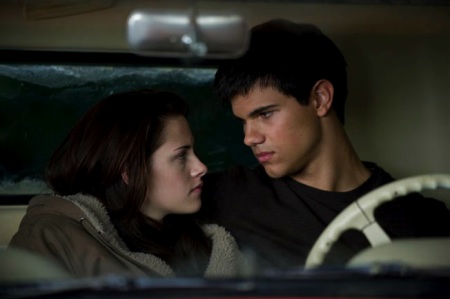
Edward, convinced that their relationship will always put Bella in danger, leaves, telling her he will never see her again. She is devastated and isolates herself from everyone. She discovers that Edward appears to her when she is in danger, so she takes some foolish risks, just to feel close to him. But then the quiet support and gentle teasing of her friend Jacob (Taylor Lautner) begin to make her feel that she is able to be a part of the world again. Like Edward, Jacob loves Bella and would do anything to protect her. And like Edward, Jacob has a secret. He is part of a tribe of wolf-people. Like “The Hulk,” his anger manifests itself in a powerful transformation. And Bella finds herself at the center of a centuries-old war between the vampires and the wolves.
The wildly popular Twilight Saga has the core elements of girl-friendly romances from “Wuthering Heights” to “Titanic:” a boyfriend who is not approved by parents who is utterly undone by the appeal of the female lead, and something to make sure that their relationship is about longing, not satisfaction. Just in case you aren’t paying close attention, we see Bella sleeping with a copy of “Romeo and Juliet” on her pillow, and her English class watching a video of the play. The teacher calls on Edward to recite one of Romeo’s speeches. And later, Edward, like Romeo, believes that his love is dead and decides he cannot live without her.
There is a lot of longing. Characters exchange meaningful looks and take an extra beat before responding to allow for some strategic intakes of breath and swelling of the score. There are moments that are more perfume commercial than movie. And as in the book, this big love Bella and Edward feel is expressed mostly in talking about the big love they feel. In a way, this is wise; we never see them doing or seeing anything that would interfere with our ability to project onto them whatever the specifics of our own fantasies of love look like. All we know or need to know is that Bella and Edward have the big, total, all-encompassing, would do anything for each other love. Just like Romeo and Juliet.
And we have Lautner’s excellent abs, which play such a significant role they should have their own billing. Lautner also has an easy confidence and sincerity on screen that nicely leavens the intensity and drama of the Bella-Edward connection. The screenplay is seasoned with some humor and a reference to self-referential cleverness that is almost meta.
New director Chris Weitz does not have Catherine Hardwicke’s feel for the rhythms of teenage interactions and the intensity of teen romance. And he does not have her ability to tell the story through the settings; we miss the lush natural world of the first chapter. Weitz and screenwriter Melissa Rosenberg also have to grapple with a transitional story that translates less well to screen than the first one. But the film benefits from his greater experience with special effects and a bigger budget. He catches the spirit of the story and allows the natural chemistry between his leads do the rest. And that is enough to make this movie enormously enjoyable and keep us looking forward to the next one.
Some scary images including skeletons, voodoo, alligators, characters in peril, sad deaths
Diversity Issues:
Diverse characters, strong female characters
Date Released to Theaters:
December 11, 2009
Date Released to DVD:
March 16, 2010
Amazon.com ASIN:
B0034JKZ86
Disney has cooked up a yummy batch of gumbo with this blend of the past and present. “The Princess and the Frog” is a satisfying and thoroughly entertaining return to the hand-drawn animation that built the studio. Although it is set in 1920’s New Orleans, it has a modern twist with the studio’s first African-American “princess” — and this is not a heroine who warbles about waiting for the prince to come and rescue her. This is a working woman and the prize she has her eyes on is not some happily-ever-after fairy tale wedding. She wants to run her own business — a restaurant. Like Gepetto, she wishes on a star, but as her father advises her, “that old star can take you only part of the way. You have to help it out with hard work of your own.”
We first see Tiana as a little girl, playing with a good-hearted but spoiled little girl named Charlotte. They enjoy listening to Tiana’s mother, Eudora (Oprah Winfrey) read them the story about the princess who kissed a frog and turned him back into a prince. But Charlotte is wealthy and Eudora is employed by her father (John Goodman) as a seamstress. Tiana’s family may have modest means, but her parents love her dearly and she shares her father’s passion for cooking that signature New Orleans dish, gumbo.
When she grows up, Tiana (Aniki Noni Rose of “Dreamgirls” and “The No. 1 Ladies Detective Agency”) is working hard, determined to make her father’s dream of a restaurant come true. (It is implied that he was killed in World War I.) So she works two jobs while her friends tease her about not having any fun.
Meanwhile, Prince Naveen (Bruno Campos of “Nip/Tuck”) arrives in town, hoping to marry a rich woman but much more interested in playing music and having fun. When he is turned into a frog by Voodoo villain Dr. Facilier (“Coraline’s Keith David), he must find a princess to break the spell. That does not include Tiana, even though she is dressed like a princess at Charlotte’s masquerade ball. He persuades her to kiss him by promising to give her the money she needs to get the building for the restaurant. Since she is not a princess, it goes wrong and she turns into a frog instead.
And that puts them on a journey through a swamp to find a way to become human again. At first the free-wheeling prince and the serious-minded would-be restaurateur have little in common. But soon, as they make new friends (a horn-blowing alligator named Lou and a brave firefly named Ray) and try to keep away from frog-hunters and other dangers, they discover that they get along. They inspire each other to be their best but they like each other for who they are. And that, it turns out, is the real magic.
There is some real Disney animation magic in the details of the settings, especially the jaunty New Orleans of the Roaring 20’s and a musical number in the swamp with fireflies that is heart-stoppingly lyrical. The lively score by Randy Newman pays tribute to the vitality of New Orleans influences, with some zydeco spiciness, but there is sweetness as well, especially when she sings about her dream for the restaurant and imagines what it will be like.
Because this is Disney’s first African-American princess, there has been some extra scrutiny and some extra sensitivity. Some have already been critical of the film because Tiana is not a “real” princess, because she spends a good bit of the story neither black nor white but green when she is a frog, and because her romantic interest is not African-American but from the fictional European country of Moldavia (Campos is from Brazil). There will also be criticism because of the voodoo (with some scary skeletal images) and SPOILER ALERT this is the first Disney film in my memory where one of the key sidekick characters is actually killed by the villain.
I like the fact that Tiana is not a “real” princess like Jasmine, Snow White, Sleeping Beauty, and Ariel. Like Belle, she is non-royal, but romantically involved with a prince. More important, she is an independent, self-supporting, hard-working woman with ambition that goes beyond some sort of romantic rescue. The movie lightly touches on but does not ignore the racism of the era. I like the inter-racial romance (and note that the only other loving couple is Tiana’s parents, both African-American, voiced by Winfrey and Terrance Howard). Setting the story in New Orleans, an exceptionally diverse city, and in the 1920’s, an era of great creative vibrancy, was an especially clever idea. As for spending most of the movie as a frog; well Mulan spent most of her movie as a man. Transformation is at the heart of fairy tales. And in her human form, Tiana is as lovely as any Disney character in history, without being squeezed into a wasp-waist and harem pants like Jasmine. I have some smallish quibbles with the voodoo villain and some overly complicated plot twists, and a more medium-sized quibble with the death of a character. Though it is handled with some grace, it is still unnecessary and likely to upset some younger audience members.
But the movie is genuinely enchanting and the old-fashioned, hand-drawn, 2D animation has a timeless quality that makes us feel welcome. It turns out you don’t need CGI and 3D to feel that you can almost smell that spicy gumbo.
To the list of the biggest lies of all time (“The check is in the mail,” “I’ll still respect you in the morning,” etc.) this must now be added: “All the answers are in your packet.”
No, they aren’t. Many answers are in the packet you get handed after someone tells you that your position at work no longer exists, but they do not tell you anything about the questions you care about most: Will I get another job? How will I pay my bills? Did anything I did here mean anything at all?
Most people in that position will not be asking questions about the person who is handing them the packet, but “Up in the Air,” based on the novel by Walter Kirn, he is our hero. Close enough, anyway, as he is played by George Clooney, whose sleek movie star glow and perfect tailoring give his character a surface perfection that contrasts with his struggle to hold onto his freedom and make sure nothing holds onto him. For him, being a professional brought in by corporate management to fire people in massive layoffs is the perfect job, each relationship with an almost-immediate ending.
Clooney plays Ryan Bingham, a man who is most at home away from where he lives. Even the most generic of hotel rooms has more personality than his apartment, too personality-less even to be considered spare. The 290 days he spent on the road last year were the ones where he felt most connected, most authentic, most at home. In his apartment, he feels rootless. What he loves about travel is the thousands of micro-encounters, all encapsulated into tiny predictable pieces. His affinity points at hotels and airlines gets him an extra “Nice to see you again, Mr. Bingham!” with a smile as fake as Bingham’s assurances that the answers are in the packet. But it is the very fake-ness of it that makes Bingham feel at home because he understands it and it understands no more about him than he wants it to.
At one point in the movie, his sister, who is about to be married, sends him a cardboard cut-out photograph of herself with her prospective husband so that Bingham can take pictures of it in different locations for a scrapbook they are creating instead of the honeymoon trip they can’t afford. Reitman creates a nice, understated contrast between the artificiality of the “travels” by the cardboard duo and Bingham and his fellow road warriors.
Bingham is not the first person and certainly not the first movie character to think that he can get through life with maximum efficiency, with as little weighing him down or holding him back as possible. He has systems for maximizing momentum and minimizing inertia from a small group of impeccable and virtually identical suits to the formula for getting the most out of frequent flier miles. When he finally meets a woman (Vera Farmiga) who speaks his language — their flirty banter about who has more prestige points and which hotels have the best amenities is more delicious than a warm chocolate chip cookie at your check-in — part of what makes it fascinating is that neither Bingham nor the audience can tell at first whether this is just one more frictionless encounter or a connection that will make him re-think his attachment to being unattached. Farmiga matches two-time Sexiest Man Alive Clooney’s rhythms perfectly, and watching these two glossy creatures circle and parry is one of the great cinematic pleasures of the year.
In one respect, Bingham harks back to the iconic American cowboy, alone in the wilderness. In another he is the essence of 2009, in the one sector of the American economy that is benefiting from the catastrophic avalanche of failure that will forever identify the end of this milleneum’s first decade. Co-screenwriter/director Jason Reitman (“Thank You for Smoking,” “Juno”) shrewdly puts Bingham in the middle between his tantalizingly silky no-strings counterpart and a spooky, Scrooge-like vision of another aspect of himself. A young, ambitious newcomer (a superb Anna Kendrick) to his office has an idea about how to save money by being even more ruthlessly efficient. Why do all that flying when you can fire people by video chat?
Reitman continues to populate his films with characters we want to know better and actors who make even small parts into gems of poignancy and meaning. Melanie Lynskey, Danny McBride, Jason Bateman, and J.K. Simmons are irresistible, but there is also a mosaic of reactions from the newly terminated that is even more unsettling when you find out that these are real-life survivors of lay-offs, recruited by Reitman for what they thought was a documentary about the impact of the economic crisis. And be sure to stay through the credits for another telling real-life moment.
“Up in the Air” is very much of its time but it is also one of the best films of the year for its sympathetic and layered understanding of the issues that affect us in good and bad economic times and its recognition that it is here, in these stories, where the questions left unanswered in the packet are explored.
The mood is romantic. The couple is parked in a secluded spot overlooking their charming home town. They lean in for a kiss. And then an alien rocket ship lands. I hate it when that happens.
Okay, no I don’t. I enjoy it. That’s a classic cheesy 1950’s alien invasion movie set-up and “Planet 51” knows that very well. The scene we have just watched is from a movie called “Humanoids” and it is happily being enjoyed by a theater filled with rapt, popcorn-chomping, little green creatures with antennae. Just like the couple in the car on screen. Dorothy, we’re not just not in Kansas anymore; we’re not even on planet Earth.
It feels like an idealized, if retro suburban Earth setting, though. The houses have white picket fences and the soundtrack has standards from the 1950’s. You could imagine Dick and Jane, Ozzie and Harriet, or Archie and Veronica playing hopscotch on the sidewalk, if they were green and had four fingers.
In this idyllic setting we have Lem (voice of Justin Long), very happy because he just got a job in the planetarium and is beginning to think Neera, the pretty girl next door (voice of Jessica Biel), kind of likes him. And there’s Lem’s friend Skiff (voice of Seann William Scott), who wears braces and works at the comic book store. And then things get complicated when an alien arrives.
That would be one of us.
This is “E.T.” in reverse. The American astronaut is the alien invader. His name is Chuck (voice of Dwayne “The Rock” Johnson). While many of the people on the planet (I know, they’re not human, but I’m going to call them people) are terrified and determined to kill, capture, or dissect Chuck, Lem, Neera, and Skiff are willing to try to get to know him.
This theme is very similar to the more serious Battle for Terra 3D earlier this year. But it is sillier and sweeter, with a cute robotic sidekick somewhere between R2D2 and a puppy. It is also a little bland. It is a shame that a movie tweaking retro cliches falls into the white bread conventions itself, especially from a Madrid-based production company. That they believe Americans will only buy tickets to movies about white guys shows that the message of the movie about how it is all right to be different has not really been learned.