Telegraph Hill, overlooking the North Beach section of San Francisco, is a place where all kinds of creatures from all kinds of places can feel welcome. One of them is onetime musician Mark Bittner, a man with “no visible means of support” who is himself the support for some of the neighborhood’s most colorful residents, a flock of bright green wild parrots.
Bittner knows and loves each one of them. He is in one respect a sort of St. Francis of Telegraph Hill, carting huge bags of birdseed home on the bus to feed to them and taking the sick ones into his home to nurse them. But he is also their Jane Goodall, possibly the only person in history to study a group of parrots so intently over so long a period.
Bittner does not have a job, at least not one that pays him anything. He lives rent-free in a crumbling cottage and gets free pastries from a local cafe. The birds are his full-time job. He studies them, reads up on them, consults the bird specialist at the local zoo, and develops his own treatments, even grooming one parrot when he no longer has a mate to do it for him.
Through Bittner, even the least animal-friendly viewer will begin to fall in love with these brave and beautiful birds. His passion, dedication, and understanding are first impressive, then touching, then transcendent as he begins to talk about the death of a beloved parrot named Tupelo and tells a story from a zen master about the way we are all connected. The movie’s conclusion is a moment of breathtaking perfection — the sweetest connection of all.
Parents should know that the movie has some very sad moments including the death of some of the birds and a sad parting.
Families who see this movie should talk about how Bittner decided what was important to him and the steps he took to help him deal with change and loss in his life.
Families who enjoy this movie will also enjoy “Winged Migration.”
Looming shadows fall starkly across rain-slick streets. A door chain jiggles because a very bad man wants to come in and hurt someone. Hookers pull guns from garter belts. Tough, tough talk comes from bruised lips that dangle cigarettes and spit blood.
The villians are unspeakably evil. The heroes are compromised and overmatched. The city is filled with corruption but the countryside is even worse.
In “Sin City,” two of today’s greatest stylists join forces in an audacious synthesis of graphic novel and movie. It has the logic of a nightmare. It is movie-making pared down to the essentials Pauline Kael once saw on an Italian movie poster: “Kiss Kiss Bang Bang.”
Copyright 2011 Lionsgate
It is intentionally shocking when it confronts us with heart-stopping cruelty and violence. And it is even more shocking when it finds a terrible beauty in ruination.
Robert Rodriguez (Desperado, Once Upon a Time in Mexico, Spy Kids) defied the rules of the Directors Guild to bring on as his co-director Frank Miller, the writer/artist who created the Sin City graphic novels. The result is a faithful, shot-for-shot rendition of each stunning panel. Hard, resolute voice-overs accompany stark, inky images. There are brief flashes and flutters of color — red for brake-lights, a heart-shaped bed, a lightning-streaked sky, a sleek getaway car, and for blood. Yellow for the golden curls of a dead hooker and the jaundiced skin of a cowardly villain whose toxic perversions have turned him the color of bile.
Three stories about heroes battling overwhelming odds circle around each other, amplify each other, and ultimately intersect.
Marv (almost unrecognizable Mickey Rourke in a career-restoring performance) is a gigantic brute of a man. “I love hitmen,” he says, “No matter what you do to them you don’t feel bad.” After a beating he says, “My muscles make me a thousand promises of pain to come.” He has had one perfect night of love with a golden-haired prostitute who “smelled the way an angel should.” She said she wanted him. But the next morning, he wakes up in that heart-shaped bed to find that she has been murdered lying next to him.
Marv does not think too clearly. He can hold just one thought in his head at a time, if that. The world always seems incomprehensible and dreamlike to him, especially when he thinks he sees his Goldie again. But this is her twin sister. Marv knows — he thinks he knows — that justice requires him to kill the people who murdered his angel, no matter what the cost.
John (Bruce Willis) is a cop about to retire. He has a bad heart. But he cannot quit until he finds a way to rescue a little girl named Nancy from a man who molests and kills children but is protected by the forces that control Sin City.
And Dwight (Clive Owen) is a man who has made a bad enemy, his girlfriend’s predatory and abusive ex-boyfriend (Benicio Del Toro). Their dispute will shred the fragile compromise between the corrupt cops and the gang bosses that allows the prostitutes to control their own section of Sin City.
This is a masterpiece of technique, bravura film-making with sure and complete mastery of tone, setting, and mood. A lesser cast would be lost, even invisible, but Rourke, Willis, and especially Owen are every bit as arresting as the images around them. Most of the female characters are more props than characters, but Rosario Dawson and Jessica Alba make strong impressions.
The film is overwhelming at times, intentionally keeping viewers off-kilter by combining grand heroics, stunning beauty, hideous grotesquery, outrageous butchery, toughness and innocence, tragedy and comedy. This is a movie where a man’s hand is sliced off and then he slips on it like a bananna peel. The entire film exists precisely on the edge between exploitation and artistic statement, ultimately saving itself from toppling over with the sincerity of its tone, the beauty of its images, and the honor of its heroes.
Parents should know that this movie is extremely disturbing. It is not for kids and not for many adults. It is an extremely violent movie with constant, intense, and exceptionally graphic battles and all-out butchery and slaughter. Body parts are sliced off (and eaten — off-camera). People are wounded and killed just about every possible way, including electrocuted, stabbed, impaled, shot, dumped into a tar pit, and sliced up. There are severed heads and other body parts. There are references to child rape and cannibalism. The film also includes nudity, strippers, prostitutes, sexual references, and non-explicit sexual situations. Characters drink and smoke and abuse prescription drugs. They also lie, cheat, steal, extort, and violate as many laws (and commandments) as can be packed into one movie, with some of the most loathsome and vile villains ever put on film.
Families who see this movie should talk about the enduring appeal of such dark stories and characters and the way that co-directors Miller and Rodriguez use the settings and the camera to create mood and character.
Families who enjoy this movie will also enjoy the graphic novel series that inspired it as well as some of the movies that inspired them, like The Woman in the Window, Scarlet Street, and Kiss Me Deadly. They will also enjoy films by “guest director” Quentin Tarantino, including Pulp Fiction and Kill Bill.
There are three reasons to see this movie. First: the dazzling martial arts moves of Tony Jaa, whose lightning reflexes and breathtaking gymnastics are both impressive and entertaining. Second is the authenticity. As the tagline says, this film has “no safety nets, no computer graphics, and no strings.” This is not the kind of movie that inspires critics to use words like “balletic” and “graceful.” This is the kind of movie that shows you that everything but the injuries is really happening on screen. The third reason is so that you can see the first leading performance by a man who is set to become the next big action star.
With all of that, the reasons not to see the movie — predictable script (“The fate of the whole village lies in your hands!”), effective but not especially artistic direction, and adequate but not especially impressive movie-making, with a lot of those hiccup-y little instant replays that show you the most exciting stunts a second or even third time.
Jaa plays Ting, who must retrieve the head that has been stolen from the statue of Buddha in his small rural town in Thailand. So for the first time he goes to the big city. Then he has a lot of chase scenes and fights. Then the movie ends.
But the fights are very cool. Ting fights in the street. He fights in a ring. He goes underwater. His legs catch fire. He fights with his hands, with his fists, and with knives.
Jaa is an electrifying performer and the movie is primarily designed to show off what he does best, with what little story there is just there for breathing room and a change of location before the fight scenes start up again. There is a wheelchair-bound bad guy who can only speak through an electronic voicebox (it is really eerie when he laughs) and a female sidekick with an annoying voice that may be intended to be funny but just sounds somewhere between a whine and a screech. But the movie is a showpiece for Jaa, whose talent is well worth showing and viewing.
Parents should know that the movie has constant, intense, and graphic violence with bone-crushing injuries. Some characters are killed. The plot involves drug dealers and drug use and characters smoke and drink. They also use strong and sometimes crude language (as translated in the subtitles).
Families who see this movie should talk about how Ting makes the decision about whether he will fight or not. Why did George change his name? Why was Ong-Bak so important to the village?
Families who enjoy this movie will also enjoy the films of Bruce Lee, Jackie Chan, and Jet Li.
The Mask had a clever and inventive director, striking design, wildly imaginative special effects, and Jim Carrey, who is something of a wildly imaginative special effect all by himself. ,P>
“Son of the Mask” is both watered down and jazzed up, like a kid who’s had way too much sugary bug juice. This semi-sequel (all new characters except for a cameo from Ben Stein) is directed at a younger audience, and despite some questionable material, it is more mild than wild. There’s not much by way of imagination and few of the effects qualify as “special.”
Jamie Kennedy (Malibu’s Most Wanted) may be many notches down the star pole from Jim Carrey, but he is a likeable and funny guy. For some reason, though, this film fails to make the best use of the talents he does have, making him the straight man. To a baby and a dog.
In the first film, a shy bank employee finds a Norse mask with magical powers. When he puts it on, it unleashes his hidden desires and removes all inhibitions, turning him into an infinitely malleable cartoon character transformed by every impulse. Whether he was performing in a nightclub or standing up to a gangster, he was always fearless.
At the end of the movie, the mask is once again thrown away.
In this sequel, Kennedy plays Tim Avery, awould-be animator who lives with his wife Tonya (Traylor Howard) in a cartoony-looking little house. She wants a baby, but he does not feel ready. One night, on his way to the office Halloween party, he finds the mask. Everyone at the party is impressed with his “costume” and the outrageous behavior just seems natural at an animator’s office party -– everyone assumes he is just trying out a new cartoon character. When he gets home, his wife is in bed. Perhaps it is because his inhibitions have been removed by the mask, or perhaps he is just feeling proud of himself for being asked to develop a character for a possible cartoon series. But he is willing to have a baby.
Nine months later, the baby is born. And because his father was wearing the mask when he was conceived, he has some of the mask’s powers. This comes to the attention of Loki (Alan Cummings), the Norse god of mischief and the original owner of the mask. His father, one-eyed Odin, king of the gods, orders him to get it back, so Loki begins checking out every baby born on Tim’s baby’s birthday.
Tim is looking for the mask, too, but it has been hidden by his dog, who is experiencing something like sibling rivalry. Tim has no idea of his baby’s unusual abilities; he just wants the mask back so that he can finish creating that cartoon character his boss is asking about.
As Loki gets closer and closer, Tonya leaves town on a business trip, with Tim on full-time daddy duty, just as the baby’s transformational powers really start to take over and Loki finds what he was looking for. The movie then gets turned over to the special effects department for some cartoon-ish fun.
Kids will enjoy the silly humor, but parents may question the appropriateness of some of the material in the movie, especially for younger children, who may be disturbed by the idea that some children may not be wanted. While there is nothing explicit in the film, some families will find it inappropriate that the baby’s powers were the result of his father’s wearing the mask when he was conceived.
The movie is dumb and loud, which some children will confuse with entertaining but others will just find overwhelming. It is a shame not to make better use of Kennedy’s talents; he is mostly limited to reaction shots. It’s a bigger shame to waste this technology and the goodwill left over from the first film on a dull story with forgettable characters.
Parents should know that this movie has strong language for a PG (“Hell, no” “The crappiest piece of crap in crap-town”). There is a lot of comic violence, including hits to the crotch that are supposed to be funny. There is some mild sexual material, including discussion of wanting (or not wanting) to have a baby, and the central plot point is based on Tonya getting pregnant while Tim is wearing the mask. Tonya jokes that she is going to make a baby with the neighbor. There is some vulgar humor, including potty jokes.
Families who see this movie should talk about how parents decide when they are ready to have a baby. Why was it so important to Tim that he be someone his child would be proud of? Why did Tim say that the baby helped him grow up? What is “positive reinforcement” and why is it important? Why are there stories about a god of mischief? What other characters in stories and myths like to cause trouble?
Families who enjoy this movie will also enjoy Spy Kids, also featuring Cummings, and Bill and Ted’s Excellent Adventure and its sequel Bill and Ted’s Bogus Journey, which, like this film, also features a game of Twister. Tim’s last name is a tribute to animator great Tex Avery, and families will enjoy some of his classic cartoons as well. And all families should learn about some of the great Norse myths, featuring Loki, Odin, and Thor.
Rated PG-13 for crude and sexual humor, language and some drug content
Profanity:
Very strong language for a PG-13
Alcohol/ Drugs:
Drug humor, drinking, smoking
Violence/ Scariness:
Comic violence including guns, characters shot but no one badly hurt
Diversity Issues:
A theme of the movie
Date Released to Theaters:
June 23, 2004
Date Released to DVD:
October 26, 2004
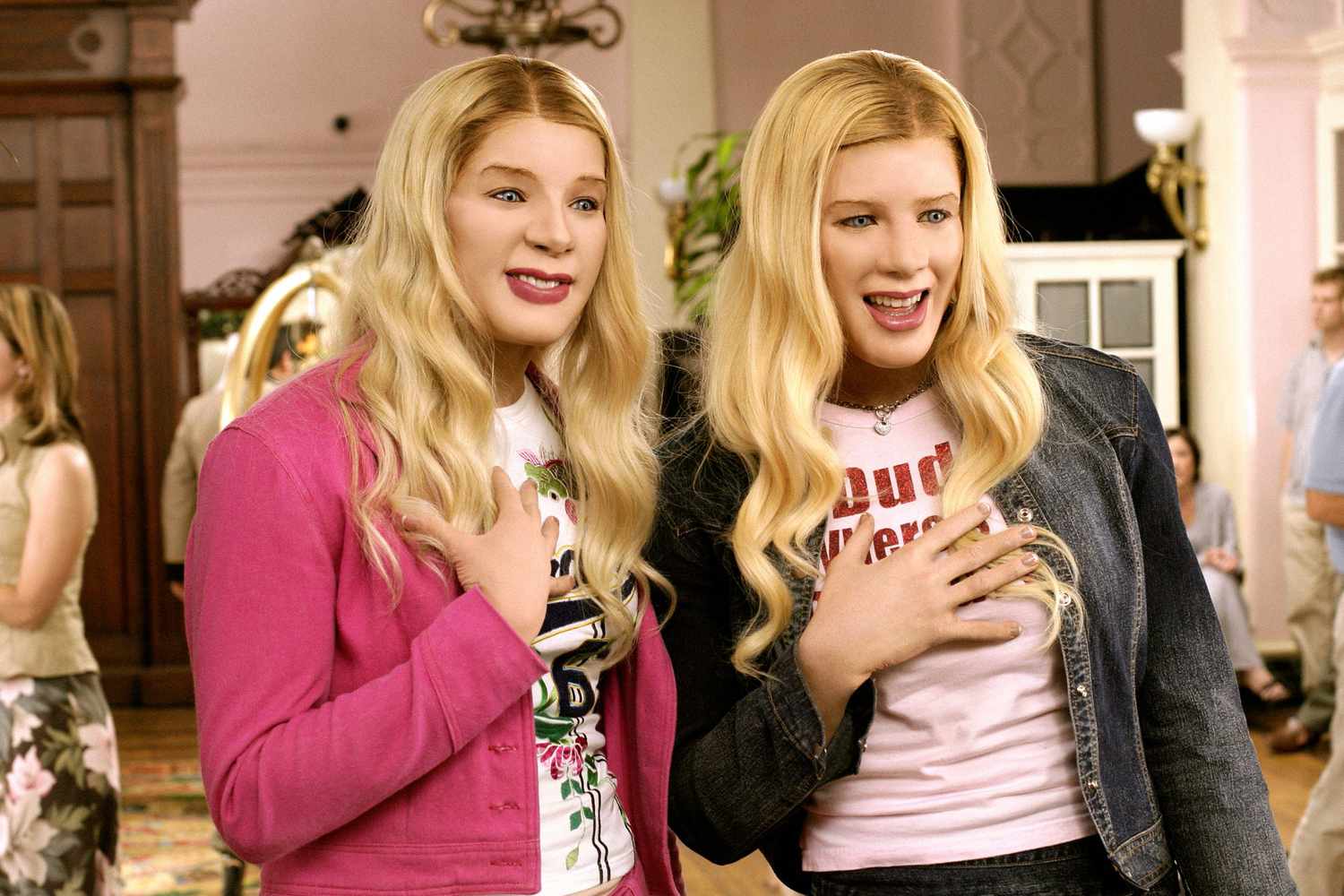
Appealing performers and a couple of very funny moments don’t make up for a lazy and generic script in this predictable farce about two black male FBI agents who go undercover as spoiled rich white girls. I knew we were in trouble when there was a “Hammer Time” joke in the first few minutes, a reference way past its sell-by date. And a Bjork swan-dress joke? In white chick terms, that’s so yesterday.
Copyright Columbia Pictures 2004
In rap music terms, this movie samples characters and plots from many other movies, including the already vastly over-used (attractive and principled but do-things-their-own-creative-way law enforcement types always getting chewed out by choleric superiors until one of their wacky schemes pays off and they get to be heroes) and the already done so brilliantly and distinctively that no one should ever try them again (whoever thought of appropriating the “Junior” plot twist from Some Like it Hot should be sent to the screenwriter equivalent of solitary confinement).
Even the movie doesn’t even appear to paying attention to its plot. Movies don’t have to be logical; they don’t even have to make sense. But sloppy inconsistencies like the ones here become a distraction that interferes with the ability of the audience to enjoy even the jokes that work.
Shawn and Marlon Wayans, apparently both the Zeppo Marxes of the talented Wayans family, play FBI agents Kevin and Marcus Copeland. It is typical of this movie’s problems that no one had the energy to give these characters anything resembling a personality. They are almost indistinguishable from each other except that one has a hysterically jealous wife and the other has a goatee and is single.
After they bungle a drug bust, they are assigned to escort the Wilson sisters (think Paris and Nicky Hilton), who may be targets for a kidnapper. They are on their way to a weekend at the Hamptons where they hope to be photographed for the cover of a magazine. A minor car accident on the way there leaves them with scratches on their faces and they refuse to be seen that way. So, the Copelands call in the FBI’s crackerjack undercover make-up team to transform them into the Wilsons. Conveniently, they both already have earrings.
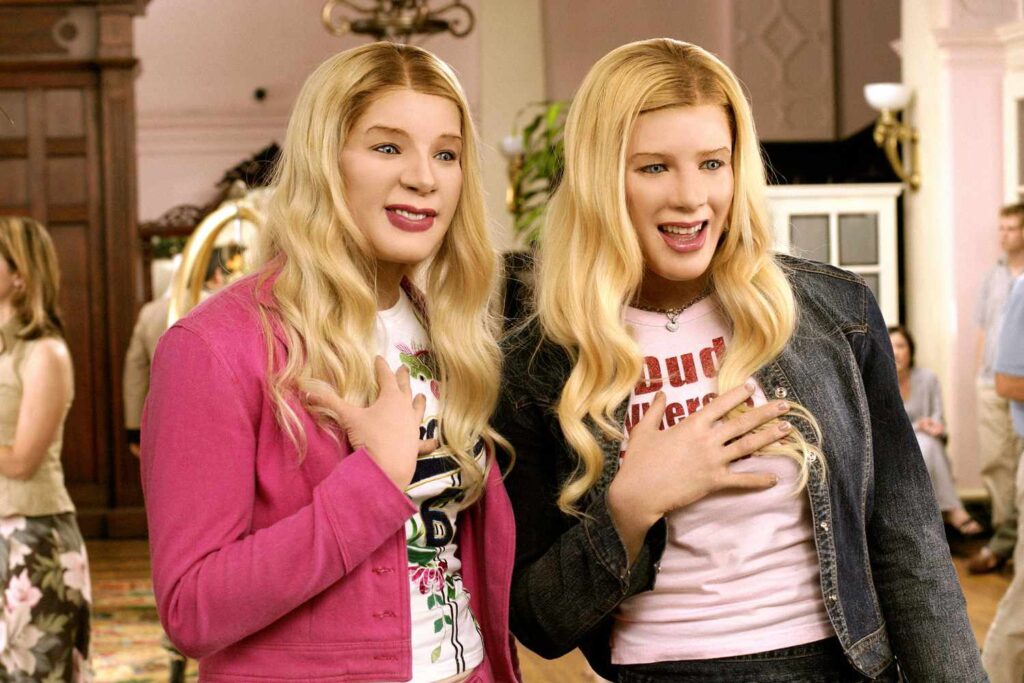
Despite the fact that they are taller than the girls and the latex masks applied to their faces make them look like victims of Botox overkill, no one in the Hamptons seems to notice anything significantly different about “the girls” (one friend guesses that they’ve had collegen treatments to turn their lips from “Cameron Diaz to Jay-Z”). The Copelands squeal and giggle, shop with the girls, go all mean girls on the snooty rich snobs, and participate in a fashion show and a dance-off (okay, that dance-off is pretty funny). They also go out on dates, Marcus in drag with a smitten athlete (the very funny Terry Crews) and Kevin as a man but pretending to be someone else to impress a pretty reporter.
Gender and race-switching are inherently funny but the situations and jokes in this script do very little to build on that energy and sometimes actually get in the way. There are predictable culture clashes, as when the society girls sing along to Vanessa Carleton’s “1000 Miles” and the Copelands have to pretend to know the words. Then, when the rap song comes on…well, you know where this is going. (A twist on this scene later on provides the movie’s most sustained laugh.) There is a lot of gross-out humor involving various body parts and functions, and some leering double entendres. There are also predictable life lessons as the Copelands develop more empathy for women and encourage the society girls to have more self-respect, to insist on the best for and from themselves. Too bad the Wayans forgot to learn that lesson themselves; the insights are delivered with no more enthusiasm, sincerity, or imagination than the comedy.
Parents should know that the movie has very crude and vulgar material for a PG-13, with comedy based on sexual references (including a game where players have to choose between two unappealing sexual encounters), drug jokes, insult humor, and a lot of graphic potty humor. Characters use strong language, not just the usual “almost-R” words but also terms that may concern parents like “yeast infection,” “coke whore,” “bitch fit,” and the n-word. Racial insults and stereotyping are intended to be comic. The movie has some comic and action violence, meaning that a lot of punches are thrown and a few shots are fired but no one is seriously hurt.
Families who see this movie should talk about what Kevin and Marcus learn from pretending to be white women. Why was it so hard for Karen, Lisa, and Gina to feel good about themselves and their relationships?
Families who enjoy this movie will also enjoy the better movies it borrows from, like Some Like it Hot, which was first on the American Film Institute’s funniest movies of all time, and Tootsie, which was second. They may also enjoy Martin Lawrence in drag as an undercover cop in Big Momma’s House. The freshest and funniest Wayans film is still I’m Gonna Git You Sucka.