All of Shakespeare’s plays have been filmed, many more than once. Some of my favorites are:
1. Twelfth Night A shipwreck survivor disguises herself as a man and gets involved in many mix-ups as she finds herself falling for her boss and being fallen for by the woman he has asked her to woo on his behalf.
2. A Midsummer Night’s Dream An all-star cast appears in Shakespeare’s merriest romantic comedy, with the entanglements of three romantic couples and a little fairy dust.
3. The Taming of the Shrew Famously bombastic couple Richard Burton and Elizabeth Taylor play famously bombastic couple Petruchio and Kate in this raucous battle of the sexes. It is not only the shrew who is tamed.
4. Henry V Kenneth Branaugh’s fierce version of one of Shakespeare’s most thrillingly heroic stories is brilliantly done — and a lot of fun to compare with Laurence Olivier’s very different WWII-era version.
4. Hamlet Mel Gibson stars in one of several great versions of the play about the conflicted Danish prince.
6. The Merchant of Venice Al Pacino plays Shylock in the story of a money-lender driven to revenge by the defection of his daughter. Lynn Collins is luminous as the heroine Portia.
7. As You Like It Another woman-disguised-as-a-man story and another lovers-in-the-forest story — but this time transplanted by the film-makers to Japan in a very colorful production with a radiant Bryce Dallas Howard as Rosalind.
8. Macbeth Orson Welles’ version of the Scottish play is arresting and provocative.
9. The Tempest I’m still waiting for a worthy version of my favorite Shakespeare play, but until that happens, this version of the story of the shipwreck survivors on an island with a sorcerer and his daughter is worth seeing.
10. Shakespeare in Love This multi-award winner makes no pretense of historical accuracy but it is wise, exciting, and ravishingly romantic.
Steve Lopez thought maybe he would get a column out of the homeless man who was playing a violin with only two strings. He did get a column, and then more, and then a book, a friend, a lot of complications, an education, and a cause. The man he saw on the street was Nathaniel Ayers. The book is called The Soloist: A Lost Dream, an Unlikely Friendship, and the Redemptive Power of Music. And now the story of Lopez and Ayers is a movie starring Robert Downey, Jr. and Jamie Foxx.
I spoke to Lopez in a little coffee shop on Capitol Hill, just before his meeting with Hill staff to talk about mental health policy.
Why does our society do so poorly in helping people who are mentally ill?
There is a “There but for the grace of God” aspect to it, “This could have been me.” It is so easy to look past somebody, to wrap yourself in the generalizations and stereotypes — they might all be dangerous, they might all be capable of lashing out. But it is not a decision. These are our brothers, sisters, sons, daughters. As you go through this population you see that mental illness does not discriminate on the basis of race or income. It is cruel and unrelenting but people can be helped.
What do you hope to accomplish with this book and movie?
I want people to ask, “How does this exist in American society?” The mentally ill are shoved off into this human corral, out of sight, out of mind. Would we do this with cancer or muscular dystrophy? The answer is clearly no. The reason places like Skid Row exist is the stigma of mental illness. I hope this story shines a light on that and addresses some public policy issues.
Tell me about Nathaniel Ayers.
He was not typical but relatively normal. He grew up in Cleveland. A woman recently brought me a photo of him when he was very young, before the breakdown, just charming. You see the photo before the fall, there’s such hope in his eyes, a great future in front of him, passion for music, a great kid in a good family with a mother who had him mind his manners and go to piano class and get good grades, He gets whacked with this just as his career is about to take off. He was a former classmate of Yo Yo Ma.
How aware is he of his illness? Enough to help in his treatment?
Nathaniel has insight issues. There are times when he is very much aware of his own condition and times when he is not. In some ways he has it made. He found out his purpose in life and has everything he needs.
What have you learned from him?
I found him on the street and wanted to help him get him out of his situation. My life was hectic and frantic. He forced me to reconsider the definitions of success and happiness. In some ways this is a story about a man who has lost everything but has a purpose in life that those of us who are considered successful would envy. A change comes over him when he is with the music. He is more coherent and sane. It could be the science and math of it — he sees and hears things we don’t and it is hard to process all the signals, but the notes are in the same place they have been for 200 years. The world can be so terrifying for people who have schizophrenia. So you build a cocoon, a tin foil hat, or something. In Nathaniel’s case he will do his scrawlings. In that safe cocoon of his, music is the medicine, it is what keeps him whole.
I don’t think “What a wonderful life,” I just think most people do not have his purpose, joy, and passion. For me, journalism had become such a negative experience because we sit around newsrooms grousing about the good old days. Seeing Nathaniel made me realize I do not want to spend the last days of my career grousing about what used to be. I heard about an opening in California for a media person for mental health services, thought about doing that, and then decided I could find my purpose by continuing to write. I realize I’m working on the story of my life. It is not only the human drama but he’s helping me and giving me a chance to shine a light on our public policy failures. I am a storyteller, and that is my passion, equal to Nathaniel’s. It would be foolish to give it up. There are other ways to tell stories, and this new movie is one of them. So now I still write but I savor it a little bit more knowing it is what I chose to do. Nathaniel has made me feel much more grateful and devoted.
What were your disappointments or frustrations? In the book you talk about how you felt when he lashed out at you.
I felt very conflicted when despite my best efforts the condition was more powerful, bigger, more relentless than I was. It wasn’t Nathaniel, it was the condition. But how much patience do you have? I understand how families throw their hands up. You ask, “Can I sacrifice all this time for no guarantee of making a difference?” I know and admire and love him too much to turn back. Recovery is not linear, you slide a lot. Nathaniel has been in an apartment for three years. He has a girlfriend, he comes to concerts. Before, he didn’t consider himself worthy enough to see a concert. He would say, “People should not have to sit next to me.” But he now goes himself sometimes. That growth in him is pretty remarkable. Partly it is a friend handing him a lifeline, partly his own courage.
What is it people most misunderstand about mental illness?
They think, “We offered help and they didn’t want it” or “They can go to a shelter.” They do not realize how many challenges and psychological hurdles mentally ill people face. They have a fear of rules, a fear of having to be more social, a fear of being ostracized. Nathaniel feared a return to the world in which he had snapped. All of the places he played on the street were really noisy. He said, “The city is my orchestra.” With the noise, it was impossible for him to hear his mistakes. He did not want to leave the place he used to play because he said the statue of Beethoven would be alone. We got him a bust of Beethoven for his apartment so he could still keep Beethoven company.
What kind of recommendations are you on Capitol Hill to talk about today?
One of my heroes and mentors, Sister Mary Scullion, co-founded Project Home in Philadelphia. They have taken over abandoned neighborhoods and rehabbed the houses. They have turned lost neighborhoods into anchors of the community. We have Project 50, survey teams with clipboards find the 50 neediest and most desperate and chronically ill people and give them wraparound services, coordinating health care, housing, everything. One year into it, 88 percent are still in housing. It is a double tragedy. People are on the streets and we know what works and can bring them in. Not only is this the humane thing to do, it is the cost-effectrive thing to do.
The Disney Princesses, each the star of her own movie, are now a team and something of a marketing juggernaut. They have transcended their individual stories and now appear together in a wide range of merchandise. And now Snow White (born a princess and married to a prince), Cinderella (married a prince), Little Mermaid Ariel (born a princess and married a prince), Belle (married a prince), and Sleeping Beauty (born a princess and married to a prince) will be joined by the first African-American princess, Tiana.
Disney has had non-white female lead characters before — Mulan (not a princess or married to a prince), Jasmine (born a princess), and Pocahontas (a Native American equivalent to a princess). But Tiana is the first African-American to star in her own fairy tale movie, based on a combination of a traditional story, a recent novel, and Disney’s own magical transformation. According to The Washington Post’s Neely Tucker,
It draws inspiration from an 18th-century fairy tale from the British Isles, and “The Frog Princess,” a 2002 teen novel from Maryland writer E.D. Baker. Disney transferred the story to 1920s New Orleans and changed her name, race and almost everything else.
In the Disney version, Tiana is a young waitress and talented chef who dreams, like her father, of owning her own restaurant. She eventually kisses a frog and is transformed into one. She must journey into the dark bayou to get a magical cure from a good voodoo queen. She is aided by a goofy firefly and a trumpet-playing alligator. The frog turns out to be handsome Prince Naveen, from the far-off and fictional land of Maldonia.
The stills released by the studio show Tiana in full princess regalia: a powder-blue gown, tiara and hair in an elegant upsweep.
Tony Award winner Anika Noni Rose voices Tiana. Other parts are played by Oprah Winfrey, John Goodman, Terrence Howard and Keith David. The music is by Oscar winner (and New Orleans veteran) Randy Newman. It is directed by Ron Clements and John Musker, the same team behind “Aladdin” and “The Little Mermaid.”
Tucker writes about the sensitivity involved in this image, as have all of the Disney heroines, which have been criticized for ethnic and gender concerns. At one time, he writes, the character was called Maddy, short for Madeline, but it sounded too much like “a slave name.” The love interest is of indeterminate race.
Prince Naveen, for the record, is neither white nor black, but portrayed with olive skin, dark hair and, need we state the obvious, a strong chin. The actor who plays him, Bruno Campos, hails from Brazil.
Tiana is a fantasy figure and so it is not surprising that she fits an idealized and doll-friendly image. But we have come a long way from the racially insensitive images in past films like “Dumbo,” “Peter Pan,” and “Song of the South.” I appreciate the care and yes, love, that have gone into creating this character and I am really pleased to have what appears to be a very strong and beautiful role model added to the princess line-up.
“American Violet,” the fine new film about the real-life woman who took on corrupt and racist law enforcement officials in 2000, was written by Bill Haney. It was a very great pleasure to get to talk to him about the film.
Tell me a little about your background and about what made you want to write this story.
I grew up in a Benedictine monastery in Rhode Island. My dad was a teacher there and I went to school there and left to go to college. It was there I got the general idea that the goal of life isn’t to get something from the world but to give something to the world. The purpose of storytelling is to illuminate and express something useful about the human condition, sometimes joyful, sometimes distracting, but in an ideal world, constructive. I like stories about an ordinary person called upon to do something extraordinary. I heard Wade Goodman on NPR talking about this case in Texas. His storytelling was classic NPR expositional context so that I felt compelled and moved, and that was what launched the journey to find the people and write the story.
It seems to me to be a essentially American story — an underdog seeking justice.
It is a systemically frustrating view of American justice, and the way they fought to get justice. We’ve been doing these word-of-mouth screenings with really interesting discussions. One woman said she was really pleased to see the message that we can get change through the system, that if we are educated and stand up it can work.
I am often of critical of films that set the lighting for the white characters and do not to justice to black skin tones but this film lights the black characters beautifully.
That was important to us, too. It is challenging to make sure the visual beauty is equally spread.
What has happened to the real-life woman who is called Dee in the movie?
In a lot of ways she is doing great. At one level this has been a marathon experience for her. She stayed in the community until four weeks ago. She’s gone through a lot of struggles including some serious health problems. She’s still there and he’s still there so it hasn’t ended, but it has been cathartic for her to get this experience out there. She’s a bright, charismatic woman. But her community is blighted. In the local high school, 169 entered as freshmen, but only three graduated and none went to college. There are these inherent limitations and she pierced right through that. She’s out giving talks, finding a voice and a place in society. Her children have found this process hugely validating and inspiring. Telling her story this way helped them respect and admire her. She is articulate and persuasive. It has left some marks on her but she is stronger and a person with a bigger voice in her world as a result.
What are some of the movies you saw when you were young that inspired you to want to make films?
At the all boys school we had no television but we had these screenings on Saturday nights. I saw “Guns of Navarone” and was completely smitten. I love Peter Weir movies, especially “The Year of Living Dangerously” — a magical story for me.
What are you working on next?
I’ve outlined three movies and a documentary about endangered species. Half my work is connected to something around the environment and food will be at the core of the next movie. Food is a great subject because it is about love, health, appreciation, beauty, soulfulness, and humor.
What makes you laugh?
PG Wodehouse. My wife has me on a Wodehouse allocation. She will only let me read for like 15 minutes at a time. I love dry humor, fish out of water stories. My own three kids make me laugh — kids know how to surf your waves. If you’re not laughing at them you’re laughing with them. I love Abbott and Costello and Charlie Chaplin’s “The Great Dictator” and Jim Jarmusch’s “Night on Earth.”
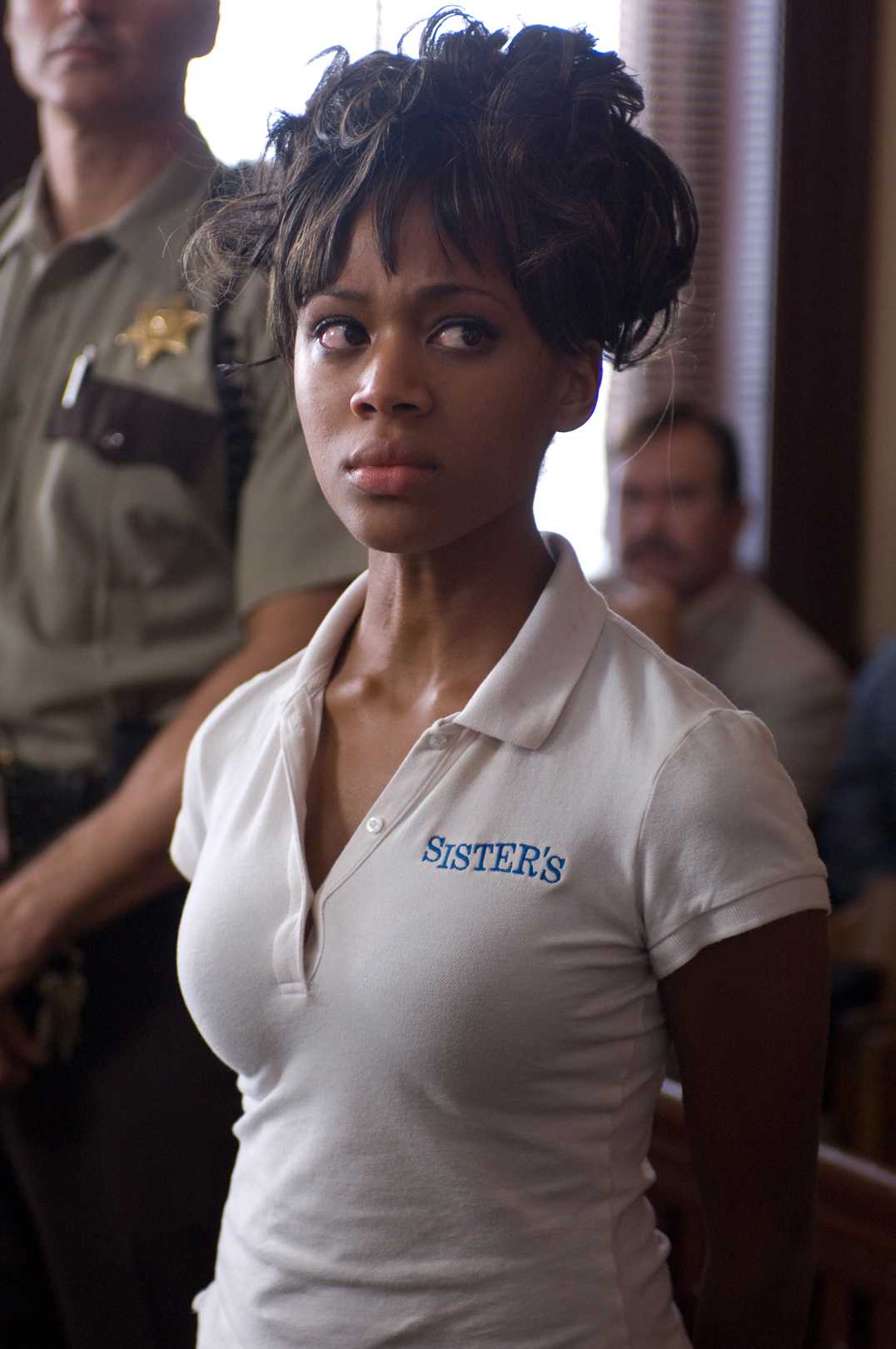
“American Violet” is based on the true story of a woman who helped to expose corrupt and racist law enforcement in her Texas community with the help of the ACLU and local counsel. Dee, the lead role, is played by newcomer Nicole Beharie in a stunning performance mingling strength and vulnerability. Dee is afraid but never loses her dignity or her moral center. Be sure to check out Beliefnet’s exclusive clip to get a glimpse. Beharie is simply dazzling in this film and I look forward to seeing whatever she does next. I was thrilled to get a chance to interview her and found her every bit as engaging in person as she is on screen. I was very relieved to find that this movie was not another in a long series that make the white person the hero in a story about black people. Although the lawyers are important, Dee really is the heart of the film. A lot of that comes from the vitality of your performance.
Thank you! But a lot of that comes from the script and their not wanting to do that. And some comes from the woman herself. Dee was very vocal up to the last deposition and suggested they use the African-American lawyer to depose the sheriff. It was a godsend that the attorneys showed up, but even before the lawyers showed up, Dee was active and outspoken. Dee had to make some very tough choices under a lot of pressure. Could you have been as brave and persistent as she was?
I don’t know! Some days I say yes, some days no way. I like to believe that I could, seeing how much she sacrificed and how much it meant to her. It has made me think about what you do for the things you care about and what you ignore. Too often people do not do anything. They say, “They know what they’re doing” or “That’s the system.” One thing that really impressed me was how many emotions you were able to convey at once — in some scenes you had to be scared and brave, worried and determined all at the same time. What do you to to prepare for a scene like the deposition or the one where your want to keep your daughters from their father and his girlfriend?
You take it all as personally as you possibly can, try to connect to it personally. What I thought of in the scene with my children’s father in that moment was fear for my children, a little bit of guilt in having them in this predicament, but once he busted those doors, its not about me — its about those two girls. What is your background?
I went to arts high school in Greenville, South Carolina, a public school for the arts and humanities. I fell in love with the notion of doing theater then. My director asked me to apply to drama school and gave me the 100 dollars for the Julliard application. I was accepted and studied there. One thing that is so endearing about Dee is that with all of the stress and difficulty of her life, she still takes the time for some very serious hair. How do you act under all that?
Yes, Dee did give attention to her hair! I give a lot of credit to Charles Gregory Ross, who designed the hair and had it all laid out so I did not have to sit for hours. The most difficult thing was the bun with the freeze curls, all pinned and manipulated, and really heavy! Alfre Woodard had to deal with it to. She had a different look in every scene. Your interaction with the girls who play your daughters feels very real and natural, even in the intense scenes. How did you work with them to make that happen?
I got a lot of my perspective from watching my mother raise the four of us. And when I first got to the set, before anything else happened, I got to work with the four real-life sisters who played my daughters. They had their own shorthand and hierarchy. They don’t know my name to this day. My name is Dee to them so it was natural for them to interact with me that way. And we involved them in the movie. All the artwork that is supposed to be from Dee’s children, so they got to see their own pictures hanging in Dee’s home. Did you ever meet the woman known as Dee in the movie? What did you try to take from her in your performance?
I met her once I got to the set, but by then I had watched hours of footage. I paid attention to the way she looked out of the corner of her eye, to rhythmic things, to her pitch. Are their particular performances that inspired you to want to go into acting?
“Miss Evers Boys” with Alfre, which made working with her so exciting for me, believe it or not “Ghostbusters,” “The Sound of Music,” “The Wiz.” I love Michel Gondry and really enjoyed his films, “Be Kind Rewind” and “The Science of Sleep.” What’s next for you?
I did pilot for CBS, a medical show, and I play a social worker. And I have an Annenberg grant to develop my own material. I’m working on a theater program in South Africa. And what makes you laugh?
My sister and my nephew make me laugh. He’s 12! My grandmother, too — my family will have me on the floor. They’re the only people who know what my goofy capabilities are.
Coming soon: an interview with “American Violet” screenwriter Bill Haney.



 . And now the story of Lopez and Ayers is a movie starring Robert Downey, Jr. and Jamie Foxx.