
Bloody Sunday

Posted on December 13, 2002 at 5:18 am

On January 30, 1972, thousands of civil rights demonstrators in Derry (Londonderry), Ireland, held a rally to protest the British Government’s use of internment without due process in Northern Ireland. British military forces were ordered into the unarmed crowd to capture some of the rowdier youths. What followed has been the subject of great debate and a well-known U2 song, but amidst the confusion, the army opened fire on the protestors, killing thirteen and wounding fourteen others. The day became a turning point for the Northern Irish “Troubles” and is attributed with inspiring thousands of new volunteers to the Irish Republican Army (IRA).

As far as subject matter is concerned, many people are more familiar with the U2 song than they are with the actual event or the factors that led to the day. This movie takes a turn at correcting this imbalance by recounting what happened on Bloody Sunday in a powerfully realistic half- drama, half-documentary.

Five characters represent the major forces of the day: a reluctant protest organizer and popular local –Protestant—politician, Ivan Cooper (a mesmerizing performance by James Nesbitt); a seventeen year old Catholic boy, just out of jail and torn between protesting and staying out of trouble, Gerry Donaghy (Declan Duddly); the radioman whose shock and disgust with his fellow soldiers is pitted against his loyalty to the unit, Soldier 027 (Mike Edwards); the dutiful but sympathetically human Brigadier, Patrick MacLellan (Nicholas Farrell); and, the unbending imperialist with the order to end the unrest, Major General Ford (Tim Pigott-Smith). However, it is in the faces of those around these characters where so much of the event is framed: the subtle shift of expression on the face of the Captain of the local police force as the Major General orders soldiers into position; the desperate grimace of an unnamed man as he rushes to resuscitate a corpse; the vacant eyed shock of a man learning of the death of a loved one beneath iridescent hospital lights.

Director Paul Greengrass does an excellent job at crafting a documentary feel for the story, complete with grainy film, jumpy shots, wavering sound and naturally gray light. Reportedly, Greengrass sought out people who were there on January 30th –those who lost loved ones as well as soldiers and bystanders—casting them as extras to add to the verisimilitude. The dialogue might be hard to follow between strong accents and a shifting aural perspective but the result is so realistic that the abrupt ringing of the phone or the crack of gun fire makes you flinch.

Not allowing the viewer to be passive, the movie catches us up in this pivotal day in Ireland’s history. Greengrass chooses not to review events leading to Bloody Sunday beyond passing references, however the moment itself is caught with a moving clarity: whether you agree with Greengrass’ portrayal of controversial events or not, he does a good job of capturing the feel of a society in flux during the early 1970’s and portraying the plight of Derry’s denizens. And, yes, they do play U2’s “Sunday Bloody Sunday” as the credits roll.

Parents should know that this movie depicts a tragic, violent event. The graphic shooting of unarmed protestors is very disturbing and the ensuing images including mayhem and grieving are likely to terrify younger children. Young adults accustomed to Hollywood’s comic book portrayal of violence are likely to be disturbed by the events so realistically framed on 35mm film.

Families who see this film could be discussing it for days. First, from a historical perspective, families might wish to talk about how this movie relates to current news stories about the Troubles in Northern Ireland. Both the Major General and the protest organizers work as much as possible with the media. How is the debate being presented to the court of public opinion? How has this changed since Bloody Sunday? When Ivan says that the IRA scored its biggest victory on Bloody Sunday, what does he mean?

Second, families may wish to discuss the ramifications of having military forces in populations that are predominately civilian. For some historical perspective, the paratrooper unit responsible for firing on the crowd –the First Battalion Parachute Regiment—was created in 1940 by Sir Winston Churchill, gaining the nickname “Red Devils” during fighting in Northern Africa, Sicily and France during WWII. In the years before being stationed in Northern Ireland, they were stationed in the Middle East, Aden, Cyprus and other hotspots. With a respected history in combat, the First Battalion considered themselves part of Britain’s fighting elite. Why would this group –trained to face armed enemies—be given a peacekeeping role in Ireland? What friction exists between the Regiment and the local police? What are their respective goals and responsibilities? What lessons might there be for us regarding troops in other urban situations, such as the Balkans or the Middle East?

Greengrass has chosen to film this account with a distinctly “documentary” camera style, intended to make an audience feel like they are there as a witness to history. As a brief notice in the credits mentions, the movie is based on events that did occur, however many of the conversations and characters were created for the purpose of the story. Is it important to the story that the audience think of this film as a documentary? If so, what issues might this raise for Greengrass or other filmmakers when they are presenting stories based on controversial events?

Families who are interested in seeing more on non-violent protest and the difficulties of maintaining peaceful demonstrations in the face of force might wish to watch “Gandhi” (1982). For those who are interested in the theme of mismatch between military units and the political objectives asked of them, “Black Hawk Down” (2001) might be of interest. Those who are interested in seeing more on the Irish Troubles might be interested in director Jim Sheridan’s 1990’s trilogy (“In the Name of the Father”; “Some Mother’s Son”; and, “The Boxer”) or Neil Jordan’s “Michael Collins” (1996). For families who wish to see James Nesbitt in a vastly different role, “Waking Ned Devine” is a lighthearted look at an isolated Irish town far away from Bloody Sunday and, indeed, from any troubles at all.
Related Tags:


Based on a true story Drama

Mary Poppins

Posted on December 13, 2002 at 5:18 am

A+
Lowest Recommended Age: Kindergarten - 3rd Grade
MPAA Rating: G
Profanity: None
Alcohol/ Drugs: None
Violence/ Scariness: None
Diversity Issues: The cause of votes for women is presented as unimportant, even daffy; subtext that parents should spend time with their children in
Date Released to Theaters: 1964
Date Released to DVD: December 09, 2013
Amazon.com ASIN: B00E9ZAT4Y

marypoppins5In honor of the upcoming “Saving Mr. Banks” and the 50th anniversary of the original film, Disney is releasing a superclifragilisticexplialidocious new edition of Mary Poppins.

Based on books by P.L. Travers (whose reluctance to allow a film to be made is the subject of “Saving Mr. Banks,” the film switches the 1930’s-era setting to the more picturesque London of 1910, where the Banks family has a loving, if rather chaotic, household. A nanny has just stormed out, fed up with the “incorrigible” children, Jane and Michael. Mr. Banks (David Tomlinson) writes an ad for a new nanny and the children compose their own, which he tears up and throws into the fireplace. The pieces fly up the chimney, where they reassemble for Mary Poppins (Julie Andrews), who is sitting on a cloud. The next day, a great wind blows away all of the nannies waiting to be interviewed, as Mary floats down.

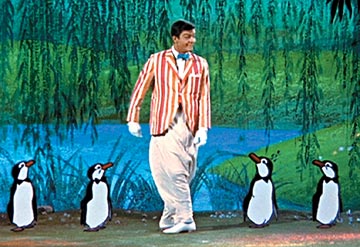
Somehow, she has a mended copy of the qualifications written by the children that Mr. Banks tore up and threw into the fireplace.  To the children’s astonishment, she slides up the banister.Out of her magically capacious carpetbag she takes out a tape measure to determine the measure of the children (“stubborn and suspicious” and “prone to giggling and not tidying up”) and her own (“practically perfect in every way”).  She directs them to clean up the nursery, and shows them how to make it into a game (“A Spoonful of Sugar Helps the Medicine Go Down”). Once it is clean, they go out for a walk, and they meet Mary Poppins’ friend Bert (Dick Van Dyke) drawing chalk pictures on the sidewalk. They hop into the picture and have a lovely time, or, rather, a “Jolly Holiday” in a mixture of live-action and animation that has Bert dancing with carousel horses and penguins.

Mary-Poppins-RooftopMary takes the children ato see her Uncle Arthur (Ed Wynn), who floats up to the ceiling when he laughs, and they find this delightfully buoyant condition is catching. Later, Mr. Banks takes the children to the bank where he works, and Michael embarasses him by refusing to deposit his tuppence because he wants to use it to buy crumbs to feed the birds. There is a misunderstanding, and this starts a run on the bank, with everyone taking out their money. Mr. Banks is fired.

Mr. Banks realizes that he has been too rigid and demanding. He invites the children to fly a kite with him. Mrs. Banks realizes that in working for the vote for women, she had neglected the children. Her work done, Mary Poppins says goodbye, and floats away.

This sumptuous production deserved its many awards (including Oscars for Andrews and for “Chim Chimeree” as best song) and its enormous box office. It is fresh and imaginative, and the performances are outstanding. (Watch the credits carefully to see that Van Dyke also plays the rubber-limbed Mr. Dawes.) The “jolly holiday” sequence, featuring the live-action characters interacting with animated ones, is superb, especially Van Dyke’s dance with the penguin waiters.

The resolution may grate a bit for today’s families with two working parents, but the real lesson is that parents should take time to enjoy their children, not that they should forego all other interests and responsibilities to spend all of their time with them.

Family discussion:  If you were writing a job notice for a nanny, what would it include?  Which of the children’s adventures did you most enjoy and why?

If you like this, try: books by P.L. Travers and the documentary about this film’s Oscar-winning song-writers, The Boys: The Sherman Brothers’ Story. And go fly a kite!

Related Tags:


Based on a book Classic Comedy DVD/Blu-Ray Pick of the Week Family Issues Fantasy For the Whole Family Musical Stories About Kids

Sweet Home Alabama

Posted on December 13, 2002 at 5:18 am

B-
Lowest Recommended Age: Mature High Schooler
MPAA Rating: PG-13 for some language and sexual references
Profanity: Some mild language
Alcohol/ Drugs: Drinking as a sign of free-spiritedness, character gets drunk and gets sick
Violence/ Scariness: None
Diversity Issues: Positive gay characters
Date Released to Theaters: 2002
Date Released to DVD: 2002
Amazon.com ASIN: B00007E2F5

It’s official. Reese Witherspoon is the new Meg Ryan.

That means Witherspoon has the charm, sparkle, and impeccable comic timing to keep an entire movie afloat and make it look effortless. She makes watching it seem effortless, too. That’s a good thing, because it takes every bit of her talent and all-around adorability to keep it aloft, considering the considerable weight of its uncertain script. Without her, even the enticing premise and an exceptionally able supporting cast would sink under the weight of a plot that somehow manages to be both predictable and disjointed (I’d bet a bucket of popcorn that there was some serious recutting along the way).

Witherspoon plays Melanie Carmichael, a fashion designer just breaking through to the big time with her first solo show. Not only is it a huge success, but she also gets a swooningly romantic marriage proposal from a gorgeous, thoughtful, supportive man who adores her – and who happens to be the son of the mayor of New York (Candice Bergen).

It’s the 21st century Cinderella dream come true, except for one hitch — literally. Way back when she was just Melanie Cooter of Pigeon Creek, Alabama, she got herself hitched to her childhood sweetheart, and now she needs to get herself unhitched so that she can be free to marry Prince Charming.

So, she goes back home for the first time in seven years, and she finds out that you can take the girl out of Pigeon Creek, but you can’t take Pigeon Creek out of the girl. Her accent comes back, and, more disconcertingly, so do some of her feelings for her husband, Jake (Josh Lucas).

The movie spends too much time reuniting Melanie with people from her past. There’s a lot of “Melanie? Is that you, girl?” It also spends much too much time introducing us to all kinds of adorable cracker stereotypes without much payoff. It wastes time on a tired plot twist about Melanie’s exaggeration of her family’s social standing that even the movie’s characters seem bored with. But Witherspoon is such an unquenchably winning presence and such a fine actress that I defy anyone to watch it without smiling.

A terrific soundtrack also helps, with a cover of the irresistible title tune and delicious songs by country greats. Lucas and Dempsey are both dreamy enough that even movie-savvy viewers may find it hard to pick the winner. Director Andy Tennant (“Ever After”) delivers a romantic comedy that should be able to hold a strong position at the box office until the next Julia Roberts movie comes along.

Parents should know that the movie has brief strong language, gay characters (one out, one closeted) who are positively portrayed, and references to an out of wedlock teen pregnancy. Melanie gets drunk (and gets sick). Drinking, vandalism and minor crimes are portrayed as evidence of a free spirit.

Families who see this movie should talk about why people are tempted to lie about their past, and how they would respond if they found out someone they cared about had lied to them. What does Melanie mean when she says “I figured if I was pointing at you, no one would see through me.” What didn’t she want them to see? What is Melanie likely to do next?

Families who enjoy this movie will also enjoy, “The Runaway Bride” and “Never Been Kissed.” They should also check out the wonderful classic with a similar plot, “I Know Where I’m Going.”

Related Tags:


Movies -- format

The Country Bears

Posted on December 13, 2002 at 5:18 am

Less story than product placement, “The Country Bears” may go down in history as the first movie ever based on a theme park attraction. I hope it goes down as the last. Much as I enjoy the ride, I don’t want to see “Pirates of the Caribbean: The Movie”* or “The Tiki Room Birds on Broadway.”

Disney World’s robot bear performances may just have a better plot than this movie, which is basically “The Blues Brothers” with fur. Yes, it’s the old story about getting the band back together.

The movie begins with some wit and style – a wood-burning credit sequence and “Behind the Music”-style clips about the beloved band’s rise and fall. Their last series of concerts was called the “Hiber-Nation” tour.

But then it disintegrates into a dumb story about a bear adopted by humans (voice of Haley Joel Osment as “Beary”) who runs away from home because he feels different. The Country Bears Hall is about to be torn down by wicked Reed Thimple (Christopher Walken). Beary decides that the only way to raise the money to keep it standing is to get the band back together. That sets up the rest of the movie as we meet up with a series of indistinguishable bears and watch Beary remind them of what they used to mean to each other.

Some surprising guest appearances by Elton John, Willie Nelson, Bonnie Raitt, Don Henley, and Queen Latifah (Raitt and Henley contribute singing voices) and some lively musical numbers by Disney label artists provide bright spots. But the in-between doses of silliness and syrup just dragged. The kids in the audience loved the scene with the policemen caught in the car wash, though.

Parents should know that although the movie is rated G and has none of the usual parental concerns, they should be sensitive to some of the issues in the movie that may trouble children. Beary runs away, and his parents are frantic about his safety, but he does not let them know where he is and does not seem to miss them for most of the movie. Beary’s human parents don’t tell him the truth about his adoption. He is told about his origins very cruelly by his jealous brother. Some parents will regret having their children see a character “play” music on his armpit if it sparks some attempts at imitation.

Families who see this movie should talk about how everyone feels different from the rest of the world at times, and how we make connections with those who are and who are not like us.

Families who enjoy this movie will enjoy The Muppet Movie and The Muppets Take Manhattan.

*I was kidding when I wrote this, but it turns out that a Pirates of the Caribbean movie did happen and, as you may know, it was terrific..

Related Tags:


Not specified

Treasure Planet

Posted on December 13, 2002 at 5:18 am

If “Treasure Planet” is not Disney at its best, it is still Disney at its still-pretty-much-better-than-anyone else, and well worth a look with this 10th anniversary re-release. It is based on the classic Robert Louis Stevenson story “Treasure Island,” filmed many times before. This version is set in outer space, but it is not the galaxy NASA or even “Star Wars” ever dreamed of. It is a dazzling vision that has masted schooners sailing past stars and planets. Computer and hand animation are brilliantly combined, using the best of both worlds so that the characters have a full range of expressions while the vistas are magnificently three-dimensional. This is exactly what animation should be about, presenting us with a thrillingly imaginative adventure that is utterly liberated from trivialities like the laws of physics and possibility.

http://www.youtube.com/watch?v=gxVlmXQoq9A

Jim Hawkins (voice of “Third Rock” star Joseph Gordon-Levitt) is a spirited kid who worries his single mother by getting into trouble with a contraption that is like a flying skateboard. A dying man gives him a map that can lead him to the planet where the greatest pirate in history hid all of his treasure. Dr. Doppler (voice of David Hyde Pierce), a family friend, finances an expedition to go in search of the treasure.

Doppler and Jim set off on a huge ship led by Captain Amelia (voice of Emma Thompson), with a crew that are better described as creatures than sailors. Jim is assigned to work with the ship’s cook, John Silver, a cyborg who is part human, part machine. John has a gruff manner with everyone but his shape-shifting pet. Jim thinks John is his friend until he overhears him talking to the crew about plans to take over and steal the treasure for themselves.

Once on the planet where the treasure is hidden, Jim meets BEN, an oddball robot with half his memory missing (voice of Martin Short). Jim, John, and the others race each other and the pirate’s booby-traps to get the treasure.

The movie is wonderfully visually inventive, with dozens of witty details. John Silver is a marvel of animation integration and form tied to content, his mechanical parts created by computer and his human parts created by hand. The voice talent is marvelous, especially Thompson, playing the captain as a sort of starchy governess who happens to be extremely brave and have a wicked sense of humor, and Short, who was born to be animated.

Parents should know that the movie has some scary moments, with extreme peril. A character is killed by being cast adrift. There is some potty humor, including a character whose language is called “Flatula.”

Families who see this movie should talk about why it was hard for Jim to behave before the trip and what will be different for him afterward. If you had all that treasure, what would you do with it?

Families who enjoy this film will also enjoy some of the movies based on Stevenson’s Treasure Island, especially Disney’s own 1950 version, starring Robert Newton as Long John Silver. And they will also enjoy Disney’s “The Emperor’s New Groove” and “The Rescuers.”

Related Tags:


Action/Adventure Animation Based on a book
THE MOVIE MOM® is a registered trademark of Nell Minow. Use of the mark without express consent from Nell Minow constitutes trademark infringement and unfair competition in violation of federal and state laws. All material © Nell Minow 1995-2026, all rights reserved, and no use or republication is permitted without explicit permission. This site hosts Nell Minow’s Movie Mom® archive, with material that originally appeared on Yahoo! Movies, Beliefnet, and other sources. Much of her new material can be found at Rogerebert.com, Huffington Post, and WheretoWatch. Her books include The Movie Mom’s Guide to Family Movies and 101 Must-See Movie Moments, and she can be heard each week on radio stations across the country.

Website Designed by Max LaZebnik