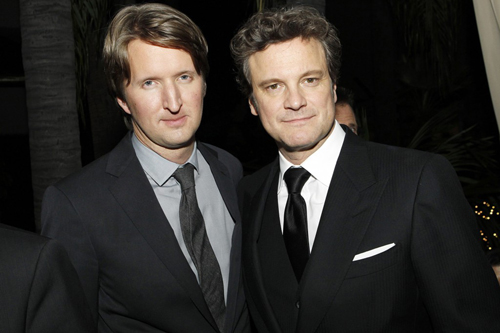
Tom Hooper, nominated for Golden Globe and satellite awards as best director for his acclaimed film, “The King’s Speech,” spoke to me about what made the movie especially meaningful to him, why the MPAA’s decision to give it an R-rating was so disappointing, and what he and star Colin Firth learned from watching footage of a speech by the real King George VI.
I don’t know anything at all about sports in the United States or the U.K., but I loved your last film, “The Damned United” (about real-life soccer coach Brian Clough).
That’s fantastic to hear! It was a very hard sell in America. I’m actually not a soccer fan myself, so for me to do it was proof that for me it worked on many levels and not just the sporting story.
There is some similarity to “The King’s Speech” as both are about big events surrounding the relationship between two people.
Weirdly, they’re almost unlikely companion pieces. They’re both about love between men, or at least strong companionship. And both films explore how men become great through the help of a friend. They can’t do it on their own. We live in a society that’s very focused on self — me, me, me, all about going into yourself to make yourself better. And my films suggest that it’s actually sometimes about opening ourselves up to collaboration with others that we can achieve our best.
 How did you come to this project? I know the screenwriter, David Seidler, worked on it for decades.
I only came to it because I happen to be half-Australian, half-English and living in London. My Australian mother happened to be invited late 2007 by some Australian friends in London to make up a token Ozzie audience to a play reading of an un-produced, un-rehearsed play called “The King’s Speech.” She’d never been invited to or attended anything like that and it didn’t sound very promising. But it was a good thing she went because she rang me up afterward and said, “Tom, I think I’ve found your next film.” And so the moral of the story is, “Always listen to your mother.”
What’s extraordinary about it is that it was going nowhere, even as a play. It was off the mainstream industry’s radar completely. It’s a great reminder that there’s often wonderful material that’s gone unnoticed and we should remain alert to that, and the extraordinary role that chance can play.
I agree with that! Seidler was dedicated to the story in part because of his own struggles with stuttering. And it sounds like the story became very personal for you as well.
As a half-Australian, I had wanted to tell an Australian story for years, or a something that explored my background. In some ways the narrative of my childhood was my Australian mother dealing with the effects on my father of his rather brutal English upbringing. It was nice that it came through my Australian side because there were some strong emotional connections for me.
It was very important to the story that Lionel was Australian, an outsider.
It was essential. Just before Christmas I was in Australia and Baz Luhrman hosted a wonderful screening in Sydney. In his introduction, he said the movie expressed a key Australian quality which is that the Australians are “impervious to majesty.” I think that quality is very key to Lionel Logue. He’s not so in awe of it that he is can’t approach Bertie about his childhood or his father brother or his struggle, which the aristocracy would consider not good form to talk about.
My mother told my father that over her dead body would her children go to an English boarding school, because those schools had a big effect on a generation of English men, including my father. His father died in the war when he was two and he was sent to boarding school when he was five, incredibly young. That was the era of cold baths in winter and corporate punishment and outside loos with no doors and all those British innovations. My mother was always great at saying, “This obviously affected your dad and it is up to us to unpack it. She was in a much gentler sense a kind of Lionel Logue to my dad.
I’ve been very frustrated and unhappy about the MPAA’s R rating for this film because of a brief scene of some bad words used in a vocal exercise. What is your response?
I’m finding it very sad. We just did a staggering opening in England, twice the next film, ironically titled “Little Fockers,” talk about language. And it’s playing as a family movie; people are taking their 10-year-old kids. Although it appears to be starring middle-aged men, it’s essentially about the risk that you can carry the effects of your early childhood right through your adult life and never address them and always be locked by it.
One of the key lines in the movie is the line Lionel says to Bertie, “You don’t need to be afraid of the things you were afraid of when you were five years old.” You’re living your adult life in the same defensive cringe you had to adopt when you were five and the world really was against you. But now you’ve got a lovely wife and lovely kids — it’s not that world any more. You don’t want kids to wait until therapy when they’re middle-aged to learn that. It’s so important to understand.
I respected the economy with which you established the characters of Bertie’s brother, David and Mrs. Simpson, the woman he abdicated the throne to marry.
One of the challenges was how to draw tip of the iceberg portraits of these two key characters without being caricature. David Seidler warned me when we first sat down of the danger of having them hijack the movie. In his original script, Wallis Simpson literally didn’t open her mouth. We had an incredible ensemble cast and having actors of the talent of Guy Pearce and Eve Best really helped– Guy did as much research as if he was playing the lead role in the film.
How did you work with Colin Firth to achieve an authentic stutter?
Partly it was talking to David Seidler, who had a childhood stammer and was the best source. We did have some speech therapists, but their specialty is teaching people how not to stutter, not making people start. Colin’s sister is a voice coach, so she was helpful to him. But mainly it was watching the archive footage of the real King George VI. There’s a wonderful 1938 clip where you can see him really struggling. In his eyes, all he really wants to do is the right thing and he keeps drowning in these terrible silences.
How did you decide to use the Beethoven in that last scene? It is so stirring.
My wonderful editor, Tariq Anwar, who cut “American Beauty” and “The Madness of King George” — the very first time he showed me the assembly of that final climax he used the Beethoven 7th and it was a revelation. It was so well chosen. When we showed it to Alexander Desplat, who did the score, I expected him to say, “I should write something for that scene myself.” But he didn’t. He said, “The reason that choice is so good is that Beethoven exists in our public imagination, our public space. It helps to elevate the speech to the status of a public event instead of a private event. No film score can do that because it’s always internal to the movie.” And I thought was a rather brilliant explanation about why that was a perfect choice.
Great actors say a lot when they act and you have this risk that the composer comes along and it’s like he says, “No, no, no, what he really means is that he’s very sad. It’s just a sad scene.” Music can be quite reductionist because it’s harder for music to move from mood to mood second by second. Alexandre was particularly brilliant at dancing with these great performances, understanding the greatness in the performances and protecting and amplifying the performances and amplifying the sense of multiple meanings, not closing them down.


 , starring Jeffrey Wright as Dr. King, and should study the history of the
  . Paul Winfield has the lead in
  , a brilliant and meticulously researched NBC miniseries co-starring Cecily Tyson that covers King’s entire career.
  , starring Whoopi Goldberg and Sissy Spacek, makes clear that the boycott was a reminder to black and white women of their rights and opportunities — and risk of change.
  is a PBS documentary with archival footage of Dr. King and his colleagues.
  has his famous speech in full, still one of the most powerful moments in the history of oratory and one of the most meaningful moments in the history of freedom.
 and
and  are a good introduction to Dr. King and the Civil Rights movement.