
Why the Oscar Almost Always Goes to the Wrong Song

Posted on January 17, 2015 at 8:00 am

The rules governing which songs are eligible for the Oscar are out of date and out of whack. Okay, it’s fine with me if “Everything is Awesome” from “The LEGO Movie” wins this year, first because I love the song and second because I will get to laugh every time I hear the words “Oscar-winner Andy Samberg” (he co-wrote the lyrics). Gosh, if he gets a Grammy, too (the song is nominated), he’ll be halfway to an EGOT!

But nominees often include at least one song no one even remembers because it played over the credits after everyone has gone home. Also because it is completely forgettable. Songs that play an important role in the storyline are often overlooked or ineligible.  I was glad to see a terrific article on the A.V. Club by Jesse Hassenger spelling out how wrong the rules are and how absurd the results are because of the strange rules.

For example, take the 74th Academy Awards. One of the five Best Picture nominees was a bona fide musical, Baz Luhrmann’s Moulin Rouge! Most of the film’s songs were mash-ups, covers, and reimaginings of previously existing pop songs, but one had never appeared in a film before: “Come What May,” a crucial romantic duet between Ewan McGregor and Nicole Kidman. But the song was deemed ineligible as an original—because technically, it was first written for Luhrmann’s 1996 version of Romeo + Juliet, only to wind up in Luhrmann’s next film instead. Never mind that “Come What May” never actually appears in Romeo + Juliet or on its soundtrack; the mere intention (and, presumably, some manner of accompanying songwriting registration) was enough to invalidate its obvious centrality to the movie in which it made its actual debut.

On its own, this case would be a frustrating technicality. But taken in context, it seems downright arbitrary. One of the more respectable recent Best Song winners, “Falling Slowly” from Once, appeared on not one but two albums released for general sale well before the movie came out. But while the Academy’s music branch did review this case, they eventually concluded that the movie’s gestation period was protracted enough to make the case that the song being written in 2002 and performed on two different albums since then had no bearing on its eligibility as part of a movie released in 2007. (The two albums on which it appeared were “venues,” in the Academy’s words, “deemed inconsequential enough not to change the song’s eligibility”).

Hassenger makes an important point about the difference between a song that is important to the movie and one that will go over well in the Oscar award television show. “We Are the Best” is a terrific movie about three girls who form a punk group. Their song is a critical part of the movie. ““Hate The Sport” is vital to the bond the characters in We Are The Best! form. It’s catchy not as a pop song, but as a piece of these characters’ lives.” But it is not going to provide a “Let it Go” television-friendly moment. Also, since the movie is Swedish, the nominees’ names would be a bigger challenge than Idina Menzel. The song should be nominated just to let John Travolta try to announce it.

The song I was rooting for this year did not get nominated. In my opinion it is by far the best movie song of the year: “For the Dancing and the Dreaming” from “How to Train Your Dragon 2,” with lyrics by Shane MacGowan (of the Pogues) and music by Jon Thor Birgisson and John Powell. It does everything a song in a movie is supposed to do. It gives the characters a chance to express what is going on and it moves the story forward. And it is gorgeously beautiful and so touching.

Related Tags:


Awards Music Understanding Media and Pop Culture

Critics Choice Awards 2015

Posted on January 16, 2015 at 9:45 am

Copyright Rachel Apatoff 2015

Sweetest moment of the Critics Choice Awards last night: when Emily Blunt was accepting her award for Best Actress in an Action/Sci-Fi Movie, her husband John Krasinski ran out from backstage, where he was waiting to present an award, to give her a congratulatory kiss. I also loved her comment that it was good to be in an action movie where she was not a damsel in distress. Other highlights included the special awards to “MVP” Jessica Chastain, for her work in four films in 2014, and to Kevin Costner and Ron Howard for their body of work. Chastain spoke movingly of the need for more diversity in filmmaking. Coster’s speech was a touching tribute to the unsung heroes of the film work, the crew who make it possible. And Ron Howard was inspiring in his fearless engagement with changing technologies and distribution systems.

The most satisfying part was that on the same day that the Oscars snubbed some of my most-loved films, performers, and directors of 2014, the Broadcast Film Critics came through. “The LEGO Movie” won best animated film and “Life Itself” won best documentary.  It was wonderful to be back in the historic Hollywood Palladium and we were thrilled to be on the wonderful A and E Channel for the first time.  They took great care of us.

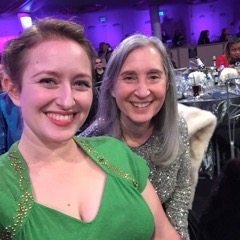
But the best part was enjoying the dazzling event, surrounded by glamorous stars, with my daughter, Rachel, a costume designer who works in Hollywood.  Here we are in our vintage gowns and furs.

BEST PICTURE
Boyhood

BEST ACTOR
Michael Keaton, Birdman

BEST ACTRESS
Julianne Moore, Still Alice

BEST DIRECTOR
Richard Linklater, Boyhood 

BEST ACTING ENSEMBLE
Birdman

BEST ADAPTED SCREENPLAY
Gone Girl

BEST ORIGINAL SCREENPLAY
Birdman

BEST COMEDY
The Grand Budapest Hotel

BEST ACTRESS IN A COMEDY
Jenny Slate, Obvious Child

BEST ACTOR IN A COMEDY
Michael Keaton, Birdman

BEST SUPPORTING ACTRESS
Patricia Arquette, Boyhood

BEST SUPPORTING ACTOR
J.K. Simmons, Whiplash

BEST SONG
“Glory,” Common/John Legend, Selma

BEST ANIMATED FEATURE
The Lego Movie

BEST ACTION MOVIE
Guardians of the Galaxy

BEST ACTRESS IN AN ACTION MOVIE
Emily Blunt, Edge of Tomorrow

BEST ACTOR IN AN ACTION MOVIE
Bradley Cooper, American Sniper

BEST YOUNG ACTOR/ACTRESS
Ellar Coltrane, Boyhood

BEST SCI FI/HORROR MOVIE
Interstellar

BEST DOCUMENTARY FEATURE
Life Itself

BEST CINEMATOGRAPY
Birdman, Emmanuel Lubezki

BEST VISUAL EFFECTS
Dawn of the Planet of the Apes

BEST EDITING
Birdman, Douglas Crise, Stephen Mirrione

BEST ART DIRECTION
The Grand Budapest Hotel, Adam Stockhausen/Production Designer, Anna Pinnock/Set Decorator

BEST COSTUME DESIGN
The Grand Budapest Hotel, Milena Canonero

BEST HAIR & MAKEUP
Guardians of the Galaxy

BEST SCORE
Antonio Sanchez, Birdman

BEST FOREIGN LANGUAGE FILM
Force Majeure (Sweden)

Related Tags:


Awards

Exclusive Trailer: Horse Camp with Dean Cain

Posted on January 16, 2015 at 6:00 am

All her life Kathy has wanted to ride a horse. Her dreams finally come true when her parents send her to a prestigious horse camp. Most of the girls at camp could see that Kathy is a natural with the horses and all the animals, but some of the other campers prove to be a bit more difficult. She tries her best to fit in and make friends and soon blossoms into a spectacular rider. When she challenges the most popular girl at the camp, Kathy soon finds out that kindness is always a winner. We are delighted to be able to premiere the trailer for “Horse Camp,” starring Dean Cain and Jordan Trovillion.  The DVD is exclusively available from Walmart and the film can also be seen on VOD.

Related Tags:


Trailers, Previews, and Clips

A Most Violent Year

Posted on January 15, 2015 at 5:58 pm

B+
Lowest Recommended Age: Mature High Schooler
MPAA Rating: Rated R for language and some violence
Profanity: Very strong language
Alcohol/ Drugs: Drinking, smoking
Violence/ Scariness: Crime and violence including guns, suicide
Diversity Issues: A theme of the movie
Date Released to Theaters: January 16, 2015
Date Released to DVD: April 6, 2015
Amazon.com ASIN: B00RNELG5E
Copyright A24 2014
Copyright A24 2014

After three very different movies, we know two things about writer/director J.C. Chandor. First, he is already one of today’s most original, thought-provoking directors, with a remarkably mature and insightful eye, and second, he is vitally interested in the survival instincts of characters who are under the direst of pressures. His “Margin Call” is the best take we have seen yet from Hollywood on the Wall Street meltdown, taking place in one day as a huge financial firm finds out it is on the wrong side of a bet that will bring down the entire company. It is filled with sharp, smart, character-defining dialogue that all but sizzles. His second film was “All is Lost,” an almost-wordless, one-character story with Robert Redford trying to stay alive a boat that is damaged in a collision, and an ending that viewers are still debating. And now, his third film is his first period piece, set in 1981 New York, one of the most violent years in the city’s history.

Oscar Isaac and Jessica Chastain star as Abel and Anna Morales, husband and wife and ambitious owners of a home heating oil company. The company is doing well and they have the chance to take it to the next level with the purchase of some property on the water that will reduce their delivery costs. But they are under tremendous pressure, moving into an expensive new home, on the hook to come up with the money for the land in 30 days, under investigation by a prosecutor who is equally ambitious (“Selma’s” David Oyelowo), and being pushed hard by cut-throat competition from his competitors, who harass his drivers, hijack his trucks, and steal his oil.

Like Michael Corleone, Abel wants to be strictly legitimate, but he is not there yet.

Both husband and wife are trying to move past their origins into the upper middle class. Abel is an immigrant who began as a driver for the company when it was owned by Anna’s father, a gangster.  They love each other deeply, but each is by nature mistrustful and secretive.  “You won’t like what happens if I get involved,” Anna tells Abel, and they both know he is right.  Anna and Abel may have some trust issues but Isaac and Chastain, who have been friends since they studied together at Juilliard, as actors have a fearlessness with each other that requires complete trust as actors.  Every scene they are in together crackles.

We first see Abel running through the streets.  This was when running first became popular as exercise.  But Abel is running all the time.  Isaac is always calm and reassuring in his manner, but he has a white-hot inner fury.  That is probably what drew Anna to him.  He wants it all — money, respectability, family.  And he knows that in order to get it he will have to deal with some very bad people and some very weak people and that means he might have to do some very bad things and some people might get hurt.

In his first period film, Chandor creates an atmosphere so authentic we can almost taste the smog.  He has been compared to Sidney Lumet for the gritty, layered texture of the settings and the storyline.  He is extraordinarily gifted with actors, starting with the casting.  Alessandro Nivola is superb as a highly civilized gangster who lives in a home so fortified it tells us how thin that veneer of civilization really is.  He creates a complex and fully-realized world that brings home Faulkner’s famous line: “The past isn’t dead.  It isn’t even past.”

Parents should know that this film includes very strong language, and some peril and violence including guns, suicide, and criminal activity, drinking, and smoking.

Family discussion: How would this story be different if it took place today?  Why does the film begin with Abel running?

If you like this, try: “Margin Call” and “All is Lost” from the same director

Related Tags:


Crime Drama DVD/Blu-Ray Pick of the Week
THE MOVIE MOM® is a registered trademark of Nell Minow. Use of the mark without express consent from Nell Minow constitutes trademark infringement and unfair competition in violation of federal and state laws. All material © Nell Minow 1995-2025, all rights reserved, and no use or republication is permitted without explicit permission. This site hosts Nell Minow’s Movie Mom® archive, with material that originally appeared on Yahoo! Movies, Beliefnet, and other sources. Much of her new material can be found at Rogerebert.com, Huffington Post, and WheretoWatch. Her books include The Movie Mom’s Guide to Family Movies and 101 Must-See Movie Moments, and she can be heard each week on radio stations across the country.

Website Designed by Max LaZebnik