
Blue Moon
Posted on October 21, 2025 at 5:24 pm
A-| Lowest Recommended Age: | High School |
| MPAA Rating: | Rated R for language and sexual references |
| Profanity: | Very strong and explicit language |
| Alcohol/ Drugs: | Drinking, smoking, alcoholism |
| Violence/ Scariness: | Reference to sad death and wartime trauma |
| Diversity Issues: | References to homophobia |
| Date Released to Theaters: | October 24, 2025 |
Lorenz Hart, called Larry by most people, was one of the greatest lyricists of all time. He and Richard Rodgers created songs of ineffable wit and pure poetry, mingling melancholy with romanticism, songs like “My Funny Valentine” (“Your looks are laughable/unphotographable/but you’re my favorite work of art”), “Bewitched, Bothered, and Bewildered” (“I’m wild again, beguiled again/A simpering, whimpering child again/Bewitched, bothered and bewildered – am I”), and the song that gives this movie its title, “Blue Moon” (“And then there suddenly appeared before me/The only one my arms will hold/I heard somebody whisper, “Please adore me”/And when I looked, the moon had turned to gold”).
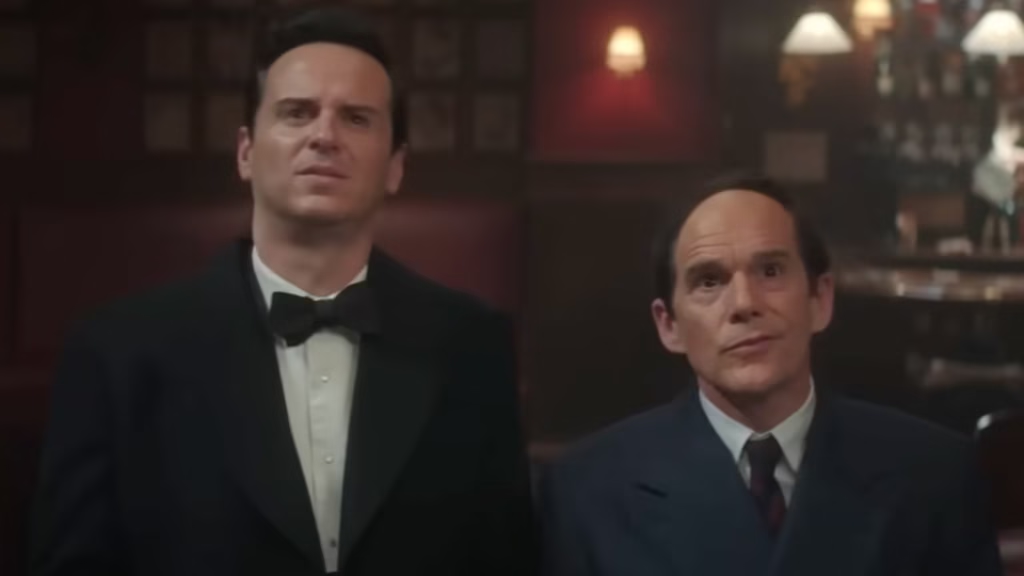
This movie takes place on one night, almost entirely in one place, Broadway’s favorite bar and restaurant, the now-century-old Sardi’s. It is 1943, and it is a night that will change American theater and the fortunes of Rodgers and Hart forever. Unfortunately the fortunes of the two men will change in opposite directions. It is the opening night of “Oklahoma!” (with an exclamation point in the title), which moved Broadway musicals from fanciful light entertainment with forgettable plots and dancing chorus girls doing taps and kicks to stories about American archetypes, choreographed by Agnes de Mille, who made the dance help define the story and characters, and with songs by Rodgers and his new partner, Oscar Hammerstein, that moved the story forward.
Hart (played by Ethan Hawke, with a comb-over and some movie magic to make him appear to be under five feet tall), sees the opening number of the show and knows immediately that it will be a huge hit, that it is corny and superficial, that he could never produce anything like it, and that his partnership with Rodgers is doomed. So he leaves the play and goes to the bar, where he talks to a sympathetic bartender (Bobby Cannavale) and a GI on leave, playing the piano (Jonah Lees).
One of the most heartbreaking and beautifully written scenes of the year has Rodgers (Andrew Scott) and Hart talking about the possibility of working together again. They argue about the purpose and meaning of what they do. Hart wants to send a message. Rodgers wants to make people happy and be successful. Rodgers wants to meet at 9 and work on a schedule. Hart wants to struggle for inspiration. It is agonizing to watch as it is for the characters because they have obvious respect and admiration and gratitude for one another, and because they are both right, both wrong, and incapable of finding a way to reach one another. Another brilliantly conceived scene has two of the mid-century’s most gifted writers talking to each other, Hart and E.B. White (Patrick Kennedy). The dialog is gorgeously written, a conversation between two men who know what it is to appreciate language of precision and beauty.
The movie is about Hart’s fatal combination of sense of superiority and self-loathing. We sometimes see that conflict in his lyrics, as in “The Lady is a Tramp.” He is charming and seductive but he is also smart enough to deliver devastating barbs. Hart is anguished by longing for the impossible, here personified by a 20-year-old college girl named Elizabeth (Margaret Qualley).
He wants desperately to be loved. He quotes the line from “Casablanca,” “Nobody ever loved me that much.” But he is so terrified of the risks of intimacy that he is compelled to pursue the unobtainable or push away anyone who might get too close, to make sure he never gets another “I love you, but not that way” response. Elizabeth wants to use him to meet Rodgers, but she really does care for him. Unfortunately, what she loves about him is his endless, hungry interest in what she says, things, and does, which she is young enough to mistake for affection instead of manipulation and a twisted sense of himself as the participant in her stories rather than the one who hears them after the fact.
Elizabeth is based on a real-life character whose correspondence with Hart was part of the basis of the film. But the big scene between them is a disappointment, too long, too redundant. The brief appearances by not-yet-famous visitors to the opening night party whose names might be more recognizable today could be of interest to those immersed in theater history, but it becomes stunt-ish and distracting. That is just because the rest of it is so good we want to get back to what it does
Director Richard Linklater and screenwriter Robert Kaplow last worked together on the under-appreciated “Me and Orson Welles,” another story about a complicated creator of ambitious art. And Linklater has a second film coming out this year, “Nouvelle Vague,” about another complicated creator of ambitious art, Jean-Luc Goddard as he made his first film, “Breathless.”
In the film, Hart explains that he fell in love with intricate internal rhymes when he heard George M. Cohan’s “Over There.” Kaplow’s script is itself lyrical, a beautiful meditation one life, art, loss, and longing, and this film shows us that Hart is himself something of an intricate internal rhyme, complex, unexpected, and sometimes hard for others to understand.
Parents should know that this movie includes drinking and alcoholism, smoking, strong language, and explicit sexual references.
Family discussion: Why was it hard for Rodgers and Hart to understand each other and compromise? What do we learn from Hart’s conversation with E.B. White?
If you like this, try: Listening to Ella Fitzgerald singing the Rodgers and Hart songbook, and if you don’t mind its utter historical inaccuracy and just want to enjoy performances of classic Rodgers and Hart songs by Judy Garland, Lena Horne, Betty Garrett, and Mickey Rooney, watch “Words and Music”