
Tribute: Leonard Nimoy

Posted on February 28, 2015 at 12:00 pm

We mourn the loss of Leonard Nimoy, who created one of the most iconic characters of all time, “Star Trek’s” half-Vulcan, half-human Mr. Spock, with pointed ears and angled eyebrows perfectly designed to convey a wry sense of irony.  The storylines of the original “Star Trek” were provocative political and cultural allegories, but the heart of the show was the reflection of the internal struggle we all try to reconcile: fire and ice, Athenian and Spartan, id and superego — between the passionate, impetuous Captain Kirk (William Shatner) and the cerebral, deliberate Mr. Spock.

Adam Bernstein wrote in the Washington Post:

Spock was the ultimate outsider — a trait Mr. Nimoy said he understood. He was Jewish and had grown up in an Irish section of Boston. Going to movies as a child during the Depression, he was drawn to actors who specialized in bringing pathos to the grotesque — especially Boris Karloff in “Frankenstein” (1931) and Charles Laughton in “The Hunchback of Notre Dame” (1939).

By most accounts, Mr. Nimoy portrayed the most popular character of the “Star Trek” cast. While some critics thought that Mr. Nimoy’s acting was dour or wooden, fans might have argued that these were precisely the characteristics of the emotion-suppressing, logic-obsessed Spock.
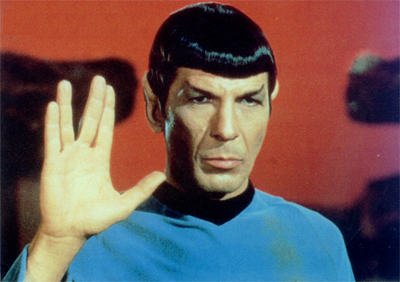
Copyright 1968 Paramount

Nimoy was a fine actor, and he gave a dry wit to Mr. Spock. The character was fascinating because of his emotionless, stoic, purely rational approach.  Once in a while, his human side showed through. And although most of the time he seemed to conclude (rationally) that the Vulcan approach was superior, he occasionally seemed to envy his human colleagues’ capacity for emotion. And certainly, he showed himself capable of friendship with Captain Kirk.

I loved his father’s explanation of why he married a human: “It seemed the logical thing to do at the time.” Spock also had the enviable ability of telepathy and could immobilize a humanoid enemy with a neck nerve-pinch.

Bernstein’s obituary quoted an interview Nimoy gave to the New York Times:

“I knew that we were not playing a man with no emotions, but a man who had great pride, who had learned to control his emotions and who would deny that he knew what emotions were. In a way, he was more human than anyone else on the ship.”

He added: “In spite of being an outcast, being mixed up, looking different, he maintains his point of view. He can’t be bullied or put on. He’s freaky with dignity. There are very few characters who have that kind of pride, cool and ability to lay it out and walk away. Humphrey Bogart played most of them.”

He spoke to Pharrell Williams about his life and career and developing the character of Spock.

The devotion of “Star Trek’s” fans is legendary, and the subject of documentaries including Trekkies and its sequel, and no character had more fans than Mr. Spock.

A particularly fitting tribute was in an episode of “The Big Bang Theory,” where the hyper-rational Sheldon Cooper (Jim Parsons) has the most emotional reaction in the history of the series because he receives a special gift, a napkin that had been used by Leonard Nimoy.

In another episode, Nimoy provided the voice for Cooper’s Mr. Spock action figure.

Nimoy was the son of Jewish immigrants from what is now Ukraine. It was his idea to use the traditional rabbinic blessing gesture, with the fingers spread apart in a V shape as the Vulcan greeting.

He was also a successful director, not just of “Star Trek” films but also of the popular comedy “Three Men and a Baby” and the Diane Keaton drama “The Good Mother.”

In 1968, Nimoy responded with warmth, generosity, and wisdom to a letter from a biracial girl who identified with his bi-planetary character. He told her to “realize the difference between popularity and true greatness. It has been said that ‘popularity’ is merely the crumbs of greatness. When you think of people who are truly great, and who have improved the world, you can see that they have realized that they are people who do not need popularity because they knew they had something special to offer the world, no matter how small that offering seemed. And they offered it and it was accepted with peace and love.”

He left us with a beautiful final message via Twitter.

A life is like a garden. Perfect moments can be had, but not preserved, except in memory. LLAP

Nimoy gave us many perfect moments.  As long as there are devices to view content, new generations of fans will love and be inspired by Mr. Spock. May his memory be a blessing.

EPIX will pay tribute to Nimoy this weekend.

A Conversation with Leonard Nimoy: AIRING: Friday 2/27 – 11:00PM ET, Saturday 2/28 – 5:40PM ET & 10:00PM ET, Sunday 3/1 – 8:00PM ET 

Leonard Nimoy shares insights and personal anecdotes from his nearly 50-year involvement with the phenomenon that is Star Trek.  

Star Trek Into Darkness: AIRING: Saturday 2/28 – 10:15PM ET, Sunday 3/1 – 8:15PM ET

In the wake of a shocking act of terror from within their own organization, the crew of The Enterprise is called back home to Earth. In defiance of regulations and with a personal score to settle, Captain Kirk leads his crew on a manhunt to capture an unstoppable force of destruction and bring those responsible to justice. As our heroes are propelled into an epic chess game of life and death, love will be challenged, friendships will be torn apart, and sacrifices must be made for the only family Kirk has left: his crew.

Related Tags:


Actors Television Tribute

Interview: Ryan Potter, Hiro in “Big Hero 6”

Posted on February 24, 2015 at 3:58 pm

Ryan Potter provided the voice for Hiro in this week’s DVD/Blu-Ray Pick of the Week, the Oscar-winning Big Hero 6. Talking to him on the phone, it was easy to imagine I was talking to Hiro himself.

Other than a few moments with Maya Rudolph, who played Hiro’s harried guardian, he did not interact with the other voice performers. But, he told me, he was never recording by himself. “You know, it’s funny, sometimes you work with another actor, sometimes you don’t, but you are never really in a room by yourself. You are in the room with people just as important as other voice cast members of the film. You are in the room with the head of production, the director, the producer, the editor, the sound engineer the head of story. You get to create with people just as important to the film as let’s say Scott Adsit, who played Baymax. So you’re never in there by yourself.”

Copyright 2014 Walt Disney Studios

He was excited to find out that “Baymax is kind of a real thing. Someone over at Carnegie has created soft robotics and it’s unreal. There’s kind of danger of having a robot nurse or a robot caregiver is that they could potentially harm you because they are made out of metal. And we’re not made of metal so we are definitely susceptible to being injured by that. But having a soft kind of robot, not pliable but a rubbery or a bouncy nurse would make total sense. They would be able to be a caregiver without harming you.”

Potter told me that the filmmakers wanted “to cast true to Hiro’s ethnicity, which was Japanese-American. They just couldn’t quite find somebody and I guess they didn’t know about me at the time. And they were calling school programs and church groups. Don Hall was not going to give up on casting a Japanese-American, so when they found out about me I guess they were very excited and it kind of showed in the audition process. You usually to go in do this whole song and dance and go, ‘Oh how did I do?’ and the casting director would go like, ‘Alright, thank you, bye.’ This time I went in and I met Don and he was kind of quizzing me on Japanese pop culture. The two of us vibed. Instead of an audition it was more of a work session. It kind of created what Hiro ended up being in that audition. At the end of the day it came down to me being myself. And it was very surreal, I walked out of there very confident in what would we had done and couple hours later they called and asked what my availability was, and if I could send them everything I have done work wise. A couple weeks later we got the call that we got it and I’m like, ‘You are sure you don’t want to do a second audition?’ It was great.”

Copyright 2015 Ryan Potter

In creating the character, Potter had “a little bit of source material with the comic books,” but “Disney wanted to do their own interpretation. I saw how similar he looked to me when I was 13/14 years old. I went in there and said, ‘that looks at me when I was in middle school.’ So it was great.” He has spent a lot of time in both San Francisco and Tokyo, so he especially enjoyed the imaginary world of “San Fransokyo.” “Being able to see the blend is just uncanny. Tokyo is in a constant state of renewal. When a building gets too old they tear it down and build something new. And San Francisco is the very opposite. They appreciated heritage and preserve it to the best of their ability. So seeing how well they blended the two cities is absolutely unreal. They didn’t lean heavily to one side or the other. It’s literally the perfect 50-50 blend of both Tokyo and San Francisco.”

He feels that 2014 was one of the best years in the history of film, especially films with very smart heroes. “The Theory of Everything,” “Whiplash,” “the Imitation Game” are just three that like “Big Hero 6″ celebrate smart individuals in their field. It is an absolute honor to be able to be in ‘Big Hero 6’ and to represent one of the most successful films of the year in a year where film was as important as it was 75 years ago, in a year of legendary classics.”

He is also proud of the film’s ground-breaking representation of diversity on screen, “what the United States genuinely looks like. If the United States is the melting pot of the world you need entertainment, you need visuals that represent that. They were the first multicultural animated Disney characters of all time. I am very proud to be able to be a part of the film that’s going to open so many door for the Asian American community and the Latin American community and the African American community.”

Related Tags:


Actors Interview

Julianne Moore and Patricia Arquette — Why We’re Rooting for them on Oscar Night

Posted on February 18, 2015 at 11:02 pm

No one is smarter about actors and Oscars than Susan Wloszczyna, and I was honored to be included in her latest Big O piece about front-runners Julianne Moore and Patricia Arquette, and why wins for the two of them will be especially satisfying.

But what will make a triumph for Moore even more satisfying is that the 54-year-old actress, who has been nominated four times before with no Oscar to show for her efforts (and probably should have had a fifth nod for 2010’s “The Kids Are All Right”), is considered long overdue. She hasn’t even been in the race since 2002.

Meanwhile, 46-year-old Arquette — a member of a high-profile acting clan who made her film debut in 1987’s “A Nightmare on Elm Street 3” — has never gotten the recognition she deserves for her standout roles in such films as 1993’s “True Romance,” 1994’s “Ed Wood,” and 1996’s “Flirting With Disaster.” She has been better served as the star of the TV series “Medium,” which aired for seven seasons starting in 2005 and won her an Emmy.

As for Arquette’s role in “Boyhood,” in which she plays a devoted mother determined to better her position in life, it is essentially a lead and probably the most substantial showcase for her talent that she has ever had. That alone practically assures that she will not go away empty handed.

Fingers crossed for both of them Sunday night.

Related Tags:


Actors Awards Critics Understanding Media and Pop Culture

Meryl Streep as The Worst Singer Ever and Why We Love Awful Failures

Posted on February 17, 2015 at 3:57 pm

Why is complete artistic failure so fascinating? I’m a huge fan of Epic Fail: Bad Art, Viral Fame, and the History of the Worst Thing Ever by Mark O’Connell, who pays tribute to the “sort of accidental surrealism” of bad art from people who have no idea how bad it is. He describes a mental condition called the Dunning-Kruger effect. “Not only do they reach erroneous conclusions and make unfortunate choices but their incompetence robs them of the inability to realize it.” The people with the lowest competence were also the most likely to overestimate their ability, especially in areas like humor, logic, and grammar. It is kind of the opposite of the Imposter Syndrome, sort of being your own courtier in the story of the Emperor’s New Clothes.

One legendary example of this syndrome was a wealthy woman named Florence Jenkins, who wanted very badly to be a great opera singer but who had a dreadful, off-key voice. Her still-popular recordings include The Glory (????) of the Human Voice. Meryl Streep will be playing Ms. Jenkins in an upcoming film, with Hugh Grant co-starring. Can’t wait to see it. In the meantime, here is the original.
And a reminder of what it is supposed to sound like.

Related Tags:


Actors In Production

Tribute: Louis Jourdan

Posted on February 16, 2015 at 7:20 pm

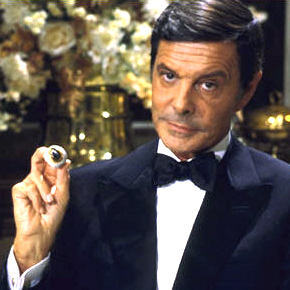
Copyright MGM/UA 1983

We mourn the loss of French movie star Louis Jourdan, who has died at age 93. Best remembered as the handsome, elegant, bored Gaston who lost his heart to Gigi (Leslie Caron), he appeared in a variety of roles opposite leading ladies from Elizabeth Taylor (“The VIPS”) to Grace Kelly (“The Swan”), Shirley MacLaine (“Can-Can”), and Doris Day “Julie.” Adam Bernstein’s astute obituary for the Washington Post noted that Jourdan was not happy playing the all-purpose European romantic lead, and especially enjoyed his chance to be a Bond villain in “Octopussy.” May his memory be a blessing.

Related Tags:


Actors Tribute
THE MOVIE MOM® is a registered trademark of Nell Minow. Use of the mark without express consent from Nell Minow constitutes trademark infringement and unfair competition in violation of federal and state laws. All material © Nell Minow 1995-2026, all rights reserved, and no use or republication is permitted without explicit permission. This site hosts Nell Minow’s Movie Mom® archive, with material that originally appeared on Yahoo! Movies, Beliefnet, and other sources. Much of her new material can be found at Rogerebert.com, Huffington Post, and WheretoWatch. Her books include The Movie Mom’s Guide to Family Movies and 101 Must-See Movie Moments, and she can be heard each week on radio stations across the country.

Website Designed by Max LaZebnik