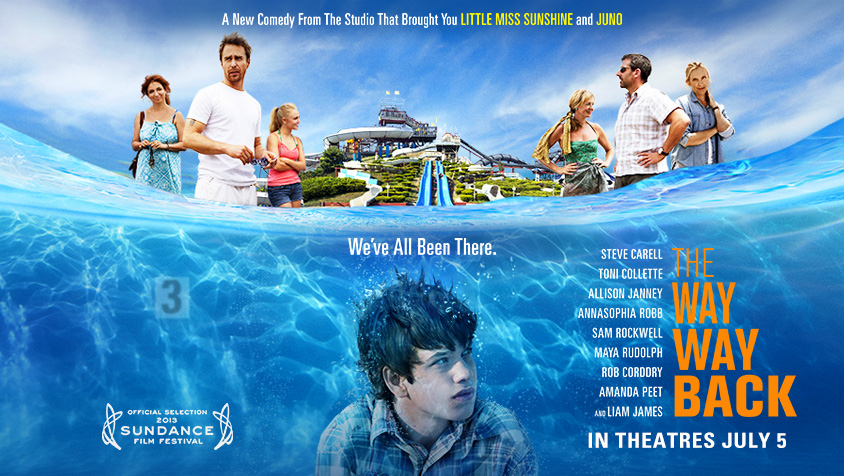
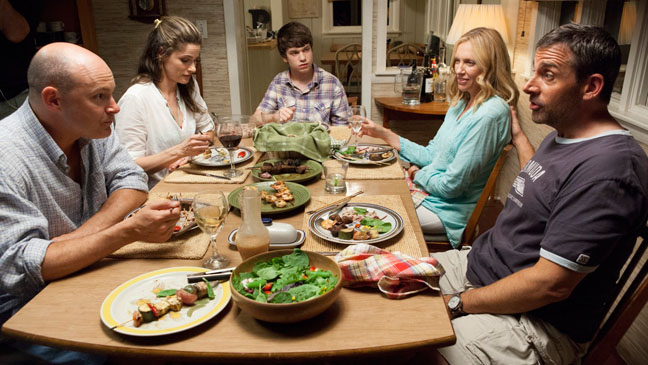
 Nat Faxon and Jim Rash won a screenwriting Oscar for “The Descendants” and won the next day’s headlines by imitating Angelina Jolie’s leg-out pose when they accepted it. I talked to them about “The Way Way Back,” which they wrote, produced, directed, and appear in as actors. It is a coming of age story about a 14-year-old boy named Duncan (Liam James), reluctantly staying at a summer home on the beach with his mother, Pam (Toni Collette), and her new boyfriend, Trent (Steve Carell). To get out of the house, he takes a job at a local water park, where he is befriended by the manager (Sam Rockwell as Owen). Faxon and Rash play some of the other employees. I talked to them about casting Steve Carell as a bad guy, using Spotify to find songs for the film, what acting has taught them about directing, and the very important task they forgot on the first day.
Do all teenagers look for a new family?
NF: You’re always saying, “I don’t belong here! Where is someone who understands me?” We all go through that.
JR: Except me! My family was perfect. (Laughs)
What do we look for?
NF: We think there’s something better, someone who’s not going to tell us what to do. We hope there’s always going to be a cheerleader who will give us independence. And then we realize — hopefully — that the place we were in was good for us in the long run.
Adolescence is such an excruciating time of life and yet we keep being drawn to those stories.
JR: The vulnerability that you have at that age, the innocence that is transforming, a rite of passage, becoming more of a free-thinker, more opinionated about what your views are and what you like and don’t like as emblems of who you are — there’s something very relatable and very honest in that transition time. With the help of someone else or on your own, you’re making that leap and that’s universal no matter where you come from.
NF: And once you’ve been through it, you have a context, and you can look back and remember it and understand more than you could when it was happening. You’re endeared to these characters pretty instantly because you know exactly what this is.
Who thinks of nicest-guy-in-the-world Steve Carell as a bad guy who is a liar and a bully? Where does that come from?
NF: We went against type for a lot of reasons and he came to mind pretty fast. Steve’s character, Trent, is difficult. He’s a jerk, but he’s more complicated than that. He’s a tragic male character, stuck in a cycle. But we needed that innate likability. His girlfriend, Pam , where she is right now, she is scared, so she needs to see the attractiveness in this protection he offers. We see him with his friends. We see what he’s like with them, and how he is appealing. We needed an actor who understood that Trent’s not on a typical arc of change. He’s in a circle of non-change. Some people who have seen it a second time start to feel some sympathy for him. Not that they want to hang around him, more like, “I hope you get better,” or “I hope you wake up.” He’s also needed for Duncan and Pam to allow them to have this moment of awakening. So Steve was perfect because he embraced that.
And Steve Carell was probably thrilled to play a role like this.
NF: He wrote us a very nice note saying that he loved the script. And then there was this phrase…
JR: He said, “I love this, but, lest I become a Trent to my own family, I have to decline.” We were shooting during the summer and he spends a lot of time on the east coast with his family. He didn’t want to be on location away from them. So we wrote back and said, “What if we shoot where you’ll be?”
That’s how you found your location?
JR: And so he said all right. We were originally planning North Carolina, which is where I’m from. But the East Coast experience is the East Coast experience. East Coast destination vacations are completely different to me than West Coast, where we are now. We were like, “We can shoot in your back yard.”
NF: We lucked out in terms of locations. We were so fortunate because our scouting literally took one day. We had two locations that were central in the movie, the water park and the house. We found one in the morning and one in the afternoon. We wanted the place to feel local and not one of these enormous, corporate, Six Flag-y type water parks. We also didn’t want it to be so sad and pathetic that you would never go there. It had to be fun and sort of Oz for our movie. And this place really exists, it’s really named Water Wizz, off of Route 28, and it really is a family-owned establishment. It’s the perfect size, it’s the perfect look, it had everything that we needed. We shot there while the park was open, and so a lot of those people were just water park go-ers.
What have you learned as actors that helps you work with actors as directors?
NF: Because we know this material and we are actors and have had the fortune to work with good directors, we know that for actors it is nice to talk about the character, what makes them this way. There are directors who are more technical. We are more about how we know the script, we know the intent, we know the performance, we know actors. We put that angle on it, and we try to keep those conversations with the actors about that. These people are fantastic. All you need is to give them any kind of clarity about what is happening now, what’s it about, where we are in the story. And then you just let them have a little free reign to explore that. And we’re all in a tight time line, so we have to do it in four takes! Some of these bigger movies, they’re shooting two pages a day, and so that’s different — we have to shoot six to make our time line. And we had a lot of one set-ups, maybe two set-ups. We had walks along the beach that was basically one shot, sitting and waiting for Trent at one point, all in one shot. So we did a lot of those for time and for the aesthetic of feeling in the moment, feeling that we’re voyeurs, eavesdropping on this moment. Both creative and logistic decisions.
JR: Trying not to micro-manage, letting the actors trust their instincts, trying not to over-note them. That’s something that feels more comfortable when you’re not thinking about the twelve things the director just told you but just one or two adjustments that might help.
What guided you as first-time directors with camera placement and all the technical stuff? Who influenced you?
NF: Being first-time directors, it was important for us to surround ourselves with very experienced, talented department heads, like our Director of Cinematography, John Bailey, whose list of films is incomparable. We had a lot of discussions with him about the look and feel — that was something we could speak very confidently about. It’s important while Duncan is in the house that he feel very isolated and claustrophobic. What’s the best cinematic way to achieve that? Should we put the camera down low to feel a little bit of the closing in? Then when we get to the water park it would be great to have it more open and fluid and vast and colorful, use steadicam more. When it got super-technical, lenses and all that, we would just say, “That looks great!” “You got it!” That’s the benefit of having someone like John Bailey, who you can trust with all of the little, important, specifics.
And you worked with one of the greats in costume design!
JR: The legend, Ann Roth.
NF: Our producer had worked with her on “The Hours” and a bunch of other movies. He reached out and she read the script and she loved it and wanted to be a part of it. We were so incredibly fortunate. You don’t have to work with her to know what a legend she is, and to work with her is really fun because she is such an incredible personality and you want to spend as much time with her as possible.
JR: Just for the soundbites!
NF: She is brutally honest and she wants you to be brutally honest but terrifies you! The actresses showed up and it was fantastic. We would talk about the characters and as soon as they knew it was Ann Roth, they said, “Fine. She’ll tell me what to wear.” They trust her so completely. That type of care and confidence.
She’s so intimidating. She had an idea for a shirt for Duncan in the opening scene. In our eyes it felt slightly too Midwestern, maybe like a farm boy look. I worked up the courage to say, “Ann, I just want to let you know, we might want to go another way with the shirt, look at some other choices….” and she goes, “All right…” and calls the co-designer, Michelle Matland, and says, “THE DIRECTOR DOES NOT LIKE THE SHIRT. THE SHIRT WILL NOT PLAY!!” And I was like, “I’m so sorry! Is that okay?” “I PREFER THAT YOU TELL ME WHAT YOU WANT.” She’s very intimidating, but very collaborative. She wants to know what your opinion is and respects you more if you are able to tell you that.
JR: She was so excited because the pants Allison is wearing the first time you meet her, these tight pants with a rodeo on it, she has been trying to get that into a movie forever. Shirley MacLaine wore them many many many years ago, and she’d been saving them. She pulled them right out and did not miss a beat.
NF: She is a love and a joy to work with and so is Michelle, who is a wonderful counter-balance.
I thought the music was exceptionally well chosen, too.
JR: We had Linda Cohen. We were on a budget and music is not cheap. We wanted to make sure the film had a cross-section of music to represent both the characters — Trent probably had CDs he left at the beach house year after year — and we needed some more modern stuff for the water park, with a blend of what Owen would love. Imagine his Shuffle. We wanted to make sure it had a timeless feeling. When you’re a kid at first your taste relates to your parents’ music, and then it evolves. We had to get creative. Linda sent us tons of great music and sometimes we would put bands we loved into Spotify and that’s how two songs came, from Trampled by Turtles and The Apache Relay.
NF: My father-in-law is this legendary drummer, Steve Gadd, and he knows an incredible amount of artists. I said, “if there’s anybody you can think of, we’d love your help in any possible way.” He had been playing with Edie Brickell and he made the connection. She watched the movie and really liked it and wanted to be a part of it. She sent us song after song after song for ideas for the movie. She was so sweet, so collaborative, so creative, an amazing wealth of music. Two of those songs bookend the movie. They fit so well and we were so fortunate.
How did you cast yourselves?
NF: We knew we needed a great-looking guy…we played against type, really stretched ourselves. I was a little stressed out about it to do both. We didn’t have the technology to make it a little easier, playback, monitors, so you could see what you’re doing. So it was a bit of a challenge. But we started writing together because we wanted to write parts for ourselves that Hollywood had decided we didn’t play. Not these particular roles, but it was frustrating because you go through these fazes with casting and movies, any actor, even a star. It’s really upon you to say, “No, no, I can do other things.” Sometimes you have to fight to audition for those things and hopefully you can prove that you’re right. Even though this is not exactly an example of that, that was our intention. It’s important for us always nurture the performers in ourselves. We’ll have smaller parts, and we’ll work cheap, save a few bucks, and we’re pretty easy to work with.
JR: We had rain the first few days and we didn’t have a lot of rain cover in terms of what else we could shoot. So we sort of pushed our acting debuts in the movie until near the end, but we were forced to do them on the first day because of the rain. There was one particular moment when we were in a scene and the scene just sort of ended and we’re looking around, “Hmm, somebody’s not saying ‘Cut.'” then we heard our producer, saying, “Um, cut…?” And we’re like, “Yes! Cut!” We had completely forgotten.

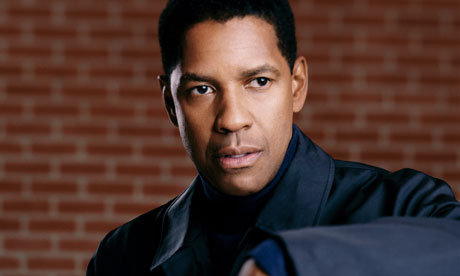 He has a couple of Oscars and is one of the biggest stars in Hollywood, but I don’t think we fully appreciate Denzel Washington, in my opinion the finest actor working in Hollywood today. As we look forward to “2 Guns” this week with Washington and Mark Wahlberg, let’s take a look at some of the highlights of his remarkable career.