
Interview: Daniel Ellsberg

Interview: Daniel Ellsberg

Posted on February 8, 2010 at 3:59 pm

The Most Dangerous Man in America: Daniel Ellsberg, a documentary just nominated for an Oscar, is the story of the man who gave secret government documents about the Vietnam war to newspapers for publication in 1971. The impact of his leak was seismic. And it continues to reverberate today as many of the same issues of military strategy and government accountability are debated by another generation.

Dr. Ellsberg, a one-time hawk on the war who had served as a Marine and worked in the Department of Defense, wrote his own book about his experiences and his views, Secrets: A Memoir of Vietnam and the Pentagon Papers. His dissertation, Risk, Ambiguity and Decision, is still considered a major contribution. I spoke to Dr. Ellsberg about the past, the present, war, peace, and the movie.

Are you the most dangerous man in America?

Not at the moment. Fom the point of view of the Obama administration it would be whoever leaked the secret cables of Ambassador Eikenberry, to the Times. I had not seen facsimile copies like that since the Pentagon papers. I am sure there is a tremendous search to find out who was responsible. It’s quite contrary to what Eikenberry testified to in Congress about being fully in accord to McChrystal’s recommendations for sending more troupes. The cables gave the lie to that, a warning against any such involvement.

Why were you considered so dangerous?

It wasn’t what has already been leaked that was the problem, it was their worry about what might be next. Kissinger feared I would put out material on Nixon, and that brought him down. It was that fear that led Nixon to get personally involved in illegal activity to try to stop me. And that led to his resignation and that led to the end of the war.

The movie doesn’t make really clear why I was regarded as the most dangerous man. Krogh referred to the fact that they thought I had documents on Nixon. That was why they went into my doctor’s office. That was the part that involved the president himself, in the case of the actions against me they had a number of witnesses that he ordered that himself. If it weren’t for that, he would not have had to cover up because the trail didn’t lead to him. The important thing was not to find out what I had as much as to keep me from putting it out.

They knew I had some material directly from Nixon’s office, because I had given it to Senator Matthias who wanted to be a Republican white knight. They had to worry about it without knowing exactly what it was, they had to take extreme measures including sending people to beat me up or possibly kill me.

The movie portrays you as a hero to many people. Who are your heroes?

Howard Zinn, one of the greatest human beings on earth. Noam Chomsky. People who have openly refused to go to war. Rosa Parks and Martin Luther King. I met met Rosa Parks on the way to my arraignment. I took a toothbrush and went off to a football field where they were meeting in New Orleans. If it weren’t for Rosa Parks and Martin Luther King I wouldn’t be where I am today. I was talking to her and said “You’re my hero,” and she said, “You’re my hero.” You can imagine what that meant to me.

Why this time? What made the difference? She said, “I had given up my seat to a white woman a number of times but had never been asked to give it up to a white man. I asked myself what I would do? I didn’t know what I would do.” When the moment came, she knew, and she said no. It is the way things happen.

You don’t know what you are doing or how you will respond until you get into it, but it helps to think about it beforehand. The situation has arisen before and people think about it and then they are cocked like a pistol and ready to do it. Now is the time.

You were a team player and then decided to play for a bigger team.

That’s well put! A much bigger team in numbers. The key thing there was meeting people who were on the larger team like Bob Eaton. We stood in a vigil line for him, he was going to prison for draft resistance. Stepping into that vigil line, standing in front of the post office on a hot day, when I had been writing something for Nixon, I could not do both. It was like the first date with Patricia, marching around the White House and worrying that a picture of me might appear in the Post.

I didn’t have a good excuse for getting out of going to the protest. I thought of saying I was sick that day but I was shamed into standing in that line. Once you’re in the line it was like stepping over the line at a recruiting station. I had stepped over a line and was recruited into the anti-war movement. Passing out leaflets instead of writing memos for the President, in my mind I had shifted sides from being an insider to being a citizen. Days later I had the experience of seeing Randy Keeler, but I don’t know if it would have had the same effect except for having been at that vigil.

Pastor Martin Niemoller was testifying while I was at the vigil, and he had a big influence on me. I was at the same war resister’s conference. I am still not a total pacifist. He had been a U-Boat commander in WWI. He was imprisoned in 38 or 39 and spent the war in Dachau. The famous quote always puzzled me.

In Germany, they first came for the communists, and I didn’t speak up because I wasn’t a communist. Then they came for the Jews, and I didn’t speak up because I wasn’t a Jew. Then they came for the trade unionists, and I didn’t speak up because I wasn’t a trade unionist. Then they came for the Catholics and I didn’t speak up because I wasn’t a Catholic. Then they came for me — and by that time there was nobody left to speak up.

He did speak out, so what is he talking about? He is describing the attitude of the average German. He told me that he had not been a pacifist in the second World War. He thought Hitler should have been opposed. He didn’t become a pacifist until 1950 when Heisenberg informed him about the coming H-Bomb. And that made him a nuclear pacifist. I was having lunch with a couple of pacifists and arguing with them as I had often done, a strong argument against total pacifism is the Brits who fired at the bombers over London.

Why do you oppose our military strategy in Iraq and Afghanistan?

The last thing that you do is the thing that Al-Qaeda wants to you to do. Osama bin Laden wanted us to invade Afghanistan and Iraq, which was his enemy anyway. Even better would be to attack Iran, his enemy, to get the Muslim world against us. We fell right into Obama’s trap, born and bred in the brier patch; he wanted that oil. I have no doubt that he prefers us to be fighting in Afghanistan forever. I would have cooperated with the rest of the world including people we do not like, make it easy for them to cooperate with us and share their information about those who want to attack us. There are ways to respond without generating recruits for the terrorists. Getting the oil was more important than Al-Qaeda, so that is where Bush went.

But you said you are not a complete pacifist. So how do you decide when force is necessary?

I was giving Niemoller my example of the Brits, etc. You could not stop Hitler’s blitzkriegs with non-violence. Non-violence would not have saved the Jews. As in the old cartoons a light bulb appeared over my head — violence didn’t save the Jews, nothing saved the Jews. They all died. Here was the cruncher, the ace up the sleeve, partly because we didn’t use our violence to save the Jews. It made me remember something by Raoul Wallenberg. The Holocaust could not have been carried out except in wartime conditions. You need the secrecy. I went to Neimoller and said is it possible that the resistance that people put up to Hitler was at the expense of the Jews? I thought he would take time but he said right away, “It cost the Jews their lives.” I have always realized that. It doesn’t mean that people weren’t justified in resisting but far from saving them, it doomed the Jews.

I asked what else am I wrong about?

What do you want from the movie?

If more people see the movie we will have more leakers like the Eickenberry cables and that will be for the good.

Related Tags:


Behind the Scenes Interview
Interview: Dominic Cunningham-Reid and Taran Davies of ‘Journey to Mecca’

Interview: Dominic Cunningham-Reid and Taran Davies of ‘Journey to Mecca’

Posted on January 19, 2010 at 3:55 pm

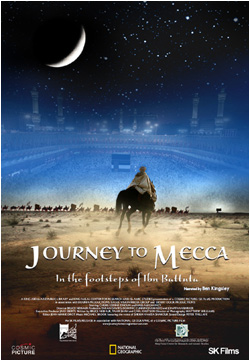
In 1325 a 21-year-old man named Ibn Battuta set out from his native Tangier on pilgrimage to Mecca that would take him 18 months. And now the story of that journey has become an extraordinary IMAX film, stunningly beautiful, soul-stirring, and genuinely historic.
The Hajj, or obligation to visit Mecca, is one of the core requirements of Islam. Battuta found it to be so important that he would return five more times over the course of travels that would take him 75,000 miles over 29 years. He was the greatest explorer of the Old World, traveling three times further than Marco Polo before returning home to write down the story.
Journey to Mecca” follows Battuta (played by Chems Eddine Zinoun) on his perilous journey in the context of a compelling picture of Islamic civilization during the 14th century. The story is book-ended by a close-up look at the contemporary Hajj, a pilgrimage to Mecca that draws three million Muslims from around the world every year who perform rituals that have taken place for over 1,400 years. JourneyToMeccaPoster01_250px.jpg
Dominic Cunningham-Reid and Taran Davies took time to speak to me on their recent visit to Washington about why the film was important to them and what was involved in getting it made.
It seemed to me that if you had made a list of every single obstacle to making a film, you not only covered them all, you added a few new ones. You had everything but a temperamental star — or maybe that was the camels.
TD: The camels might have been a little temperamental. It was really our personal Hajj in a sense. It just had to be done; I think that was the point. The IMAX challenges are enormous, particularly in this environment. There are millions of people there. Each roll of film lasts only three minutes and then you have to change your magazine. And each roll is incredibly expensive and you need several people to change the magazine. It is an incredibly daunting process in any environment but put that into one of the largest gatherings of people on earth and have them pull that off and it’s almost impossible.
The Hajj has been filmed before but only in low-quality video. It is so difficult to film logistically with the massive amount of people. And so we chose to really rise to that challenge and bring the greatest quality of production to this extraordinary cultural and spiritual event that deserves to be documented in such a fashion.
The images are stunning, exquisitely breathtaking. IMAX was really made for those vistas.
TD: There is some CGI in the film. We re-created Medina and Cairo in the 14th century. But the contemporary Mecca material with the Hajj, that is as it is. You see Mount Arafat on the Day of Standing, the holiest day of the Hajj from a helicopter we’re circling at dusk just a couple of hundred feet above the ground — totally unique, never been done before shot — with literally two million people in that frame. If you asked why would anyone do this, why would anyone make this film, that is the reason.
That is such a powerful image. Tell me about the historians. You worked with a wide variety of experts who did not always agree about some of the most sensitive issues.
TD: One of the crazy things we set out to do was really make the definitive film about the most sacred sanctuary of Islam and its rituals and we needed to get it right. We were working in a very sensitive environment where getting it wrong is not an option. We wanted to make sure that we brought on board as many experts on this subject as possible to make sure that we got it right. We had the leading experts on the Hajj, on Ibn Battuta, on Islamic architecture, on the architecture of Mecca, from all over the world, the United States, Morocco, Saudi Arabia, France, the UK, Kuwait, amongst other countries.
DC-R: The Grand Mosque of the year 1325, we had no visuals to go on. We had history books with verbal descriptions. We had to translate with all of the experts and research into a visual representations. One of the great moments we had is when we had actually sunk 18 pillars of the mosque and then the lead researcher calls up and says, “No, no, they weren’t square, they were round!”
Oh, no!
DC-R: So we had to pull them all out. And start again. Very, very challenging.
The biggest of challenges had to be your subject matter. It could not be more sensitive both from the perspective of believers and people who are ignorant of or hostile to Islam. How did you mediate differences between your experts?
TD: As I look back through time it is such a rosy picture of collaboration, I can’t really recall any disagreements! I think that would be too strong a word to describe what was a collaboration. We needed to receive as much information as we could on the subject of Islam and so we reached out to as many people as we could to provide it. We wanted to get things right from the way the ihram, the white cloth is worn. Do you have the shoulder uncovered or covered? Off-white? How off-white? What material is the cloth made of? Do the pilgrims in the 14th century wear sandals? When they perform the tawaf, what prayers do they say as they are circumambulating the ka’ba. If there were disagreements often among the Muslim community, they have different ways of doing things. It is a very daunting experience for them and many of them don’t know precisely how they are supposed to do it. It was as if we were doing the Hajj because we had to learn how do it right. We were approaching the ka’ba. We had to learn the proper way to perform the tawaf to be able to represent it.

(more…)

Related Tags:


Interview Spiritual films
Interview: Bruce Faulk of ‘Soul of the Church’

Interview: Bruce Faulk of ‘Soul of the Church’

Posted on January 18, 2010 at 12:00 pm

I was able to speak to the man behind the Black History Collection: Soul of the Church DVD, Bruce Faulk, who assembled a treasure trove of gospel performances into this stirring and inspirational collection. It even includes some of the vintage commercials.
Tell me how this production came together.
This was a syndicated mid-60’s television series called “TV Gospel Time.” It was the idea of a Chicago advertising agency. Their idea, which was rare at the time, was to go from town to town and record local gospel choirs and feature singers with the hosts being some of the best-known gospel singers of the time. The premise was unique. There were many many many many shows and we have just about all of them. This first release has sixteen of them and we were able with bonus material to include six songs from “Mahalia Jackson Sings.” It is an amazing array of the icons of the golden age of gospel. In many cases these are the only visual recordings of these artists. It’s just totally amazing. Just on this release we have James Cleveland, Sally Martin, the Blind Boys of Mississippi, Ernestine Washington, the Dixie Hummingbirds, Alex Bradford, Clouds of Joy. The Highway QC’s a group from Chicago was founded by two people you don’t think of as gospel — Sam Cooke and Lou Rawls. One of the celebrities is Ruth Brown. You don’t think of her as gospel; you think of her as a pop and R&B singer. But she’s here. This is an amazing look at Americana and gospel as an American form of music. It gives me chill bumps! Gospel means good news and this is certainly good news.
What a treasure trove! And it is history as well as music, culture, and worship.
It’s amazing that these survive; it’s amazing that they were recorded to begin with. Even though the show was sponsored by, recorded for, and broadcast to the African-American market, it crossed over to the Caucasian market. It was broadcast during church hour and it opened the music up to an entire new demographic.
Where did these come from and how did you come to them?
My background is in children’s programming. I worked in television animation and produced some well known seasonal pieces. I met a gentleman at CBS, a controller there, and to save room they were throwing away some old shows and he started buying. He now has the largest privately help film library in the world. These are kinescopes, camera pointed at the camera as it was broadcast live. Even though we’ve digitally enhanced it, it is still kinescope.
Growing up, a lot of these songs, I immediately wanted to see how they were handled by these singers. How did Marie Knight treat “Jesus Lifted Me?” “When the Saints Go Marching In,” or Tommy Browns doing “Keep Trusting.” I wanted to know how they did with the songs that were my all-time favorites and they were just amazing.
It’s like any other type of music — but jazz and gospel are American music. Gospel was the call and response put to music for an era when so many did not read. Over the years it’s been changed, augmented, tampered with, but you still find that line almost like a jazz riff that goes right through it. These recordings are like those early Sun recordings with Elvis. To see them work, to see their enthusiasm and spirit is something to behold.
Is there one performance that really is special to you?
Ernestine Washington doing “Down by the Riverside” just tears me up! She is the quintessential queen of gospel. The six songs from Mahalia Jackson, especially “Walk On” and “Just as I Am.” She was President Kennedy’s favorite singer and performed at his inauguration. She was Dr. Martin Luther King’s favorite singer.
What’s next?
We are working on a separate Mahalia Jackson release and we have enough for several more collections.
To order, click on Black History Collection: Soul of the Church

Related Tags:


Documentary Interview Music Musical Spiritual films Television Understanding Media and Pop Culture

Interview: Scott Cooper of ‘Crazy Heart’

Posted on January 11, 2010 at 3:57 pm

I spoke to writer/director Scott Cooper, whose first film, Crazy Heart has been acclaimed for its authenticity, its captivating music, and a performance by Jeff Bridges that many people believe will bring him his long-deserved Oscar.

You must be thrilled with the reaction your film is getting.

Oh, Nell, for a first time writer/director who has never been to film school or directed a commercial or a rock video — I am over the moon. Not just the critical response, but the reaction from my colleagues who have sought me out and who really loved the film. It just means the world to me.

And it must be a special joy to see the response to the performance of Jeff Bridges as the lead character, country singer “Bad” Blake.

I wrote the role for Jeff, and once I finished the film and sent the script to Robert Duvall, I told him that there are two people I need to make this film happen. One is Jeff Bridges and the other is T. Bone Burnett. In my estimation, both Jeff and Duvall are America’s two finest screen actors and I was able fortunately to get those guys. But I don’t want to overlook Maggie fine work and Colin Farrell.

I’m glad you mentioned Farrell, because I thought he was extraordinary as Tommy Sweet, the big country star Bridges’ character had mentored on the way up.

When I cast the movie, Colin Farrell is not the obvious choice. He looks like a movie star but he is really a character actor. He is a very humble guy. I felt like he’s the kind of guy who would support Jeff Bridges and Robert Duvall. And in such a short time on screen he gives such a nuanced, masterful performance, and he has a beautiful singing voice. It just was inspired all the way around. I wanted to design it so that you were set up to dislike his character and then he is humble and gracious and owes everything to this elder statesman and it all comes through.

One thing I respected about the film is what you left out — a lot of people would have put in a rehab montage and the usual scenes to make us feel we see all the details but you suggested them and then left it alone.

I think it is important that we realize this man is on a road to redemption. We all see redemption. We all are flawed individuals. The themes of hope and regret and loss, all of those course through this movie and course through our daily lives and course through the great country songs. So all humans who see this and suffer through the human condition will understand this.

So you’re a fan of country music?

Oh, I am! I literally cut my teeth in the Blue Ridge mountains of Virginia going to really great blue grass festivals in Virginia with my parents and then I segued to my father’s LP collection — Waylon and Cash and Haggard and Kristofferson. I loved that these guys wrote about their life experiences. So I was very well steeped in these songs and it was very personal to me. I hope that country music listeners will enjoy the picture and find a little bit of themselves in these characters and relate to it.

I wanted the pacing of the film, the look of the film, everything to have the feeling of an old George Jones song, “He Stopped Loving Her Today.” You have to really listen closely and let the song develop. It has a third less cuts than most films, a more languid pace.

So if you didn’t go to film school, did you watch a lot of movies and study them on your own?

I watched a lot of films from the 1970’s, my favorite decade of American film, and I would watch with the sound off, so I could see how they would move the camera, how they would tell the story through performance and lens selection. I would watch the greats like Terrence Malick, with “Days of Heaven” or “Badlands” or Robert Altman, Peter Bogdanovich, Coppola, all those guys. And film-makers of today, Sean Penn, Robert Duvall, Ed Harris, Billy Bob Thornton, guys who are complete film-makers, actors and writers and directors.

You said you could not do the movie without T. Bone Burnett. What does he bring to the movie?

He really is peerless in his Americana roots genre. He understands behavior, he understands characterization, he understands the un-obvious and he understood the alternate universe I wanted to create, one part Willie, one part Waylon and Kris, some Merele and Townes Van Zandt, Billy Joe Shaver. He could do that and bring it into this fictional character. He’s just a master at what he does. I told him we have to have a narrative thread through the course of this movie that him write a song over the course of this movie that helps him rediscover his artistry and helps him rediscover who he is as a person. Then we had Ryan Bingham, a young man who in my opinion is the heir apparent to Hank Williams, and he came in with “The Weary Kind” because that’s who Bad Blake is, he is a weary individual. It captures all the themes that I wanted and it’s a stunning, stunning song. It’s a part of the fabric of the film.

What inspires you?

My two beautiful girls inspire me every day. Great art. Music, gospel, classical, jazz. It’s part of my life. Mostly by people who aren’t afraid to take risks intheir lives, who live their lives as if every day was their last. People who have strong convictions.

What did you learn from your first film?

The most important lesson I learned was to always trust your instincts, never stop learning — and steal from the best, because I surely did.

Related Tags:


Behind the Scenes Directors Interview Writers
Interview: Michael Cudlitz of ‘Southland’

Interview: Michael Cudlitz of ‘Southland’

Posted on January 8, 2010 at 3:00 pm

john-cooper-photo.jpg

Actor Michael Cudlitz was in Washington today to talk about his television series about LA cops, “Southland,” now on TNT. He and I sat in the “America’s Most Wanted” studio at DC’s National Museum of Crime and Punishment and talked about acting, Steven Spielberg, Robert Redford, and home-schooling.

You seem to get a lot of uniform roles — you’ve played a WWII soldier, a customs officer, and now an LA cop.

Interestingly enough, my more high-profile things are in uniform. But if you look at my full body of work there’s a lot of stuff that’s not in uniform. But I do a lot of stuff in the service and I think that’s just how I’m built physically. It just serves the roles. There’s an energy as well to it. And I’m fine with it.

I understand you have done a lot of research for this role. What was that like and what have you learned?

We did firearms training, we did cuffing techniques, we did these things called situation simulations, sit-sims, where they’ll basically put you in a situation with very little information, have you walk into that situation and try to find out what’s going on. We jump into that situation, we do what we think we would do as a police officer, and then we get critiqued on how many ways to Sunday we got ourselves killed, everything we did wrong. Having physically partaken in this event, you remember it way more viscerally than you ever would by reading about it. They say, “Make sure you know where someone’s hands are. You can never get that close.” There are these things you need to be aware of as an officer.

Everything sort of culminated in these ride-alongs. They were more important than anything else we did because we got to see all these different officers all doing the same job and all doing it differently. It’s all based on the same standards of technique in their training but each of them is different and we saw that there isn’t only one way to do something. It helps wash away stereotypes in your way of developing the characters. Once you get the training and know what you are supposed to do, you can sit back and rest on the training. It’s like when the boots come out of the academy. They have all this training that they want to handle. I deal with this in the pilot — you have to get him out of his head. It’s a very zen concept. You’re not going to do it by thinking about how to do it. Get him think about what he’s seeing in the present.

Your character is more than just a cop on the job. You have other things to deal with like some physical problems and other issues.

All of these Southland characters are so multi-dimensional. And Ann Biderman has it all in her head. She has done an amazing job of avoiding cliches. She has created a group of very strong individuals with weaknesses and nobody’s supercop or knows everything or has all the answers but they are good people trying to get through life like everybody.

Did you watch cop shows when you were growing up?

Of course! Everything. Starting from “The Blue Knight,” “Baretta,” “Starsky and Hutch,” “Police Story,” “Police Woman,” “Rockford Files,” “NYPD Blue,” “Third Watch,” just love them. I’ve been watching a lot of TNT lately and been re-introduced to these old “Law and Order” shows. Jerry Orbach is just phenomenal. He is genius, so present.

Related Tags:


Actors Interview Television
THE MOVIE MOM® is a registered trademark of Nell Minow. Use of the mark without express consent from Nell Minow constitutes trademark infringement and unfair competition in violation of federal and state laws. All material © Nell Minow 1995-2026, all rights reserved, and no use or republication is permitted without explicit permission. This site hosts Nell Minow’s Movie Mom® archive, with material that originally appeared on Yahoo! Movies, Beliefnet, and other sources. Much of her new material can be found at Rogerebert.com, Huffington Post, and WheretoWatch. Her books include The Movie Mom’s Guide to Family Movies and 101 Must-See Movie Moments, and she can be heard each week on radio stations across the country.

Website Designed by Max LaZebnik