
Interview: Costume Designer Colleen Atwood of “Into the Woods”

Posted on March 23, 2015 at 3:24 pm

Copyright Disney Studios 2014

Stephen Sondheim’s dark take on fairy tales, Into the Woods, out on DVD/Blu-Ray this week, includes Meryl Streep, Emily Blunt, Anna Kendrick, Johnny Depp, and Chris Pine, but equally important is the contribution from another superstar, three-time Oscar winning costume designer Colleen Atwood. I am a huge fan of her work and loved talking to her, but the most exciting part was when she got off the call for a moment to tell someone to “try the other pair of shoes,” and I got to imagine an actress all decked out in a fabulous costume, as Ms. Atwood presided over the finishing touches.
Copyright Disney Studios 2014

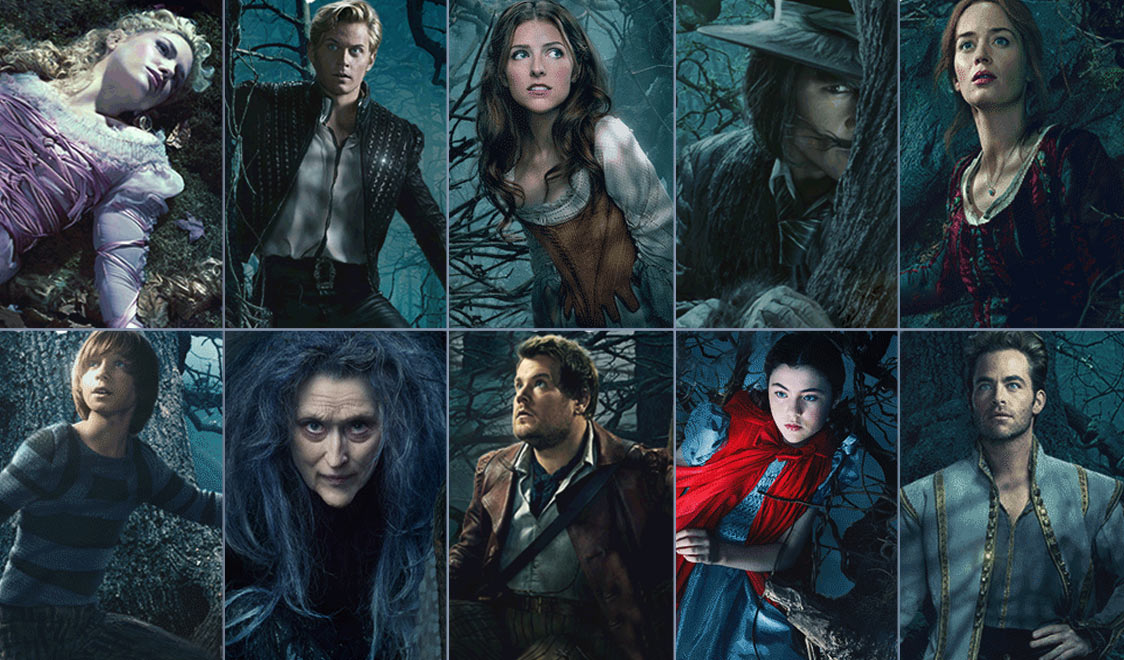
“If you know it’s Sondheim, you know it’s not going to be what anyone expects,” she said, “maybe a sideways look at the fairy tale. You see what’s behind the fairy tale, which is what makes it a unique experience.” She loves working with Meryl Streep, who plays the witch in the film and transforms from a hag to a beauty. “When she is the Dark Witch, her costume is a collapsed version of the big blue witch, which was her ideal of beauty and loveliness. I wanted to do two things with her costume. I wanted to tie her in with the trees, the way the bark is tortured and gnarled. So I used strips of really fine leather applied on chiffon and twisted it the way tree bark grows in twisted formations, and used the same technique on the blue dress even though it’s three times bigger and with different materials, satin ribbons and things, used the same shape but applied it on a different way.”
Copyright Disney Studios 2014

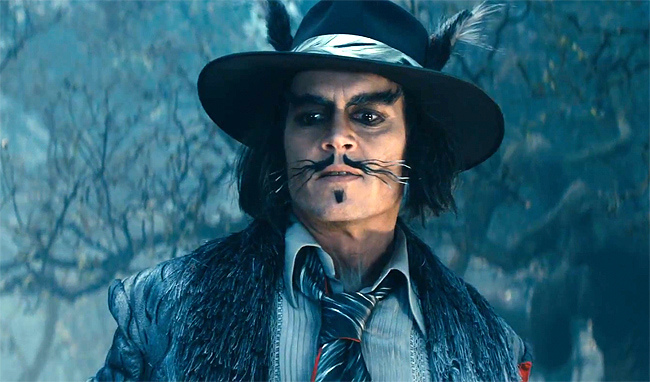
For Johnny Depp’s Big Bad Wolf, she took his suggestion. “I wanted a wolf that wasn’t all fur, and the original idea for the vibe of the costume as a zoot suit came from Johnny’s take on the music.  He wanted a kind of Tex Avery wolf so I took a zoot suit approach to the shape of the costume and then I drew wolf fur on it and had all that embroidered.  Then instead of fur for the collar and tail I used a thread-tying technique that used to be used for wig-making in the 1920’s for flapper wigs.  I’ve always thought it was an amazing thing.  It was sort of a weird combination of 20’s and 30’s coming together.  Johnny has a lot of panache, that’s for sure.”

Atwood is famous for creating and adapting her own textiles, so I asked her if she had done that for this film.  “Absolutely,” she said. “There’s so much craft in this film, probably the most amount of craft I’ve done in a movie.”  Because most characters only had one or two costumes, she had the chance to use hand embroidery and a lot of textile technique and combining of textiles “to get the kind of woodcut effect I wanted.”

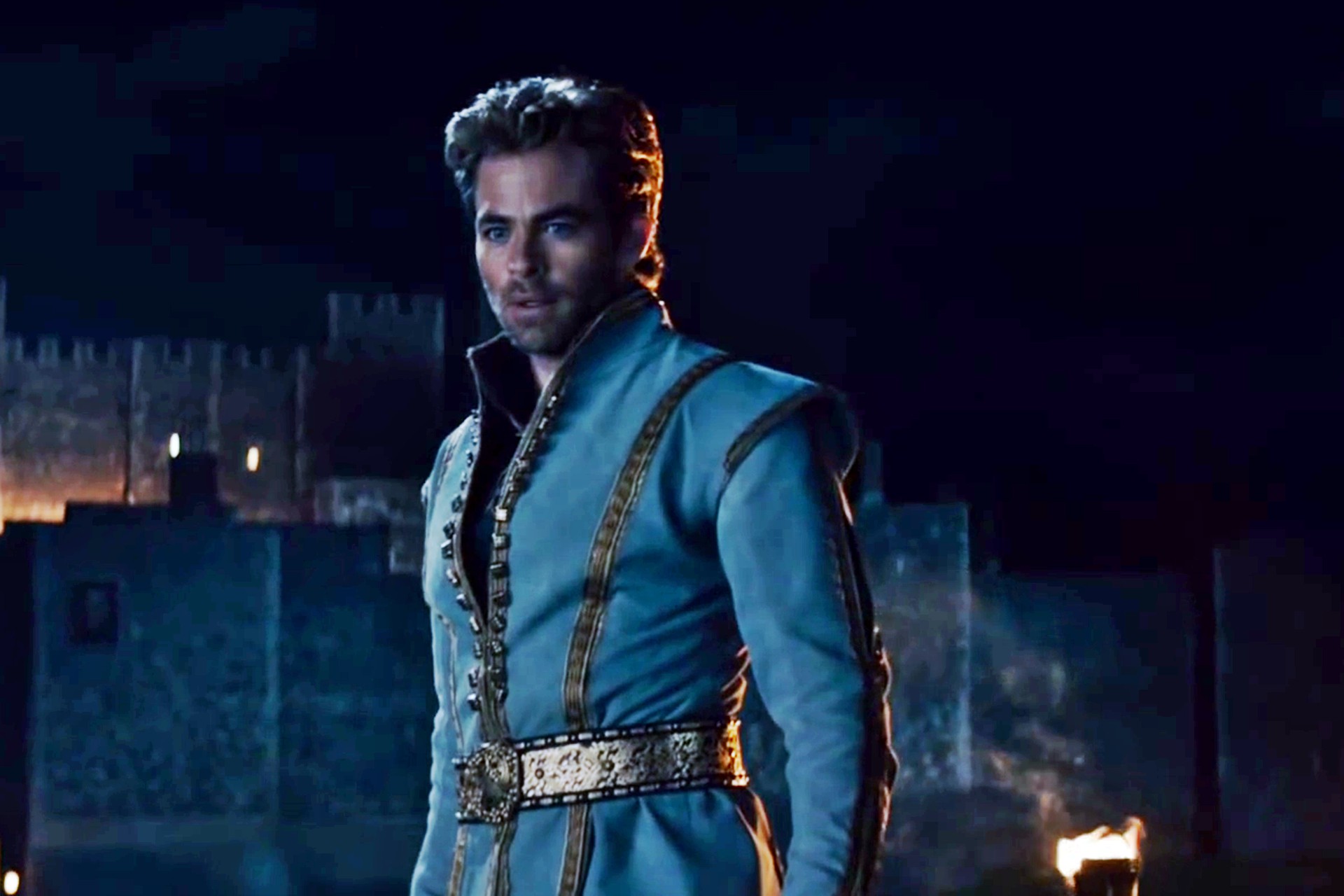
She especially enjoyed working with the prince characters. “I thought they should be sexy and romantic, but they should also be bad boys — which is very attractive!  So I took the element of the biker bad boy with Billy Magnuson’s character, the prince who loves Rapunzel, and took the almost-but-not-quite Elvis approach with Chris Pine, who plays the prince who loves Cinderella.  And they were both so funny they both took it to another level. Usually, it’s the girls you’re having all the fun with but it was a hoot to do these prince costumes.”
Copyright Disney Studios 2014


Related Tags:


Behind the Scenes Interview

Interview: Tom Berenger of “Lonesome Dove Church”

Posted on March 23, 2015 at 3:12 pm

Copyright Nasser Group 2015

Tom Berenger stars in Lonesome Dove Church, available March 24, 2015 on DVD. He spoke to me about the role and why Westerns have such enduring appeal.  And I have a copy of the DVD to give away!  Send me an email at moviemom@moviemom.com with Dove in the subject line and tell me your favorite Western star. Don’t forget your address!  (US addresses only).  I’ll pick a winner at random on April 3, 2015.  Good luck!

How did a kid from Chicago learn how to act in cowboy movies?

I’ve been doing Western since 1978 (Butch and Sundance – The Early Days), and that was a big one and it was three months and it was just constantly on horseback, all kinds of terrain. It was in the mountains, it was in snow, it was on rocks, it was on ice, it was in rivers, it was full gallop, so just a little bit of everything. The first time I learned to ride a horse was bareback and it was fine, yes, it was okay, no reins so you just jerk the mane one way or the other. He always tried to rub me off on a tree but I didn’t let him, so I learned about controlling them. In this one, I drove a buckboard.

You play a preacher in this film. What is he like?

He is pretty much upbeat. He is a real upbeat character that does not allow himself to get down too much despite whatever the situation. And so he is not given much to moods or depression or anything like that. He’s not overbearingly joyous of course but he is pretty well grounded in his beliefs as well so he’s an anchor. He’s starting a new church in Missouri in the 1850s and so it’s right before the Civil War. And in the opening scene he talks a bit in his Sunday sermon about that, about his concern that the country could be torn asunder over slavery. And as far as people in the congregation I would say half maybe are for slavery and half against. So remember if it’s Missouri it’s a border state. He of course is anti-slavery and when you’re in Missouri you are also next to Kansas and the Civil War actually started out there. No we don’t see this yet but it was pretty, pretty bad out there, pretty vicious and it actually really sort of begun before war was declared.

Do you typically read a lot of the history before you work on a project or did you know all of this before?

I knew all of that beforehand and I remember talking to the prop guys about certain rifles and things like that, because they hadn’t developed repeating rifles as yet, and all that sort of thing.

The conflict in the film is also personal as your character has to be there for his son, who has made some bad mistakes and gotten in trouble.

Well, you know teenagers. I’m sure this was true in Roman times as well. Romeo and Juliet were teenagers. So you just sort of brace yourself for it and kind of remember what you were like as well. Certainly my character is pretty patient and understanding but frustrated about his son’s behavior, getting in trouble. He doesn’t want to see him get killed, he doesn’t want to see him go to prison. And he just wants him to get in touch with his religion and society. He loves him a lot as a parent.

Well I guess the West was something we had that nobody else did.  In Europe all the borders were established forever.  There were wars constantly but there was nowhere to go when it got too crowded or you ran out of farmland or it became so established that you never could improve yourself classwise. So here there was always a West where you could go and try it again. The whole country was like that to begin with.  All these people get a chance to get away from their problems and start all over again with a clean slate.
And I’m not saying it was easy but like every wave of immigrants there was some hope that they could lift themselves up and be accepted and not be stuck in a class system. There are still many big open spaces if you drive through there.  Endless opportunities. But not easy. You can see those old photographs of farmers out there and you can see how exhausted they were.You see them emaciated from hard work.

What’s the best advice you ever got about acting?

I worked with Richard Brooks. He started as a writer but he was a real character. He looked like a Marine with that haircut and the way he dressed.  He looked like some guy on the cover of Field and Stream magazine or something.  He smoked a pipe and drank black coffee and wouldn’t go out to lunch. I was the same way, I wouldn’t eat lunch and he and I would sit around and talk about stuff.  He said, “Lunch is the worst American habit. Watch it, they will come back in and they will be slow, they are digesting their food, the are daydreaming, somebody will get hurt. And that happened, too, just as he predicted.

Related Tags:


Actors Contests and Giveaways Interview

Interview: Robert Kenner of “Merchants of Doubt”

Posted on March 22, 2015 at 7:03 am

Copyright 2015 Sony Pictures Classics

Robert Kenner’s Merchants of Doubt is a deeply unsettling documentary about the way corporations divert money they should be spending on making better products more effectively to spend it instead on undermining science and scientists. By creating fake “public interest” groups with generic names to argue that scientific findings are not sufficient to take action they use the tactics perfected by the tobacco companies to delay government action for decades while people suffer the consequences. These days, that primarily means “selling” the idea that there is not a scientific consensus on the reality and the causes of climate change, but it applies to many other scientific findings as well.  The scientific method is rigorous, checked and counter-checked, and ruthlessly truthful, with no other agenda but the facts.  This is the method that produces all advances in technology and medicine.  These efforts to devalue and undermine science by selling doubt the way corporations sell products obstruct efforts at the most fundamental level to establish policies based on the latest and most documented understandings of how the world works.

Writer/director Robert Kenner (“Food, Inc.”) said that while much of the film focuses on the fossil fuel companies’ efforts to discredit the science of climate change, “It is not about any specific industry. It’s about a group of very talented individuals who honed their craft in tobacco and were able to take the most difficult subject, a product that they knew was cancer causing, and for 50 years maintain doubt about it. They couldn’t say it doesn’t cause cancer because it’s a lie.  They could say,  ‘We don’t have enough science.  We need to do more study.’ It’s the ‘doubt and delay’ tactic.  So, they would switch the subject and say, “You’re taking our freedom away.  We should be allowed to smoke on airplanes.”  We had people picketing at Washington’s National Airport saying, ‘We demand the right to smoke on airplanes. You’re taking our freedom.’ So what’s interesting is on one hand we think of tobacco slightly as an old hat subject but what’s interesting is that playbook that was created lives on exactly the same way today.  What’s so interesting is not only is it a lot of the same people but it’s the same very specific tactics.” He says it is a kind of “anti-Enlightenment.”

The industry-sponsored consultants who fabricate “interest groups” with uncredentialed “experts” are the primary culprits in the film, but one of its most significant and disturbing revelations is the complicit nature of the media, whose reflexive commitment to “showing all sides” means that they will bring on any contrarian without checking the legitimacy of the source, training, expertise, or conflicts of interest. “The real battle here is I don’t think newspapers should be putting people who play scientists on television, quoting them as equals. I think the media is playing a role in encouraging false debate. There’s always going to be one guy out there arguing that the earth is flat but that does not mean the question is not settled.”

So it is especially gratifying to see an exception in the film’s portrayal of two Chicago Tribune investigative reporters who spent two years on a brilliant expose of fraud, misrepresentation, and fake science funded by the tobacco and chemical industries that led to fire retardant regulations that (1) didn’t work and (2) exposed infants to toxic chemicals.

But Kenner points out that there are “fewer and fewer and fewer” news organizations able to devote those kinds of resources to exposing these corporate scams. “There are now 4.5 PR representatives for every journalist. When I started out there were far more journalists than PR Reps. So as people get fired from their newspapers they get hired by the very companies that they might have investigated.”

This should not be a political issue, he says. “I talked to George Schultz and he said the greatest thing he and Ronald Reagan did was the international ozone treaty. He said, ‘We didn’t know 100% but we were in the high 90’s and it was the right thing to do. We had to take action. It was a great insurance policy.’ And Nixon created the Environmental Protection Agency, and George Bush with acid rain — so there is a tradition of conservative environmental protection. We might all hate the EPA for being such nags, but the air and water are cleaner and so we are lucky they are there.”

He also insists that it is not an anti-corporate film. “It’s really important to say that corporations are in the best position to be the solution.”

Related Tags:


Directors Interview

Interview: Dan Fogelman, Writer/Director of “Danny Collins”

Posted on March 19, 2015 at 3:55 pm

Copyright 2015 Bleeker Street Films

Dan Fogelman wrote “Cars,” “Tangled,” and “Crazy Stupid Love,” and now for the first time has directed with “Danny Collins,” starring Al Pacino and Annette Bening.  Fogelman told me he was wasting time on the internet because he did not know what he wanted to write next when he came across a headline about a musician who did not find out that John Lennon wrote him a letter until 34 years after it was sent.

I had just finished the movie Crazy Stupid Love and I was trying to figure out what to do next. And I was just completely stumped and procrastinating and sitting in front of the blank computer for months on end and looking at the Internet as you do when you are procrastinating and I came across this musician who receives a letter from John Lennon forty years too late.  I called him that day. I tracked him down immediately and I told him I heard his story which became the jumping off point of this story the letter, and the receiving of the letter. That’s exactly what happens in the film “Danny Collins.”  Literally we wrote out pretty much the same letter. So that is all absolutely true, he was a young musician in the early, early 70s. They said, “We think you are the next big thing”. He said, “I’m terrified of what fame and fortune might do to me,” and cut to 34 years later John Lennon had read that interview had written him a letter offering him advice and he didn’t get letter until the present day.  It got sent to him care of the magazine and somebody saw a handwritten letter from Lennon, it got sold to collectors and just never came across his bow until 40 years later. So I couldn’t stop thinking about that, the what-if of the entire situation.

Pacino plays Danny Collins, an aging rock star who can still fill a stadium with his baby boomer fans, who are happy to sing along when he plays his hits. But it feels stale and empty to him, and when he sees the letter from Lennon, he realizes he could have taken a different path and been truer to himself as an artist and a man. Fogelman said,

His life has become everything he feared that it would become. And when I first talked to Al about the character, we talked about the dark place that this guys is in. He is alone, he is very lonely, he is very alone and he is very unhappy with the way his musical career, the direction it has taken.  And who he is as a person. He is a drug addict and a drunk and he is dating well beneath his appropriate age range and who he is. And he doesn’t have a family which is a big part of this. He doesn’t have that human connection with people. And so he gets this letter at 65 years old, and that kind of sends him on this course correction.

Lennon’s letter was written to reassure a young musician that success and fame do not have to be corrupting, but in the case of Danny Collins, his concerns about that were justified.

Any form of art is also commerce nowadays. I mean some art becomes popular posthumously but any artist who becomes famous in their own lifetime learns that art starts becoming commerce and vice versa. You are making your living off of it. Your identity is defined by it, your legacy is defined by it, whether it’s music or writing or acting or television or film or journalism. I think when you are defined by your art it is a weird line.

A central  image of the story is Collins’ arrival at the very ordinary kind of place he has not seen in decades — a small chain hotel in New Jersey.  The design of the hotel had a very specific inspiration.

When I first heard the story of the real guy, Steve Tilston,  I knew exactly what I wanted the story to be about. I knew I wanted it to be about family and reconnection. And so I got a couple of images in my head. I said,  “Where would be the craziest hotel in the world for Al Pacino to just check into indefinitely?”  And I pictured the Woodcliff Lake Hilton which was the hotel in New Jersey that I went to every eighth grade party. I was actually a best man four different times in that hotel.  If Al Pacino walked in, they would be ill-equipped to handle him. It would be such a disconnect.  We had to shoot the movie in LA but we recreated the Woodcliff Lake Hilton in California and we actually screened it back in that neighborhood and nobody realized that we weren’t actually in New Jersey. New Jersey felt like the most normal place in the world to me because it is where I am from.  So the street we had for Bobby Cannavale and Jennifer Garner, with that neighborhood we tried to paint that kind of picture like when I go and visit my friends – the issues they are dealing with, and the kids, that kind of picture.

As Collins, Pacino wears heightened, rock-star attire in the early part of the movie, a striped jacket, scarf and pocket square.  And then, as his life becomes more normal, connected, and authentic, his clothing is toned down.  He even mentions shopping at Banana Republic.

Danny was a bit of a dandy which I like.  When you see Al, in real life, he is kind of vagabond.  He has a very cool bohemian look and he is always in black, a sloppiness but it is kind of a put-together sloppiness.  That carried over to Danny Collins because for him it is all an act. It is all performance for him to seem really sharp and dandy.  He is referred to numerous times in the movies as a ridiculous man and the outfits needed to be able to be both ridiculous in palette but also really precise in the cut and the fit and the accessorizing. And so he always has a scarf and he also has varied vibrant prints and stripes.  And we start taking that down as the movie goes on.  He is never going to be a guy who walks around in jeans and a T-shirt.  By the end, though, he has a black shirt, but he is still wearing it wide open. He has become a fully formed regular human being as much as he is capable of.

Related Tags:


Directors Interview Writers

The Grandparent Effect: Superb New Resource for Families

Posted on March 16, 2015 at 3:51 pm

I am a huge fan of Olivia Gentile’s new website, The Grandparent Effect, a warm, wise, and highly informative resource for parents, grandparents, and caregivers. As she explains,

Grandparents are healthier, wealthier, and longer-lived than ever before.

What does this mean for us all?

On this site, I consider the growing importance of grandparents to their children and grandchildren.

I hope to entertain you.

And I hope to turn everything you thought you knew about grandparents upside down.

The site features all kinds of guidance and commentary, including the best picture books about grandparents and grandchildren and heartwarming thoughts by writer Lois Wyse on what it felt like when her first grandchild was born.  She reports on grandparents in the news, from Hillary Clinton’s #grandmothersknowbest hashtag in her tweet on vaccines to the grandpa who trucked in snow for his granddaughter to play with and the Congressman who is proud of his transgender grandchild.  And she welcomes the stories of families about their own experiences.

Olivia generously took time to answer my questions about what grandparents can give their grandchildren and about the challenges and conflicts in maintaining the relationship across three generations.

Olivia Gentile, photo by Deborah Copaken, copyright 2015

Where did the idea for the site come from?

My dad’s mother and both of my mom’s parents were hugely important to me, especially when I was a young adult.

My dad’s mom lived in Boston, so when I was growing up in Washington, D.C., she was a plane ride away. But I ended up at Harvard for college, and that’s when our relationship blossomed.

My college years were rough. Early on, I developed a horrible case of obsessive-compulsive disorder, and it wasn’t properly diagnosed or treated until after I graduated.

I did try to get help during college, but no one at the campus health center seemed to know what to do with me. It was the early 1990s, and clinicians didn’t know nearly as much about OCD as they do now.

So I didn’t have a good psychiatrist, but I had my grandmother, who lived three T stops away from campus in an apartment building for senior citizens.

My grandmother didn’t really believe that there was anything wrong with me, so I didn’t discuss my problems much with her.

But she baked me wonderful lasagnas, took me downstairs to visit with her friends, and told me stories about the guy down the hall who had a crush on her. (It wasn’t requited.)

All that love helped me a lot.

And then, in my sophomore year, I began to realize that someone else in my family had a terrible case of anxiety: my mom’s father.

I’d only known my mom’s parents casually when I was growing up, even though they lived in Washington, too.

They were close to my mom, but I think by the time my sister and I came along, they weren’t too keen on spending time with screaming kids. And once we were more civilized, we got busy with school and friends.

But slowly, when I was in my early 20s and my grandfather was in his early 80s, he and I started opening up to each other about our respective problems. He probably had OCD, too, but his psychoanalyst, whom he’d been seeing daily for 40 years, called it “free-floating anxiety.”

It was such a relief to be able to talk to someone who understood what I was going through. And he had a great sense of humor about his anxiety and life in general.

Soon, he and my grandmother were two of the most important people in my life.

My dad’s mother, the one in Boston, died in 1997, a year after I finished college, but my mom’s parents both lived long enough to steer me through my 20s. My mom’s father died in 2005, at age 93, and her mother died in 2011, at 94.

I got the idea for The Grandparent Effect not long after that.

My grandparents had saved me. And I suspected that there were millions of people all over the country who’d been saved by their grandparents, too.

I wanted to tell my family’s story, and I wanted to collect stories from other families, too.

What are your most cherished memories of your grandparents?

My dad’s mother took me to Disney World twice when I was little, and I have vivid memories of the fun we had together, particularly on the rollercoaster Space Mountain.

My favorite memories of my mom’s parents are from my 20s. After college, I worked a newspaper reporter in New England, but I’d fly to Washington often to spend weekends with them, and we always had a blast.

They lived in Dupont Circle, so that’s where a lot of our adventures took place.

They really liked taking me to Restaurant Nora to eat fancy organic dinners. Other nights, we’d round up a bunch of my friends and take them to the Brickskeller, which served beer from around the world.

During the day, my grandmother and I would pop in to the Phillips Collection and Kramerbooks. And we’d always spend a little time at Secondi, a clothing consignment store. She had a great fashion sense, and she’d help me choose my work clothes and the dresses I needed for friends’ weddings.

Other times we’d just hang out at my grandparents’ house. My grandmother and I would read novels and the paper while my grandfather watched Court TV.

(more…)

Related Tags:


Interview Parenting
THE MOVIE MOM® is a registered trademark of Nell Minow. Use of the mark without express consent from Nell Minow constitutes trademark infringement and unfair competition in violation of federal and state laws. All material © Nell Minow 1995-2026, all rights reserved, and no use or republication is permitted without explicit permission. This site hosts Nell Minow’s Movie Mom® archive, with material that originally appeared on Yahoo! Movies, Beliefnet, and other sources. Much of her new material can be found at Rogerebert.com, Huffington Post, and WheretoWatch. Her books include The Movie Mom’s Guide to Family Movies and 101 Must-See Movie Moments, and she can be heard each week on radio stations across the country.

Website Designed by Max LaZebnik