Ali Faulkner is in every way the heart of the new faith-based film, “The Song.” She plays Rose, who inspires the title song and marries the musician who wrote it for her. Unlike most films, this one does not end with the wedding — it is only after they get married that the story really begins, as their marriage is tested when her husband spends most of his time touring. We are honored to have an exclusive clip about the film to share.
I spoke to Ali about the challenges of playing a good person and how she helped to define her character with some important costume decisions.
“When I first tried out, I definitely was intimidated because I first thought ‘this person is perfect and I’m far from that. How am I going to do her justice?’ But then I got some really good advice from an acting coach. He said, ‘Her name is Rose and every rose has a thorn.’ And that just really struck home with me and so it kind of gave me a little bit of freedom to know that even though this is an incredibly beautiful person, she still has her weaknesses and but of course no person sees their own weaknesses until something big happens. So I just tried to rely on the truth of who she was. I mean you can’t get round the fact that she’s a wonderful person but her flaws showed up naturally in the film and I just tried to be as true to that possible.” Writer/director Richard Ramsey reassured her not to be afraid to give Rose a lightness and sense of humor. “He was like ‘Don’t be afraid to let her be beautiful and shine in her own way and have fun. She doesn’t have to be matronly.’ That is something that you definitely wanted to shy away from because no young girl is going to relate to that.”
The story covers many years and several different stages in the relationship, but they shot out of order. Ali and co-star Alan Powell had to go backwards at times, from the complicated scenes of hurt and betrayal to the earlier scenes of easy intimacy. “It’s just about talking, recognizing where you are in the relationship and the physical stuff helped a lot. I tried to wear like bangs when she was younger and then have a more mature look when she was older. Naturally you’re just thinking about what they’ve been through at moment right before the scene and then that kind of helps. I wanted her to wear a lot of light colors because it just felt unnatural to have her wearing black. In fact the only time I really wanted her to wear black was at her dad’s funeral,that’s it. And even there was one part where she wears a little sash around her dress and it was originally black and I changed it to brown. I don’t know it is one of those things where she’s just such a light spirit that I couldn’t, I just couldn’t put her in dark colors so Rose wore a lot of creams and ivories that really looked and felt beautiful and sweet and conservative but still at the same time womanly in her own way.”
Ali’s first interest in performing was singing. “Singing was my first love and then I got into musical theater and really loved that and just fell in love with the acting side of it and about seven years ago I decided to get into the film world and I just loved it and haven’t a looked back since. I just feel like film gives such opportunity to create things that live on. Our human instinct is going to create thing that will live on in some way.” She is guided by the advice not to try in acting, but “to allow. If you are open enough you can really allow yourself to connect with certain characters but if you try too hard you kind of get in your own way. So that I think is the biggest challenge and struggle that I’m always working on and that I feel like is really important.” Her early inspirations included opera and big, epic films like “Gladiator.” “They seem to pull me into a world that just resonated so deeply and I love it so much. Those are the films that inspired me the most probably.” The movie she’d recommend for a date night is “Love Actually,” which she describes as uplifting and warm.
Ali hopes that the couples who watch this film learn that “no matter where they are in their life we see things in a different way. I just want to them to take away whatever touches them or what ever aspect of the film speaks to them in any sort of positive way. But specifically I guess that challenges can be overcome, that there is hope for relationships that have been broken. And that the beautiful thing that forgiveness is and that forgiveness can heal.”
Interview: Composer Matthew Margeson of “Kingsman: The Secret Service”
Posted on February 11, 2015 at 3:35 pm
Matthew Margeson and Henry Jackman composed the score for Matthew Vaughn’s new spy movie, “Kingsman: The Secret Service.” Margeson told me that “Henry and I had composed the film score to ‘Kick Ass 2’ together. And that kind of went well for all three of us, for Henry, myself and the director Jeff Wadlow and also Matthew Vaughn. He came to us both direct and said, ‘Hey, I’ve got this new film that’s again based on a martial arts comic book and it’s a love letter to the British espionage genre.’ The way he sold it to us is that it was definitely going to be this very fun film, and definitely have his fingerprints all over it, his style of filmmaking.” The movie is a throwback to the sleek, sophisticated spy films of the 1960’s, but a commentary and heightened, comic version, which is a challenge for the composers, but they got a lot of guidance from Vaughn. “When you look at it, the pace of it, the style of it, it wasn’t that hard. I mean Matthew Vaughn definitely is quite a stylistic director. When he does things with his own film production company, it’s all him and the films have a look about them, they’ve got a pace about them. He has a real good sense of music placement and first and foremost, he absolutely loves music and working with music. So he is a director and producer that really gets involved and knows exactly what he wants and knows, in his opinion, knows when something is not right and when it is right. So he is a good person to steer us in the direction of where he wants to go.”
Margeson and Jackman have worked together in different ways, but this time they were literally in the same room. “It depends on the film. I have done quite a bit of kind additional arranging for Henry on his films when either time is of the essence or they just need more hands on deck. And the dynamic for that is quite different than something like this where we are co-composing the score for ‘Kingsman’ where we were both on board from the very beginning. And so even before we started watching footage, the two of us were in a room probably for two or three weeks just jamming on the piano literally both sitting there together at the keyboard. I’m going, ‘Listen to this,’ and a lot of times Matthew Vaughn was on speakerphone from London kind of stopping us saying, ‘No, no, no, what was that note there?! Could that one go up instead of down?’ So it was a really great collaboration. I mean one way I know a lot of people will do things is maybe you take this script and I will take this character, you take this theme and I do this and we meet back in a week until we’ve stopped but we have the luxury that both of our writing suites are in the same building; we are about 50 yards away from each other, so it’s very easy for him to just give me a ring or for me to give him a ring and just say, ‘Hey, come down here, come over here and check this out.’ So it was a really healthy collaboration. We were definitely doing it together simultaneously and a lot of times like I said, on one set of 88 keys.”
Margeson told me that the score had to reflect a transition in the storyline. “When the film starts in the first probably hour, hour and 15 minutes or so it is a very elegant film and we are sitting here and Eggsy, our main characters is kind of learning the ropes of how to be a gentleman spy. He’s learning how we dress and he’s learning how to use weapons and he’s learning proper English and he’s learning how to eat and how to order a drink. And so there was a little bit of self-discipline in retaining that British elegance. I definitely had to learn quote unquote how to make a cup of tea on this one. However as the film kind of gets more in depth with Samuel L. Jackson’s character and what he is going to do and as the story unfolds, I think Matthew Vaughn’s filmmaking style kind of starts peeking out about an hour into the film a little bit more and by the last half hour of the film you are like, not necessarily ‘Are we still watching the same film?’ but like, ‘Oh my God, how did we get here?’ The amounts of just really visceral action and excitement are a lot different than say the first 15 minutes of the film. Compositionally, towards the beginning of the film when we are still kind of in more of an old-school approach, we are looking at those compositional building blocks that make up the genre and that make us more constantly reminded of that we have to be proper both musically and narratively. And I think that once you get into the meat and potatoes of the movie later on then you have license to be a little bit more contemporary and break some of the rules. And we also had to always be reminded that Harry who is Colin Firth’s character, is a Kingsman of a different time period than Eggsy, our younger kid. And so we have license to kind of get a little bit dissonant and inject some guitars and some drum kit and some bass and a little bit more knarliness into the score as it develops. We had to very often look at the big picture and say, ‘Well, we don’t want to spoil this line too early and we don’t want to hold on to the British elegance too much throughout the film.’ And a lot of times we were wrong and it’s a constant state of chasing our tails and rethink these big story bullet points to let the music unfold with the story.”
When he was working on “Kick-Ass 2,” someone asked what his dream project would be and he said it would be a James Bond film. Now that he has come close with “Kingsman,” he is happy to be working on “a really cool and different film for Paramount called ‘Scouts versus Zombies.’ It’s a really, really fun film and I speak the truth when I say, it’s 110% comedy and 110% horror so there are some really, really funny moments in it but there are some really great scares and of course you have zombies so how can you lose?’
Interview: Dogs on the Inside, Documentary About A Prison Program for Rescue Dogs
Posted on February 10, 2015 at 7:00 am
“Dogs on the Inside” is a profoundly moving documentary about a program that teaches prisoners how to care for rescue dogs. Seeing the dogs and the men in prison learn patience and trust from each other is touching and inspiring. I imagine it will attract the attention of Hollywood as it would make a great feature film.
BC: Doug and I were looking for a story about dogs that we wanted to be both compelling and kind of informative about how great dogs are. But we wanted it to have a little bit of an edge and we discovered this prison dog training program and thought it was both a no-brainer in the sense that the program existed and taking stray dogs and pairing them with prison inmates, I thought it was interesting. I think that was the story to bring to life on film.
What did the inmates learn from the dogs?
BC: I think the biggest thing that they learned was understanding, kind of getting outside of their own heads and learning about the benefits of helping others and in this case it was dogs.
DS: I think the most important thing they learned was that they are still human. If an image were to pop in your head of an inmate you might just think that of something negative and I think what this film does is remind people that wherever you are, if you are even an inmate it does not matter, you’re still human.
CS: From an inmate’s point of view, it was more often learning how to cope and deal with not only the other cons but also with dogs as well and growing with them as well as a person.
What are the qualities that are required for the inmates who participate?
Copyright 2015 Bond/360
DS: Before they can be allowed into the program, each of the inmates is thoroughly screened. What they are looking for is patience, responsibility, and trust, and most importantly caring. And overall they cannot be violent, they cannot have any type of violent history.
Are there other programs like this throughout the country?
DS: There are and since we started filming over three years ago they have been continuing to pop up all over the country.
And are there any studies being done of how effective they are or monitoring the participants after they leave?
BC: Yes. There is a great program called New Leash On Life USA, based in Philadelphia. And they are the gold standard for this type of prison program because they have measurable results and the recidivism rate for prison inmates coming out of Philadelphia prison system goes down about 50% by comparison to the average. These guys are actually staying out of jail because of what they do helps them get internships, help get them placed in jobs in animal care and those kinds of things. So it is much about a person as it is about an animal.
Do many of them chose to continue professionally with animal care when they get out?
CS: I want to be a zookeeper. I love animals in general. The person that gets into these dog programs, they have got to love animals first and foremost. If I could, I would own a farm and adopt all of them. Because I love animals in general but reality is that I can only take the step of helping the dogs that are in shelters. I’m going to be donating my time doing that in a shelter out in Springfield, Massachusetts. I’m going to get my education and try to see if I can become the very best zookeeper that there ever was in history.
Candido, tell me a little bit about your first experience in working with one of the dogs.
CS: My first experience was with Sam, who was a very scared dog, he was very skittish, he used to tremble when he first got there. He used to growl when anyone got close to him and it took me a little bit of time to actually get him comfortable with me. What I mean by that is, it took me a few days but I got half my body inside the crate in order for him to feel comfortable with me. Then once I was able to finally caress him and rub him, I guess he looked at me like “Wow! You are not what I expected.” So with that being said I carried on and everything, he was a Chihuahua and by the end of the term he got adopted to a very young, very beautiful kindhearted person. She got married, the lady that is Sam’s owner and they sent me pictures of Sam in a tuxedo, so I’m guessing he was the Best Dog.
When an animal has been abused and is afraid of people, how do you gain their trust?
CS: I know that for me it took a lot of patience first. I looked at Sam the way I looked at my own life. I could relate to the way he felt, the way he thought probably. And in the beginning when I tried to get close to him and he growls, I got up, kept walking around doing whatever I had to do in the room but I still talked to him and I told him “Don’t worry about it. I got you, I’ll take care of you, sooner or later you’ll come around.” And that’s basically it, you have got to have a lot patience and a lot of love for any animal that goes through something like that. I mean it’s horrendous to begin with but you have got to have a lot of understanding too behind it. I’ll say this too, it took a little bit of bribery too. I used to give them treats, and I mean, who doesn’t like treats? I love treats. I love candy bars so you give me a candy bar and I’ll do anything for one bar, how about that?
So you can identify.
CS: Yes, I could definitely, with Sam and with every dog that kept coming through there.
And what was the most important thing that you learned from the training that you got about working with the dogs?
CS: I learned a lot actually. The trainer that we had, her name is Paulette, she is a very good trainer. She taught us and it was installed in me by her to have patience but be firm, to be loving and caring at the same time. But also to try to understand their point of view as much as possible. It’s about them primarily, you’ve got to put them first before yourself. It’s like having a baby, when you have a baby, your baby comes first before yourself.
What do you want people to learn from this film?
DS: If they could adopt a dog that would be wonderful but that’s a lot of responsibility so I think one of the things that people can take away from this film is that they have the opportunity to make a difference on their own. And it is attainable for them, it is not too far out of reach for each person. And not only that but to remind people that everyone is equal and to believe in second chances.
BC: I think for me it is to remind people that there’s some really good things going on around the world. That is one of the motivations we had in looking for a story. It just goes to show that with effort and the right thoughts we can really create the magic in this world.
Interview: Ira Glass Talks to “Boyhood’s” Richard Linklater and Ellar Coltrane
Posted on January 29, 2015 at 9:59 am
“Boyhood” writer/director Richard Linkater and star Ellar Coltrane talk to “This American Life’s” Ira Glass about making the film over a twelve year period that began when Coltrane was six years old.
Interview: Nancy Spielberg and Roberta Grossman of “Above and Beyond”
Posted on January 28, 2015 at 1:26 pm
Copyright Paramount Productions 2015
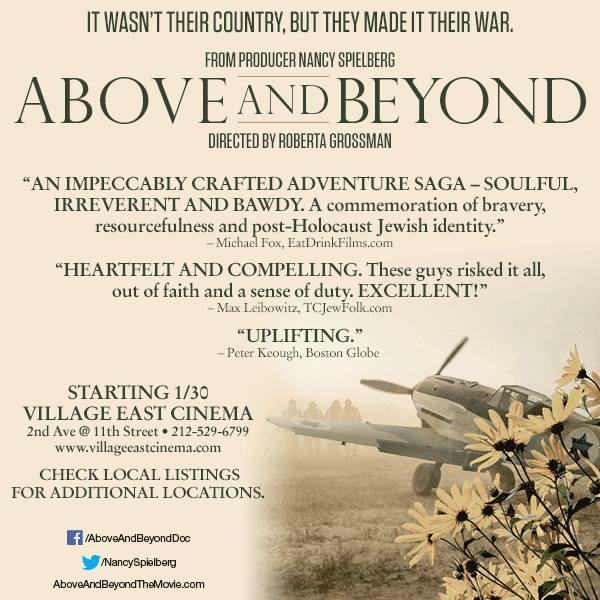
In 1948, a group of World War II pilots volunteered to fight for Israel in the War of Independence. As members of “Machal” (volunteers from abroad), they not only turned the tide of the war, they also laid the groundwork for the Israeli Air Force. “Above and Beyond” is the first major feature-length documentary about the foreign airmen in the War of Independence, featuring new interviews with pilots from the ’48 War, scholars and statesmen, including Shimon Peres, to tell their story. I spoke to producer Nancy Spielberg and director Roberta Grossman about making the film and why this story mattered so much to them.
Why tell this story now?
NS: First of all the, “Why now,” is any of the stories that are coming from this generation of World War II veterans and Holocaust survivors, that whole generation, whatever they did, are things that if we don’t grab them now, we’ve lost them and they are slipping through our fingers. And I think we’ve all seen that that the way that people learn, mostly way the the younger people learn is visual. They don’t read books, they don’t like history books, they don’t want black and white on a page. The best way to teach it, to capture it, is through a visual format. And I think that the urgency of getting stories like these, is that the stories are just incredible. To me it’s a study in character, in human nature. What makes these heroes? What makes these veterans, these World War II veterans that served their country, survived; one of them was shot down and wandered for a couple of months, another one almost crashed his plane. What made these people come out of war, get back to their normal lives or be supposed to be getting back and then drop everything to go help somebody else? And it is just sort of amazing because I think they are very matter of fact about it but it is a wonderful lesson for all of us. To what degree, what extent would you undertake such personal risk to help somebody else? And I just think that is a lesson that we all have to hold onto.
What was it like doing the research and finding the archival footage for the film?
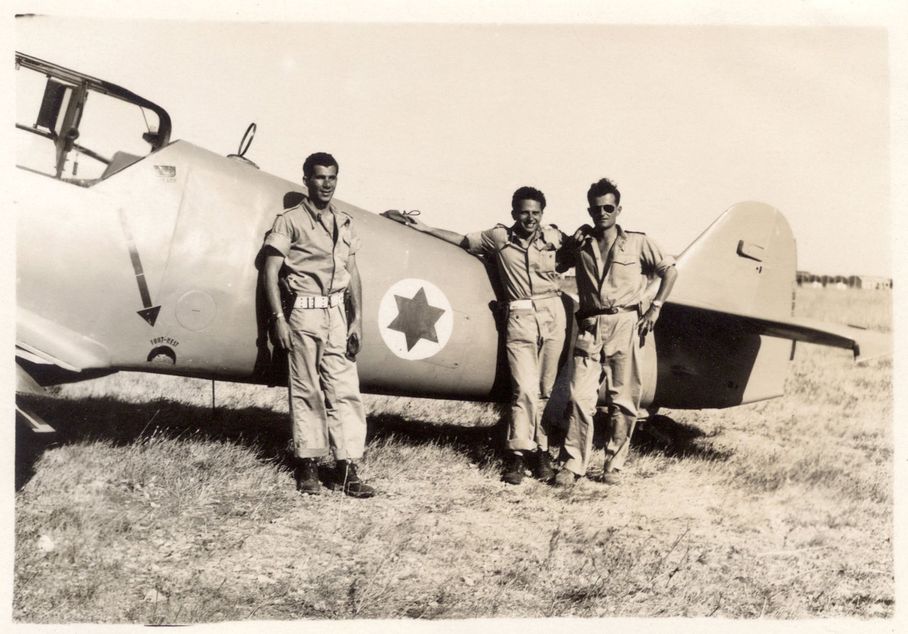
Pilots Lou Lenart, Gideon Lichtman, and Modi Alon in Israel in 1948. Copyright Paramount Productions 2015
RG: Well, first of all I should say that there is a lot of archival footage in the film that was drawn from a lot of different archives around the world, primarily of course Israel and the United States. But there is a lot of footage in the film that is unabashedly made to look like archival footage and blend with our footage that is actually re-creations that we did in conjunction with Industrial Light and Magic. So the conceit was to make re-creation look like archival footage when the fact of the matter is there were gun cameras. There were cameras on pretty much every American plane in World War II but in the the ragtag Israeli Air Force in the 1948 war, there were no cameras since the planes could barely fly. So we pretended that there were those cameras there and created sequences that would match or illustrate the stories they were telling. I strongly believe that documentary filmmakers get to use all the tools of cinema and using those tools as historically accurately as possible or else you lose the trust of the audience.
NS: Roberta, you have these connections more than I do with the archivists and people were so engaged with the story that they really dug around it. There is one shot we have which is authentic archival footage of this Egyptian spitfire that kept flying and bombing over Tel Aviv and all they could do on the ground was run in their houses and get the camera and film it because there was no fighting back. They had no planes, they had no way to defend themselves, it was duck and cover. And the idea that this plane could just keep flying over at will, bombing whenever it wanted must have been a feeling of being so exposed and vulnerable for these people. But like Roberta said, this wasn’t World War II with a rich camera crew going off. This was people running for their lives that have nothing. So I think that finding that footage was huge and it really was the efforts here in America and over in Israel, and we had footage archives in Czechoslovakia, really all over.
RG: We really like to try to dig as deeply as possible as time and resources would allow because a lot of footage or archival footage gets recycled all the time because it is the stuff that bubbles to the top, we see the stuff over and over and over again. So if you want to find interesting material you have to keep digging. Our editor, Chris Callister is really great with archival sequences, to really make scenes out of that footage, that’s the idea.
You touched on one of the key differences in aerial combat between the experience that these men had in World War II and the resources available and the documentation of the effort in Israel. Were there differences in strategy as well? What were some of the differences that these men had to adapt to?
RG: The differences were tremendous. In World War II, the American pilots that flew in that war were part of a giant machine. And in Israel there were so few that they each became their own machine and probably made much bigger strides in the overall war efforts.
Because in fact in May 29, that one battle where they were just right outside of Tel Aviv, there were supposed to be five planes to fly against them and these planes had been brought in in pieces and assembled and one plane wouldn’t work so instead of five they had four and they had five pilots. I mean working with bare-bones. So only four planes could go out and try and stop an army.
And in that battle, one of the men died. So in the very first aerial battle, 25 percent of the Air Force was lost. So it was sort of incredible because it’s such a smaller fishpond and so these guys were bigger fish and I think that strategy wise, I think their training supposedly helped a lot but they had to wing it a lot because it’s not like this is a wealthy country with lots of supplies. They had to be pretty versatile. There was a 26-year-old put in charge of the Air Force and there really were only two Israeli pilots that were experienced enough to be able to take command but there wasn’t a lot of order back then. There weren’t manuals and operational guides. It was really sort of “fly by the seat of your pants.”
So they had a young guy who tried to keep it together. But what he was trying to keep together was also a group of foreigners that spoke different languages. Most of them spoke English and English was the official language of the Israeli Air Force. It’s the language almost everybody knew. The Israeli Air Force was really molded from the British Royal Air Force and American Air Force and South African. So they had access to those manuals and later on they used those as guidelines.
When you interviewed the men, was this a story that they had told before or was it something that was a surprise to their families?
RG: It certainly wasn’t a surprise to their families, their kids knew about it. But I think in some cases when their kids saw the finished film, they saw a fuller and heard a more wonderful story than they had heard before because they heard not only their father’s story but they heard about it in an historical context and they heard of the entire efforts. And so I think that a lot of the kids, the children of the pilots were really, really so excited and so happy about the film not only because the film honors their fathers in such a wonderful way but because it gave them a fuller picture of what their fathers had done during the period.
NS: The grandchildren actually love it. They think that their grandfather is the coolest dude around. They really related to him in a different way.
RG: But some of these stories are new because the interesting part of the question is that there wasn’t a lot of talking about this chapter because of the legal ramifications of it. And when the guys first came back and I think many years afterwards, they didn’t go around boasting about it because it was illegal to fight for a foreign country, it was illegal to smuggle a plane. Some people did go to jail for it, one lost his citizenship. It wasn’t something that people talk about a lot. It’s been really interesting everywhere that we have gone and shown the film. People just kind of came out and said, “Oh, my uncle smuggled machine guns,” or, “My grandfather was part of this.” Just on and on and on. It was just like people just are very excited to put all the pieces together.
NS: In fact one person said to us he thought the FBI were going to come always knocking on the door so he really never wanted to share these stories. And another gentleman brought a personal photo album that had never gone out of the house. We used some of those pictures in the film.
Do you think today’s audiences have an understanding of the origins of Israel? And do you think this movie will change their ideas about Israel?
NS: I do not think that people bother too much to think about origins of Israel. And I say that in this sense because I think people are caught up with a CNN version of Israel and don’t go beyond that. When you stop for a second and go, wait a minute, there was a partition plan for a two state solution and the Jews agreed to it. I don’t know, I am not naïve but that could have changed a lot of things and so in some ways the idea that Israel was there, Israel was interested in a two state solution. Israel was attacked, Israel defended itself. I think those things just have to be emphasized again.
What do you want people to learn from this film?
NS: I hope that they will consider a few things. First of all the idea that these guys went to help somebody in trouble, that’s a great universal lesson that we should be there for other people, we should be there to help each other. I also do hope that people will just go, “Hmm, let’s not be so harsh about Israel and Israel’s right to exist.” That is personally important to me but my most important thing is sort of focusing on some feelings of American pride, of Jewish-American pride, of the idea that being a volunteer is a good thing and that you should do it because it is the right thing to do, not for the glory necessarily.
RG: I hope they understand how urgent the situation on the side of Israel was at the time of its creation, how right and necessary it was, how different things might have been if the partition plan had been accepted and how tenuous the state was in its beginning, how it could have easily gone another way and how threatening the issue was in 1948. I think just to take another look. Obviously it is a very fraught issue but I really think that the discussion is so one-sided these days. We’ve got sort of frantic anti-Israel sentiments; believe me I understand why, but it is really nice to have a story that talks about what the intentions were, what the need was, what the spiritual standing of the state was.