
Interview: Drew Waters of “The Ultimate Life”

Posted on January 11, 2014 at 8:13 pm

The Ultimate Gift, based on the book by JIm Stovall had James Garner as a wealthy man who left his grandson twelve “gifts” to teach him that the true meaning of life is not about money but about love, compassion, and giving.  Now this inspiring film has led to a prequel, the story of how the character played by Garner learned those lessons himself.  Between the pressure of running a foundation started by his late grandfather, being sued by his greedy extended family, and seeing his beloved Alexia leave on an extended mission trip to Haiti, Jason Stevens’ world is unraveling. But when Jason discovers the lifelong journal his grandfather began as a Depression-era lad, Red Stevens’ writings transport Jason to a front-row seat on an incredible rags-to-riches ride. With everything he loves hanging in the balance, Jason hopes he can discover the real meaning of “The Ultimate Life.”  I spoke to Drew Waters, who stars in “The Ultimate Life,” now available on DVD/Blu-Ray.

Tell me a little bit about this new film.

The Ultimate Life is a prequel/sequel to “The Ultimate Gift.” It shows how Red Stevens earned his billion dollars and what he learned.  The ultimate thing is that money can’t buy everything and it isn’t the end-all. It’s love and happiness that you have around you at the end of the day that is the most important thing. And Red loses that during the search and his struggle for the almighty dollar.  And at the end of it, when he finally gets it, he realizes he belongs and that he kind of pushed aside everybody who cared about him in that pursuit. And so there’s a great family redemptiveness within it.

What were the challenges in making the sequel?

Well, it happens in two different periods/ages of Red’s life. So it starts out with Austin James playing the young Red.  The funny thing about it, we are both from Texas and we never met each other.  So we had to make sure that we both kept Red’s character true to what James Garner played in the first movie and trying to interact and intertwine little quirks and characteristics that make you feel like you are going back in time from “The Ultimate Gift.”

The journals are really are a character in the film.

Red was a big believer in writing down his thoughts.  It shows you how he learned that through “The Ultimate Life.”  Writing down your thoughts helps you think things through.  When you say it out loud and you write something down, it helps you think through things and come up with a solution. And it also gives a timeline in your life, which, in the movie was a great help to the character Jason to overcome his own struggles within his life and try to figure his life out and how the businesses took so much of his time away. And Red’s journals give a very documented look to his life and the struggles that he went through throughout everyday towards chasing his goal and then realizing the goal that he was chasing was the wrong one.  And that was something Jason really learned at the end of the movie and allows himself to start chasing the real goals in his life.

What would you say is the age group for this movie?

It is a great family-friendly story about redemption and there is nothing inappropriate.  You are never too young to start learning good morals and boundaries and balance within your life.  I kind of loved Red’s life growing up. I started working when I was 12 years old and my dad was a blue collar worker. He worked hard. Some would say he  was a workaholic. And I grew up, joined the military and when  I came back, I became the same. I started chasing money instead of happiness.  Until I had a daughter.  I woke up and said, “I am doing the wrong thing here. I am chasing something that is not important to me as this” and so I changed my life and I started chasing passion and because of it, I am a better father for it, I am a better person for it. I have more joy in my life because I am happy about what I do every day.

You are one of three actors who play this role. So how do you try to make that seamless for the audience?

When I met with Michael Landon, Junior, the director, we started talking about it a little bit and I told him that I am a big fan of James Garner.  I went back and watched some of his old movies and I went back and really tried to catch some of his movements and the quirks that he has and the traits within his characters. But when Austin came in to play the younger Red, he and I never met before we started shooting this movie.  I was already on set two weeks when Austin came in. But he’s a Texas boy, I am a Texas boy. He rodeos, I rodeo. The only thing different about Austin is that he’s left-handed and I am right-handed.

I met him two weeks into the shooting.  He came in and I started talking to him about “Hey, I am taking Red this way…” And he’d say, “I swear I was thinking of taking him that way, too.”  Our characteristics already matched to who we were. All we had to do was portray it in Red’s character and it works well. I think it works really well.

What do you want families to talk about when they see this movie?

I am a big fan of these kind of movies and for this reason alone… is that it doesn’t discriminate anybody… it doesn’t matter what race, belief… anything. Anybody can sit side by side and watch this movie and not feel threatened in any way. And everybody will take a different message from it, depending on where they are at in their lives and how they are feeling.  What we’d like to see is people open up the doors of communication and start having a conversation. No matter where you are at in your life or what struggles you are going within your life, the movie itself has that redemptive message.  People can take from that message and build in for their own lives and open up the doors of communication and have conversations and see where they go. And to me, that’s what storytelling is about. It’s not to try to tell somebody something but to open up the imagination and the process of thought and go out and ask questions and try to learn.

You talked about how this affected you as a father. What kinds of things do you do with your children to help them understand that important message?

Well, for me, it’s passion. I grew up with respect. I grew up with a handshake being the structure of business deals.  If you say something, then you need to try and fulfill that to the best of your ability. Well, you need to explain why something doesn’t work and try to figure out the ways to fix it. Everybody is so fearful of people being sued and people coming back at them and no one is really looking to move forward so much anymore. They live in fear. I think that’s a sad way to live. You can’t control it. You can’t control what life throws at you. All you can do is look at it and make a decision and a direction to go in. And that’s what I am teaching my kids. If I can give them a sense of self-worth and then a sense of security within their own life, and structure, I think they can accomplish anything.

What are you are working on next and how can people can stay touch with what you are up to?

I actually, have been working on a project that’s near and dear to my heart called “Nouvelle Vie” and in English it means “New Life” and I created it because I lost a grandfather to a broken heart and he was my best friend at the time and I could not understand how a person could give up on life when so many people around them cared about them. He didn’t see it that way. He just decided that he didn’t want to go any further. I wanted to do something.  Everybody wants to leave something that they are remembered for and I knew my kids were getting older and I wanted to show them that there is always something to live for. And just remember the positive moments of life and one negative side of it.

I am not a preacher. I don’t want to make movies that come out straight and preach to somebody because I am somebody that is still learning and thinking my journey on a daily basis. And I want a movie that I can think about and learn from and visually be drawn into and then at the end of it, go off and either have some kind of closure to my own personal problems or open up the door to the opportunity of healing. And this movie does that. So we are in pre-production now. We start shooting at the end of April. We have got a great cast. I showed the script to Jim Stovall, the writer of the novels of The Ultimate Journey, Ultimate Life and Ultimate Gift. He read it aloud on an airplane and he said, “I got so many business cards from people who want to know how it ends.”  He goes, “Whatever you need, you got it.  I’ll write the novel if you want me to write the novel. I’d be honored to. I can relate to the character. I feel good about it”. So he’s doing the novelization of the book and we have the blessings from Ted Baehr  from Movie Guide and now the process has come full circle. So we are shooting it in April and our company has three other projects that we have under development right now that we are excited about in all different levels. We have Karen Young’s best-selling novel Blood Bayou, which is a thriller. The message that is “Can you forgive somebody” Instead of judging somebody from a visual, can you dig deeper and really find out what you are?”  And we are excited about it. Who knows where the future leads but right now we have a good grasp on where we want to be and the direction were we want to lead our children and their children.

Related Tags:


Actors Interview

Interview: Nicholas Britell, Composer of “12 Years a Slave”

Posted on December 23, 2013 at 8:00 am

One of the most powerful moments in the extraordinary film 12 Years a Slave has its main character, Solomon Northrup (Chiwetel Ejiofor) joining with the other slaves to sing a spiritual.  It was a great pleasure to speak with the talented young composer, Nicholas Britell, who wrote “My Lord Sunshine (Sunrise)” and “Roll Jordan Roll” as well as three traditional fiddle tunes on the soundtrack.  He painstakingly researched this lost form of music, which was never recorded and in many cases never written out, in an effort to bring the most accurate musical representation and help to tell this story.

http://www.youtube.com/watch?v=8PGeyMfdGag

Tell me a little bit about the research that you did to create music of this period.

It was a really unique challenge because the main character is a violinist and the movie itself, we knew, was going to have so much music in it, literally onscreen in the world of the characters.  And it’s interesting because the 1840s is such a long time ago that we don’t have recordings, obviously until 50 to 60, 70 years later.  And then on top of that, the spirituals themselves in the 1840s, there was really no music notation that was ever done of those songs.  We only started getting people attempting to notate the songs of the slaves around the Civil War time.  And even then, all the notes that they tried to write down, they all talked about how difficult it was, and how Western notation wasn’t really able to notate the sounds that they were hearing, people singing in the fields.  Today, we can imagine that it was because of the unique rhythms, the syncopations, the African rhythms, all of the different cultural influences of those people who were there in the field.  On the one hand, there is much as possible about whatever there was to be known but then we had to attempt to, essentially, recreate and re-imagine the sound because we’ll never really know what it actually sounded like in the 1840s.  So I went to the library, I read everything I could, I looked at primary source texts.  And there were two angles of the research: one was figuring out what was the music that Solomon would have played, and then what the slaves’ music would be.   So the first question is really “What would an African-American violinist have played in New York in 1841?”  Very interesting,  very specific question.

What I discovered was there is much more research on the string music traditions certainly that goes back many hundred years so I was able to ascertain pretty well that the music that he probably would have been settling was very influenced by Scottish and Irish folk tunes.  He wasn’t playing Beethoven but, interestingly, by way of re-imagining that world because it was so close to that era, this was within 12 years of Schubert’s death, essentially.  That’s where we’re talking.  Mendelssohn was still alive in Europe.  Schumann was composing in Europe so some of the music that might have been coming over was some of this classical music and I imagined Solomon was a very accomplished violinist.

That was the starting point of mine.  And because of that, I imagined that he might have had knowledge of a lot of different music potentially.  So, on the one hand, while he was playing some of his Irish and Scottish folk tunes, I actually worked very hard with the violinist Tim Fain, an amazing violinist.  We worked very hard to sort of imagine a unique sound for the violin that actually had elements of almost classical technique but not really.  We wanted it to have a different feel than what we imagined fiddling sounds like today just to really kind of re-imagine that sound and give it a unique quality so we even did things like, there’s research that indicate the fiddlers would have held the violin more low-slung on their shoulder, the tuning would have been different.  So we really tried to incorporate all of these thoughts into the way that, not only, the music was arranged and written because some of those are actually totally new songs that I wrote, some are arrangements of traditional songs that the research indicated might very well been played by Solomon.

But then the big thing was the sound.  We really wanted to make sure that it had a very interesting quality to it.

Where is this research?  Where do you go to look that stuff up?

I went to the library, I went on the internet, I spoke with people.  We spoke with many on the violin side.  I worked with Tim, the violinist, very closely.  We know a lot of people in the string music world so there were many different angles on the question but, frankly, a lot of it is just going back to very old books and history books.  It’s interesting because, actually, not that much was written on the music of the 1840s specifically.  There’s a lot more music history written, it seems, on the Colonial Era.  And then on the Civil War Era.

But the 1840s was an interesting period where, certainly, there was a lot of music going on in America.  This was a world in America where every town had its own sort of like brass band.  It was a very unique and fascinating musical world but, again, there just wasn’t much specifically on that decade so it was interesting.  The more challenging side was really with the spirituals because the spirituals themselves and the work songs are something that, just by their nature, weren’t being notated.  I think one thing I tried to be very conscious of was how much music changes in very short periods of time.  Even 20 to 30 years can be a long time stylistically in music.  It’s basically 20, 30 years between what the classical era of music and the romantic era of music.  It’s 30 years between the height of Jazz and then Rock ‘n’ Roll really.   So if you then imagine how different music would be a hundred years apart that I try to be very conscious of the responsibility of it.   I tried to balance and really come up with very strong rationale for why I was thinking in a certain way but interestingly, there is a lot that you can find.

There’s a lot of research on the lyrics.  It’s a lot easier to find information on the lyrics than the music itself.  So lyrically, certain things are true that there was definitely quite a bit of Biblical influence and also, lyrically, every culture has work songs going back to the dawn of time where these were songs that were sung to get through the day and actually to functionally sort of help you do your work.  So the work songs in the fields are like the song I wrote “My Lord Sunshine.” I spent a lot of time, not only lyrically trying to get it right and musically imagining it but rhythmically to figure out even just the tempo of it so it matched the swinging of the cane chopping which was another sort of variable to think about.  There were a lot of different sort of variables to get right and that song lyrics really were there’s Biblical influence.  And while I was writing, I felt like I tried to put myself in the mind of if you were working 10, 11 hours a day under the hot sun, what would you have been singing to get through that day.  I think that I imagined the Biblical influence of “my Lord.”  But also the sunshine is such an omnipresent element to that so the lyrics, things like “it’s late, it’s hot, my Lord Sunshine” things like that so it all felt very true to life to what might have been like.


Related Tags:


Composers Interview Music

Interview: Daniel Ferguson of “Jerusalem”

Posted on December 9, 2013 at 3:54 pm

jerusalem3DDaniel Ferguson told an audience that making his extraordinary 3D IMAX film about Jerusalem required four years and “thousands of cups of tea.”  It took four years.  But he was able to persuade Muslims, Christians, and Jews to allow him to film the most sacred places of the city.  He attended seders and Shabbat dinners, Easter celebrations, and Iftar dinners.  His goal was to challenge assumptions, and “overcome fatigue,” to show “the same spots with different narratives.”  While it was daunting to try to fit 5000 years of history into 45 minutes, he knew that “the best IMAX films are poems in honor of their subject.”

He talked to me about making the film, choosing the music, finding the three girls to represent the three religions of Jerusalem, and working with narrator Benedict Cumberbatch.

Let’s start with the music.

Michael Brook is the composer.  We did license some music, obviously, but I would say 85 percent of it is Michael’s.  And Michael has done all kinds of different films.  He had done music for “Into the Wild,” the Sean Penn film and “The Fighter,” “Heat,” “An Inconvenient Truth.”  He did the film about Palestinian Statehood, State 194.  He did “Perks of Being a Wallflower.”  He’s incredible.  Michael’s background is he worked with Real World, Peter Gabriel’s label, so he knows all kinds of musicians.  We worked with Michael on “Journey to Mecca,” and what’s great about Michael is he didn’t do a sort of typical era pastiche thing.  Obviously, we have some sort of typical belly dance tunes or whatever to kind of play to that and make it fun for kids but I think what’s great is that Michael was able to find a musical language that was actually culturally, religiously, and maybe even emotionally somewhat neutral.  Because the hard thing about music, frankly the hard thing about the film in general, but the music is the ultimate microcosm for this is Jerusalem is never one thing.

It’s a total leap off a cliff because the music could be too spot-on.  I think both Michael and I struggled with the music.  He’d send me a cue and I would say, “It’s gorgeous but for another movie.”  “It’s too exuberant,” you know?  I need something that has a bit more darkness in it, that has something that’s unsettled that sort of searching.  How do you compose for that?  It’s a totally abstract concept and yet we went back and forth.  We tried to have a unified theme as well, sort of a Jewish return theme.  The notes were very subtle and in fact, they were largely in the same key and all kinds of layers to work on a sort of subliminal level to convey the synchronicity between traditions.

Your narrator, Benedict Cumberbatch, is excellent.  He seems to be everywhere this year.  

We had a lot of narrators thrown at us and we needed someone who was sort of neutral in a way.  I didn’t really know his work that well.  I started to watch “Sherlock,” and I really got into it.  He’s young; he’s sort of up-and-coming so he was the first one we reached out to.  We thought of a woman’s voice, that was our first choice and, in fact, we had a woman in our initial trailer. But the reality was we had three girls and Dr. Jodi Magness and so everyone said, “You need a male counterweight to this.”  We heard Benedict sort of doing books on tape and we thought, “Wow!  This guy could do something understated, wouldn’t be bombastic about it, he’s an actor, and he’s a voice actor.  Because the images were so big.  Benedict was able to play the mystery and be respectful, and it’s like the kind of nuance when we do a line like Prophet Mohammad’s travel on a miraculous journey.  I mean you could do that line like he did a reading and said, “No, that sounded far too fairytale.  Let me do that again,” and he knew the nuance.  He would make little tweaks and changes.  He came totally prepared.  He had notes all over the script, he’d seen the cut so many times.  And he said, “Oh yes, this is where Farah comes in.  Let me do this.  How about a bridge like this?”  It was amazing.  He gave me at least four takes for every line.  They were all totally different.

It’s a little poignant in the end where the girls say “Maybe someday, we would meet.”

I think it’s very poignant. We filmed alternate endings just because as a filmmaker, you should have everything in your back pocket. We were worried about audiences would be very upset with that as an ending.  And I’ll be honest.  We actually let the shot play a little longer in the earlier cut and our test audiences absolutely hated it.  Do you know what it was?  It was the fact that they literally passed each other and the audience said, “Oh my God!  You took me through this whole time and you went and punched me in the stomach.” And it wasn’t my intent.  It was just that was for me was the reality.  It was the tragedy of the city that these girls have similar interests, they look the same.  They have the same food.  Yeah, that’s the point.  And so the casting was somewhat deliberate for that.  And yet there is no natural opportunity for them more so between the Arab Christian and the Arab Moslem because similar language and they would live a bit closer to one another but nonetheless, not as much as you would think.  I mean there are coexistence programs in Jerusalem that’s fantastic.  A lot of them funded from outside.

Have the girls seen the movie?

Only one girl has seen the movie.  The Moslem girl, Farah, saw it in Houston.  She’s studying in Dallas.  She’s studying Genetic Engineering.  It’s amazing because I meet her when she was 15.  And now she’s just turned 18.  And she’s so mature.  Anyhow, Farah loved the movie.  So I was so nervous.  She wrote me to say the ending is perfect because we filmed so many different versions of it like we had a scene where the girls talked and they had a conversation.  And it was thrilling, and interesting, and they would say things like “I thought you had to always wear that headscarf?”  “No.  No.  I only wear it when I go to the mall.”  “Oh really?” “And I thought you were not allowed to wear jeans.  Don’t all Jews have to be in black and white?”  “No!  Are you kidding?”  “Are you Orthodox?  What are you?”  It was really interesting.  “What kind of Christian are you?” “Well, it’s complicated.  My father’s Greek Orthodox, my mother’s Catholic.” It was like, “What? How does that..?”  So that was like another movie.   It could have gone on and on and on.

The problem is it took like two minutes and the whole film is not like a talkie movie so you had to find the same way to do that in a way it was more poetic, more cinematic, and frankly more poignant because the girls were good sports and they did everything that I asked but sometimes they would be uncomfortable.”  So I had to find like a neutral place where they can all be there and even then, we started filming early in the morning.  So it was really tricky, I think, especially in the old city because I think a lot of Israelis are sort of ambivalent about the old city.  They feel like it isn’t the safest place so they have to be careful.  They stick within a quarter and I was forcing them.  I’ve maintained such a careful line where I have not stepped in the political camp and I don’t feel comfortable to do that.  All I hope is that a film like this could just reframe the dialogues so that one could say, “I didn’t know your narrative before.”  And that was really it.  And that was my way of doing without getting into checkpoints, suicide bombing, and the heaviness of all that which the great films have been made about it but that isn’t the market for this.  I firmly believe that.

I’ve been in it but I don’t think I’ve seen it on film before.

No.  Western crews’ generally not allowed.  I mean look, they would say flat out, “How do we know this isn’t like some propaganda film?” And so we had done a film in Mecca which helped.  We were very honest about our mandate, who we were.  I was Canadian.  I’m not Israeli, I’m not Palestinian.  I don’t have any stakes other than my job is to entertain and educate National Geographic brand is tremendously helpful.  The IMAX brand is tremendously helpful.  We brought key stakeholders to Paris, to London to see other films we’ve done.  And I think the museum is a place like Smithsonian that carries so much weight for these kinds of permissions.  So people say, “Wow!  This is not just a television documentary or one of.  Let’s take a chance on this” so people really put their necks out like if this doesn’t work, I’m going to lose my job.  There was risk and heaviness.  People invite me to their families, their homes.  And these countless cups of tea would be over meals and it would just be like there’s no contract.  It’s just a handshake.  Don’t screw this up.

It was the same way with every community; Ashkenazi, Sephardic, Mizrahi Jewish, Greek Orthodox, Catholic, Protestant, Mormon, I mean Evangelical, Sunni, Even Shia, I mean even if there’s no market, try and weave a line where you get what you’re looking for at a picture, so if you’re Christian, you get to walk in the footsteps of Jesus but then you get to learn something about another community that’s outside your comfort zone.

I think it was very wise to focus on the three girls because they’re young and they’re the future.

And each one of those girls is curious about the other.  That was the key for me.  Even if they said things about “I grew up… I hate the other” Honestly, there was some of that and I said, “Why?” “I’m not sure.  I inherited this.”  And they’re willing to have that and that was honest for me.  I didn’t get kids who were so politically correct that they were involved in coexistence, whatever the new dramatic tension.  Anyhow, that was important for me.

It must have been a challenge to use the IMAX equipment in these locations.

We shot with five different camera systems.  The IMAX camera itself and three of the cameras like bigger than a washing machine.  It sounds like a machine gun.  The film magazines are just three minutes and take ten minutes to load.  So if you’re doing the Via Dolores procession which is once a year, sometimes you need three cameras at once.  We filmed in Digital 3D, we had lightweight system, we built new rigs to put it on the body and have the person walk with the camera attached to them on steady cam so we could do all the Western Wall stuff and in the streets. So it was a lot of problem-solving.  And then there was, “Okay, we got to get underground” so we need a lightweight night kind of low light cameras so that would be another set of test:  How little light can we go?  Can we go candlelight?  A lot of testing, a lot of research and development which is the cool part about making IMAX films which is like taking a camera to space, taking a camera underwater, taking a camera to Jerusalem.

What did you learn from living there that you didn’t learn from all your research trips?

Oh, goodness, just the daily rituals and the idea of the ritual of having the three Sabbaths for example.  I love that.  I actually really love that because I was always invited somewhere else.  Friday, Shabbat dinner was fantastic or meals in the West Bank or in East Jerusalem or something. And always so welcoming, and that’s the thing.  Obviously I had the unique vantage point.  I’m a filmmaker but I was curious and people had stories to tell.

Related Tags:


3D Directors Documentary IMAX Interview

Interview: Playwright Jason Odell Williams of “Handle With Care”

Posted on December 3, 2013 at 3:50 pm

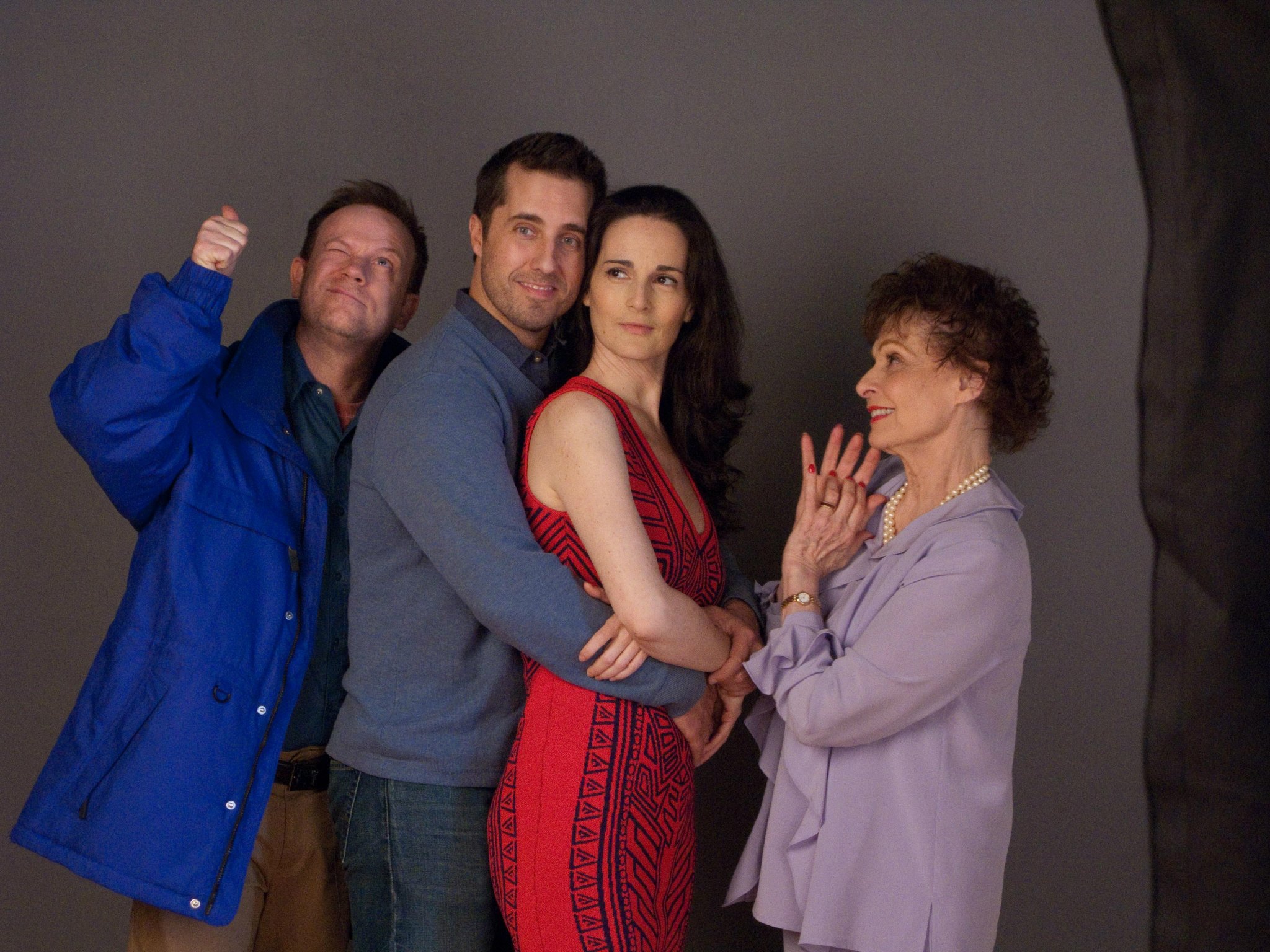
handle with care posterMany thanks to playwright Jason Odell Williams for taking time to talk to me about his romantic comedy, Handle With Care, opening tonight in New York, and starring Broadway legend Carol Lawrence, the original Maria in “West Side Story.” It tells the story of a young Israeli woman who reluctantly travels with her grandmother to America. Fate and hilarious circumstances bring together the young woman, who has little command of English, and a young American man with little command of romance. Is their inevitable love an accident? Or destiny generations in the making? Produced by my lifelong friend Sara Crown Star along with Doug Denoff, it arrives in New York after rave reviews around the country.

What was the initial inspiration for this story?  is any of it based on characters or incidents from real life?

The initial inspiration was I wanted to write a play for my wife. I was an actor at the time and was becoming tired of bad auditions and mediocre plays that were angry and about “serious important issues.” I wanted to write a romantic comedy – in the best sense of that word – that people from 8 to 88 could enjoy. Like Neil Simon or the classic sitcoms from the 60s and 70s. So I asked my wife what kind of play she’d like to act in, and she wanted something where she couldn’t be understood or where there was a communication gap. She’s Israeli and speaks fluent Hebrew so i thought i’d start with that. I thought she should be lost or stuck somewhere where no one or very few people can understand her. And from there a play was born! It’s not based on any specific real life incidents but I drew on my experiences when I first visited Israel and Charlotte’s nieces and nephews couldn’t understand me and we had to find some common-ground method of communication. And the two main characters, Josh and Ayelet, started off as versions of my wife and I, but over time became their own characters. I usually begin writing a character with a person or actor in mind and then the character takes over and becomes its own living breathing being.

What is the biggest challenge in creating a romantic comedy?  The Atlantic wrote about how the genre seems to be disappearing from movies — why is it hard to create one these days?

I think because everyone is so familiar with the structure – and you can’t really deviate from it too much or it won’t work. Boy and Girl meet, there are obstacles along the way, Boy and Girl fall in love and end up together. It’s no secret that the two main characters are going to get together in the end and it will be a happy ending – the only question is HOW. So everyone knows what’s coming and therefore it’s harder to surprise them. And it’s hard to not seem schmaltzy. It’s hard to be sincere in this day and age. It’s definitely the hardest genre but ultimately my favorite. Because you’re challenge is to make people laugh, cry, smile, feel warm, and delight them from start to finish. No easy task.

What is it like to work with the legendary Carol Lawrence?  How does her extraordinary background in theater contribute to this production?

She’s pretty amazing. I sometimes forget about her roots and her background and just see her as lovely Carol, the actress playing Edna, but once in a while I have to pinch myself when I remember she was the original “Maria.” Her stage experience and also just her life experience help her bring such amazing depth and warmth to the role. And she’s also extremely sweet and endearing in person. Lovely to have in the cast. We’re very lucky!

What makes the relationship with a bubbe so universal?handle with care

Everybody has one. And if you weren’t particularly close to your bubbie, you know what’s it like to be close to SOMEONE in your family. And that’s universal. Family and Love are the most universal topics I think. And the best topics.

What did you learn from regional productions of the show that helped make it work off-Broadway?  Were there any major changes along the way?

Yes, and there are still changes! There will probably be script changes up until a few days before opening night! But that’s what theatre is about. Tweaking and re-writing until you get it right. We learned SO much from the regional productions. Learned where the laughs are, where audiences were confused, where they were bored, where they were charmed, surprised, enthralled. Listening to an audience watch your play night after night is incredibly informative. It’s the only way to know what’s working. So i will use the first several preview performances to tinker and finalize the script for sure.

What were some of your favorite romantic comedies — legitimate theater or movie — when you were growing up?

When Harry Met Sally is the perfect romantic comedy film. And then for theatre, Barefoot in the Park is a benchmark play for me. If I can come anywhere close to Nora Ephron, Rob Reiner or Neil Simon, I’d consider myself very lucky.

What do you want families to talk about after they’ve seen the show?

I want them to talk about their own families, their own stories of fate and destiny, whether or not they believe in fate or destiny or soul mates or if it’s all just a bunch of random chaos, to talk about their own stories of finding love and falling in love. I want them to leave the play buzzing and smiling and happy and feeling a renewed faith in humanity! Is that too much to ask??

What makes you laugh?

My wife and my daughter. A great romantic comedy. And of course – this play!

Related Tags:


Interview Live Theater Writers

Interview: Antonio Vargas of “Silver Bells”

Posted on November 30, 2013 at 3:59 pm

antonio and bruceAntonio Vargas plays an angel-like character who changes the life of a type-A father in Silver Bells.  He talked to me about how he broke into show business  and singing in the airport with his co-star and fellow 70’s television icon Bruce Boxleitner.   He’s best known for playing the street-smart Huggy Bear in “Starsky and Hutch.”  The movie premieres tomorrow, December 1 on UP TV, at 7pm, 9pm and 11pm ET.

Tell me about your character in the film.

I play Major Melvin Lowell of the Salvation Army and he’s a little bit like the ghosts in “A Christmas Carol” or the angel in “It’s a Wonderful Life” because he takes this other character, Bruce Dalt, on a journey, and he comes out on the other side with an appreciation of giving through humility and giving the new eyes to see the benefits and the spirit of Christmas.  He’s very much the connector, like Huggy Bear was that connected between Starsky and Hutch.  Major Lowell is connector between Bruce’s old life like Scrooge and the spiritual sense of purpose.  It was a fun role to play.

Bruce said the two of you really bonded and had a great time on the set.

Yes, we did between having dinner or traveling together to and from the set.  It all started when we arrived together in an airport together in the blizzard.  And we sang and spent the time, I think it was almost two hours, to get to our location and that was the beginning.  And then every day, it’s sharing the same dressing room and just about the work, being a seasoned veteran that he is, and for me after 40 years to be working with him and leading these young actors, and accepting responsibility.

It’s a very important message for families, isn’t it?  Why is it people lose sight of what’s important in the holidays and get caught up in the external craziness?

It’s a lot of social peer pressure and, again, losing sight of what the essence of Christmas is about.  And for somebody like Bruce Dalt to be one of those — I’ve been around football dads and soccer dads with so much vested that they lose sight of what it’s about.  It’s about the young person having an opportunity.

Bruce is so driven in his own self that he fails to see how he’s missing the point.  And that’s what happened at Christmas.  The commercializing of it and the pressures that puts on people to have instead of knowing that it’s about what we give.  People have a tough time getting through that and it just reminds you that the meek shall inherit the Earth so I really get it when people go down and go to a soup kitchen and try to get some of the commercialism out of Christmas.  

How did your family celebrate Christmas when you were growing up?

Well I come from meager means in New York but there was still a sense of innocence.  If we got one thing, it was great.  My dad was at the Department of Sanitation.  He was a garbage man.  He picked up trash around New York.  It was dignity.  And I was one of eleven children so we knew about hand-me-downs.  And government milk, and I always said, “When I grow up, I’m going to have butter because we always had this margarine.” I grew up in the projects in New York where there was a sense of family, where people looked out for each other and someone could admonish someone else’s kids if they were wrong and we had to respect your elders.

What was the first acting job that you got paid for?

The first thing I ever did was a movie called “A Cool World” with my mother’s urging at 14, I tried out in this film about gangs sort of like West Side Story but this was set in Harlem.   And I remember I made $20 a day and first check number was 127.  I think I made $60.   Three days and I loved it.  Here I was going to the movies, RKO in New York, and I would see Cary Grant, John Wayne, and all these people up on the screen.  And to think that I was going to be up on that screen like that, it created such a hunger in me that I could get out of self and I found a family of artists that felt different like I felt.   These feelings and an opportunity to express them, it was such a liberating experience and because the times, coming out of the hippie generation, Vietnam War, and all these things that were happening to music and all.  I mean it was just a very, very rich time.  Then from 14, I got into a play called “The Amen Corner” which went to Europe, and ended up working for The Beatles, Manager, Brian Epstein. My parents had to go to high school to get my diploma on graduation because I had to be in Vienna for the opening of the play.  I bathed in the River Jordan on my 18th birthday in Israel.

Wow!

It’s just been a phenomenal ride and then to culminate as of 2013, with a Christmas themed story for television.  It’s wonderful, feels wonderful and right where I’m supposed to be and I so pleased to get an opportunity to share the gifts that I got, and to put those into motion and something that resembles a spiritual story for the people and to give hope to people because you don’t always get to choose.

Related Tags:


Actors Interview
THE MOVIE MOM® is a registered trademark of Nell Minow. Use of the mark without express consent from Nell Minow constitutes trademark infringement and unfair competition in violation of federal and state laws. All material © Nell Minow 1995-2026, all rights reserved, and no use or republication is permitted without explicit permission. This site hosts Nell Minow’s Movie Mom® archive, with material that originally appeared on Yahoo! Movies, Beliefnet, and other sources. Much of her new material can be found at Rogerebert.com, Huffington Post, and WheretoWatch. Her books include The Movie Mom’s Guide to Family Movies and 101 Must-See Movie Moments, and she can be heard each week on radio stations across the country.

Website Designed by Max LaZebnik