Science fiction luminary Arthur C. Clarke has died at age 90.
His pioneering theoretical work on orbits made possible the development of communication satellites and the author of over 100 books. His thoughtful interview in 1999 covers his experience writing “2001: A Space Odyssey” with director Stanley Kubrick and his thoughts on the U.S. Space program.
Ira Sachs is the writer/director of “Married Life,” a story set in 1949 about a married man (Chris Cooper) who falls in love with a young widow (Rachel McAdams). He believes that it would be kinder to kill his wife (Patricia Clarkson) than to leave her. Pierce Brosnan plays his best friend, who finds himself learning secrets from all three of the other characters.
This is your first film set in another time. What does that bring to the story?
Every time you make a fim you create a world. You make decisons about sets and costumes and you create a universe connected to reality but not reality itself. The year 1949 was a choice that we made and we were authentic to that choice. But as William Faulkner said, “The past isn’t dead; it isn’t even past.” Our parents, our grandparents, are like ourselves; they were full-bloofed full-bodied people who had sex and fights and relationships and and were not different from us. So even though it is set in another time, it is about us.
Elements of this film are very stylized and yet it straddles more than one genre.
Suspense films are often based on communication problems, and that affects all of the plot points. It almost gives it kind of a fable feeling. The animated title sequence gives the audience the understanding that they should not take what follows too literally. It is an entertainment that speaks about things that are very true. Mildred Pierce is not the Maysles brothers . Movies are romantic fantasies. As i’ve gotten less righteous, less pedagogic, I have become more loving of the artificiality, the art form, the imitation of life in film. That is the way I hope people approach this film, directly. Enjoy its roller coaster ride of twists and turns, not to have to think about it while you watch but it will give you food for thought. I am trying to take advantage of entertainment as not being a negative word. One of the things that is different is that it does not stick to any one genre, like a good cocktail, a mix. It is something original, something new. It uses all those genres beause they are all part of our collective understanding of how to tell a story.
There was a feeling on the set that we all had a chance to do something adventurous emotionally, a genre film on some levels, but with something bubbling up underneath.
In honor of this week’s release of “Horton Hears a Who,” the best movie for the family in a long time, Entertainment Weekly has put together a list of the 20 all-time best movies for kids. These are not movies to toss in the DVD in the back of the minivan or to give to the babysitter on the parents’ night out. These are movies that need to be shared, movies that create and strengthen connections, as all truly great movies do.
The obvious classics are there, of course, The Wizard of Oz, The Sound of Music, E.T. – The Extra-Terrestrial. A list of 20 only has room for one Harry Potter but squeezes all three The Lord of the Rings into one spot. I could quibble with them about their choice of a Disney animated classic — they choose The Lion King while I would have gone with Pinocchio, for me the best-ever hand-animation, story, and soundtrack. And for a Disney live-action classic, for me, the wonderful The Parent Trap is edged out by the even more wonderful Pollyanna . With only 20 choices Entertainment Weekly had to bypass some of my favorites like Finding Nemo, Yellow Submarine, and The Black Stallion. But there is no question that every movie on EW’s list is one that the whole family should take time to watch together. And then watch again.
I was delighted to see a terrific article about the fabulous Anita Renfroe in the New York Times. It is especially gratifying to see the mainstream media embrace a performer who is frank and upfront about her Christianity. It is a welcome reminder to everyone along the spectrum from believer to skeptic and beyond that humor’s inherently subversive aspects are not inconsistent with sincere faith and religious practice.
One of my first postings on this blog was Ms. Renfroe’s “William Tell Overture” version of everything a mother says in a 24-hour period and I am pleased to have a chance to post it again for those who might have missed it. Check out her home page for her response to the dads who asked for their own version. Check out Good Morning America for her “Estrogen Theater” updates on life’s most crucial issues and confounding questions.
Once again a politician is in disgrace and once again his wife appears at his side at the press conference. While he admits his mistakes, she stands there in silent support. What is she thinking? Of the sacrifices she made over the years, the time spent smiling, shaking hands, pretending to be interested, wishing she was alone with her family or pursuing her own interests? Of the humiliation of seeing her family’s most personal information dissected by pundits and cackled over by people who have never contributed to the public good?
An excellent BBC miniseries starring Juliet Stevenson explores what might be on the mind of one such woman. It is called, of course, “The Politician’s Wife.”

 is not the Maysles brothers . Movies are romantic fantasies. As i’ve gotten less righteous, less pedagogic, I have become more loving of the artificiality, the art form, the imitation of life in film. That is the way I hope people approach this film, directly. Enjoy its roller coaster ride of twists and turns, not to have to think about it while you watch but it will give you food for thought. I am trying to take advantage of entertainment as not being a negative word. One of the things that is different is that it does not stick to any one genre, like a good cocktail, a mix. It is something original, something new. It uses all those genres beause they are all part of our collective understanding of how to tell a story.
 ,
,  ,
,  . A list of 20 only has room for one
  but squeezes all three
  into one spot. I could quibble with them about their choice of a Disney animated classic — they choose
  while I would have gone with
  , for me the best-ever hand-animation, story, and soundtrack. And for a Disney live-action classic, for me, the wonderful
  is edged out by the even more wonderful
  .
.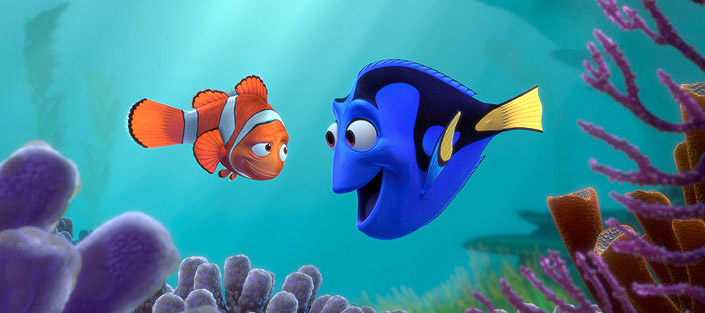 With only 20 choices Entertainment Weekly had to bypass some of my favorites like
  ,
,  , and
, and  . But there is no question that every movie on EW’s