New From Audible: Born a Crime Audiobook by Trevor Noah of “The Daily Show”

Posted on November 14, 2016 at 3:11 pm

“The Daily Show” host Trevor Noah has written a new memoir, Born a Crime: Stories from a South African Childhood, available as an audiobook from Audible, and we are pleased to be able to share a clip. In the Mail & Guardian, Darryl Accone wrote:

Born on February 20 1984, Trevor fell foul of any number of apartheid-era laws: to start, his parents had broken the Immorality Act (the 1927 version of which is the apt epigraph to the book).

In the simple, powerful prose that characterises Noah’s writing here, he recounts: “The doctors took her up to the delivery room, cut open her belly, and reached in and pulled out a half-white, half-black child who violated any number of laws, statutes, and regulations – I was born a crime.”

He was also born with a confusion of nationality, ethnicity and identity: “My mother lied and said I was born in KaNgwane, the semi-sovereign homeland for Swazi people living in South Africa. So my birth certificate doesn’t say that I’m Xhosa, which technically I am. And it doesn’t say that I’m Swiss, which the government wouldn’t allow. It just says that I’m from another country.”

The past is another country, they say, and Noah takes the reader through the years from 1984, with brief servings of our history and its lurid laws and practices around race, work, sex and violence to contextualise his personal story for non-South African readers.

This is Trevor Noah’s story told through stories and vignettes that are sharply observed, deftly conveyed and consistently candid. Growing organically from them is an affecting investigation of identity, ethnicity, language, masculinity, nationality and, most of all, humanity – all issues that the election of Donald Trump in the United States shows are foremost in minds and hearts everywhere.

The best way to enjoy this fascinating story is to hear it in Noah’s own voice, and the Audible version lets you feel as though he is really telling you his story.

Related Tags:


Books Trailers, Previews, and Clips

Critics Choice Award Nominations: Television

Posted on November 14, 2016 at 10:36 am

The Broadcast Television Journalists Association has announced the nominees for this year’s Critics Choice Awards. I was delighted to see nominations for the outrageous new series “Fleabag” and its creator Phoebe Waller-Bridge, and Rod Lurie’s “Killing Reagan” get a nod as well. The awards will be announced on A&E on Sunday, December 11 at 8PM ET/7PM CT/5PM PT.

BEST COMEDY SERIES
Atlanta – FX
Black-ish – ABC
Fleabag – Amazon
Modern Family – ABC
Silicon Valley – HBO
Unbreakable Kimmy Schmidt – Netflix
Veep – HBO

BEST ACTRESS IN A COMEDY SERIES
Ellie Kemper – Unbreakable Kimmy Schmidt – Netflix
Julia Louis-Dreyfus – Veep – HBO
Kate McKinnon – Saturday Night Live – NBC
Tracee Ellis Ross – Black-ish – ABC
Phoebe Waller-Bridge – Fleabag – Amazon
Constance Wu – Fresh Off the Boat – ABC

BEST ACTOR IN A COMEDY SERIES
Anthony Anderson – Black-ish – ABC
Will Forte – The Last Man on Earth – FOX
Donald Glover – Atlanta – FX
Bill Hader – Documentary Now! – IFC
Patrick Stewart – Blunt Talk – Starz
Jeffrey Tambor – Transparent – Amazon

BEST SUPPORTING ACTRESS IN A COMEDY SERIES
Julie Bowen – Modern Family – ABC
Anna Chlumsky – Veep – HBO
Allison Janney – Mom – CBS
Jane Krakowski – Unbreakable Kimmy Schmidt – Netflix
Judith Light – Transparent – Amazon
Allison Williams – Girls – HBO

BEST SUPPORTING ACTOR IN A COMEDY SERIES
Louie Anderson – Baskets – FX
Andre Braugher – Brooklyn Nine-Nine – FOX
Tituss Burgess – Unbreakable Kimmy Schmidt – Netflix
Ty Burrell – Modern Family – ABC
Tony Hale – Veep – HBO
T.J. Miller – Silicon Valley – HBO

BEST GUEST PERFORMER IN A COMEDY SERIES
Alec Baldwin – Saturday Night Live – NBC
Christine Baranski – The Big Bang Theory – CBS
Larry David – Saturday Night Live – NBC
Lisa Kudrow – Unbreakable Kimmy Schmidt – Netflix
Liam Neeson – Inside Amy Schumer – Comedy Central

BEST ANIMATED SERIES
Archer – FX
Bob’s Burgers – FOX
BoJack Horseman – Netflix
Son of Zorn – FOX
South Park – Comedy Central
The Simpsons – FOX

BEST REALITY COMPETITION SERIES
America’s Got Talent – NBC
MasterChef Junior – FOX
RuPaul’s Drag Race – Logo
Skin Wars – GSN
The Amazing Race – CBS
The Voice – NBC

BEST STRUCTURED REALITY SERIES
Chopped – Food Network
Inside The Actors Studio – Bravo
Penn & Teller: Fool Us – The CW
Project Runway – Lifetime
Shark Tank – ABC
Undercover Boss – CBS

BEST UNSTRUCTURED REALITY SERIES
Anthony Bourdain: Parts Unknown – CNN
Chrisley Knows Best – USA Network
Deadliest Catch – Discovery
Ice Road Truckers – History
Intervention – A&E
Naked and Afraid – Discovery

BEST TALK SHOW
Full Frontal with Samantha Bee – TBS
Jimmy Kimmel Live! – ABC
Last Week Tonight with John Oliver – HBO
The Daily Show with Trevor Noah – Comedy Central
The Late Late Show with James Corden – CBS
The Tonight Show Starring Jimmy Fallon – NBC

BEST REALITY SHOW HOST
Ted Allen – Chopped – Food Network
Tom Bergeron – Dancing with the Stars – ABC
Anthony Bourdain – Anthony Bourdain: Parts Unknown – CNN
Nick Cannon – America’s Got Talent – NBC
Carson Daly – The Voice – NBC
RuPaul – RuPaul’s Drag Race – Logo

BEST SUPPORTING ACTOR IN A DRAMA SERIES
Peter Dinklage – Game of Thrones – HBO
Kit Harington – Game of Thrones – HBO
John Lithgow – The Crown – Netflix
Michael McKean – Better Call Saul – AMC
Christian Slater – Mr. Robot – USA Network
Jon Voight – Ray Donovan – Showtime

BEST SUPPORTING ACTRESS IN A DRAMA SERIES
Christine Baranski – The Good Wife – CBS
Emilia Clarke – Game of Thrones – HBO
Lena Headey – Game of Thrones – HBO
Thandie Newton – Westworld – HBO
Maura Tierney – The Affair – Showtime
Constance Zimmer – UnREAL – Lifetime

BEST ACTOR IN A DRAMA SERIES
Sam Heughan – Outlander – Starz
Rami Malek – Mr. Robot – USA Network
Bob Odenkirk – Better Call Saul – AMC
Matthew Rhys – The Americans – FX
Liev Schreiber – Ray Donovan – Showtime
Kevin Spacey – House of Cards – Netflix

BEST ACTRESS IN A DRAMA SERIES
Caitriona Balfe – Outlander – Starz
Viola Davis – How to Get Away with Murder – ABC
Tatiana Maslany – Orphan Black – BBC America
Keri Russell – The Americans – FX
Evan Rachel Wood – Westworld – HBO
Robin Wright – House of Cards – Netflix

BEST DRAMA SERIES
Better Call Saul – AMC
Game of Thrones – HBO
Mr. Robot – USA Network
Stranger Things – Netflix
The Crown – Netflix
This Is Us – NBC
Westworld – HBO

BEST GUEST PERFORMER IN A DRAMA SERIES
Mahershala Ali – House of Cards – Netflix
Lisa Bonet – Ray Donovan – Showtime
Ellen Burstyn – House of Cards – Netflix
Michael J. Fox – The Good Wife – CBS
Jared Harris – The Crown – Netflix
Jeffrey Dean Morgan – The Walking Dead – AMC

BEST MOVIE MADE FOR TELEVISION OR LIMITED SERIES
All the Way – HBO
Confirmation – HBO
Killing Reagan – National Geographic
Roots – History
The Night Manager – AMC
The People v. O.J. Simpson – FX

BEST ACTOR IN A MOVIE MADE FOR TELEVISION OR LIMITED SERIES
Bryan Cranston – All the Way – HBO
Benedict Cumberbatch – Sherlock: The Abominable Bride – PBS
Cuba Gooding Jr. – The People v. O.J. Simpson – FX
Tom Hiddleston – The Night Manager – AMC
Tim Matheson – Killing Reagan – National Geographic
Courtney B. Vance – The People v. O.J. Simpson – FX

BEST SUPPORTING ACTOR IN A MOVIE MADE FOR TELEVISION OR LIMITED SERIES
Sterling K. Brown – The People v. O.J. Simpson – FX
Lane Garrison – Roots – History
Frank Langella – All the Way – HBO
Hugh Laurie – The Night Manager – AMC
John Travolta – The People v. O.J. Simpson – FX
Forest Whitaker – Roots – History

BEST ACTRESS IN A MOVIE MADE FOR TELEVISION OR LIMITED SERIES
Olivia Colman – The Night Manager – AMC
Felicity Huffman – American Crime – ABC
Cynthia Nixon – Killing Reagan – National Geographic
Sarah Paulson – The People v. O.J. Simpson – FX
Lili Taylor – American Crime – ABC
Kerry Washington – Confirmation – HBO

BEST SUPPORTING ACTRESS IN A MOVIE MADE FOR TELEVISION OR LIMITED SERIES
Elizabeth Debicki – The Night Manager – AMC
Regina King – American Crime – ABC
Sarah Lancashire – The Dresser – Starz
Melissa Leo – All the Way – HBO
Anna Paquin – Roots – History
Emily Watson – The Dresser – Starz

Related Tags:


Awards Television
Interview: Co-Director Angus MacLane on “Finding Dory”

Interview: Co-Director Angus MacLane on “Finding Dory”

Posted on November 14, 2016 at 8:00 am

Angus MacLane is co-director of the adorable “Finding Dory,” the sequel to “Finding Nemo.” In an interview, he spoke about the changes in technology and the decision to shift the focus to the memory-impaired fish voiced by Ellen DeGeneres. The DVD/Blu-Ray is available November 15, 2016.

How has the technology changed since finding Nemo and how did that affect your story, the setting and the characters?

That’s a good question. I think that thirteen years from release to release is such a huge time technologically. And so there was a brand-new animation system, there were brand-new articulation tools for the characters, there were brand-new lighting tools that were entirely different. So basically the system from the ground up was different. I think that one of the things that was a challenge in the first film was that water was so difficult to do and very complex, so it was difficult. It is still difficult but the effects we could get were so much more satisfying technologically that what we wanted to do was not the challenge that it was in the first film.

And so it just afforded us the chance to not worry about how these characters could break the surface of the water, which would have been a challenge in the first film, or where we were going to really spend our dollars doing splashes or big effects. They weren’t insignificant but it wasn’t a major hurdle in the same way where we would have to carefully plan for each of those effects that would potentially affect our story thirteen years ago. The technology improves and the renders in the computer speed improve and we’re always asking the computers and everyone to do things that are infinitely harder to keep pace with the speed and the technology. So it wasn’t any faster necessarily but we did have a lot of new technologies and a very capable crew to implement them and try out a bunch of new and interesting things.

Most sequels continue the story of the main character but this one makes Nemo and Marlin secondary to Dory. What went into that decision?

Well I think that the reason to do this film for Andrew Stanton really rested in seeing “Finding Nemo” in 3D several years ago, long after its release. He was worried about Dory. And so the question about where she had come from and if she was going to be okay became the reason for him to make the movie, the question that he most wanted to answer. So the idea was after this film the audience members would not be concerned for Dory and feel confident that if she got lost she could find your way back again.

This film has at least five characters with disabilities including Nemo, Dory and Hank. What was most important to you portraying the way that these characters adapt to and think about these disabilities?

I think the thing that was most important to us was that we showed them as four dimensional characters. Everyone in the film is at kind of a different stage than Dory is about their disability. Dory over the course of the film — not to spoil it for those people that haven’t seen it — but she learns to fully accept and embrace her disability and work it in a way that she did not at the beginning of the film. Hank has already moved past that. He is already on to other things. He isn’t worried about it that much. I think that people with disabilities, they have everyday struggles but I think more than anything, the ones that we are familiar with are certainly very, very capable and it was about portraying the truth in that.

What exactly does a co-director do?

Copyright 2016 Disney

The co-director position is different for every movie. I had worked with Andrew most closely on “Wall-E” as a story artist and he was a Directing Animator and then he was the Executive Producer on “Burn-E,” the short film, and then on “Toy Story Of Terror.” So we had a wonderful creative partnership that continued on this film.

When I started working on the film, Andrew asked that I just try to do what wasn’t getting done and try to fill in the gaps. I was in pretty much all the meetings Andrew was in and there were some things that he delegated to me to manage. I would have input on pretty much everything with the understanding that it is ultimately Andrew’s decision. But he is a generous creative partner and an intelligent creative partner in the sense that he has surrounded himself with people who are not afraid to disagree with him if they have different opinions. And so a lot of the job is suggesting different ideas or trying to take a different point of view, and trying to drill down to get to the best idea. So it’s kind of a second opinion.

Do you remember your first Disney animated film you ever saw and what made the most significant impression?

It was either “Sleeping Beauty” or “The Rescuers.” For Sleeping Beauty it would have been that in the end Prince Philip has a battle with a dragon. And if it was “The Rescuers” I think it had this kind of really muted and dark and dirty colour palette that was kind of similar to or echoed a lot of the unease and uncomfortability of the 70’s animation. Most notable was the concept of a giant diamond inside this skull. It was kind of terrifying to me as a kid, so that kind of freaked me out.

And what was the best advice you ever got about directing, from Andrew Stanton or any of your other role models?

The most helpful stuff is just doing the job or being next to somebody that’s doing the job day in and day out and seeing the minutia that they deal with. But there’s something that John Lasseter said once about if you’re giving someone direction and they are not getting you what you want it’s not their fault, it’s your fault for not explaining it well. To me that’s just fantastic advice because in addition to being the person that explains what your vision is, it’s also your job to get other people excited about your vision. It should be a collaborative effort that involves all parties and it starts with the director and continues with the crew.

There are so many comedic moments throughout “Finding Dory.” Where do you guys fine inspiration to make it so funny from start to finish?

Angus: Most of it is trying to make each other laugh — to try to do something that’s weird, something that we think is funny. If you come with a gag that is in story, we try to make sure that that gag continues or is able to read as it goes through the production pipeline because jokes can be funny for different reasons and often jokes can be ruined if the elements that make it funny aren’t adhered to or understood as it goes through production. I’m glad you think it’s funny because I think we just are trying to make each other laugh, that’s kind of our rule.

Related Tags:


Behind the Scenes Interview
Interview: “Finding Dory” Character Art Director Jason Deamer

Interview: “Finding Dory” Character Art Director Jason Deamer

Posted on November 13, 2016 at 3:14 pm

Finding Dory, one of the most purely delightful films of the year, is out on DVD/Blu-Ray this week, and I got a chance to interview character art director Jason Deamer about making the movie.

What is a character art director? How do you work with the character designers, the writers and the directors?

Character Designer Jason Deamer is photographed on February 3, 2016 at Pixar Animation Studios in Emeryville, Calif. (Photo by Deborah Coleman / Pixar)

A character art director is still a character designer. Basically there is a small team of artists. And what we do is, we work with the directors and writers and we pre-visualize what the characters are going to look like. It’s a small team of maybe five of us. We’re looking at the script and getting pictures from the directors and we are drawing hundreds and hundreds of the versions of what the character could potentially look like and then showing them to the director and he is saying, “No no no no no, maybe this one a little bit.” And we go literally back to the drawing board and we do it all again. The art director’s job is to just make sure that is moving along and checking with all those artists. Ultimately, once we define stuff on paper that looks like what the director is after, those artists move on to other things and the art directors stay on the movie and work with the modeling team, the rigging team, the shading team and the animation leads as the characters’ becoming realized on the computer. And so the art directors’ gig is sort of about ushering the whole process long from beginning to end.

What technological changes since “Finding Nemo” made a difference in making this film?

One of the biggest, most noticeable, things about this film is that our lighting software and shading software has gotten so much more advanced. We’ve got something called ray tracing that bounces off the light in a way that’s much more close to reality and I think it’s noticeable. The tangible qualities of the film are much more significant than the first one although the first one is really beautiful. It’s gotten so much more advanced that it was really an exercise in trying to limit ourselves a little bit to make sure that it was done in a way that felt like the first movie.

I’ll just give you an example. The first time that we used the software there was a glass of water in the table in the background and the way light bends through water, this software is so mesmerizing that instead of looking at the characters we are all looking at the glass of water in the background. This is a problem, right? You need audience to be looking at the characters. So we had to go in and figure of ways to tamp that down a little bit, made the water a little blurrier or put more particulate matter in there to be a fireworks display of lights bending through water that was not that distracting.

Would the Hank character have been possible in 2003?

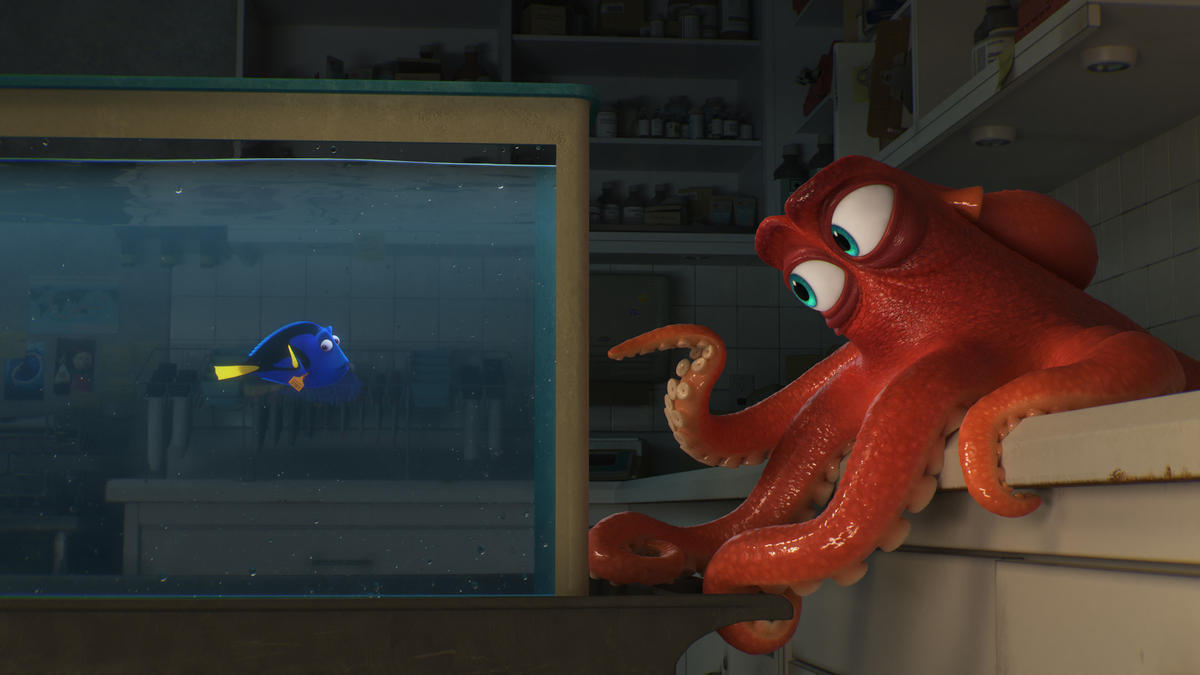
Absolutely not. We barely pulled it off this time. Let me take that back, it would have been possible if we had 10 years because one of the things that we are we better at is rigging which is the controls with which the animators use to animate characters, the digital puppets. We probably could have done it 13 years ago except for the rigging control would have been so complex, someone would have have to be going in hand by hand of been like 1000 controls per each tentacle so it could have been done with just sheer effort and muscle and taken forever but it would not look as good even with all that effort. So the short answer is no.

Copyright 2016 Disney

What special concerns arise from creating characters who live and move under water?

There is no water in the computer so the concerns are trying to figure out how to send signals to the audience that makes it look like water. The animators spend a lot of time learning how fish locomote through water and having the little paddling and the drift done in such a way that it looks like they’re suspended in the medium. Then we work on shading and lighting things. We’re trying to send enough visual cues to the audience to make it feel like water. Another example would be particulate matter which is the dust that is suspended in water, so we put a bunch of that into the film, just enough so that when the fish are swimming around we’re also simulating that particulate matter so when the fish moves its tail you see those little bits of sand that are catching the light that kind of get disturbed by the movement of the fin. It is a collection of a bunch of little signals like that that tells you that the fish is in water.

Do you have a favorite animated classic Disney character?

I do, it’s Maleficent. I love the design of Maleficent. I just think it’s really beautiful, on the character design level.

What characters did you like to draw when you were growing up?

It was an ever-changing, ever-evolving thing. When I was really, really little for some reason I was obsessed with drawing ninjas like in kindergarten. And then comic books and it just went on and on and on. I’m still constantly change my mind about what I like to draw.

Related Tags:


Behind the Scenes
Anna Kendrick Memoir: Scrappy Little Nobody

Anna Kendrick Memoir: Scrappy Little Nobody

Posted on November 13, 2016 at 9:38 am

Copyright Touchstone 2016

No matter what character Anna Kendrick plays, you can’t help wishing you could just hang out with her, having some tea and laughing at the world. Now she has written a memoir called Scrappy Little Nobody, and her wry, self-deprecating, razor-sharp take on the world is the next best thing. My friend, movie critic Susan Wloszczyna wrote about it for The Buffalo News.

For the precocious Kendrick, who defines that p-word as meaning “this kid is annoying,” it arrived rather early. This diminutive dynamo with rafter-rattling vocal abilities made her Broadway debut at age 12 and got a Tony nomination for efforts in the musical “High Society” as well as earned an Oscar nod at age 24 for ”Up in the Air.” Turns out she not only possesses a well-honed humorous perspective on her all-too-human foibles – just one reason why her witty Twitter account has amassed more than 5 million followers. But this down-to-earth young lady has also collected a reasonable supply of insider showbiz anecdotes and observations about growing up in limelight as well.

Related Tags:


Actors Books
THE MOVIE MOM® is a registered trademark of Nell Minow. Use of the mark without express consent from Nell Minow constitutes trademark infringement and unfair competition in violation of federal and state laws. All material © Nell Minow 1995-2026, all rights reserved, and no use or republication is permitted without explicit permission. This site hosts Nell Minow’s Movie Mom® archive, with material that originally appeared on Yahoo! Movies, Beliefnet, and other sources. Much of her new material can be found at Rogerebert.com, Huffington Post, and WheretoWatch. Her books include The Movie Mom’s Guide to Family Movies and 101 Must-See Movie Moments, and she can be heard each week on radio stations across the country.

Website Designed by Max LaZebnik