
Interview: Jamie Bradshaw of “Branded”
Posted on September 5, 2012 at 8:00 am
Jamie Bradshaw and Alexander Doulerain are advertising executives and brand specialists who have written and directed “Branded,” set in a dystopian future where corporate brands have created a disillusioned population and one man’s effort to unlock the truth behind the conspiracy leads to an epic battle with hidden forces that control the world.
I spoke to Bradshaw at Comic-Con about the movie and how advertising permeates our consciousness.
How do you bring what you know as an advertiser to getting the word out on this movie?
Well, the first thing you do is you find yourself a really awesome movie distributor who has great marketing people who work at it, because you need them to help you shepherd with the kind of distance from the movie they can offer you, a campaign. I’m really grateful a bold company like Roadside Attractions is taking on such a film, because it’s a visionary film, but it’s also a film that, because it’s visionary, is very different from anything in the marketplace and easily could’ve fallen into one of the black holes of distribution, and those guys are awesome. They’re really great at marketing and they’ve come up with a very signature vision of the marketing of the movie.
Do you think people are more anti-corporate right now? Do you think people are more willing to think of corporations as bad guys?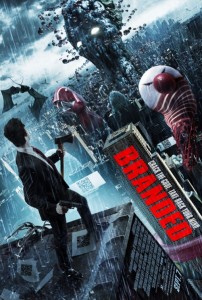
Nope, I actually think people are kind of lukewarm on brands, I think people believe brands and corporations are things so fundamental to our life that—why would you criticize them? And I think that’s exactly why I want to make a movie like this because ultimately, when you turn a blind eye—ultimately, nothing if not critical, because if you turned a blind eye to the things that fundamentally define the world and not think about them, that’s how they get you.
There are studies showing that children recognize logos for products more often than they recognize Jesus or the President.
It’s just awesome how they manage to get you, too. I remember taking my son to McDonald’s as a kid because he demanded to go, and we were writing this film at the time, and I kept thinking, “Oh, the irony,” but he would go and he didn’t want the food, he wanted the toy. I would make him eat the food because I paid for it, for God’s sake. And sure enough, five years later, after five years of telling me, “I don’t like that food, it doesn’t taste good,” but he wanted the toy for five years; five years later, now he likes the food because the food, the taste of the food has become part of his psychology, and as we all know—that’s what marketing is—marketing is fundamentally sculpting and shaping the identity of people.
Yes, that’s right, by making you feel bad about yourself and that you need something that you will get from spending money.
Right, exactly, and over time, changing, truly, and defining, truly, what your taste buds are, how you physically react to everything from sex to buying things to death; everything about life is defined around that kind of consumption experience.
All the brands come to Comic-Con to appeal to these very passionate fans. What do you hope to get from bringing this movie to Comic-Con?
I hope we get awareness of the film at Comic-Con. Obviously I believe the film tells an original story and it has some truth-telling kind of power to it, so perhaps I sound naïve, but I’m hoping people will become more and more aware of it, because if people are not aware of your product, then they can’t consume it. So on some level, the irony of it all is that I’m here like everyone else, obviously trying to sell something to the world in the same way everyone else is. I think the difference is the extent to which this film is actually telling the truth about the world that we live in; it’s a film fundamentally defined by the truth and I don’t think that most of the films that I see are very truth-inspired these days. I think that they’re copies of films that I’ve seen before and there’s something deceitful about that, deceitful in the packaging of themselves as well, because they try to trick you (obviously) into thinking they are stories you haven’t heard—that’s the whole idea of selling a movie these days, right? You have to make it look like it’s something compelling and new that you haven’t seen before, and then—you go and they told a story I’d heard a thousand times before.
A lot of people who want to go see exactly the same movie they saw before. That’s why remakes and sequels are so popular.
Exactly, and it’s very historical and historically traceable, the way in which people can be sculpted over time to believe the things they believe about the world. In the case of movies, sure, Sumner Redstone 20 years ago decided the Blockbuster didn’t need to have anything besides a new-release section. At that point, movies became over about a 15 year period something that most people don’t know very much about at all. Who knows the history of movies? Who’s seen “Citizen Kane” these days? Very few people. Very few people see anything except new films, consumable so that you forget about them the next week or the next moment after you’ve seen them. How better to make a consumable film of that sort than to make a film that’s just new packaging of a story you’ve already seen before? It’s the easiest thing to sell in 15 seconds to an audience because it doesn’t require any story-telling effort. “Oh, I remember that person, that thing I’ve seen before, I know what that is, okay, I’m aware of it, I can go and get it from the kiosk.” But that kind of film-making is doomed to its own deceitful unoriginality.
Netflix exists in exactly the same kind of continuum and packaging space that Blockbuster did. 95% watch what they’re aware of, because how else could you watch anything else? And they’re aware of new-release movies that have saturated the marketplace with their own awareness because they spend tons of money on advertising. People watch the same stuff they watched at Blockbuster and Netflix will be gone at some point very soon, replaced by more sophisticated VOD platforms that target you on a much more psychographic level that allow you to get inside the head of what prepackaged thin you can easily consume even better that they could—it’s all going to be new stuff.
Is there a case where you can think of where branding worked, really I would say, to the betterment of society?
One would think that the 20th century was about the rise of Marxism and socialism and all this kind of stuff. I think the Soviet Union was one of the best brands ever created. It was a pretty powerful vision of the world in stark contrast to everybody else’s view. I don’t know that the tyranny of choice has left us feeling very good about ourselves.
The world is the world for good and bad. The world exceeds ethics to me because the truth exceeds ethics; the truth is what it is. Ontology would always—any philosopher would tell you, any ontology or fundamental vision of the world—ontology would take precedence over ethics, so if you want to understand the way things are, you’ve got to look at what they are, first, and then marketing is what is; so I think the first thing we have to do is look at what is for what it really is and experience it as such. I hope that what we’ve been able to do is provide the emotional journey that will allow you to see the world for what it truly is and feel it for what it really is.
Tell me about the hero in the movie.
The hero is a brilliant Russian advertising executive, who through various supernatural circumstances was given this brilliant gift for advertising, a gift he does not understand, believes is a curse for a lot of the time, uses it at some point to make a lot of money and live a very powerful life that he then has to, at some point, at one point or another is taken from him by a conspiracy that destroys him, and ultimately it is the gift and technology he uses to turn into a weapon to fundamentally change the world forever. By the end of this film he has used as a weapon things you’ve never conceived of could be weapons, and has fundamentally turned the world into a completely different looking place.
 , were eager to provide backing for a movie version of Miller’s story of his journey from a very strict fundamentalist upbringing to his studies at one of the most free-thinking schools in the world,

