
Mad Men Enters the Civil Rights Era

Posted on March 25, 2012 at 8:00 am

From the New York Times:

There was no question that “Mad Men” would get around to the civil rights movement. From the start, racism was the carbon monoxide of the show: a poison that couldn’t always be detected over the pungent scent of cigarettes, sexism, anti-Semitism, alcoholism, homophobia and adultery, but that sooner or later was bound to turn noxious.

That promise was made in the opening scene of the premiere episode of Season 1. The first face on screen is a black one in profile, that of a waiter carrying a tray of cocktails across a bar crowded with white, mostly male customers. The camera closes in on Don Draper (Jon Hamm), scribbling ideas on a napkin for a Lucky Strike campaign. Asking for a light, he notices that the busboy, an older black man, smokes Old Gold, and Don asks him why he is so loyal to that brand.

“Is Sam here bothering you?” a white bartender interjects before the busboy has uttered a word. Shooting the black man a warning look, the bartender tells Don, “He can be a little chatty.”

It was the dawn of the 1960s, and that kind of humiliation was so commonplace that both Don and the busboy shrug it off.

What I find especially interesting about this is that, contrary to most depictions of the racism of the era, there is no attempt to portray the white characters as aware of or concerned about the casually bigoted arrogance of the time.  Don Draper is only interested in how to help his clients.  But I suppose that reflects an element of self-interest that played a role in the era’s changes as well.

Related Tags:


Television

Appalling Critiques of Jennifer Lawrence’s Body in “Hunger Games”

Posted on March 24, 2012 at 10:58 am

Thanks very much to L.V. Anderson for a piece in Slate about truly horrifying discussions of Jennifer Lawrence’s body in reviews of “The Hunger Games.”

A baffling, infuriating trend has cropped up in reviews of The Hunger Games: critics bodysnarking on Jennifer Lawrence. “A few years ago Ms. Lawrence might have looked hungry enough to play Katniss,” writes the New York Times’ Manohla Dargis, “but now, at 21, her seductive, womanly figure makes a bad fit for a dystopian fantasy about a people starved into submission.” The Hollywood Reporter’s Todd McCarthy comments that Lawrence’s “lingering baby fat shows here.” And—most bluntly—Hollywood Elsewhere’s Jeffrey Wells calls Lawrence a “fairly tall, big-boned lady” who’s “too big” for Josh Hutcherson, who plays Katniss’s romantic interest.

As Anderson points out, Lawrence is very slender and attractive.  If she does not look super-model skinny (the kind of severely underweight body recently outlawed in Israel for models in ads in an effort to combat eating disorders), I consider it a major step forward to give audiences  heroine whose body communicates health and strength.

Oh, and one other appalling — and revealing — aspect of Wells’ comment.  Why make the obligation of physical suitability on Lawrence?  Why not say that Hutcherson, who is in a supporting role, is too small for her?

To add insult to injury — and some more insult, too — Wells advises his readers to beware of the reviews of “The Hunger Games” by female critics “as they’re probably more susceptible to the lore of this young-female-adult-propelled franchise than most.”  Um, “most?”  Who would that be again?”

Once again, the male gaze, or Wells’ male gaze, is the norm and everyone else is just an outlier.  Thanks to Matt Singer of indieWire for pointing out that there is no statistically significant difference between the ratio of positive to negative reviews of this film by male and female critics.

Related Tags:


Understanding Media and Pop Culture
Mad Men-era Ads in Newsweek

Mad Men-era Ads in Newsweek

Posted on March 24, 2012 at 8:00 am

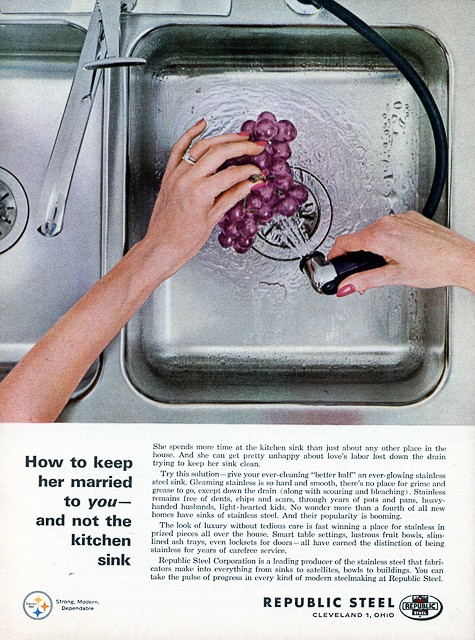
Newsweek salutes the long-awaited return of “Mad Men” with a special issue this week, including examples of real and unabashedly sexist ads that ran in the magazine back in the 1960’s.  These are what the real Mad Men of the era were working on, along with some pioneering and underpaid Mad Women like Peggy.

As another ad of the era would say, “We’ve come a long way, baby.”  (Of course, that was an ad for a “women’s” cigarette!“)

Related Tags:


Advertising Television Understanding Media and Pop Culture

Remake of “Steel Magnolias” with Queen Latifah and Phylicia Rashad

Posted on March 23, 2012 at 3:45 pm

I was thrilled to hear that Lifetime is working on a remake of “Steel Magnolias” with Queen Latifah as M’Lynn (the part played in the movie by Sally Field), Phylicia Rashad as Clairee (played in the movie by Olympia Dukakis), Jill Scott as beauty salon owner Truvy (played in the movie by Dolly Parton) and Alfre Woodard as the irascible Ouiser (played in the movie by Shirley MacLaine).  Rashad’s daughter Condola will play Shelby, a character inspired by the playwright’s sister, who died of complications from diabetes but who would “rather have 30 minutes of wonderful than a lifetime full of of nothing.”   This is a dream team of performers and I can’t wait to see what they do with this juicy story.

Related Tags:


Based on a play Inspired by a true story Television

John Hanlon’s 10 Differences Between the Hunger Games Book and Movie

Posted on March 23, 2012 at 11:43 am

My friend John Hanlon launched his new website today with a terrific list of the 10 biggest differences between the Hunger Games book and movie.  Big spoilers alert, but when you know them both, it is both thoughtful and lots of fun.  I actually liked the movie better than the book, partly because instead of the subjective re-telling by Katniss it is an objective and more cinematic version of the story.  I agreed with the decisions about what and where to trim.  And of course the movie benefited tremendously from the performance of Jennifer Lawrence as Katniss.

Related Tags:


Books Spoiler Alert
THE MOVIE MOM® is a registered trademark of Nell Minow. Use of the mark without express consent from Nell Minow constitutes trademark infringement and unfair competition in violation of federal and state laws. All material © Nell Minow 1995-2026, all rights reserved, and no use or republication is permitted without explicit permission. This site hosts Nell Minow’s Movie Mom® archive, with material that originally appeared on Yahoo! Movies, Beliefnet, and other sources. Much of her new material can be found at Rogerebert.com, Huffington Post, and WheretoWatch. Her books include The Movie Mom’s Guide to Family Movies and 101 Must-See Movie Moments, and she can be heard each week on radio stations across the country.

Website Designed by Max LaZebnik