
Halloween Books for Kids from Reading Rockets
Posted on October 22, 2011 at 8:00 am
Reading Rockets has ten books for families about Halloween, including A Newbery Halloween : A Dozen Scary Stories by Newbery Award-Winning Authors


Posted on October 22, 2011 at 8:00 am
Reading Rockets has ten books for families about Halloween, including A Newbery Halloween : A Dozen Scary Stories by Newbery Award-Winning Authors

Posted on October 21, 2011 at 8:00 am
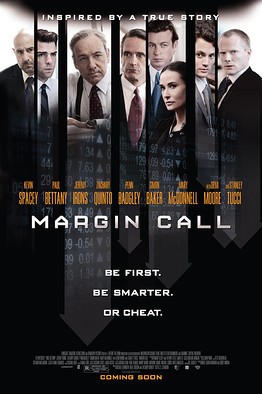 J.C. Chandor wrote and directed “Margin Call,” a sharply-scripted thriller about one night at a never-named Wall Street firm. The top executives discover that they are at risk of catastrophic failure and have to decide before the markets open in the morning whether they or their clients will take the losses. The movie stars Jeremy Irons, Keven Spacey, co-producer Zachary Quinto, Stanley Tucci, and Demi Moore. It is specific enough to make some very pointed commentary on the financial meltdown but universal enough that its themes of betrayal and externalized costs could be set in any industry or indeed in any organization.
How did you come to write about the financial meltdown?
I had written several different things in several different capacities but had never done anything even sort of remotely topical let alone completely topical. This was being written for myself to direct so it was from a very personal place, not a Hollywood script to go out and sell. A lot of what has become the strength of the project and drew people to it came from an odd place, from production restraints I placed on myself to keep the budget realistic.
I’m a total real estate junkie and took time off to set up a partnership to renovate an old building and it happened to be on the other side of the real estate bubble. The godfather of one of my partners was a very prominent investment banker, a ground-breaker, an intellectual, invented the concept of a real estate hedge fund, a whole new model. He intervened in his godson’s life and about halfway through our project came to him and said, “Those offers you’ve been getting to buy the project half-completed — take them. I’ve been leaving millions of dollars in deposits on the table because it is time to get out.” We took his advice, mostly because we were having trouble with one of the other partners but also because we had the feeling things were not going well in the markets. We just broke even and felt like a defeat at the time but a year and a half later I felt I had a new lease on life.
As things really started bubbling to the surface I thought back to that man and what it was like to be walking around — you never know for sure, but he felt pretty strongly things were bad enough that he had to take a financial hit to avoid a worse one and warn us. I thought it was an interesting issue to look at it from the inside, and do a small character-driven story about investment bankers as they see what they thought their lives were about changing in a deep way and what their responsibility was, all those things that were a little bit unsaid in the film but that the actors and I knew were all there. I have only so much time, so much energy, this skill set, and this is what I’ve used it for.
It has the setting of a drama but it feels like a thriller.
To be there on that day was an interesting limited view into a wide problem. It’s a ticking time bomb structure, which is a thriller by its very nature. The one total deviation is that 45 minutes into the movie you know the bomb can’t be defused. The drama is who will they hand the bomb to?
Do you see them as villains?
What most people would choose to do in this scenario is what these characters do — to look out for themselves. To look at it in the macro viewpoint, they made the decision when they walked into the door coming out of Harvard or wherever they were to use their time and skills and very intense intelligence and education and have the big majority of those people get siphoned off into this world. People who have already made that choice when they walk in the door it is unrealistic to expect them five, ten, fifteen years later to make a different choice about who to take care of.
Your father worked on Wall Street, at Merrill Lynch. Did he guide you at all on the script?
For superstitious reasons I didn’t show the script to anyone in my family. I’ve had a lot of false starts if you know what I mean! I didn’t really tell my family I was doing this until we were really at the point of no return. But what I learned from my father and from friends over the years is the toll that it takes on the people who stay behind and keep their jobs when others are let go. It’s one of the only businesses that even in their best years still culls 5-10 percent of the workforce every year purely for motivation. The people who last are the ones who play the game correctly. For certain characters like Spacey’s it’s not about greed; it’s about survival. For others like Simon Baker’s and Demi Moore’s it is about ego and the way you define yourself.
I originally wrote the scene when it wasn’t the big dramatic day, yet. It was supposed to be more run of the mill, but as things developed in real life by the time we shot it, it became too subtle.
The way it was revised though, gets Stanley Tucci’s character out of the building, and that is important for the plot.
The fun thing about Stanley’s character, Eric Dale, is that I have a hard time naming characters and I usually use names from people in my life. Eric Dale just worked and it is amusing for him because every character says the name through the film as he becomes the symbol of the paranoia that the information will get out.
I won’t give it away, but I wanted to tell you how much I liked your ending — you took something of a risk and it paid off.
The ending and the music are the things most people feel comfortable having an opinion about. For me, the movie started with the ending and then you figure out how you get there. Kevin Spacey would say something different but for me the most important thing is what’s behind him, the house. It became very important to understand that in his mind, he did need the money. No matter what you make, the way people rationalize their connection with money is almost identical. As Paul Bettany says in the film, “You learn to spend what’s in your pocket.”

Posted on October 19, 2011 at 3:59 pm
“Martha Marcy May Marlene” is the story of a young woman who returns after living off the grid in a remote group home with a predatory, cult-like leader. She moves in with her newlywed sister (Sarah Paulson) after years of no contact. We never get the details of the source of their estrangement or why the young woman who at various times goes by all of the names in the title wanted to give herself to an abusive man. But we do see that the experience has left her almost feral, without the most basic ability to recognize social norms.

The young woman who plays Martha Marcy May Marlene is an extraordinary young actress named Elizabeth Olson, who has two more movies coming out and is still completing her studies at NYU. She is the younger sister of Mary Kate and Ashley Olson, the actresses/producers/moguls, who named one of their fashion lines after her. She and I sat down for a quiet chat that covered everything from how she came up with the way her character in the film eats, to why she’s not a method actor, and putting on a family-friendly version of “A Chorus Line” at summer camp.
Tell me about looking at the script for the first time.
You don’t get to read many good scripts and this instantly stood out. It’s a part that gets to navigate so many different experiences and emotions it seemed like something I would have to wait to do, to do the bad stuff before I would get a chance to get to the good stuff. But they wanted an unknown actress so it was like being in the right place at the right time. I read twice, first the diner scene and a lighter scene with the sister.
What was the best part of making the film?
Sean Durkin and I work really well together, really honest and direct but he is very gentle so it isn’t off-putting. I said, “I trust you. Save time and don’t beat around the bush. If I am not getting it, just tell me. Tell me if I’m not giving you what you need or if I’m having an off-time.” I wish I could say that I trusted everyone that much.
You worked with one of my favorite actresses, Sarah Paulson, who plays your sister. The movie does not tell us very much about their family history. Did the two of you work something out to fill in those blanks?
We worked six to eight weeks and filmed all the farmhouse stuff first. She came in and she and Hugh Dancy (who plays her husband) went over things together about their relationship and then she and I sat down and tried to make a timeline that was as specific as possible and understand when was the time that she left and at what point was my character fully abandoned. In order to figure out all the tensions in the script we had to be so clear with what happened in the past. Families sometimes do not talk about the things in the past that affect them today. My family is very good at communicating. But some never learn how to do that. This is one of those examples. We do mention in the film the mother passing away and living with the aunt, so there are those hints.
This character is a challenge because she is so internal. How do you convey all of her fragility and fear without being able to talk about it?
I kept thinking of the risks that she was willing to take and showing too much fear or vulnerability was a risk for her. So in every scene, even if she was by herself there had to be something she was reacting against or towards. There was always something she was in relation to, a sound on the roof, a car outside. How much she was willing to give that away was the meter I was playing with. And she has so much energy. There is an absurd humor in a way at times and projecting anger onto people. What are the instigators for when that happens? I am really an analytical person so to try to figure out at what point she was comfortable and when was the peak of her fear was really fun to navigate. You have do do work. We all gotta do work on things.
You have classical training as an actress. How did that affect the way you approached this role?
I studied at the Atlantic Theater Conservatory, founded by William H. Macy and David Mamet. It’s based off a writer’s view of approaching the script. Everything the actor does is to serve the script and the story. Every action you have is to tell the story. It has nothing to do with your own experience. It has to do with the function of what you are trying to accomplish. Another thing that is fundamental is that you are not your character. They don’t believe in method or emoting. For something like this, that couldn’t be more helpful! I had to have an outside perspective and make concrete things happen that I had control over and trust that the story-telling of the script and editing is going to tell the other part. I don’t have to do the whole thing.
One very telling detail in the movie is your character’s style of eating. Was that in the script or was it something you developed?
Those things are really fun to play. She has not eaten in the presence of a man for all the time she has been away. So at the lake house , for the first time she is eating with a man at the table. So I played with the fact that I am watching him eat and trying to figure out what our relationship is. And she is used to not being allowed to eat until late in the afternoon, so that seemed odd to her. Those things that are out of the norm added to what seemed slightly off. Because she had something happen to her that the audience is trying to figure out as the story goes on, it was fun to try to figure out how much of the backstory I understood, to unravel it myself.
What draws someone to a cult?
For this character I think it was a feeling of purpose and being part of something larger than yourself, that you actually have a home somewhere. And she felt she had unconditional love.
What movies made you want to act?
When I was young, “Singin’ in the Rain,” “Guys and Dolls,” “Gypsy,” “Pal Joey.” That is what spurred my interest and I went to musical theater camp. They wouldn’t pay for the rights so we did our own versions. We did “A Kid’s Chorus Line,” so with different lyrics, and “A Comedy Tonight,” which was our version of “A Funny Thing Happened on the Way to the Forum.” My favorite was playing Ado Annie in “Oklahoma.” I was in 5th grade and my sisters were in 8th grade and brought their guy friends and I was so embarrassed that they were there. My dream role was Adelaide in “Guys and Dolls.” My brother influenced me and he has darker taste, like “Return to Oz” and then I started to love Woody Allen and Wes Anderson and as I got older P.T. Anderson and of course “Star Wars” and “Lord of the Rings” and “Gone with the Wind.” I don’t just want to do indie films; I’d like to try it all!
Posted on October 19, 2011 at 8:00 am
This week’s release “The Mighty Macs” is inspired by the true story of coach Cathy Rush, who took the basketball team from the tiny women’s college to three national championships in the early 1970’s, the dawn of women’s basketball. Now co-ed and called Immaculata University, it is a Catholic school sponsored by the Sisters, Servants of the Immaculate Heart of Mary and is proud to be considered the birthplace of modern American women’s basketball. Here’s an ESPN segment about the real-life team.

Posted on October 19, 2011 at 8:00 am
Coach Cathy Rush arrived at tiny Immaculata College at a moment when there were big changes in women’s basketball. The rules were changed to allow women for the first time to play the all-out game by the same rules as the men. And for the first time there was a national championship. Coach Rush took her team to the national title for three of the first four years. And this week, a movie based on her story is opening. It is called “The Mighty Macs.”
I was delighted to get a chance to speak to Coach Rush about her experiences at Immaculata and what she is doing now.
You must be very excited about the movie!
The excitement is really building as we approach the premiere. I’ve been traveling around doing pre-release screenings and we’ve had standing ovations. We showed it in New York and they were ecstatic.
What was the rule change that was so important in the early 70’s?
This goes back to the 1930’s when my mother was playing basketball. They didn’t think women could run up and down the court more than once or twice so there were three players on one side and three on the other and you never went full court. You were not allowed to cross half-court. One group of three would shoot and the other side was just defense.
Because women were too frail?
Absolutely! The Olympics didn’t have a marathon for women until the 90’s. And then people realized women were capable of more. In the 60’s it had morphed into a huge scoring game where it was too easy to score. One player in Iowa was averaging 58 points a game. It was too easy to score when you were playing three on three?
Did you have a nun as an assistant coach as happens in the movie?
That is actually not true but part of the Immaculata story could never be repeated because of the community that was there and was so important. The Mother Superior was not really with us in the beginning so the assistant coach character was the embodiment of all the nuns who loved us and prayed for us and did extraordinary things to support us. Even after we started winning there was some controversy about whether Immaculata should be known as a jock school. Everyone had to wear skirts to class and the dining hall — it was a different era.
Wasn’t it a challenge that you did not have a chance to recruit talented high school players?
Whoever showed up on your college campus was who you used. Coincidentally — we’ve often thrown around the idea of Divine Intervention — Theresa Shank Grentz was intending to go to Mount St. Mary’s. Her family home burned down and the family basically got out with what they had on. She didn’t have money or clothes. So she ended up commuting to Immaculata and was one of our strongest players. Because there were no scholarships we had nothing to offer players except the chance to be a part of the program. I did start recruiting later on and found Mary Ann Crawford Stanley who was fabulous. So we decided not to leave in fate’s hand and recruit some players but all we could offer them was a good education and a good program.
I think it is a testament to your vision and leadership that so many of your players became coaches — even more than that they became champions. What inspired them to follow in your footsteps that way?
Their experience at Immaculata, certainly, but also Title IX had just come in and major universities realized they had to find coaches and provide a little equality, well, not a whole lot but a little. So these people went right into Division 1 jobs. Part of it was the opportunity that they had. Teresa was a biology-chem major and I asked how that prepared her to coach and she said she should have been a Psych major. We’ve also had a bunch of doctors and other amazing women. They came to Immaculata for an education first.
You had some unusual drills in the movie — were those things you really did?
We did a lot of stuff. I did bring in boys to compete against. We had 11 kids on the team and when we went from the first five to the second five the competition was not at good, so we brought in the boys. I was blessed to be in the Philadelphia area where there were great men’s coaches who knew the 5-member game and they were kind enough to let me see all of that and put it into our own system so I was very, very lucky.
What is important for a coach to know?
Coaching is really teaching. We’re all teachers of some kind — parents are teachers, too. The players who became coaches do not coach like me; they are all smart enough to coach within the framework of their personality. I was not a screamer. I didn’t have to yell to get across what we needed to do. Being so young, I had kind who were two and three years younger than me but there was no question of my authority. I was Mrs. Rush or Coach. People need to lead by example.
The movie makes it clear how much some things have changed since the 1970’s.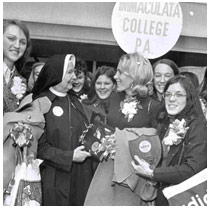
I was a 60’s woman and not the Berkeley 60’s. I was from a small town and went to a conservative college and then coached at an even more conservative college. It was a different time. My life plan at that time was to get married, teach for three years, and have a family and never work again. When I say that to kids today, they do not understand it. But in those days people had different expectations for their sons than their daughters.
What are you doing these days?
I have a girls’ basketball camp. This is our 41st year, our biggest year ever, over 9000 kids in camp. My youngest son runs the business and every now and then I come in and tell him what he’s doing wrong .
You’re still coaching!
That’s right!