
Warner Brothers Shares Classic Treasures

Posted on April 20, 2009 at 10:00 am

One of the things I find most thrilling about movies is that they are timeless. Watch a movie and you can see the same performance your grandparents watched when it was first released. We will never know what it was like to hear Jenny Lind sing or see Sarah Bernhardt on stage, but we can watch Cary Grant, the Marx Brothers, Marilyn Monroe, Humphrey Bogart, Audrey Hepburn, James Dean, and John Wayne at their very best. That is why I am so happy about Warner Brothers opening up its archive to make available for the first time some of their treasured releases.
Take a look at the listings and you are sure to find some favorites you have not seen in years and some very worthwhile surprises. F. Scott Fitzgerald’s only screen credit was for “Three Comrades,” a heartbreaking drama set in pre-WWII Germany with an incandescent appearance by Margaret Sullavan. There are biographies of Thomas Edison (with Spencer Tracy), Abraham Lincoln (with Raymond Massey), and “An Affair to Remember” co-stars Cary Grant and Deborah Kerr re-team in “Dream Wife,” about a diplomatic advisor assigned to assist on the upcoming wedding of her former beau to an Asian princess. One of Warren Beatty’s most arresting early performances is in a little-known film called “All Fall Down,” co-starring Eva Marie Saint, Karl Malden, Angela Lansbury, and “Shane’s” Brandon de Wilde. And Burt Reynolds appears in “Angel Baby’ with Salome Jens, who is mesmerizing as an evangelical preacher. Some are available for on demand download as well as on DVD and many have clips available online. Desson Thomson talked to NPR’s Scott Simon about some of the highlights of the collection. I will be highlighting some of my other favorites in upcoming posts.
Turner Classic Movies’ Robert Osborne likes to quote Lauren Bacall about old movies: “If you haven’t seen it, it’s new to you.” These films are not all classics, but there is something there for everyone.
Related Tags:


For Your Netflix Queue Neglected gem

Interview: Bill Haney of ‘American Violet’

Posted on April 19, 2009 at 9:22 am

“American Violet,” the fine new film about the real-life woman who took on corrupt and racist law enforcement officials in 2000, was written by Bill Haney. It was a very great pleasure to get to talk to him about the film.

Tell me a little about your background and about what made you want to write this story.

I grew up in a Benedictine monastery in Rhode Island. My dad was a teacher there and I went to school there and left to go to college. It was there I got the general idea that the goal of life isn’t to get something from the world but to give something to the world. The purpose of storytelling is to illuminate and express something useful about the human condition, sometimes joyful, sometimes distracting, but in an ideal world, constructive. I like stories about an ordinary person called upon to do something extraordinary. I heard Wade Goodman on NPR talking about this case in Texas. His storytelling was classic NPR expositional context so that I felt compelled and moved, and that was what launched the journey to find the people and write the story.

It seems to me to be a essentially American story — an underdog seeking justice.

It is a systemically frustrating view of American justice, and the way they fought to get justice. We’ve been doing these word-of-mouth screenings with really interesting discussions. One woman said she was really pleased to see the message that we can get change through the system, that if we are educated and stand up it can work.

I am often of critical of films that set the lighting for the white characters and do not to justice to black skin tones but this film lights the black characters beautifully.

That was important to us, too. It is challenging to make sure the visual beauty is equally spread.

What has happened to the real-life woman who is called Dee in the movie?

In a lot of ways she is doing great. At one level this has been a marathon experience for her. She stayed in the community until four weeks ago. She’s gone through a lot of struggles including some serious health problems. She’s still there and he’s still there so it hasn’t ended, but it has been cathartic for her to get this experience out there. She’s a bright, charismatic woman. But her community is blighted. In the local high school, 169 entered as freshmen, but only three graduated and none went to college. There are these inherent limitations and she pierced right through that. She’s out giving talks, finding a voice and a place in society. Her children have found this process hugely validating and inspiring. Telling her story this way helped them respect and admire her. She is articulate and persuasive. It has left some marks on her but she is stronger and a person with a bigger voice in her world as a result.

What are some of the movies you saw when you were young that inspired you to want to make films?

At the all boys school we had no television but we had these screenings on Saturday nights. I saw “Guns of Navarone” and was completely smitten. I love Peter Weir movies, especially “The Year of Living Dangerously” — a magical story for me.

What are you working on next?

I’ve outlined three movies and a documentary about endangered species. Half my work is connected to something around the environment and food will be at the core of the next movie. Food is a great subject because it is about love, health, appreciation, beauty, soulfulness, and humor.

What makes you laugh?

PG Wodehouse. My wife has me on a Wodehouse allocation. She will only let me read for like 15 minutes at a time. I love dry humor, fish out of water stories. My own three kids make me laugh — kids know how to surf your waves. If you’re not laughing at them you’re laughing with them. I love Abbott and Costello and Charlie Chaplin’s “The Great Dictator” and Jim Jarmusch’s “Night on Earth.”

Related Tags:


Based on a true story Interview

List: Movies About Corporate Governance

Posted on April 19, 2009 at 8:39 am

The New York Times interviewed me for its “Corner Office” section and asked me for a list of my favorite movies about corporate governance.

“Enron: The Smartest Guys in the Room” (2005). Must viewing for an almost operatic rise-and-fall story of greed and hubris.

“The Solid Gold Cadillac” (1956). Add a couple of zeros to the numbers and this classic comedy about a small shareholder who takes on a big conglomerate could have been filmed this year. Ripe for a remake!

“The Hudsucker Proxy” (1994). The Coen Brothers’ take on corporations is both spoof and satire, making some shrewd points about success and corruption.

“Roger & Me” (1989). Must viewing in the era of the bailout. Watch for the many indicators of poor business judgment, including a “Me and My Buddy” exhibit with a mechanized worker singing to the machine that put him out of a job.

“Startup.com” (2001). The go-go madness of the dot-com era amplifies the challenge of finding that fine line between vision and hubris. Unforgettable characters.

“Boiler Room” (2000). Set in an illegal pump-and-dump brokerage, this movie perfectly captures the adrenaline rush of money-making.

“Executive Suite” (1954). A rare movie that focuses on the boardroom with a post-World War II C.E.O. succession struggle between the green-eyeshade C.F.O. Fredric March and the stakeholder proponent William Holden. See also the terrific animated movie “Robots” (2005) for a similar struggle.

“Owning Mahowny” (2003). This fact-based film stars Philip Seymour Hoffman as a Canadian bank executive who embezzled millions of dollars and lost every penny in gambling casinos. What is fascinating is the way that every single person in the film, from the bank loan officers to the auditors and investigators and casino managers to the embezzler himself, are constantly assessing risk.

“The Corporation” (2003). A provocative documentary that measures corporate behavior against the standard diagnostics for human behavior and concludes that it fits the profile of a sociopath.

“How to Succeed in Business Without Really Trying” (1967). This outrageous musical comedy about a mail clerk’s rise to the top of a corporation is less of an exaggeration than it appears.

“Office Space” (1999). A cult classic about a Dilbert-ized world of workers oppressed by an endless series of management fads.

“Tucker: The Man and His Dream” (1988). A fact-based cautionary tale about corporations subverting the market. See also the documentary “Who Killed the Electric Car?” (2006) for an updated version.

“Sabrina” (1954). This elegant confection of a love triangle, with Audrey Hepburn, Humphrey Bogart and William Holden, also includes one of the most stirring defenses of the public corporation as a force for opportunity and creativity that has ever been put on film.

Related Tags:


For Your Netflix Queue Lists Media Appearances Rediscovered Classic

Grey Gardens, Act III

Posted on April 18, 2009 at 12:55 pm

What is is about the story of Grey Gardens that has been so enduringly fascinating? They have inspired a documentary film, a Broadway musical, endless articles, even a song by Rufus Wainwright.

Some people think it is because the two women who lived in splendid squalor were the aunt and cousin of one of the world’s most famous and glamorous women, Jacqueline Kennedy. And some think it is because of the schadenfreude effect — seeing two women born to wealth and power fall into helpless poverty. Both are certainly a part of it, but I believe the reason that the story of the two Edith Beales is so enthralling is because of something central to the lives of all of us. It is about family ties that both sustain and constrain. It is about the line between function and dysfunction. It is about devotion. It is about love. It is about control. And it is about the way that the route to madness is much more slippery and treacherous than we would like it to be.

Edith Beale and her daughter “Little Edie” lived in a mansion in East Hampton called Grey Gardens. At one time they were at the heart of high society and Little Edie, a debutante, was known as “Body Beautiful Beale.” Their lives seemed filled with luxury and promise. But by the time a documentary film crew arrived in the early 1970’s the mansion had fallen into filth and disrepair. The two women shared the house with more than fifty cats and other animals. They had almost no electricity or plumbing. The women’s behavior was outlandish, even delusional, but their resilience and ferocious passion for survival were inspiring. They were not just willing to defy convention; they seemed to relish it. The film was a sensation. It led to a Tony-award-winning Broadway musical starring Christine Ebersole. Tonight, the latest version of the story premieres in HBO, starring Drew Barrymore and Jessica Lange.

Here is a clip from the original documentary with Little Edie explaining her “revolutionary” attire, followed by Ebersole in a scene from the musical based on that monologue and a trailer for the HBO movie.

Related Tags:


Based on a true story Documentary Television

Breakthrough Perfomer: Nicole Beharie

Posted on April 16, 2009 at 12:00 pm

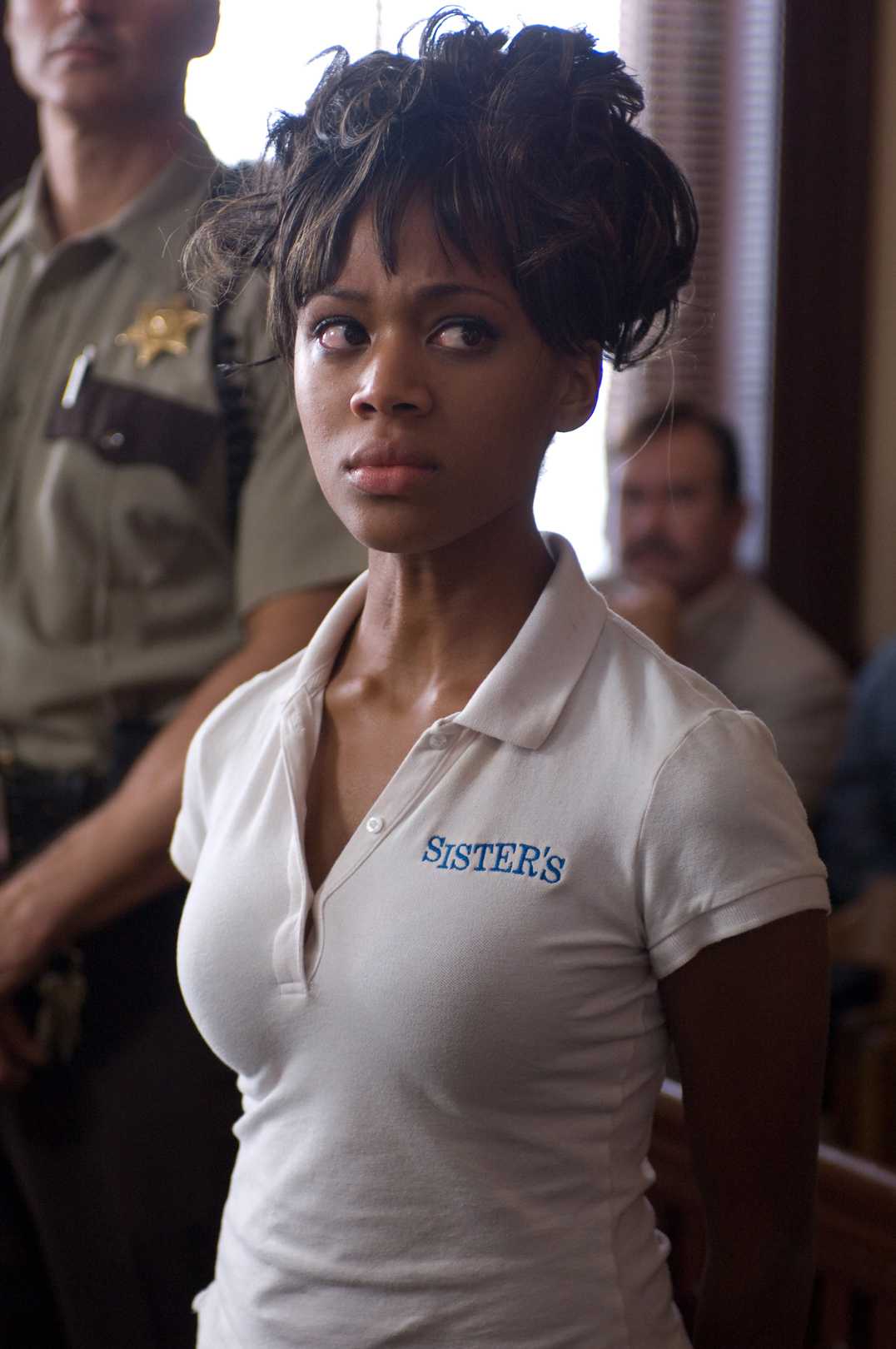
“American Violet” is based on the true story of a woman who helped to expose corrupt and racist law enforcement in her Texas community with the help of the ACLU and local counsel. Dee, the lead role, is played by newcomer Nicole Beharie in a stunning performance mingling strength and vulnerability. Dee is afraid but never loses her dignity or her moral center. Be sure to check out Beliefnet’s exclusive clip to get a glimpse. Beharie is simply dazzling in this film and I look forward to seeing whatever she does next. I was thrilled to get a chance to interview her and found her every bit as engaging in person as she is on screen.
I was very relieved to find that this movie was not another in a long series that make the white person the hero in a story about black people. Although the lawyers are important, Dee really is the heart of the film. A lot of that comes from the vitality of your performance.
Thank you! But a lot of that comes from the script and their not wanting to do that. And some comes from the woman herself. Dee was very vocal up to the last deposition and suggested they use the African-American lawyer to depose the sheriff. It was a godsend that the attorneys showed up, but even before the lawyers showed up, Dee was active and outspoken.
Dee had to make some very tough choices under a lot of pressure. Could you have been as brave and persistent as she was?
I don’t know! Some days I say yes, some days no way. I like to believe that I could, seeing how much she sacrificed and how much it meant to her. It has made me think about what you do for the things you care about and what you ignore. Too often people do not do anything. They say, “They know what they’re doing” or “That’s the system.”
One thing that really impressed me was how many emotions you were able to convey at once — in some scenes you had to be scared and brave, worried and determined all at the same time. What do you to to prepare for a scene like the deposition or the one where your want to keep your daughters from their father and his girlfriend?
You take it all as personally as you possibly can, try to connect to it personally. What I thought of in the scene with my children’s father in that moment was fear for my children, a little bit of guilt in having them in this predicament, but once he busted those doors, its not about me — its about those two girls.
american_violet_009.jpg
What is your background?
I went to arts high school in Greenville, South Carolina, a public school for the arts and humanities. I fell in love with the notion of doing theater then. My director asked me to apply to drama school and gave me the 100 dollars for the Julliard application. I was accepted and studied there.
One thing that is so endearing about Dee is that with all of the stress and difficulty of her life, she still takes the time for some very serious hair. How do you act under all that?
Yes, Dee did give attention to her hair! I give a lot of credit to Charles Gregory Ross, who designed the hair and had it all laid out so I did not have to sit for hours. The most difficult thing was the bun with the freeze curls, all pinned and manipulated, and really heavy! Alfre Woodard had to deal with it to. She had a different look in every scene.
Your interaction with the girls who play your daughters feels very real and natural, even in the intense scenes. How did you work with them to make that happen?
I got a lot of my perspective from watching my mother raise the four of us. And when I first got to the set, before anything else happened, I got to work with the four real-life sisters who played my daughters. They had their own shorthand and hierarchy. They don’t know my name to this day. My name is Dee to them so it was natural for them to interact with me that way. And we involved them in the movie. All the artwork that is supposed to be from Dee’s children, so they got to see their own pictures hanging in Dee’s home.
Did you ever meet the woman known as Dee in the movie? What did you try to take from her in your performance?
I met her once I got to the set, but by then I had watched hours of footage. I paid attention to the way she looked out of the corner of her eye, to rhythmic things, to her pitch.
Are their particular performances that inspired you to want to go into acting?
“Miss Evers Boys” with Alfre, which made working with her so exciting for me, believe it or not “Ghostbusters,” “The Sound of Music,” “The Wiz.” I love Michel Gondry and really enjoyed his films, “Be Kind Rewind” and “The Science of Sleep.”
What’s next for you?
I did pilot for CBS, a medical show, and I play a social worker. And I have an Annenberg grant to develop my own material. I’m working on a theater program in South Africa.
And what makes you laugh?
My sister and my nephew make me laugh. He’s 12! My grandmother, too — my family will have me on the floor. They’re the only people who know what my goofy capabilities are.
Coming soon: an interview with “American Violet” screenwriter Bill Haney.

Related Tags:


Actors Breakthrough Perfomers Interview
THE MOVIE MOM® is a registered trademark of Nell Minow. Use of the mark without express consent from Nell Minow constitutes trademark infringement and unfair competition in violation of federal and state laws. All material © Nell Minow 1995-2026, all rights reserved, and no use or republication is permitted without explicit permission. This site hosts Nell Minow’s Movie Mom® archive, with material that originally appeared on Yahoo! Movies, Beliefnet, and other sources. Much of her new material can be found at Rogerebert.com, Huffington Post, and WheretoWatch. Her books include The Movie Mom’s Guide to Family Movies and 101 Must-See Movie Moments, and she can be heard each week on radio stations across the country.

Website Designed by Max LaZebnik