

Interview: Steven Bingen of MGM: America’s Greatest Backlot
Posted on April 1, 2011 at 7:59 am
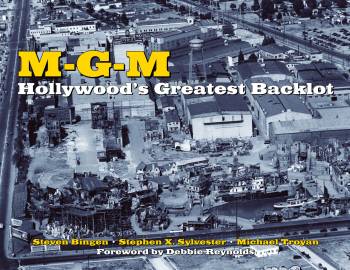 MGM: Hollywood’s Greatest Backlot
Do you remember your first visit to the MGM backlot?
In a way I feel like I’m still there. We all grew up on the MGM backlot in a curious and twisty sort of way. At least 6 generations of people have spent a not inconsiderable amount of their lives watching our dreams played out with those backlots as a setting. Turn on the television and channel surf for a few minutes and the chances are not too bad, even today, that you’ll make a visit to the MGM backlot…
But that probably isn’t a fair answer to your question is it? Truth be told, I was never able to physically visit the place while it was still intact. I’ve walked the real estate many times trying to reconstruct the layout of the sets in my head, but never while those sets were standing. One of my partners, Stephen X. Sylvester, who wrote the book with me along with Michael Troyan, got to visit the backlot (twice!) in the late 1960’s. I’ll never forget what he said. He told me that the next day his parents took him to Disneyland and compared to MGM, he found Disneyland somewhat disappointing! I guess that, in a way, I wrote the book as a way to reconstruct a place I’ve always known I would never be able to physically experience. I tried to build, in print, streets I could never actually walk, and a place I could never actually visit.
Which designers most influenced the sets on the backlot?
An art director named Cedric Gibbons designed most of the sets on the MGM backlot. He was a remarkable and vastly influential man who has never gotten his due for virtual creation of the physical look of the 20th century. People always assume that our movies are influenced by our real lives. But the truth is that very often it’s the other way around. Standards of architecture and design still in effect today were created first in Hollywood, and only later adapted in “actual” construction. Art Deco, for example was seen on-screen before it became the signature “real” design style of the 1930’s. It’s a surprising phenomenon, and one that has seldom been remarked upon. Maybe your question should be “What designers were most influenced by the sets on the backlot?”
Gibbons, by the way, is largely remembered today as the designer of the Academy Award “Oscar” statue. But his legacy is, I think, much farther reaching than that.
How was movie-making influenced by the auto manufacturers and other innovations of the industrial era?
A producer named Thomas Ince was the first filmmaker to base his business model on the factories in Detroit, where an entire car could be finished on a predetermined schedule within the walls of the factory. No one had ever tried that with movies before. And it happened first on the property which would become MGM. Ince would move on, to be followed by Samuel Goldwyn, and later by Thalberg and Mayer. But it all happened, the whole concept of using a backlot as a way to standardize production, on the very site which would become MGM. In a way the whole concept of a Hollywood studio began at the very spot where our story takes place. Today, although few realize it, there is more authentic, yet unheralded movie history to be found in the subdivisions and condominium complexes where MGM once stood than on any tourist-infested block of Hollywood Boulevard.
How did the studio backlot change to reflect changes in technology like color film and improved audio?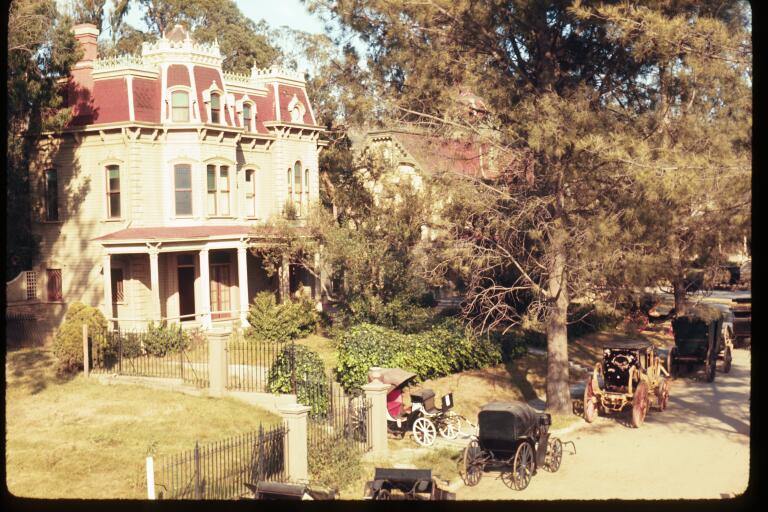
With the introduction of color film directors tended to set their cameras farther back. They wanted to take advantage of (or create) dramatic cloudscapes, or cobbled rooftops, or mountain peaks. Black and white, a more intimate and “realistic” medium, didn’t need to concern itself with such details so the sets tended to, if not get bigger, certainly get utilized to a greater degree. Filmmakers eventually started putting their cameras so far away from the action that they sometimes obscured whatever dramatic possibilities the story was supposed to be concerning itself with. The 1935 version of Mutiny on the Bounty, for example, while taking place on an epic scale, focused more on the conflict between the characters then on the jungles of Tahiti. Incidentally, both versions used the studio backlot, although the remake actually did go to the real Tahiti as well – and wasn’t any the better as a movie for it.
Was the studio careful about maintaining its archives? Were there some records you really had to work to find?
For decades the studio was very careful with both its archives and its assets. Everything from full-size fighter planes to bits of twine was carefully inventoried and socked away, awaiting the day when it might be utilized again. But as the system broke down and departments were closed or outsourced the prevailing attitude was to junk everything not in use that day or scheduled to be used the next. Management realized that they themselves could be fired at any time, and so they had no particular interest in making their successor’s jobs any easier by saving anything that could be used by that next regime. So everything from production records to, ultimately, the backlots themselves, were systematically and tragically junked.
I was lucky to have access to materials no one else had ever been able to see through the cooperation of Warner Bros., which had inherited whatever records had survived via the Turner purchase of MGM in the 80’s. But much of this material was already literally just gone with the wind by that time. For example, in our research it took us something like three years just to find a record of the studio’s original purchase of the property that became backlot number 3. This was a 65 acre parcel of real estate where some of the most famous films ever made would ultimately be produced. And there was nothing whatsoever saved by the company anywhere referencing when that property had first been acquired, or for how much! Unthinkable, isn’t it? But true. Desperate, at one point we even ended up spending an entire day inside a badly lit basement near Los Angeles city hall trying to reference tax records to find our answer there. No luck. I finally found the information we needed in the text of a 1970’s memo which actually was about the sale of the property – but which did reference the original purchase date, which was 1937, by the way.
What surprised you as you did your research? What or who was your best resource?
Like I said, Warner Bros. was invaluable, as were other archives and organizations like the Motion Picture Academy, but the people we interviewed, actual studio veterans, were the best. Some of our most interesting stories were from people who worked on the lot for decades. To a man, these employees all told us that they thought that MGM would last as long as the pyramids. It makes me sad that some of these employees, who were all so helpful and giving of their time and memories, didn’t live long enough to see the book published.
Surprisingly, a lot of great material also came from Culver City residents who, in some cases, used to literally climb the fences as children and explore. I must say, that I very much envy those people their experiences.
Do you have a favorite movie or star from the MGM golden era? What artifacts are still around?
The three of us are probably unlike most other film buffs in that we’ve spent the better part of 10 years watching pictures and wishing that those admittedly gorgeous and charismatic actors in the foreground would just get out of the way so that we could get a better look at the remarkable sets they were standing in and blocking our views of.
For us, our favorite films were the ones that found ways to use the backlot in unusual ways. I’ll give you an example. For a 1935 film called I Love My Wife “Spanish Street” was redressed to play Greece. Then they immediately flooded the same street with water so it could play Venice for Anna Karenina. 1935 audiences would have seen both these films, yet never realized they were looking at the same spot – which of course was in neither Spain, nor Greece, nor Italy, but Culver City. You know anyone could go to Europe and take beautiful pictures of these places. But I hope people will finally appreciate the wonder of getting the same effect, with more artistry, on a studio backlot. And the experience of watching these movies is actually enhanced, not detracted from, as people sometimes say, by the knowledge of this. What could be more mysterious and more wonderful than Venice reconstructed in California, and with Greta Garbo thrown in for good measure? This really is the studio’s legacy, and what survives today.
Is there anyone in the industry today who plays a role like the one Irving Thalberg played at MGM?
No. This isn’t a reflection on anyone in modern Hollywood. The business is just so different, and so adverse to risk-taking due to the enormous amounts of money involved. There really isn’t anyone out there with the opportunity to repeatedly throw the dice and come up with a winner like Thalberg so often did. But it’s important to remember that during Thalberg’s reign, even if a single production didn’t measure up, there would always be another one coming off the assembly line in a matter of days. And that second property could conceivably work out better and cover the losses incurred by the first. This process gave a creative producer like Thalberg a chance to experiment and to try out new ideas, which simply isn’t possible today. In modern Hollywood, even at the largest studios, there just are never enough pictures in the pipeline. And no single producer is ever responsible for all of them. Today, any studio picture is liable to cost so much money that a single failure could destroy careers, or even whole studios. It’s a dangerous and risky business model. One which Thalberg and his cohorts would have thought wasteful and absurd, and which they never had to wrestle with.
The MGM backlot was like a city of its own, with a restaurant, a school, water, power, construction – who oversaw operations? Were there any major problems or mistakes?
J.J. Cohn was the Studio Manager, the man in charge of making sure that all the pieces in this vast, crazy, kaleidoscope that was MGM fit together and worked in harmony with each other. He’s another one of those unsung geniuses who made the Studio system operate so well, and for so long. In fact, the MGM backlot at one time was actually referred to on studio maps as “Cohn’s Park” – which should be an apt indication of his overall influence. We were very lucky in our research in that J.J. lived a long time and film historian Rudy Behlmer had the foresight to sit him down for a long oral history in which he discussed his whole career from the pre-merger Goldwyn days right up into the 1960’s and beyond.
And yet in a way which J.J. couldn’t have foreseen, the ultimate fate of the backlots was determined in the accounting ledgers tabulated in his offices. It turned out that for the entire life of the studio, the company had never charged internal productions to utilize their outdoor sets. On the contrary, Cohn had created and maintained these sets for the very purpose of saving production dollars and avoiding expensive and unnecessary location trips. Unfortunately, in the 1970’s when the studio was floundering in red ink and management was trying to save money, the backlots were an easy target because these hundreds of standing sets appeared, from an accounting standpoint, to be generating little or no income. Sadly, after these properties were sold off and bulldozed, the studio realized and regretted what they had done almost immediately.
If there was one now-vanished spot on the backlot you could visit for a day, what would it be and why?
It would be impossible to choose one spot because the charm of the place would have been, for me, the ability to walk from an 18th century French village, into the American West, and then to turn a corner and explore a WWII military base nestled alongside a Jane Austen style estate and garden, which itself would have been adjacent to a dangerous-looking south American jungle! This weird, whimsical, whirlpool of architecture, which F. Scott Fitzgerald called the “torn picture books of childhood,” still strikes me as wonderful and magical and sinister. Just like a fairy tale.

 with Audrey Hepburn and the divine Cecil Beaton designs is unquestionably iconic. I side with Cary Grant, who, asked to play Henry Higgins, famously said that not only would he not accept the part, but unless Rex Harrison repeated his Broadway performance on screen, he wouldn’t even go to see it.
  ” by George Bernard Shaw, inspired by an ancient Greek myth. “Pygmalion” was made into a wonderful film under Shaw’s personal supervision, with his choice to play Eliza, Wendy Hiller, and Leslie Howard as Higgins. I have always been fascinated by Shaw’s decision to chance the ending of his play for the movie version. In the afterward he wrote for the play, Shaw makes it very clear that Eliza and Higgins have no romantic future; he explicitly says that she marries the hapless but doting Freddie. After all, the story not a romance; it is about class and politics and religion and ideas — like all of Shaw’s work. But when it came time to write the screenplay for “Pygmalion,” he could not help r