Masking — Why It Matters When Movie Theaters Get It Wrong

Posted on September 25, 2016 at 8:00 am

Movie theaters have to work harder and harder to entice viewers away from their big-screen TVs and same-day streaming options. The most important difference has to be in the quality of the viewing experience, and Screen Crush reports that they are increasingly failing at the most basic requirement — getting the screen proportions right. In saving money via automation, they lose the ability to make sure that each individual film is shown the way it was intended to be shown.

Screen masking involves expanding or shrinking the borders of a theater screen so that a film fills its dimensions exactly. Most mainstream movies are released in one of two aspect ratios: 1.85:1, also known as “flat” and the taller of the two, and 2.35:1, known as “scope” and the wider of the two. Masking ensures that both aspect ratios are displayed on the same screen with none of the image being lost, and none of the unused areas of the screen left visible.

Because movies come in both sizes, and because theaters often show multiple movies at the same time, screens must be built to accommodate both aspect ratios and then masked, either on the sides or on the top and bottom, with black curtains. If you’ve ever arrived early at the theater and noticed motorized curtains retract between the multiplex’s pre-show (which is typically flat) and the feature presentation (which in this case would be scope), you’ve seen screen masking in action.

If you see a film that looks distorted or otherwise not optimally displayed, speak to a manager.

Related Tags:


Understanding Media and Pop Culture

Get Out Your Handkerchiefs — Crying Movies on the Fall Schedule

Posted on September 24, 2016 at 8:00 am

The LA Times reports that there are a number of movies on the fall release schedule that will make you cry, with a dying mother (“A Monster Calls”), a lost child (“Lion”), and a mourning mother (“Arrival”). I’d add “Loving,” based on the true story of the couple whose inter-racial marriage challenged miscegenation laws, “The Dressmaker” (sad deaths), slavery (“Birth of a Nation”) and a documentary about veterans (“Thank You for Your Service”). That means: get ready to be moved.

Related Tags:


Understanding Media and Pop Culture

Mental Illness on Television

Posted on September 18, 2016 at 4:13 pm

Angelica Jade Bastién is one of my favorite critics, and her essays on film are always insightful and thought-provoking. For Vulture, she wrote about the increasingly sensitive and authentic portrayal of mental illness on television. And she calls out the still-too-frequent portrayal of mentally ill characters as serial killers, or quirky-but-wise, or even super-smart but flawed figures.

If you live with mental illness, a show like You’re the Worst is downright revelatory. During its first season, the FXX comedy introduced Edgar, a military veteran with post-traumatic stress disorder. In its second season, the show revealed that its lead female character, Gretchen, has clinical depression. And in its third season, which premiered last week, Gretchen actively seeks treatment and begins seeing a therapist.

In a television landscape that often misunderstands and misrepresents mental illness, You’re the Worst isn’t alone. Thanks to shows like BoJack Horseman, Lady Dynamite, and Crazy Ex-Girlfriend, it’s now easier than ever to find moving portraits of mental illness on television — but on the whole, most shows still struggle with flawed, careless, and inaccurate depictions….By failing to offer a diagnosis, a show’s writers can cherry-pick a variety of symptoms, which ultimately creates a dishonest portrayal that hinges on plot needs. This often leads to confused characterization, or worse, an exploitative view of mental illness.

It does not have to be a serious drama to be true to the reality of mental illness. Bastién’s good examples include “You’re the Worst” and “Crazy-Ex Girlfriend.”

Related Tags:


Critics Disabilities and Different Abilities Television Understanding Media and Pop Culture
Hollywood Still Distorting Depictions of Gender

Hollywood Still Distorting Depictions of Gender

Posted on September 7, 2016 at 12:19 am

Though the conversation on inequality in Hollywood is getting more attention than ever, a new report reveals that little has changed on screen or behind the camera.

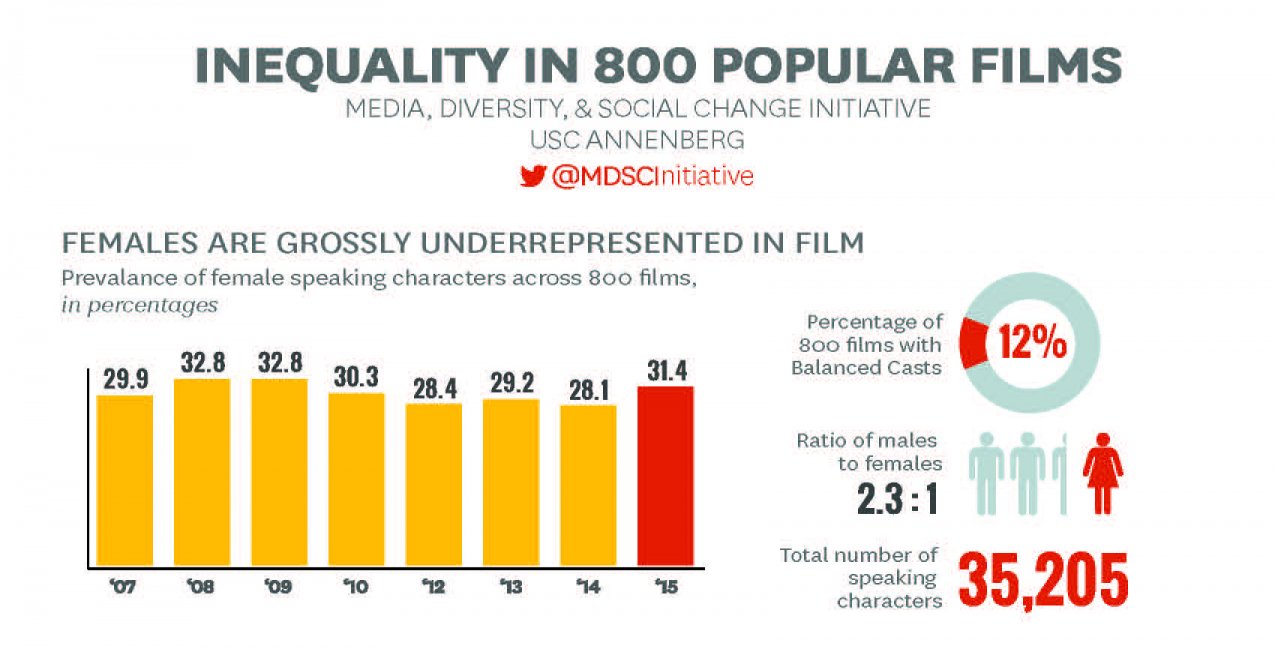
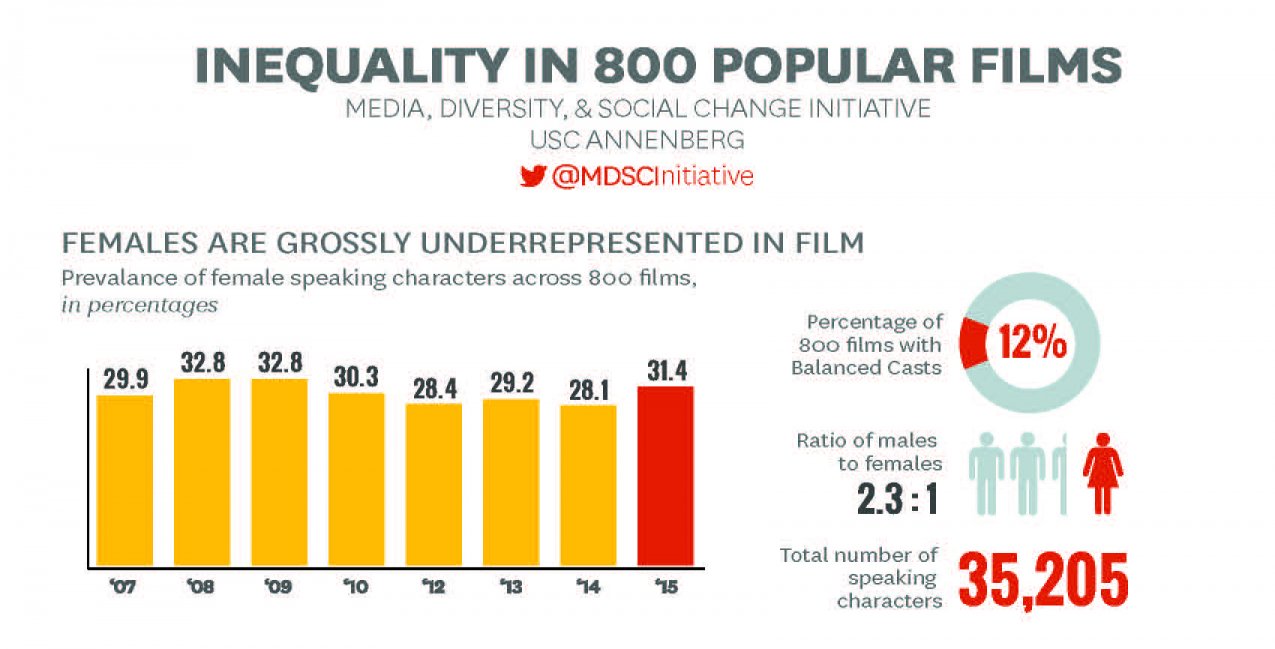
Authored by Professor Stacy L. Smith and the Media, Diversity & Social Change (MDSC) Initiative at USC’s Annenberg School for Communication and Journalism, the study is the largest intersectional analysis of characters in motion picture content to date. The group examined the 800 top films from 2007 to 2015 (excluding 2011), analyzing 35,205 characters for gender, race/ethnicity, LGBT status and – for the first time – the presence of disability. The results reveal that Hollywood remains resistant to change.

Copyright USC Annenberg 2016

Just 31.4% of all speaking characters across the 100 top films from 2015 were female, a figure that has not changed since 2007. While race/ethnicity has been a major focus of advocacy in the wake of #OscarsSoWhite, characters from underrepresented racial/ethnic groups were 26.3% of all characters. LGBT-identified characters represented less than 1% of all speaking characters. The report includes data on characters with disabilities, who filled a mere 2.4% of all speaking roles.

The report also has extensive and disturbing data on the depictions of minorities, including people with disabilities, and on the sexualization of young woman.

Related Tags:


Commentary Disabilities and Different Abilities Gender and Diversity Understanding Media and Pop Culture

Alicia Keys Stops Wearing Makeup — Good!

Posted on August 30, 2016 at 12:36 pm

Singer-songwriter-actress Alicia Keys has announced that she is not going to wear make-up any more, even in performance and on television. In the midst of the over-the-top as always VMA awards on MTV Sunday night she looked fresh, natural, and comfortable. Her spontaneous a capella song from the podium matched her unretouched look.

Women are bombarded with a lot of messages about what is wrong with the way they look, mostly from people who want to see us things to make us look and smell “better.” It is great to have a counter-message from Keys that tells us it is possible to feel happy the way we are.

She says she was inspired by showing up for a photo shoot ready to be made up and photographed, and then the photographer asked if he could take her picture without makeup.

“I swear it is the strongest, most empowered, most free, and most honestly beautiful that I have ever felt,” she wrote.
“I hope to God it’s a revolution … ‘Cause I don’t want to cover up anymore. Not my face, not my mind, not my soul, not my thoughts, not my dreams, not my struggles, not my emotional growth. Nothing.”

Related Tags:


Commentary Understanding Media and Pop Culture
THE MOVIE MOM® is a registered trademark of Nell Minow. Use of the mark without express consent from Nell Minow constitutes trademark infringement and unfair competition in violation of federal and state laws. All material © Nell Minow 1995-2026, all rights reserved, and no use or republication is permitted without explicit permission. This site hosts Nell Minow’s Movie Mom® archive, with material that originally appeared on Yahoo! Movies, Beliefnet, and other sources. Much of her new material can be found at Rogerebert.com, Huffington Post, and WheretoWatch. Her books include The Movie Mom’s Guide to Family Movies and 101 Must-See Movie Moments, and she can be heard each week on radio stations across the country.

Website Designed by Max LaZebnik