Scott Jordan Harris is the author of Rosebud Sleds and Horses’ Heads: 50 of Film’s Most Evocative Objects – An Illustrated Journey , a beautifully illustrated tribute to some of the most beloved props and costumes in film history. He writes about Marilyn Monroe’s dress in “The Seven Year Itch,” Dorothy’s ruby slippers in “The Wizard of Oz,” and Michael Myers’ mask from “Halloween.” He generously took the time to answer my questions about the book and these iconic objects.
Dorothy’s ruby slippers are one of the most popular items at the Smithsonian’s Museum of American History. In the book, they’re silver. Why the color change?
 Changing them to red allowed “The Wizard of Oz” to fully exploit the potential of Technicolor. I say in the book that nothing has ever seemed quite so resplendently red as Dorothy’s ruby slippers and I think that’s true. The redness is crucial to their visual impact, which is crucial to their resonance.
Didn’t we see Rosebud burn in the film?
We did. Just as writing a book about film’s most memorable characters would involve writing about some characters who die in the course of their movies, so writing about film’s most memorable objects meant writing about some objects that are destroyed onscreen. The book isn’t about props, as such. It’s about analyzing important objects in movies in the same way we analyze important characters, discussing their symbolism, their impact on the plot, and what they tell us about the characters around them.
Iconic objects are sometimes based on real life, like the championship belt in “Raging Bull,” and sometimes created just for the story, like the Maltese Falcon.
The two objects you mention—Jake LaMotta’s championship belt in “Raging Bull” and the Maltese Falcon in “The Maltese Falcon”—are two of my favourites. Both only actually appear in their films for a short time but both are crucial to our understanding of those classic movies.
The Maltese Falcon is the engine that powers the entire plot of its film. It is the only real connection the characters have and they wouldn’t encounter each other without it. The title belt doesn’t drive the plot of “Raging Bull” but is instead used, briefly and brilliantly, to comment on the main character. The way Robert De Niro’s Jake LaMotta behaves towards the middleweight championship belt, using physical violence to destroy the symbol of his best achievements while believing he is acting rationally, is a potent metaphor for the way he behaves in life.
Have HD and 3D and CGI affected the way props are created?
Dramatically so, I would say. CGI in particular has altered what we think of as a prop and what we think of as a character, which is an area of discussion that always fascinates me. Had “Life of Pi” been made years ago, for example, the tiger might have been a sophisticated animatronic puppet. We would have called it a prop and thought of it as an object. Because it was CGI, we think of it solely as a character.
If you could have one of the items from your book in your home, which one would you pick?
In a sense, I have one. My friend, the film writer Elisabeth Rappe, bought me a Sheriff Woody doll that sat on my bookshelves while I was writing the book.
If I could choose another, I’d have a real, working hoverboard from “Back to the Future Part II”. I was a young child when the movie came out and the hoverboard represented the true magic of the movies to me and to many people of my generation. I still feel almost cheated that hoverboards don’t exist, not by the movies but by reality.
What makes a prop or a costume iconic?
Very few movie objects become truly iconic. There are the ruby slippers, Marilyn Monroe’s white dress from “The Seven Year Itch” and perhaps a few others. Those objects have a cultural significance beyond a single film.
There are a few qualities they share. The first is an unforgettable look that makes them immediately recognizable and the second is an emotional resonance so powerful it approaches the universal. They often also have an unmistakable symbolism. The ruby slippers suggest the power of childhood fantasy and escapism, for example, while the white dress is a perfect image of irrepressible sexuality.
How did you find the artists to illustrate the book and what made them right for this project?
The book was developed from a column I wrote for a British film magazine called “The Big Picture”, of which I was editor for a couple of years. The editor-in-chief has a background in graphic design and knew various illustrators he thought might be right for the book. He spoke to them about it, they submitted portfolios, and we chose the three we thought would work best. The way their three distinct styles would blend to create the look of the book was an important factor in the decision, as was the ability to highlight in the illustrations certain aspects of the objects highlighted in the text.
In a digital world, how can a book like this demonstrate the benefits of a traditional book on paper?
As Rosebud Sleds and Horses’ Heads is about evocative objects, one of the aims behind it was to create a book that was an interesting object in itself, something that was enjoyable to handle and to display but that would still cost less than $20. That was easy for me to say, though. I’m a writer: all I do is type. It was the publishers, the printers and, most of all, the illustrators (Charlie Marshall, David McMillan and Jayde Perkin) who had the responsibility of making the book an impressive physical object, and I’m indebted to them for pulling it off.
What was the biggest surprise you uncovered in researching the book?
Years ago, when I first became interested in the subject but well before I started writing the book, I researched the horse’s head in “The Godfather”. It was a little shocking to learn that it was a real horse’s head. When I tell people that, they sometimes think it was the real head of the live horse that is seen earlier in the film. It wasn’t: it was bought from a dog food factory and then painted so that it appeared to be the head of the horse that plays the racehorse in the earlier scene. I’d be fascinated to talk to the person who had to paint the head. It can’t have been a pleasant job.
Something that surprised me when I began research with the book in mind was that a book about evocative objects on film didn’t already exist. There are many wonderful books about objects in other areas of life and about film memorabilia, but I couldn’t find one written from a film critic’s point of view about the role objects play in movies. I wanted to read one, so I wrote one.
What movie object do you get asked about most often?
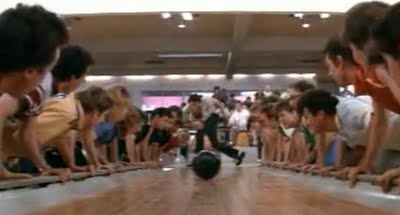
The object people talk to me about most frequently is their favorite object, the one there was no way I could possibly have left out of the book, but somehow did. That object has been everything from the watermelon in The Adventures of Buckaroo Banzai Across the Eighth Dimension to the bowling ball in Grease 2
 .
.
Those are always enjoyable conversations. It’s not like those times as a critic when you’re forced to write a top 10 list and people call you an idiot for not including X or Y. Rosebud Sleds and Horses’ Heads was never intended to be a definitive collection of the “greatest” film objects, but a celebration of some of the most evocative, and I love talking to people about their favorites. It’s such a fertile subject.