Kickstart a New Film about Movie Pioneer Alice Guy-Blanche

Posted on August 24, 2013 at 3:59 pm

This is an astonishing true story about a woman who wrote and directed more than 1000 films, including the first-ever film starring African-American actors, and built and ran her own movie studio, all 100 years ago, before women even had the right to vote. I am so glad someone is making a movie about her.

Related Tags:


Understanding Media and Pop Culture

Why Conservatives Should Appreciate “Lee Daniels’ The Butler”

Posted on August 19, 2013 at 4:20 pm

I highly recommended my friend Rebecca Cusey’s very thoughtful essay on Patheos, Hey Conservatives, Don’t Blast ‘The Butler’ (From a Conservative).  I am strongly opposed to reducing complex human stories to us-vs-them political bullet points (indeed, opposed to us-vs-them political bullet points of any kind).  As Cusey points out, this is particularly foolish and inconsistent with “Lee Daniels’ The Butler,” which is inspired by the true story of a man who served as a butler in the White House for eight Presidents, over a period that included the tumult of the Civil Rights Era.

The first reason that conservatives should like this movie is that its main character upholds core conservative principles of self-reliance, honor, hard work, and devotion to family.  Of course, these are liberal values as well, but right now we are focusing on the “conservative” criticisms that Cusey rebuts so resoundingly.  The movie makes the point that the butler and his son each devote their lives to service, an idea that should be embraced by people of all political views, even Libertarians, who may say they are acting only out of self-interest but who in their own way are trying to make the world more equitable. Cusey writes:

We need more, not less, of this in our culture because exploring the African-American experience through film is exploring our shared history and creates a conversation we all can share.

The conversation will not go very far if we conservatives immediately overreact to perceived slights in an excellent film.

The skill of the screenplay and direction in The Butler make it clear that the political views in the movie flow from and are expressions of the characters in the film. The movie itself does not make judgements on any of the presidents, but some of its characters sure do. And some of the characters disagree with each other.

That’s called good movie-making.

I think it is a beautiful and moving film for anyone to enjoy. Even whites. Even conservatives. Especially white conservatives. Try to understand the other side a little. Buying a movie ticket isn’t conceding every political point made by a character in the movie. It is simply learning.

Let me repeat that last point for emphasis.

Buying a movie ticket isn’t conceding every political point made by a character in the movie. It is simply learning.

In the first place, this movie in no way attacks conservative principles or those who espouse them.  In the second place, even if it does, the way to respond is with empathy and respectful engagement.  I found the movie’s portrayal of the Reagans to be very sympathetic.  Some of the critics (not professional movie critics, just people who have expressed views about the movie) wanted it to be more laudatory.  But Reagan, as all of the Presidents portrayed, was a complex figure who was not always willing to take on issues that in retrospect we might have wished him to, and apartheid was one of them.  That is a historical fact.   So were lynchings, which were frequent in the early 20th century and even proudly featured on postcard souvenirs. Thoughtful, sincere films like this one are intended to start conversations about ideas and experiences.

Cusey concludes her essay with a thought I wish everyone shared:

I maintain that every conservative should see this movie. Sure, there are things about which I disagree, but so what? It is excellent and we just might find we understand each other a bit better afterwards.


Related Tags:


Commentary Understanding Media and Pop Culture

What the Colors of the Clothes on Breaking Bad Tell You About the Characters and Story

Posted on August 18, 2013 at 8:00 am

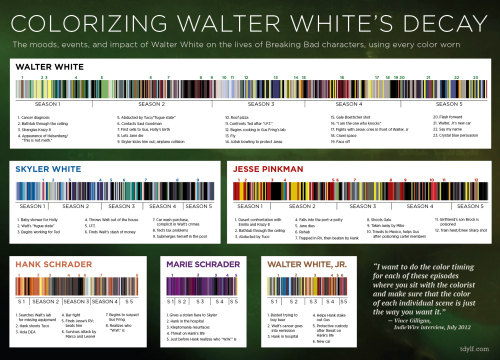
PrintI love stories like this wonderful analysis by John LaRue about the way the costume designers on “Breaking Bad” use the colors of the characters’ clothes to tell you what is going on.

There are a lot of patterns that emerge, so much so that each character has an identifying color.

After Walt’s cancer diagnosis, his colors become stronger, and eventually go black. When the cancer returns or when he’s defeated, the drab khaki returns. The closer he gets to Gus, and the stronger his ties to blue meth, the more blue shows up in his barcode.

Skyler starts out blue, but turns dark once she starts to figure out Walt’s secret. Her timeline turns deep blue, almost purple, as her flirtation with Ted grows, and then it turns green once she discovers Walt’s stash of money. The more complicit she becomes in Walt’s criminal activity, the blacker her timeline gets to the point that it’s pitch black in season 4.

Fascinating!

Related Tags:


Television Understanding Media and Pop Culture

“Casting By” — HBO Documentary About Casting Directors

Posted on August 17, 2013 at 8:00 am

Anyone who cares about movies should see “Casting By,” a new documentary on HBO about casting directors.  It is a rare opportunity to see early glimpses of some of the greatest actors live in their first roles and even never-seen before audition tapes.  But more important, it is a chance to understand the influence of casting directors like the pioneering Marion Dougherty, who championed actors like Dustin Hoffman, Al Pacino, Robert De Niro, and John Travolta and literally changed the face of movies.

In the early studio days, actors were primarily chosen for their looks, including the indefinable “screen presence.”  They were under contract, and when it came time to make a movie they would often pick whoever was available from their list of in-house talent.  They would train them in-house as well.  “They used what people looked like physically to define the character…Can we fix the nose, can we fix the teeth?  Last on the list was ‘can they act?'”

The end of the studio era coincided with a change in story-telling on film that opened the door for New York stage-trained actors who looked less like leading men and more like real people, actors who understood a new kind of acting based on “inner being, emotional truth.”  The movies were ready for “great actors as opposed to the Hollywood star-making system.”  That was where Dougherty came in.  She began casting for live television, a trial by fire that was the perfect foundation for getting to know the actors and the business.  It is touching to hear the gratitude of the actors she helped.  “She can see what other people can’t see,” we learn.  “Even before you see it in yourself,” adds Danny Glover.


Related Tags:


Actors Understanding Media and Pop Culture

Before You Download that “Educational” App for Your Baby

Posted on August 10, 2013 at 3:59 pm

The Campaign for a Commercial-Free Childhood has filed a complaint with the Federal Trade Commission charging that “educational” apps for babies do not have any documented value.  This is the same group that made the charges against Baby Einstein that led to a settlement that had Disney offering refunds to consumers who relied on their claims that the DVDs were beneficial to babies.  CCFC says:

The false and deceptive marketing by Fisher-Price and Open Solutions creates the impression that their apps effectively educate infants when time with tablets and smart phones is actually the last thing babies need for optimal learning and development. Both companies claim that their mobile apps will teach babies skills and information-including words and numbers- but neither company offers any evidence to back up their claims. To date, not a single credible scientific study has shown that babies can acquire language or math skills from interacting with screens. In addition, screen time may be harmful for babies. Research links infant screen time to sleep disturbances and delayed language acquisition, as well as problems in later childhood, such as poor school performance and childhood obesity. The American Academy of Pediatrics recommends discouraging screen time for children under two.

In their cover letter, CCFC notes that “According to a 2012 report by the Joan Ganz Cooney Center, over 80% of the top-selling apps in the “Education” category of the iTunes’ App Store target children. Sixty percent of the top 25 apps target toddlers and preschool children—more than double the percentage that target adults.”

The companies charged are Fisher-Price and Open Solutions, whose apps like “Laugh and Learn” purport to teach babies counting, words, or motor skills.  Studies show that babies learn far more effectively from interaction with people than they do from machines.  To add your name to the complaint against companies making unsubstantiated claims that their products benefit babies, visit the CCFC site.

Related Tags:


Internet, Gaming, Podcasts, and Apps Parenting Preschoolers Understanding Media and Pop Culture
THE MOVIE MOM® is a registered trademark of Nell Minow. Use of the mark without express consent from Nell Minow constitutes trademark infringement and unfair competition in violation of federal and state laws. All material © Nell Minow 1995-2026, all rights reserved, and no use or republication is permitted without explicit permission. This site hosts Nell Minow’s Movie Mom® archive, with material that originally appeared on Yahoo! Movies, Beliefnet, and other sources. Much of her new material can be found at Rogerebert.com, Huffington Post, and WheretoWatch. Her books include The Movie Mom’s Guide to Family Movies and 101 Must-See Movie Moments, and she can be heard each week on radio stations across the country.

Website Designed by Max LaZebnik