Tonight on PBS — 1971, Documentary About The Robbery that Exposed FBI Abuses
Posted on May 18, 2015 at 12:00 pm
Tonight on PBS, the brilliant documentary “1971” will be shown on the Independent Lens series. In 1971, a group of ordinary citizens broke into a small FBI office in Pennsylvania and shared with the world their findings on COINTELPRO, the FBI’s illegal surveillance program. It led to the first-ever oversight hearings on the FBI and paved the way for Daniel Ellsberg, Julian Assange, and Edward Snowden. And yet, the FBI never identified them. Now, they tell their story publicly for the first time.
Fashion icon nonagenarian Iris Apfel is renowned for her taste and style. But people who see this movie, the last from documentary legend Albert Maysles, will remember her for her fearlessness and life force. Along with the signature big, round, black-rimmed glasses, her attire on any given day could include a hand-painted leather Valentino jacket she originally bought decades ago for her husband, pants made from fabric she haggled over at an exotic open market, and gorgeous big, clunky beads as likely to be worth a fortune as they are to have been picked up at the time store.
No one ever got a bigger kick out of getting dressed than Iris (she admits she likes dressing for a party far more than the party itself) and no one ever got a bigger kick out of life and love, either.
Iris is an artist and the world is her canvas. She is a living installation project of wild color and design. But her greatest art form is her life, and it is an enormous treat to see this valentine by one legend to another.
Families should know that this film includes some strong language and discussion of illness and loss.
Family discussion: What would change in your life if you wore something a little bit more adventurous? What do you think of her comments on “pretty?”
If you like this, try: “The September Issue” and “The Eye Has to Travel”
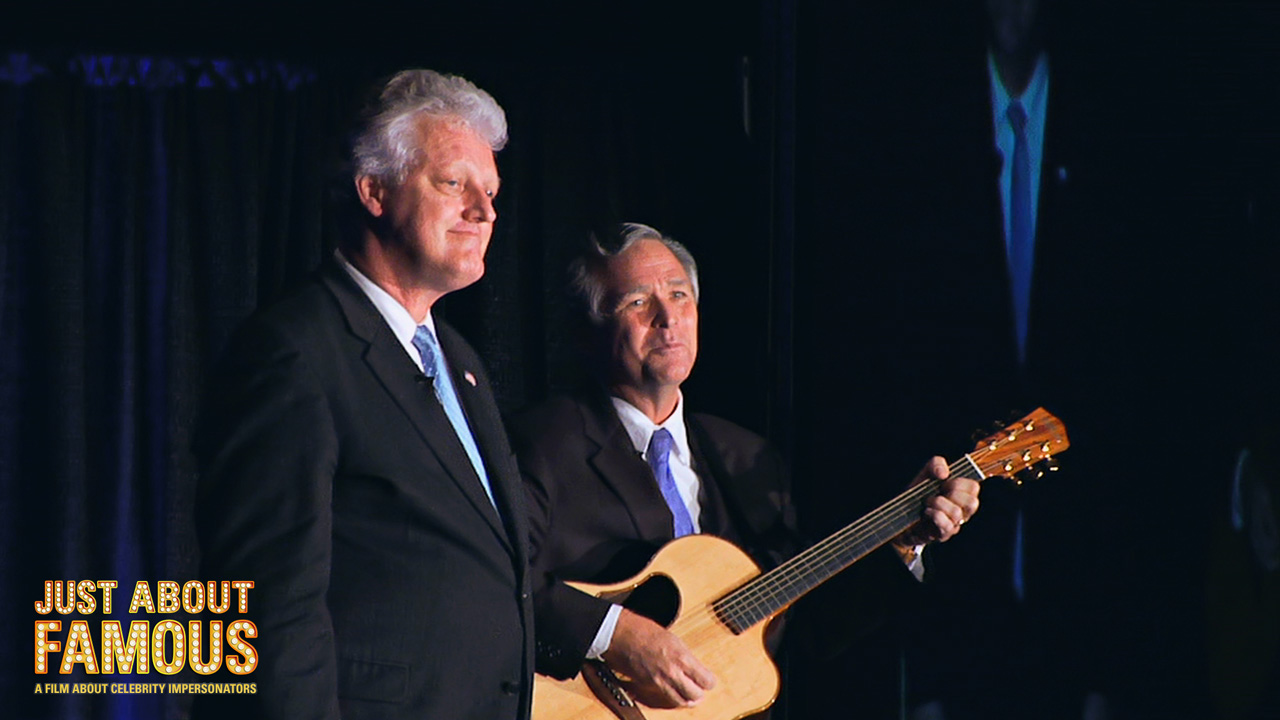
Interview: Matt Mamula of Celebrity Impersonator Documentary “Just About Famous”
Posted on April 26, 2015 at 3:59 pm
Matt Mamula co-directed “Just About Famous,” the very entertaining new documentary about celebrity impersonators. He generously took time to talk to me about the unexpected opportunities that open up when someone looks like someone who becomes famous, and it seemed natural for us to call them by their celebrity alter egos. It is available now on iTunes.
Which celebrity do you think you resemble the most?
It’s funny. I actually get compared to Rick Grimes from “The Walking Dead.” I know it is a good thing. Rick is a good-looking guy. And people have stopped to take pictures with me or asked to take a picture and I kind of feel like, “Oh, I know this world.”
One of the things that I think is so intriguing about the film is that some of the people never intended to be performers. They just happen to resemble somebody who happened to become famous. And then if they take advantage of it, their careers are tied to what happens to the person they look like.
You know it’s funny. The Dame Edna impersonator actually did not use Dame Edna’s standup routines. He actually writes his own material, People ask him, “Why don’t you do your own stand up or your own comedic material and he is like, “I don’t think I could do it.” There is something about putting on a dress and kind of becoming that character — you feel like you can now become a comedian and do that job and write his own material. John Morgan, the George Bush character, was somewhat a musician beforehand but he incorporated George Bush singing into his performances. So yes that definitely pushes them to further that talent that they may or may not have beforehand.
Lady Gaga or Madonna have to be very difficult to do because their acts are so elaborate and demanding.
There is a shot of Lady Gaga’s garage and it is insane how many costumes she has in there. She’s got costume after costume. She actually makes her own costumes which I think is unique and interesting. And Madonna the same way, Madonna has been around since the 80s and really showing no signs of stopping and so is Lady Gaga. So they are constantly having to keep up with new costumes and even just kind of the wear-and-tear that they get on them after they do shows. They don’t have the entourage or the full staff that the real celebrity has so they have to kind of to take that on as well.
Copyright Bond/360 2015
How did you first come into contact with this unusual group of people?
My co-director, Jason Kovacsev, read an article about this upcoming celebrity impersonator convention. At the time we were in between projects and we thought, “Well, let’s go check it out and see what’s there.” You know to be honest they were a little hesitant about letting us in because a lot of times people come in there and they kind of mock them and make fun of them. So they really just kind of waited to see What kind of questions we were asking. Once we got really involved with them they were totally willing to share their stories and their adventures.
We did a short film that came out around 2010 and that played at film Festivals and we kind of thought we were done with it. But every time we showed it, people said, “We want more, we want more, I want to see more.” So we basically decided to go back to the convention and look at other characters or further stories with other characters like the Elvis character and different things that happened in his life, like becoming scuba dive instructor in Las Vegas. It was just really was a blast being around them and following them. Some strange and surreal thing always happen so there was never a dull moment.
The Obama impersonator was inspired by his Obama role to get involved in politics for real.
He had done some gigs for a Democratic club as an Obama impersonator and then he got involved and they kind of said,”Hey, what would you think about this?” or maybe it is this dual idea. He’s a teacher during the day and he says something like yes “Yes, I would like to move in this direction.” There are things that happened on the road but he is still trying to push that angle. He knew the resemblance would hurt him and help him. There are two sides to that coin but it is definitely life imitating art.
What happens when the person they resemble becomes less visible in real life?
Obviously, George W. Bush has been out of office for a while. So he has been trying to reinvent his image, and as you see in the film do a lot of motivational speaking. People kind of see the comedy and the impersonation and it draws attention and then he can switch to the motivational speaking behind it. He’s always trying to look for angles to kind of use his impersonation to become something else or utilize it for something as well. Like the Tiger Woods when Tiger was going through a rough patch, the phones were not ringing as much. When Tiger is winning the phones are ringing more. So Madonna has got a new album, she probably gets more. So they definitely keep track of and follow their celebrities and I think when the celebrity goes through rough times in some ways they go through a rough time. With the Bush impersonator, I think that Bush was just such a polarizing figure good or bad during that time that people still kind of cling onto him. But yes it is definitely a concern for when their celebrity fades — how do I re-invent this and how do I still get hired?
You had a couple of people who met their doppelgangers in real life. Do celebrities get upset about being imitated?
From what we understand some of them are kind of cool with it so to speak, they don’t really kind of acknowledge it but they aren’t really are negative towards it. I know like the Brett Michaels impersonator had met with the real Brett Michaels. I know the Bush impersonator was with Bill Clinton one time and George W. Bush’s dad was there and he was yelling out, “Dad, hey Dad” trying to get his attention.I know a lot more are trying to meet them too; they all would love to. So yes, I think some of them think it’s weird and they don’t want to be part of it but other ones kind of give their approval in a way. At times they go to concerts because they want to kind of feel like they’re doing justice to them and they want to kind of earn their respect as well. Sarah Palin’s impersonator met her a couple of times and Sarah thinks it’s really funny and interesting and she’s had fun with it.
What is it that you’re hoping people will get from the film?
We are definitely hoping that they laugh, laugh out loud, chuckle and really have a good time. For us is like a popcorn film, it is not an in-depth documentary. It’s meant to be a fun, whimsical. We were hoping to basically create the same feeling that we had when we were around them. It is really just this surreal fun environment.
Everybody who worked on the show had some direct or very close experience with cancer. How does that affect the way the show is made?
It certainly made it very personal for all of us. In my case it was my grandmother. When she died when I was in my early 20’s. I didn’t even know what she had died of. My parents thought it was better not to actually tell me. Even then, which wasn’t that long ago, it shows how much stigma there was still around this word “cancer” and this whole set of diseases. And I think that’s persisted to some degree up to today. When we started this project we did so knowing that somebody in the own production team was going to be diagnosed or have someone very close to them diagnosed with cancer during the project. Sure enough there were three separate episodes during the two years we were working on this film. Edward Herman, our narrator, received a diagnosis and or died from the disease so it was very personal from the very beginning.
The series really comes at cancer in several different ways. There is a historical part, there are the individual stories, there is a science story. How do you keep that presented in an accessible way?
This is a bold experiment in filmmaking. We were not sure at all if these three strands that you just identified would work together. I’m not aware of it ever having being really tried on this scale before. Essentially we have been working in historical film which Ken Burns and I are very familiar with doing. We have pieces following patients through their journeys, being with them every day, letting the cameras roll. Then we have a very heavily scientific story in which the we are trying to explain to people and what we found to our delight was that each strand kind of resonated with the other and sort of vibrated with the other and you have almost a kind of music coming out as a result.
And when you see for example a contemporary story of Terrence deciding whether or not to roll their child in a clinical trial agonizing over the pluses and minuses and all the unknowns, we get a deep insight into what the parents must have been going through the 1950s when the first multidrug clinical trials were happening at the National Cancer Institute and children were literally being almost sacrificed for science, for the knowledge that was coming out of these trials to with very little benefits to them. Those parents must have faced an even more intense decision to make about whether to go forward with this. So the only way to understand that historical time is to see it with your own eyes, happening right now.
What were some of the challenges that you had to convey the scientific material and did you use animation? Did you do microscopic photography?
All of the above and many more things. That was in some way the most challenging part of the film itself. In the first place we had to satisfy ourselves that we understood it. So my litmus test is always, if I can understand it simply and clearly I can get it across to our viewers. So it was really about not pretending that we understood something that we didn’t understand, really asking these world-class researchers and Nobel prize-winning scientists to try to talk as if they were talking to their grandchildren. And they were remarkably successful at that.
They were able to simplify these concepts so that it really does become comprehensible and then we availed ourselves of some really, really beautiful animation. And we kind of had a worldwide search to find an animator who could do this and we actually ended up working with a woman who lives about three blocks away from me in Brooklyn. And she just happened to be really an artist not so much kind of trying to literally show what is going on but almost create a world that the viewers can kind of sink into and that way really the science became much more accessible to people, much more interesting to people.
One of the things that I think is frustrating to non-medical people is that it seems that every day there is a headline that something either does or does not cause cancer or reversing what we were told last time. What is the reason for that and what is the best way to understand it?
I think that it’s born of frustration. I mean it is still the case that some half of all cancers have no known cause at all and maybe, it’s very possible are the result simply of random copying errors inside our always dividing cells. I think this is partly especially for Americans who want an identifiable cause, something that we can stop and so we won’t ever get this disease in the first place. And while certainly true that there probably are carcinogens that we probably haven’t yet identified certainly many of these so-called causes whether it’s power lines or cell phones or sugar or whatever it is, really there’s no serious scientific evidence showing that these are carcinogenic.
The number of known carcinogens once you get past tobacco, obesity, sunlight, some viruses, there are very few that have been identified solidly. I think that is just tremendously frustrating for people so there’s that vacuum into which is poured all sorts of half-baked theories that I think do a real disservice. People running around not knowing what to eat or what to drink or where to stand on where to live and it is really, really a problem and I think one of the most important and promising areas of cancer research are in kind of honing our understanding of what is preventable and what is not preventable.
You show in the series how just a few decades ago the word “cancer” was spoken in whispers, if at all. Now Angelina Jolie writes about her surgery in the newspaper. How have we changed in the way that we talk about cancer?
I think we have made a lot of progress in that area. Cancer isn’t quite the taboo subject it was even 30 years ago when my grandmother died. And we owe a debt to people like Angelina Jolie or Betty Ford or Nancy Reagan or people who have publicly shared their particular stories. And I think in the case of Angelina Jolie there are some people who criticize her because she has taken these what seems like drastic steps for perhaps very little medical reason but that is a very dangerous thing to do, is to criticize another person’s choices. The service that she’s giving us is that she’s willing to talk about it and she’s willing to say, “I have a gene that may well give rise to cancer and this is what I’m going to do personally to try to prevent that from happening. You don’t have to follow my lead but this is one option.” And I think it is less what she has chosen to do than the fact that she has discussed it at all openly that is a real achievement and service she has given us.
What do you think is the most promising avenue that you have discovered for either prevention or treatment in the course of working on the series?
Just since this book came out five years ago, there is a whole new sort of frontier in how cancer research has developed. Immunotherapy is setting the cancer world on fire. It’s not just us, our decision to focus on it, it’s really universally thought of as being the most exciting new area of cancer research. And the reason for that is that for centuries people wondered why the human immune system couldn’t, didn’t fight cancer the way it fought every other infection. Why can’t our immune system help us? So (a), it does help us we probably have cancer all the time in our bodies and the immune system is part of the defense mechanisms that are fighting the cancer but more importantly even there are very specific reasons that the immune system as it turns out doesn’t fight cancer mostly because it doesn’t see it, it doesn’t recognize it as ‘other’ and that’s partly because cancer is so close to our cells, it really is our cells.
So what’s so exciting about this is that they have devised ways to basically unblind the immune system, to take the restraints off the immune system and that means a possibly non-toxic therapy, a therapy against which the cancer cannot form a resistance. All the defense mechanisms that cancer has are rendered useless when the immune system is unleashed against it. This isn’t even hypothetical, there is a billion-dollar industry already, and there are approved drugs out there that are working remarkably well against certain types of cancer. And every month it seems there is a new clinical trial for a different kind of cancer. You rarely see scientists in this field jumping up and down and getting giddy and childishly giggling but you do see that when you talk to them about immunotherapy. With all the caveats about where we’ve been before and had all these promising sort of moments before it in history cancer research there is still a lot of optimism about this new field.

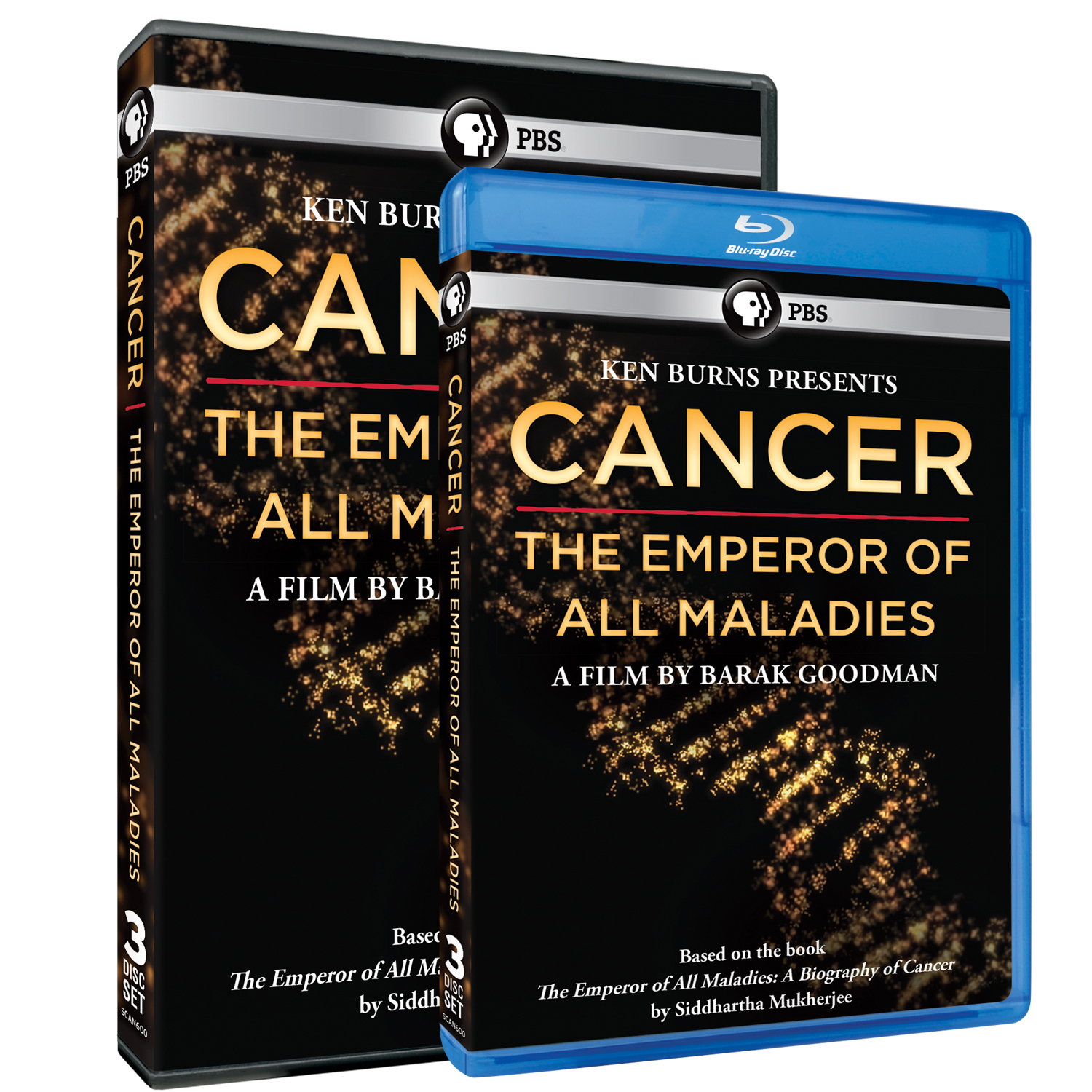
 , now available on DVD. The series is produced by Ken Burns, based on the book by
  .
.