
Sleeping Beauty
Posted on October 6, 2008 at 6:00 am
Disney’s gorgeous “Sleeping Beauty” is out in a magnificent new Diamond edition this week. This classic should be in the library of every family and every animation fan.
The King and Queen happily celebrate the birth of their daughter, Princess Aurora. The young Prince who is betrothed to the baby and three good fairies, Flora, Fauna, and Merryweather, join the celebration. But wicked Maleficent, a bad fairy, is enraged when she is not included. She arrives at the party to cast a spell on the baby Princess. When she turns 16, she will prick her finger on the spindle of a spinning wheel, and die.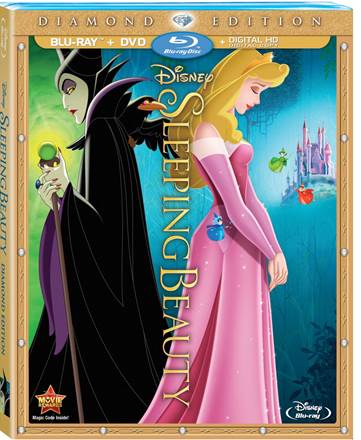
The good fairies cannot remove the spell, but they change it from death to a deep sleep from which Aurora can be awakened only by love’s first kiss. The King and Queen try to protect the princess by sending her off with the good fairies to live in a tiny cottage in the woods until her sixteenth birthday is over. They cannot use their magic powers because it would lead Maleficent to the princess. Aurora (called Briar Rose) grows up. Out in the woods, she meets the Prince, and they fall in love, not knowing they are already engaged. But the fairies prepare for her birthday party and argue about whether the dress they are making for Aurora should be pink or blue, and cannot resist using their magic. Maleficent discovers where they are and is able to make Aurora prick her finger and fall into a deep sleep. Maleficent also captures the prince to make sure he cannot break the spell. After the fairies help him escape, Maleficent turns herself into a dragon to stop him. He kills the dragon and wakes Aurora with a kiss. At her birthday party, they dance, not even noticing that her dress turns from blue to pink as the fairies continue to argue about the color.
In this classic story, as in “Snow White,” a sleeping princess can only be awakened by a kiss from the prince. Psychiatrist Bruno Bettelheim and others have written extensively about the meaning of these stories, and the ways in which they symbolize the transition to adulthood and sexual awakening. Bettelheim’s theory was that such fairy tales begin to prepare children for developments they are not ready to assimilate consciously.
There is no reason to discuss this interpretation with children, of course. But it is worthwhile to talk with them about Maleficent, one of Disney’s most terrifying villains, and why her bitter jealousy makes her so obsessed with vengeance. Is that what she really wants? Isn’t she doing exactly the opposite of what is required to achieve her real goal, acceptance? Children also enjoy the little squabbles of the three good fairies, which may remind them of arguments with their siblings.
 Extras on this new edition:
· Art of Evil: Generations Of Disney Villains – This legacy piece spotlights Disney’s favorite villain animator, Marc Davis and his infamous creations of characters such as Maleficent and Cruella. Throughout the piece, we will talk to modern day animators like Andreas Deja and also the new generation of Animators (Lino DiSalvo Animation Director of FROZEN) on how Marc’s designs and characters influenced what they do today.
· DisneyAnimation: ARTISTS IN MOTION (Extended Edition) – Join Walt Disney Animation Visual Development artist Brittney Lee as she goes through the process of creating a three dimensional sculpture of Maleficent, completely out of paper. In this extended edition, go deeper into Britney’s process
· Never Before Seen Deleted Scenes:
o The Fair (With Deleted Character – The Vulture) – In this version of the story, the fairies do not take the Princess to live with them in the forest. Convinced that King Stefan’s order to burn all the spinning wheels in the kingdom will not prevent Maleficent’s curse, the good fairies put a magic circle around the castle and cast a spell: “No evil thing that walks or flies or creeps or crawls can ever pass these castle walls.”
o The Curse is Fulfilled – The three good fairies have just returned Aurora to the castle and give her a crown. They leave the room to give Aurora some time alone…but Maleficent pays her a visit.
o Arrival Of Maleficent (Alternate Scene) – Maleficent arrives uninvited to the christening of the Princess Aurora.
· BEAUTY-OKE “Once Upon A Dream” – Sing along to this kinetic text video of Aurora’s signature song.
· Classic DVD Bonus Features Include:
o The Sound Of Beauty: Restoring A Classic – This featurette covers the creation of the 7.1 mix of the score of Sleeping Beauty that was done for Blu-ray, using the source tapes from the original recording sessions resulting in an audio experience of superior quality with greater detail and fidelity that you have ever heard before.
o Picture Perfect: The Making Of Sleeping Beauty – Discover the behind-the-scenes magic that transformed a beloved fairy tale into a cinematic work of art. Legendary Animators, actors and film historians reveal the secrets behind Disney’s masterpiece.
o Eyvind Earle: A Man And His Art – Early in his career, renowned American Artist Eyvind Earle worked as a background painter at the Walt Disney Studio. Walt Disney liked his work so much that he entrusted him with the assignment to be the Art Director for Sleeping Beauty. This was the first time that one artist was given the responsibility for the entire look on one of Disney’s animated features. This piece follows Earle’s development as an artist and his years at the Studio.
o Audio Commentary by John Lasseter, Andreas Deja and Leonard Maltin
 The best-selling series of books about children who find their mysterious old house surrounded by magical creatures has been turned into a visually sumptuous treat for fans of fantasy and imagination.
 ) plays twins Jared and Simon Grace, who with their sister Mallory (Sara Bolger of
  ) and mother (Mary-Louise Parker) move into a spooky old mansion that once belonged to their great-uncle. Mallory and Simon have accepted the move but Jared is furious about their parents’ split and unhappy about the new home.