War of the Worlds

Posted on June 26, 2005 at 1:50 pm

“Is it the terrorists?” a frightened child asks, because that is the scariest thing she knows. But what makes this thing scary is that it is something no one knows. It is beyond our knowledge, even beyond our imagination. Earth is under attack and no one knows by whom or what they want.

These are not the “let’s play musical notes together” aliens of Close Encounters of the Third Kind or the Reese’s Pieces-loving, bicycle-flying botanist alien from E.T.: The Extraterrestrial. There’s no “Take me to your leader,” or Klaatu Barada Niktu. These aliens don’t even want to keep humans on as slave labor as in Battlefield Earth. They don’t want us to understand or negotiate with them. It does not seem to be about power or plunder. They just want to destroy us. As one character says, “This is not a war any more than there’s a war between men and maggots. It’s an extermination.”

Steven Spielberg knows two things better than anyone else who ever made a movie, and both are in top form here. First is his extraordinarily evocative sense of family life, the way every detail of home and connection (even, maybe especially the most frayed of connections) tell the story and make us care about it. A ribbon, a mirror, a boot, a box of family photographs, a Beach Boys song –- the juxtaposition of the ordinary with the unthinkable sustains a “golly” factor that grabs our throats and our hearts at the same time.

The special effects in the movie are dazzling. Just when we thought that we were so accustomed to the limitless wonders of CGI that we could never be stunned in a theater again, Spielberg just plain knocks our socks off. My husband counted eight spontaneous “Oh my Gods” coming from me during the movie. It isn’t just that it all looks real, seamlessly integrating the effects. It’s that what looks so real is so “Oh my God.”

The images are fresh and imaginative and yet perfectly believable, mixing the normal with the inconceivable, from the vast alien machines to the buckling of the earth and the apocalyptic landscapes. The most vivid images are when we see the trappings of everyday life transformed. In one moment of complete insanity, the bells at a railroad crossing start to clang, and the striped barriers come down as though it is a perfectly ordinary day and the commuter train is about to arrive on schedule. Everyone stops and takes a breath and then the train comes in, filled with flames.

Spielberg’s other great trick is his mastery of scale, and again, that use of context brings the story literally home. At least half of the “Oh my Gods” were responses to wow-style reveals of new threats, new invasions.

And Spielberg makes invasion into a theme, from the very beginning, when with stunning economy he sets the stage for all that is to come.

Our hero-to-be, Ray (Tom Cruise) arrives home late. His ex-wife Mary Ann (Miranda Otto), pregnant by her new husband, is standing there with a hand on her hip. The new husband is handsome, a little sleek-looking in a black turtleneck, but clearly so nice you can’t even bring yourself to hate him, though Ray has clearly tried. Even though the ex-wife is late, she decides to carry their daughter’s suitcase into Ray’s house. Ray is very uncomfortable as she opens his all-but-empty refrigerator and peeks into his messy bedroom. He feels invaded. His children seem alien. And yet, in one of the most understated but meaningful moments in the movie, a shared joke between Ray and Mary Ann shows us a glimpse of Ray’s asperity and resolve.

But all of that is under the surface. When we meet him, Ray has long been used to disappointing people. It is not clear which is worse, the sullen animosity of his son Robbie (Ray wears a Yankees baseball cap; Robbie pulls out one with a Red Sox logo) or the patient lack of expectations from his daughter, Rachel (Dakota Fanning). But when it becomes clear that something very, very bad is happening, Ray will do anything to keep his family safe. This will be his story more than it is the story of the battles. The movie is at heart, well, heart.

And Cruise does heart well. He and Fanning anchor the film with outstanding performances of conviction and charisma. Rachel’s protection of her “space” and Ray’s efforts to care for her memory and spirit all echo the invasion theme. The story moves well from the large scale destruction of a city to a small-scale intrusion into a shattered basement retreat occupied by three people. Throughout, the focus is on Spielberg’s favorite subject, the family as fortress. The government barely exists, the army is dedicated and honorable but overmatched.

And, as Ray points out, the humans are almost as dangerous as the aliens. Ray is not the only one who will do anything to keep his family alive and the ochlochratic chaos means that nowhere is safe.

The story is affecting, the action scenes are thrilling, the issues are resonant. Yet it is not ultimately as satisfying as less skillful movies like Independence Day. It may be wiser and it may have more artistic validity, but summer explosion movies call out for a more complete resolution than the Wells book allows. A valid but subtle point is lost, not for lack of respectful presentation, but perhaps because ot it.

Spoilers alert: Parents should know that this is an extremely tense and intense movie, with constant peril and violence. Many characters are killed. Many are neatly vaporized, but there are scenes with dead bodies, a brutal off-camera murder, a death by impalement, guns, grenades, lasers, and other weapons, and some grisly images. Characters use brief strong language. There are tense confrontations between family members. Some viewers will find the behavior of the humans more disturbing than that of the aliens.

Someone once said that the aliens in movies tell us more about what we are thinking about than about any likely real-life extraterrestrials. The UFO movies of the cold war era were, under this analysis, a reflection of our fears about communism and the atomic bomb — with the 1956 version of Invasion of the Body Snatchers and The Day the Earth Stood Still as examples, contrasted with the more benign aliens of Spielberg’s other movies. What does this movie tell us about our current fears?

Families who see this movie should talk about how the story has changed since it was originally written by H.G. Wells more than 100 years ago. How was that era’s interest in the relatively recent scientific discoveries reflected in the book and how has the current version used modern concerns to connect to a contemporary audience? What do you think about the balance of the story between the action and the personal drama as Ray’s character has to become more responsible and
find a way to communicate with his children. How did both parts of the story help each other? In a situation like this, who do you help? Who do you accept help from?

Families who appreciate this film may enjoy listening to the legendary Orson Welles broadcast. This version of the book has the radio script as well. The text is also available online at Project Gutenberg. The new version has a small tribute to the George Pal movie. They will also enjoy Independence Day, one of the all-time best alien invasion movies, and they might get a kick out of Battlefield Earth, one of the worst, and Signs, one that has a bit of both.

Related Tags:


Action/Adventure Based on a book Science-Fiction

The Sisterhood of the Traveling Pants

Posted on May 31, 2005 at 12:58 pm

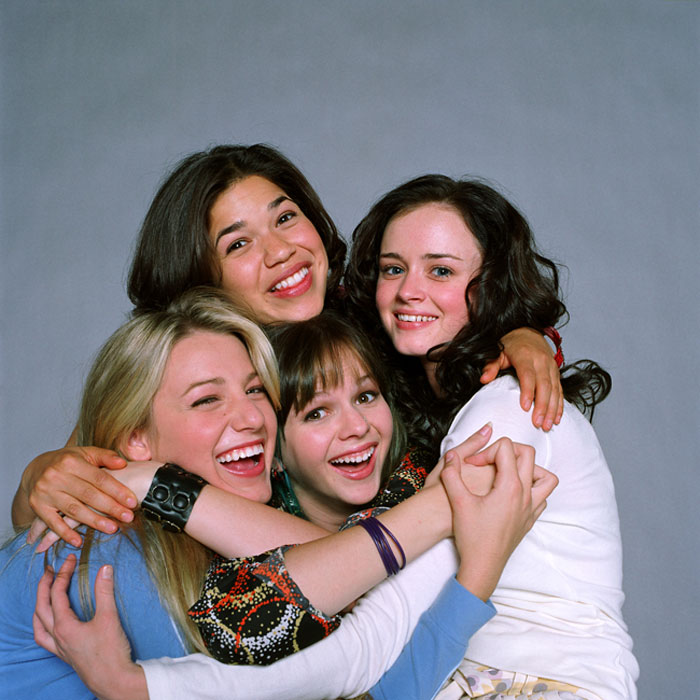
This is a story about one summer in the life of four friends, told with sincerity, heart, and a little bit of magic — the very same qualities that made the original book and its sequels a “you have to read this” classic for young girls.

Four 16-year-olds, friends since before birth, when their mothers met in a prenatal exercise class, are about to be separated for the summer for the first time ever. Just before they leave, they find a mysterious pair of blue jeans that somehow fit each of them perfectly, even though their sizes as shapes are as different as their personalities. They decide to share the pants as a way of sharing their experiences over the summer. As they mail the pants back and forth to each other, the jeans will help them share their stories and stay connected.

The first to wear the pants is shy artist Lena (Alexis Bledel of television’s Gilmore Girls) goes to Greece to visit her grandparents. On the island of Santorini she meets Kostas. Despite a multi-generation feud between their families — and a promise never to see him again, Lena and Kostas fall in love.

Outgoing and athletic Bridget (Blake Lively) goes to soccer camp. She thinks a romance with her handsome coach is what she needs to make up for the emptiness that she has felt since her mother died.

traveling pants.jpgAspiring writer Carmen (America Ferrera of Real Women Have Curves) goes to South Carolina to see her father (Bradley Whitford), who did not tell her that he was living with a woman (Nancy Travis) with two children and planning to get married.

And rebellious would-be film-maker Tibby (Amber Tamblyn of television’s Joan of Arcadia) stays home, working at a huge discount store called Wallman’s and trying to make a movie about how bleak and meaningless everything is. She meets a girl named Bailey (Jenna Boyd) who becomes her film crew.

Each of the girls wears the pants and sends them on to the next with a letter. As they all try on new experiences and emotions and feel a little lost and vulnerable, the pants and their friendship keeps them feeling close and supported.

What takes this above the level of the average something-for-everyone collection of stories with a group hug at the end is its willingness to keep things a little complicated and messy instead of tying everything up neatly into the TV-style resolutions most people think are required in stories for young audiences.

Characters make real mistakes, not cute flubs that are either quickly corrected or happy accidents that work out even better than the original plan. Some characters learn lessons and change their minds or their behavior, but others do not. Some wounds are healed and some of what is lost is found, but some not. This is more reassuring, rather than less, because in our hearts even kids know that is true; all endings are not happy. It is good to see how people handle that — and can even be enlarged by it.

The film benefits, too, from sensitive and committed performances by its five young stars (including the precociously centered Boyd, a real presence on screen here as she was in the otherwise awful Dickie Roberts: Former Child Star). They make us believe in the connection between very different characters. It’s almost possible to think of them as different aspects of the same adolescent — shy and bold, thoughtful and impulsive, cynical and hopeful. Together, like the movie itself and like those magical Levis, they are more than the sum of their parts.

Parents should know that there is a subtle reference to a sexual encounter that one of the characters initiates but later considers a mistake. This is handled sensitively and responsibly. The same is true of other difficult issues the characters must face, including the suicide of a parent, a difficult adjustment to a divorced parent’s re-marriage, and a very sad death.

Families who see this movie should talk about what makes such different girls such loyal and devoted friends? What are the most important lessons each one of them learns over the summer? Why don’t the pants fit Bailey? Families should talk about why this movie does not try to give everyone a happy ending or even an ending at all. Why was Bridget so wrong about what she thought would make her feel less lonely? How did her mistake help her to share her feelings with her friends in a way she could not before? What could Carmen have done to try to get to know her father’s new family better?

Families who enjoy this film will also enjoy The Baby Sitters Club. And, of course, they should read the bookand its sequels. They might also enjoy a different kind of story about a magical piece of clothing shared by a disparate group of people in a life-changing series of adventures, The Wonderful Ice Cream Suit.

Related Tags:


Based on a book Comedy Drama Series/Sequel
Clifford’s Really Big Movie

Clifford’s Really Big Movie

Posted on April 17, 2004 at 9:53 am

B
Lowest Recommended Age: Preschool
MPAA Rating: Rated G
Profanity: None
Alcohol/ Drugs: None
Violence/ Scariness: None
Diversity Issues: Diverse characters
Date Released to Theaters: April 23, 2004
Date Released to DVD: July 3, 2004
Copyright 2004 Warner Brothers

Clifford is not just a Big Red Dog; he’s a big, red phenomenon, hero of a series of books by Norman Bridwell, an animated PBS series, and even a live road show. Now he has moved (briefly) to the big screen with a low-key feature destined for a quick theatrical release on its way to video and DVD.

Clifford is a really, really big red dog, part of his appeal to toddlers, who live among giants and are thus drawn to huge, powerful but kind creatures who love children (like Barney). Children also like the way that Clifford explores the world around him, learning gentle lessons about getting along with others and solving problems like finding lost toys and not being afraid of a storm.

Clifford (voice of the late John Ritter in his last role) lives with Emily Elizabeth and her family on dogbone-shaped Birdwell Island. His best dog friends are T-Bone (voice of Kel Mitchell) and Cleo (voice of Cree Summer). When Clifford overhears Emily Elizabeth’s parents talk to a neighbor about how much he eats, Clifford thinks he is too much of a burden for the family and decides that he, T-Bone, and Cleo should join an animal act and compete for a prize of a lifetime supply of pet Tummy Yummies.

The animal act includes a trapeze artist ferret named Shackelford (voice of Wayne Brady) and a tightrope-walking cow named Dorothy (voice of Jenna Elfman). They are managed by Larry (voice of Judge Reinhold), who loves them very much but has not been able to make the act successful. Their only chance is to win that contest. But, Shackelford says, in order to do that, they need something big. Enter Clifford.

As soon as Clifford and his friends arrive, the act comes together and audiences love it. But Shackelford gets jealous of all the attention Clifford is getting. The daughter of George Wolfsbottom (voice of John Goodman), the wealthy man who owns the Tummy Yummies company, wants Clifford to be her pet. And Emily Elizabeth misses her beloved Clifford, and he misses her, too. Fortunately, everyone in this movie is kind and understanding and loyal, though it takes some longer to get there than others.

The limited animation style looks static on the big screen and the movie is too long for its age group even at 75 minutes. (Actually, I felt it was too long for my age group, too.) The children at the screening I attended fidgeted during the musical numbers and some seemed uncomfortable with even the mild tension in the story. The story itself is questionable, with Clifford and his friends leaving home without thinking about how upsetting that will be for their families. The song lyrics justifying it were downright unsettling at times; it cannot be wise to sing to children about how “You’ve got to be lost if you want to be found….It only gets better after it gets worst, happy ever after needs the scary part first.” It’s fine to let children know that problems can be solved, but this suggests that they cannot be happy unless they make sure something bad happens first.

Parents should know that there is some mild peril and some emotional tension. Some children may be upset when Clifford and his friends leave home or when the dogs lie about not having owners.

Families who see this movie should talk about how Clifford got the wrong idea by hearing only part of what Emily Elizabeth’s parents said about him. What should he have done instead of leaving? Make sure children know that it is never all right for anyone to leave home without talking to the family about what is wrong. Families should also talk about the lie the dogs tell about their dog tags, and about Dorothy’s saying that Shackleford is “not the most secure ferret in the world, but he means well.” Why does Mr. Wolfsbottom’s daughter want to have the biggest of everything? What does it mean to say that “okay does not dazzle?”

Families who enjoy this movie will enjoy the Clifford books and videos. They will also enjoy the books and video starring Lyle, Lyle Crocodile, especially the animated version, which has outstanding songs and voice talent. And they might like to try to make snickerdoodles, the cookies Dorothy and Cleo promise to make together.

Related Tags:


Based on a book DVD/Blu-Ray Fantasy Movies -- format

Dr. Seuss’ The Cat in the Hat

Posted on November 18, 2003 at 6:10 pm

The great thing about the irrepressibly anarchic Cat in the Hat is that even Hollywood can’t contain him. They can stretch out the story with filler that ranges from the superfluous to the distracting and once in a while reaches the level of oh-no-not-that-again. They can put in some inexcusably vulgar humor. But when Cat takes over, it is still entertaining.

Mike Meyers, as irrepressibly mischevious as the Cat himself, is a great choice for the role. His Cat seems to be a master of vaudvillian schtick with a few of the voices from The Wizard of Oz and a sort of demented Mary Poppins thrown in for what turns out to be very good measure. His energy and audacity — and his astonishingly animated expressions under all that fur — do as much as possible to keep the movie on track.

But very little of what is added to the story is worth the effort. Dr. Seuss was much too smart to try to insert any kind of a moral into his stories or to give us too much detail about the lives of the children the Cat comes to visit. This left his story universal and subject to interpretation.

But it would not fill even the short 73 minute running time of this feature film. So, this version makes the Cat into an “I’m here to teach you a lesson,” sort of guy. Conrad (Spencer Breslin) has to learn to follow the rules and Sally (Dakota Fanning) has to learn to loosen up and not be so bossy. And they have to learn to appreciate one another. Awwwwww. We also get a completely gratuitous menace in Alec Baldwin, a neighbor with a corset and an upper plate who schemes to marry the kids’ mother and have Conrad sent to a military boarding school. None of this is very original or interesting, and it all takes much too much time away from the real story, which is the absolute chaos created by the Cat and the reaction of the kids — a mixture of horror and delight, with delight winning out. And why not? Who among us does not thrill to see that “don’t you touch anything” living room covered in splotches of purple goo?

This undeniable pleasure is almost enough to keep the movie working. Those jellybean-colored sets (and Mom’s just-drycleaned dress) are cheerfully destroyed along with, Mom’s rules, some of the kids’ ideas about themselves, and, apparently, the laws of physics. We get both the fun of imagining all of that and the satisfaction of a happy ending. Meyers is simply a hoot to watch, with able support from the kids (especially Fanning) and the fish (voice of Sean Hayes).

But parents should know that this movie has some surprisingly rude and crude humor for a PG, including double entendres and almost-swearing, potty humor, and other bodily function jokes. The Cat picks up a muddy garden implement and refers to it as “a dirty hoe” and spells out the s-word. The Cat is hit in the crotch. He has a fake bare behind. It is almost unfathomable that the people behind this movie put material like that in a movie based on a beloved book for children. There is also a lot of comic peril that may be too intense for younger children. An adult character drinks beer.

Families who see this movie should talk about why Sally had a hard time with her friends and why Conrad had a hard time following rules. They might also like to pretend they are Thing One and Thing Two (or Chocolate Thun-da) and do the opposite of what they are told.

Families who enjoy this movie should read the book and its sequel and some of the other Seuss classics like Horton Hears a Who and The Sneetches.

Related Tags:


Based on a book Comedy Fantasy

James and the Giant Peach

Posted on January 20, 2003 at 4:01 pm

This movie may be too scary for kids under six, but older children and their families, particularly fans of the Roald Dahl book, will love this spectacular musical fantasy from Tim Burton and Henry Selick (“The Nightmare Before Christmas”).
James has a blissful life with loving parents until they are both killed by a rhinoceros. He then goes to live with his horribly mean aunts, until a mysterious stranger brings him a bag of magical crocodile tongues.
James trips and spills them on the ground, near a tree that then grows a giant peach. When James climbs inside, he meets a collection of human-sized insects, including the lovely Polish-accented spider (voice of Susan Sarandon) and violin-playing grasshopper (voice of Simon Callow). The peach takes off, and, tethered to 300 seagulls and flies to New York.
Exquisite stop-motion claymation, computer animation, and special effects combine to create real movie magic and an instant classic.
Kids who love Dahl will also enjoy the films of his other books, “Willie Wonka and the Chocolate Factory” and “The Witches” and Children will also enjoy Dahl’s “Matilda,” another story of a child overcoming cruel adults.

Related Tags:


Action/Adventure Animation Based on a book Fantasy For the Whole Family Talking animals
THE MOVIE MOM® is a registered trademark of Nell Minow. Use of the mark without express consent from Nell Minow constitutes trademark infringement and unfair competition in violation of federal and state laws. All material © Nell Minow 1995-2025, all rights reserved, and no use or republication is permitted without explicit permission. This site hosts Nell Minow’s Movie Mom® archive, with material that originally appeared on Yahoo! Movies, Beliefnet, and other sources. Much of her new material can be found at Rogerebert.com, Huffington Post, and WheretoWatch. Her books include The Movie Mom’s Guide to Family Movies and 101 Must-See Movie Moments, and she can be heard each week on radio stations across the country.

Website Designed by Max LaZebnik