The Glass Castle

The Glass Castle

Posted on August 10, 2017 at 5:41 pm

B +
Lowest Recommended Age: High School
MPAA Rating: Rated PG-13 for mature thematic content involving family dysfunction, and for some language and smoking
Profanity: Some strong language
Alcohol/ Drugs: Smoking, alcohol and alcohol abuse
Violence/ Scariness: Domestic violence, child badly burned in a cooking accident, child neglect and endangerment
Diversity Issues: None
Date Released to Theaters: August 11, 2017
Date Released to DVD: November 6, 2017
Copyright 2017 Lionsgate

In her 1986 best-seller, Necessary Losses, author/poet Judith Viorst talks about the beliefs each of us has to give up in order to move forward. The first and in some ways the most difficult is the understanding that our parents are not all-powerful and all-knowing, and that they cannot kiss all of our hurts and troubles away forever. Some of those realizations are worse than others. Most of us, I hope, do not have to give up on the idea that our parents at least want to take care of us and that they do their best. But parents who neglect or abuse their children take away something worse than food and safety; they take a child’s senses of trust and pride.

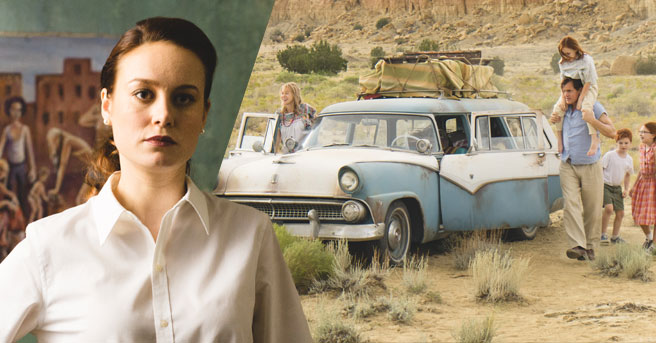
And so “The Glass Castle,” based on the best-selling memoir by Jeannette Walls, begins with Walls, a sophisticated, elegant, and successful New York journalist (Oscar-winner Brie Larson) on her way home in a cab after dinner in an expensive restaurant with her fiance and his prospective client, seeing her parents dumpster diving. They were homeless.

And so, we go back in time to see her as a very young child, telling her mother, Rose Mary (Naomi Watts) she is hungry. “Would you rather me make you some food that will be gone in an hour or finish this painting that will last forever?” It is a rhetorical question. Young Jeannette (Chandler Head) toddles over to the stove to make herself some hot dogs. But her dress catches on fire and she is badly burned.

When her father, Rex (Woody Harrelson) decides to take her out of the hospital, without doctor permission and without paying. At this point, Jeannette is still young enough to believe everything her parents tell her, like “our home goes wherever we go.” Rex, probably self-medicating for undiagnosed bipolar disorder, was immensely brilliant and charismatic. The glass castle of the title was the home he kept promising to build the family, and he spent years drawing plans for it. Rex and Rose Mary were less and less able to maintain any kind of stability at the same time that the children became more and more aware of what they were entitled to expect and unlikely to get. Instead of excitedly making plans for the castle, they began pleading with him to stop drinking. And then, when he could not, they decided to take responsibility for themselves and each other.

Writer/director Destin Daniel Cretton worked with Larson in the outstanding “Short Term 12,” which also had themes of abuse, damage, and resilience. He is especially good here in dealing with the challenge of three different performers, some quite young, portraying Jeannette and her siblings, maintaining consistency as they grow up, but using the cinematography to help convey the journey from their glowing memories of childhood, believing in their parents’ view of the world as beneath them, to the grittier life of deprivation and uncertainty. The spot where the glass castle was supposed to be built literally becomes a garbage dump.

What’s wisest and most significant is that the film becomes more than the story of survival. It is really only when Jeannette stops being afraid to tell the truth about herself that she is able to accept the best of what Rex and Rose Mary brought to her life. As Walls — and Viorst — might agree, necessary losses are worth the pain when they lead to the freedom that only comes from being true about and to yourself.

Parents should know that this film concerns the neglect and abuse of children, parents with substance abuse and mental illness problems. It includes smoking, drinking and drunkenness, domestic abuse, a child burned in a fire, strong language, and a sexual situation.

Family discussion: Why did Jeanette decide to tell her story? What was she grateful for receiving from her parents? If there was a movie about your family, who would you like to play you?

If you like this, try: “Running with Scissors,” “The Prize Winner of Defiance, Ohio” (another real-life story with Woody Harrelson as a father with a drinking problem), and “Infinitely Polar Bear,” and the book by Walls

Related Tags:


Based on a book Based on a true story Coming of age Drama DVD/Blu-Ray Family Issues movie review Movies -- Reviews

Brian Selznick on “Wonderstruck”

Posted on July 28, 2017 at 6:58 pm

For Rogerebert.com, I spoke to author/illustrator Brian Selznick, who has written the screenplay for the film adaptation of his book, Wonderstruck. I was fascinated by his description of casting deaf actors as hearing characters in the silent portion of the movie.

I realized that with a silent section in our movie it gave us the opportunity to hire deaf actors to play hearing characters. Deaf actors were hired all the time in the silent movie era because they were so expressive. They knew how to tell a story without spoken language. And so we used six deaf actors as hearing people. We had these amazing days on the set with hearing actors, deaf actors, sign language interpreters. The rest of the cast, the crew and everybody worked together.

Related Tags:


Based on a book Interview Writers
The Beguiled

The Beguiled

Posted on June 22, 2017 at 5:22 pm

B
Lowest Recommended Age: Mature High Schooler
MPAA Rating: Rated R for some sexuality
Profanity: Mild language
Alcohol/ Drugs: Some alcohol
Violence/ Scariness: War (off-screen), injuries, murder
Diversity Issues: Gender issues
Date Released to Theaters: June 23, 2017
Copyright 2017 Parmount

Writer/director Sofia Coppola has taken a 1971 Clint Eastwood movie about a wounded but manipulative Civil War soldier cared for and disruptive of the staff and students of a small girls’ school and reframed it as a story about the staff and students of a small girls’ school who care for and are disrupted by a wounded Civil War soldier. It is not so much telling the story of the spider and the fly from the perspective of the fly; it is more like telling the story with the women as the spider.

From her first film, “The Virgin Suicides,” through “Marie Antoinette,” “The Bling Ring,” “Lost in Translation,” and “Somewhere,” Sofia Coppola has been transfixed by stories of slender, ethereal young women who are a bit lost in a world created by powerful but inadequate men, and she has done her best to transfix the audience as well. Her next project, “La Traviata,” the story of a consumptive courtesan who turns out to be more noble than the man she loves, is certain to fit this pattern as well.

It is impossible to consider this latest work, a remake of a film directed by and starring two of the most testosteronic filmmakers in movie history, without that context. And that context is increasingly repetitive, with each iteration revealing not only the limits of the individual film but also the lacunae of the previous ones as well. What once seemed intriguing, mysterious, and thoughtful now appears, when the work is viewed as a whole, as superficial. It turns out that what was omitted was not because it was subtle and deep but because she had nothing more to say. While this film touches on issues of war (and warring emotions), it eliminates the slave character played in the first film by Mae Mercer, because there is really no way to do that relationship justice and any attempt to do so would throw the rest of the story off balance.

It is a pity, because she is just so good with the externals. The settings, costumes, music, and performances in her films are always superb, which makes the dispiriting emptiness even more disappointing.

Martha Farnsworth (Nicole Kidman) runs a small boarding school for girls, a retreat precariously close to Civil War battles being fought nearby. When one of the girls is out gathering mushrooms in the woods, she discovers a wounded Union soldier, John McBurney (Colin Farrell) and she brings him back to the school for treatment. Miss Farnsworth is not pleased, but she cannot turn him away. She treats him and tries to keep his presence as a male and an enemy combatant from disrupting the students and her co-teacher, Edwina Dabney (Kirsten Dunst). But he is a novelty and a distraction especially for those who long, perhaps unaware how much, for male attention.

McBurney has a gift for making each female in the house feel that he is what they most want him to be, from the teenager (Elle Fanning) to the widow (Dunst). “I’m grateful to be your prisoner,” he says. At first, he is gracious, unassuming, and charming. But he becomes a more ominous presence, dividing and disrupting the women until they take drastic action.

Kidman and Dunst are outstanding, representing two very different reactions to the intruder. It is precisely presented, even beguiling, but Coppola needs to move on or go deeper.

Parents should know that this film contains peril and violence including war (mostly offscreen), a wounded soldier, an accident, amateur surgery, mutilation, and murder, as well as sexual references and a situation, alcohol, and some strong language.

Family discussion: How did McBurney assess the vulnerabilities of each of the women and girls? How does this version reflect our era in differing from the original?

If you like this, try: the original version with Clint Eastwood

Related Tags:


Based on a book Drama Horror Movies -- format Movies -- Reviews Remake War
Everything, Everything

Everything, Everything

Posted on May 18, 2017 at 5:57 pm

B-
Lowest Recommended Age: Middle School
MPAA Rating: Rated PG-13 for thematic elements and brief sensuality
Alcohol/ Drugs: Medication
Violence/ Scariness: Theme of potentially deadly illness, reference to sad death, domestic abuse
Diversity Issues: None
Date Released to Theaters: May 19, 2017
Copyright Warner Brothers 2017

“Everything, Everything,” based on the novel by Nicola Yoon, is an updated fairy tale about a princess trapped in a castle and the prince who does not exactly rescue her but gives her a reason to rescue herself.

It’s not an enchantment or a curse that keeps her inside. It’s an illness that means any exposure to bacteria or a virus could be fatal. Maddy (Amandla Stenberg, Rue in “The Hunger Games”) cannot remember a time when she was allowed to be outdoors.

Diagnosed at 2 with the immune deficiency SCID, Maddy lives in an irradiated and sterile environment. She has never left her home and has never met anyone other than her doctor mother (Anika Noni Rose), her nurse Carla (Ana de la Reguera), and Carla’s daughter Rosa (Danube R. Hermosillo). She has books, she has an exercise machine, she has 100 identical white t-shirts, and she has an online SCID support group. She and her mother watch movies and play phonetic scrabble. Maddy studies architecture and builds model rooms, placing the figure of an astronaut in each one. This avatar is her opposite. Her world is measured in square feet; the astronaut’s is unlimited.

Maddy stands at the floor-to-ceiling window overlooking the backyard and imagines what it would feel like to stand on grass or feel a breeze of unfiltered air. And she has a seat in the corner of her bedroom overlooking the house next door, which is how she peers down at a new family moving in, a new family with a boy who has a beautiful smile. He is Olly (Nick Robinson of “Kings of Summer”). He draws his phone number on his window opposite her bedroom, and soon they are texting each other, sweetly portrayed as a face-to-face conversation at a table in Maddy’s model diner, with the astronaut looking on. She wears white; he wears black. She says, “When I talk to him, I feel like I’m outside.” But when she talks to him, she wants to go outside. And both of them find their worlds getting less black and white.

The elements of a young teen romantic fantasy are all here, primarily the disapproving parent, the utterly devoted and hunky but not too aggressive young male, adoring and supportive, and the big reason that they cannot get too physical, except maybe one perfect time. In “Twilight,” he was a vampire who could lose control and kill her. Here it’s just his normal human germs. Anyone over the age of 15 may be distracted by impracticalities and plot developments that go from improbable to preposterous, but even people who know that you have to have ID to get on an airplane and money to pay a credit card bill might just enjoy the pleasures of watching Maddy wake up to the world and Olly, through her, wake up to a few of his own.

Parents should know that this film includes risky teen behavior, some strong language, serious illness, and a non-explicit sexual situation.

Family discussion: Did Carla make the right decision? Why does Maddy put an astronaut in her model rooms?

If you like this, try: “My Sister’s Keeper,” “Before I Fall” and “The Fault in Our Stars”

Related Tags:


“Gothika Rule” Based on a book Date movie DVD/Blu-Ray Pick of the Week Illness, Medicine, and Health Care Romance
Diary of a Wimpy Kid: The Long Haul

Diary of a Wimpy Kid: The Long Haul

Posted on May 18, 2017 at 5:15 pm

B-
Lowest Recommended Age: Kindergarten - 3rd Grade
MPAA Rating: Rated PG for some rude humor
Profanity: Schoolyard language
Alcohol/ Drugs: None
Violence/ Scariness: Extended comic peril and violence
Diversity Issues: None
Date Released to Theaters: May 19, 2017
Date Released to DVD: August 7, 2017
Copyright 2017 20th Century Fox

Ah, the family car trip. Often excruciating, frequently tedious, always unforgettable. For this third in the “Wimpy Kid” movie series, based on the wildly popular books by Jeff Kinney, the story moves from the schoolyard to the highway as Greg and the Heffley family leave home for his great-grandmother’s birthday party. The kid actors from the first movie have grown up. Remember, one of the characters was played by Chloe Grace Moretz, recently in “Neighbors 2: Sorority Rising.” And if that doesn’t make you feel old, consider this: the entire cast has been replaced, with “Clueless” star Alicia Silverstone now playing the mom. Tom Everett Scott takes over the dad role from his “That Thing You Do” co-star Steve Zahn.

The Wimpy Kid stories are funny and reassuring for kids and tweens because they can laugh at and with Greg Heffley (now played by Jason Drucker) as he careens from one excruciatingly disgusting encounter to another, many involving human and animal bodily functions and the products thereof. “I like my family and all,” Greg explains, “I’m just not sure we were meant to live together.”

Greg has a dim older brother named Roderick (Charlie Wright), who mistakes the motel safe for a microwave, subjects Greg to an endless stream of demeaning comments, and explains his secret: “I spent years lowering Mom’s and Dad’s expectations.” He has a toddler younger brother who becomes a rage monster without the pacifier Dad has left behind because what better time to wean him than the road trip? Eventually, they will be joined by another passenger, a baby pig, won by the toddler at a county fair.

Along the way, the family encounters filthy motels, a rude bully Greg terms “Beardo,” and the worst horror of all — a Mom-demanded relinquishment of all devices. “This is an unplugged road trip,” she smiles at the boys. “The only connecting we’re going to do is with each other.” She even forces them to listen to dreadful music like — wait for it — the Spice Girls. And Greg has a secret goal. Trying to overcome public humiliation that has gone viral (“Now I’m a meme!”), he is determined to meet and create a video with his gaming idol at a Comic-Con-style gathering just “two inches on the map” from the party.

The kids in the audience, mostly fans of the book series, enjoyed it very much, but adults are likely to find it a very long haul indeed.

Parents should know that this film includes slapstick comic peril and violence (no one hurt), bodily function humor, and some schoolyard language.

Family discussion: Why do the worst parts of the trip make the family feel closer together? What was your favorite road trip with the family and why?

If you like this, try: the other “Wimpy Kid” movies and the books and “Alexander and the Terrible, Horrible, No Good, Very Bad Day”

Related Tags:


Based on a book DVD/Blu-Ray Family Issues Series/Sequel Stories About Kids
THE MOVIE MOM® is a registered trademark of Nell Minow. Use of the mark without express consent from Nell Minow constitutes trademark infringement and unfair competition in violation of federal and state laws. All material © Nell Minow 1995-2025, all rights reserved, and no use or republication is permitted without explicit permission. This site hosts Nell Minow’s Movie Mom® archive, with material that originally appeared on Yahoo! Movies, Beliefnet, and other sources. Much of her new material can be found at Rogerebert.com, Huffington Post, and WheretoWatch. Her books include The Movie Mom’s Guide to Family Movies and 101 Must-See Movie Moments, and she can be heard each week on radio stations across the country.

Website Designed by Max LaZebnik