King Arthur: Legend of the Sword

King Arthur: Legend of the Sword

Posted on May 9, 2017 at 3:13 pm

Copyright 2017 Warner Brothers

Director Guy Ritchie pretty much makes the same movie every time. Even when it is set in Victorian England (“Sherlock Holmes” with Robert Downey, Jr.) or Cold War-era Europe (“The Man from U.N.C.L.E.“), or based on a classic book (“Sherlock” again) or a remake of an Italian comedy (“Swept Away”), it’s really pretty much about corkscrew story-telling with tricked-up juxtapositions of quick cuts and slow motion, and flashbacks and side-cuts for emphasis and illumination. The characters are a motley crew of cheeky lower-class rapscallions taking on the rich and powerful. They range from wildly proficient to borderline incompetent, often damaged but usually pretty good with a quip, assuming you can understand the argot, and with their own kind of honor.

So, why not take that formula and set it in the Middle Ages, featuring some of the most enduring characters in the Western canon? What’s that, you say? Because it’s already been done by Monty Python? But they were using coconuts for horse clop clop, and we have all this lovely lolly for computers and explosions and fight scenes, that’s why! This begins with a riderless horse running from an exploding building and goes on to include a sort of three-headed mermaid octopus, a gigantic snake, and a therapeutic iowaska-style trip. Plus, of course, that sword gets pulled from the stone.

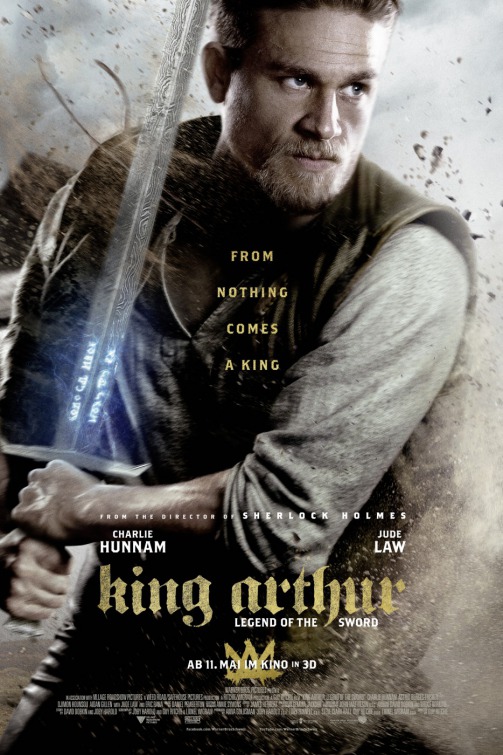
And that is how we come to have the ponderously, if generically, titled “King Arthur: The Legend of the Sword,” pretty far from the essential elements of the Arthurian legend, literally two pie slices short of a round table and no Guinevere or Galahad in sight, but per the title we do get a lot of Excalibur the sword and a bit of Arthur’s dad Uther Pendragon (Eric Bana), plus, as noted, a lot of magic and fights and explosions, plus a very cool monster, all of which are a good bit of fun.

As the story begins, the longtime pact between men and mage (magicians) is coming to an end. Uther is King, but his brother Vortigern (Jude Law, lounging menacingly in what looks like disappated British rock star garb) is so jealous that he will destroy what he loves most to get the throne, unleashing the power of the mage, which in this case includes rampaging giant elephants.

Soon Uther and the queen are dead and young Arthur is sent off in a boat, ending up in a brothel, where we see him grow up in a kaleidoscopic flurry of images that show us that he is (1) very buff (ultimately ending up as Charlie Hunnam), (2) very canny at collecting coins, (3) learning how to fight, and (4) very loyal to his friends, including the prostitutes who raised him.

Arthur’s uncle has become king. He rules with fear, which he considers not a necessary evil but the primary benefit of his position. He says it is intoxicating, that it “takes you completely.” In video game fashion, he can only assume total power if he is able to prevent Uther’s true heir from touching Excalibur to some sort of altar and completes the building of a tower. To find and kill Uther’s son, he requires every man of the right age to try to pull the sword. Thus, Arthur is revealed, though he says and possibly means that he never wanted power.

With the help of his rag tag friends from his days on the street and a mysterious mage (Astrid Bergès-Frisbey), Arthur takes on the king and his army of Blackleg soldiers. But this is exactly the problem; the one thing the audience must have in a fight is a good sense of the stakes and challenges. With magic on Arthur’s side, we never know what is really possible. And psychobabble about his not being able to access the full power of the sword until he is willing to confront his painful memories just sounds silly, in part because Hunnam, a true Ritchie not-so-anti-hero, never seems vulnerable enough to need any additional soul-searching.

It is kinetic, fast, and fun to watch, though the rumored prospect of five more in a projected series has me wishing for a mage to make it stop.

Parents should know that this film includes extended fantasy/action peril and violence, with explosions, swords, fights, arrows, torture, and monsters. Characters are injured and killed, including beloved parents, children, and spouses. There are scenes in a brothel, sexual references, and characters use some strong language, alcohol, and drugs.

Family discussion: Why does Arthur say he never had any desire for power? How do we know when is it time to face painful memories?

If you like this, try: “Excalibur” and “Lock, Stock, and Two Smoking Barrels”

Related Tags:


Action/Adventure Based on a book Epic/Historical Fantasy Remake
The Circle

The Circle

Posted on April 27, 2017 at 11:25 pm

C
Lowest Recommended Age: High School
MPAA Rating: Rated PG-13 for a sexual situation, brief strong language and some thematic elements including drug use
Profanity: Very brief strong language
Alcohol/ Drugs: Alcohol, mention of drug use
Violence/ Scariness: Peril, car accident, sad death, illness
Diversity Issues: None
Date Released to Theaters: April 28, 2017
Date Released to DVD: July 31, 2017

Copyright 2017 STX
Copyright 2017 STX
Show of hands: how many of you listed nine concerts you’ve attended and one you didn’t on Facebook this week? Those lists were as inescapable in April of 2017 as they will be forgotten in May of 2017, except by the clever little bots who now, thanks to new legislation can not only collect all of the information you make available online — they can sell it. So, every bill you pay, app you buy, search you make and much much more will be used to make it possible for corporations to monitor and target you. Those who listed Motley Crue on their concert list will get different ads from those who listed Adele. And maybe that information will be made available to employers or insurers or the IRS or your spouse’s divorce attorney as well. The online world is always a balancing act between super-cool and time-saving functionality and super-creepy intrusiveness.

So “The Circle,” based on the book by Dave Eggers and adapted by Eggers and director James Ponsoldt (“The Spectacular Now,” “The End of the Tour”), imagines a corporation that is like a combination of Google, Facebook, Apple, and Amazon filtered through the dystopian dreams of Edward Snowden and the cultish appeal of, well, pick your favorite charlatan-led cult. Unfortunately, the corporation is more interestingly portrayed here than the characters, and not in a good way. Our heroine is Mae (Emma Watson), a good girl who loves her family and is thrilled to leave her temp job in a drab utility company cubicle to work in the most exciting company in the world, The Circle, on a beautiful and self-contained campus that is part prestige liberal arts college and part Pepperland. She is initially assigned to “customer experience,” where every transaction is immediately rated with either a smile or frown and a numerical score, both instantly transmitted to her supervisor and analyzed by algorithms. The company’s goal is to “make the chaos of the web simple and elegant,” to give customers (some 83 percent of the population) one place for all their needs. That is even more true for the employees, who are not exactly required to rely on the company for all of their personal and social interactions, from support groups (there are two for those like Mae who have a parent with multiple sclerosis) to parties — with live music by Beck — and health care. Those services may be free, but all your data, including biodata are belong to them.

This seems blissful for a while, especially when The Circle generously puts Mae’s parents on the company health plan. But there are VERY CLUNKY harbingers of complications, then problems, then danger. And if by some chance you do not pick up on them, the cardboard-like characters will explain them to you, including one who not only has no reason to be there but has many reasons not to be but is nonetheless there just in case you need someone to warn you about the intrusiveness of this technology. In other words, “The Circle” goes nowhere.

You will probably not need much explanation when Mae agrees to become The Circle’s first fully transparent employee, wearing a webcam (it is on her shirt facing out but somehow is able to broadcast images of her face, a technological challenge even The Circle probably cannot master) 24/7, with timed bathroom breaks, that this is not going to turn out well and that she will carelessly humiliate people she cares about.

The questions posed are important and urgent, and Tom Hanks is superb as the big boss who has mastered Silicon Valley’s faux “don’t be evil,” we just want to make the world a better place post-corporate demeanor and rhetoric. But the last forty minutes it becomes clear that the people behind it have not thought very deeply about those questions, much less the answers, and its complete denial of a character’s moral responsibility for a tragic outcome just makes it all more disconnected and hollow.

Parents should know that this film has very brief strong language, non-explicit sexual situation, some peril including a fatal car accident, illness, alcohol and a reference to drug use.

Family discussion: Would you be willing to be transparent? Does this film change your mind about what you share online?

If you like this, try: “Disconnect” and “Snowden”

Related Tags:


Based on a book Drama DVD/Blu-Ray
The Lost City of Z

The Lost City of Z

Posted on April 20, 2017 at 5:34 pm

B +
Lowest Recommended Age: Middle School
MPAA Rating: Rated PG-13 for violence, disturbing images, brief strong language and some nudity
Profanity: Brief strong language
Alcohol/ Drugs: Alcohol, smoking
Violence/ Scariness: Peril and violence including WWI battles and attacks by indigenous people
Diversity Issues: Class, race, and culture issues a theme of the movie
Date Released to Theaters: April 21, 2017
Date Released to DVD: July 10, 2017
Copyright Amazon Studios 2017

From the early 19th to the early 20th century, the British Empire exemplified a spirit of adventure, devotion to duty, and confidence bordering on hubris that led to extraordinary achievements like the Oxford English Dictionary and the arrogant imposition of colonialism around the world. All of that is in this true story of Percy Fawcett, an officer in the British Army whose eight trips to South America in search of ancient ruins inspired characters in books by H. Rider Haggard and Arthur Conan-Doyle (The Lost World) (both friends of Fawcett’s) and in movies like “Raiders of the Lost Ark.” Basically, if the hero wears khakis as he slashes through the jungle, he owes something to Percy Fawcett.

Writer/director James Gray based the screenplay on the book by David Gann and the letters of Fawcett and his wife, and shaped the story to make it more accessible, turning eight trips into three and reflecting a more contemporary understanding of race and gender. That is notable in Nina Fawcett’s attempt to insist that she should accompany her husband on an expedition and in the treatment of the natives, who are portrayed with dignity and agency, and treated as such by Fawcett.

He also helps us understand the pressures of the era that helped to motivate Fawcett’s journeys. The unlimited opportunities of the uncharted jungle were especially compelling. In addition to giving him the chance to earn money for his family, a major discovery would allow him to return to England in triumph and overcome the disgrace his father had brought to the family name. We first see him outracing his fellow officers, showing us his skill and determination. When he has the opportunity to go to Bolivia to map the country’s boundaries — to protect the British business interests in South America — he does not want to leave his family but he is eager to escape the restrictions of Edwardian social class. “He’s rather unfortunate in his choice of ancestors,” one character sneers.

On the mapping expedition he hears about a place where there are artifacts of a prehistoric civilization and he is determined to find it and come home in triumph. He teams up with the loyal and capable Henry Costin (Robert Pattinson, unrecognizable behind a thick beard).

On his second visit, he brings along a veteran explorer, James Murray (Angus Macfadyen), who had been with Shackleton on his expedition to Antarctica, which turns out to be a very bad decision. But it is also the final proof for Fawcett that class and reputation are not determinative. On the third trip, after Fawcett’s return to military service in WWI, he brings his once-estranged son (Spider-Man Tom Holland) and reaches a new understanding and reconciliation.

Gray ably conveys the curiosity and wonder of the journeys and the passions that impel the adventurers. Pattinson’s performance is especially thoughtful and Hunnam does well, especially in an impassioned speech to the skeptics at the Royal Geographical Society and in showing us how his journeys change his views of himself and his world, perhaps inspiring us to imagine our own.

Parents should know that this film includes extended peril and violence including wartime battle scenes, sad deaths, some graphic and disturbing images, native nudity, brief strong language.

Family discussion: Why did Percy keep returning to his search? What did he learn from his experience with Murray?

If you like this, try: “The Man Who Would be King,” “The Lost World,” “Mountains of the Moon,” and the books by H. Rider Haggard and Arthur Conan-Doyle inspired by Fawcett’s adventures

Related Tags:


Action/Adventure Based on a book Based on a true story Drama DVD/Blu-Ray Pick of the Week Epic/Historical
The Boss Baby

The Boss Baby

Posted on March 30, 2017 at 5:50 pm

B +
Lowest Recommended Age: Kindergarten - 3rd Grade
MPAA Rating: Rated PG for some mild rude humor
Profanity: Some schoolyard language
Alcohol/ Drugs: "Formula" that keeps babies from growing up
Violence/ Scariness: Cartoon-style action peril and violence, no one hurt
Diversity Issues: None
Date Released to Theaters: March 31, 2017
Date Released to DVD: July 25, 2017
Copyright Dreamworks 2017

Yes, sure, babies are adorable and it is wonderful fun to nibble their toes and kiss the backs of their necks. But let’s be honest. They are also tiny tyrants. Who decides when it is time to eat and sleep? It is not the adults in the household. And who is no longer the top priority in the home anymore? The older child! (Let me state for the record that my two younger sisters are lovely people and I couldn’t be luckier to have them as siblings, but those first few months are tough.)

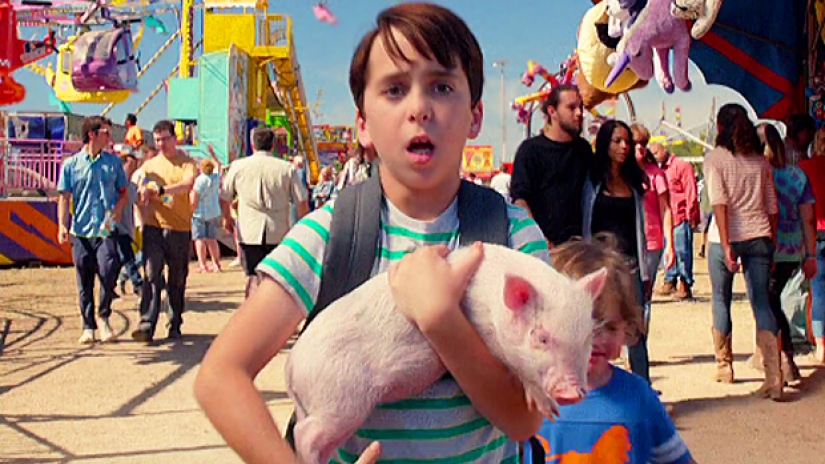
“The Boss Baby,” inspired by the Marla Frazee book, takes these ideas hilariously to the extreme with a baby who is literally the boss.  He arrives complete with suit, tie, Rolex, briefcase, and the ultra-adult voice of Alec Baldwin. This is deeply disturbing for Tim (Miles Bakshi, grandson of animation pioneer Ralph Bakshi), whose previously blissful life of undiluted devotion from his mom (Lisa Kudrow) and dad (Jimmy Kimmel) is destroyed by this demanding creature and it seems that only Tim really understands what a monster he is.

Somehow, Mom and Dad, a sweet couple who both work for a pet food company, can only see the baby’s cute little face and have no idea that the baby is really a spy, even though “if things weren’t to his immediate satisfaction, he had a fit.”  They are so numb from sleep deprivation and so captivated by what looks to them like an infant that they never suspect there is anything unusual going on.  But Tim overhears the Boss Baby talking to his office — and then the Boss Baby blandly tosses some money his way and asks for some sushi: “I’d kill for a spicy tuna roll.”

Once Tim learns that the baby will return to his office after his mission is complete, he and the baby join forces to take on the real villain of the story — I will not spoil his very funny nefarious plan.

Director Tom McGrath says that this film is a tribute and apology to his older brother, because like all younger siblings, he was for a time the “boss baby.”  He gives the story a pleasantly retro look, setting, and soundtrack, evocative of old-school cartoons and an era before everyone was mesmerized by devices. It is surprisingly funny and even more surprisingly sweet. Tim is a great kid, brave, smart, and wonderfully imaginative, and it is nice to see a movie for children that is about something other than following your dreams or learning to be confident. It’s about visceral feelings everyone will recognize — worrying that there is not enough love to go around, jealousy, competitiveness. And it is also about feelings we should recognize but too often overlook: the importance of imagination and the pleasures of being a kid.

NOTE: Stay all the way through the credits for an extra scene!

Parents should know that there is cartoon-style peril and violence along with some potty humor and schoolyard language.  The theme of the movie centers on issues of sibling rivalry.

Family discussion:  Why wasn’t the Boss Baby sent to earth as a regular baby? What are the best and worst parts of having a sibling?

If you like this, try: the “Madagascar” films, from the same director

Related Tags:


Animation Based on a book DVD/Blu-Ray Pick of the Week Scene After the Credits Stories About Kids
The Zookeeper’s Wife

The Zookeeper’s Wife

Posted on March 30, 2017 at 3:47 pm

B +
Lowest Recommended Age: Preschool
MPAA Rating: Rated PG-13 for thematic elements, disturbing images, violence, brief sexuality, nudity and smoking
Profanity: Some strong and bigoted language
Alcohol/ Drugs: Drinking, smoking
Violence/ Scariness: Wartime and holocaust violence involving humans and animals, characters injured and killed, rape of a young girl (off-camera), sexual abuse
Diversity Issues: A theme of the movie
Date Released to Theaters: March 30, 2017
Copyright Scion Films 2017

Jessica Chastain is luminous in the real-life story of Antonina Zabinski, a Warsaw zookeeper, who, with her husband and son, saved the lives of Jews during the Holocaust. Director Niki Caro (“Whale Rider”) brings her love of the natural world and her gift for telling stories of courage and triumph over bigotry to give us a timely reminder that the direst circumstances can inspire the greatest acts of courage and generosity. It also reminds us that there are still new stories to be discovered, even in a period of history that has inspired hundreds of films and thousands of books.

The movie opens on scenes of Edenic paradise. Antonina looks lovingly at her sleeping son — and at the baby lions sleeping beside him. She leans over and holds his foot, but it is the lion cubs she nuzzles. We then see her opening the zoo for the day, riding her bicycle through the magnificent Belle Epoque zoo, with the young camel loping along behind her, lovingly greeting each of the creatures. We will later learn that she is a refugee from Russia, and her childhood hardships left her more willing to trust animals than people. Animals trust her, too. Her skill at “whispering” even the most frightened and frightening wild thing will prove essential once Germany invades Poland.

Antonina is married to Jan (the Belgian actor Johan Heldenbergh), and the zoo is in every way their home. They live on the premises, but it is more than that. There is no distinction between the rooms they live in and the rest of the zoo. Animals wander in and out of the house and Antonina feels that the animals are her treasured guests — that is the term she uses.

And then Germany invades Poland, and the zoo is destroyed. A German zookeeper, Lutz Heck (Daniel Brühl of “Rush” and “Captain America: Civil War”) offers to take the best of the surviving animals to his zoo in Berlin, promising to care for them and return them after the war. Later, as an officer in the German army, he returns to shoot the animals left behind. The Jews of Warsaw are moved into the Warsaw ghetto. Antonina and Jan figure out a way to smuggle some of them out of the ghetto, and soon they are living in underground cages once used to house animals. Once again, Antonina refers to them as her guests, and each night, after the patrol has gone home, she has music and serves food on elegant trays to remind them that there is still civilization in the midst of madness and kindness and courage in the midst of brutality and terror.

It would be easy to mistake the gentleness of Caro’s approach as not sufficiently harrowing to convey the horrors of the Holocaust, especially after the Oscar-winning “Son of Saul.” But that would be wrong. Caro, who made a film about sexual predation in “North Country,” understands that an unwanted touch of a hand or coming a few millimeters too close can feel soul-destroying, especially when it is misunderstood by someone whose trust and respect mean everything. She understands that a drawing, a bunny, a chance to create, a moment of sympathy can begin to heal a ravaged heart, and she presents Antonina’s story with as much grace and humanity as Antonina showed her guests.

Parents should know that this movie takes place during WWII and the Holocaust, and there are disturbing and violent images including scenes of bombing, the Warsaw uprising, and execution of Jews. A young girl is raped (off-screen) and a woman faces a sexual predator. There is some bigoted language and human and animal characters are injured and killed.

Family discussion: How did Antonina’s love of animals help her in taking care of her “guests?” Why was it important to her to treat her “guests” to gracious entertainment in the evenings? What should she have said to her husband about Heck?

If you like this, try: the book by Diane Ackerman

Related Tags:


Based on a book Based on a true story Drama Epic/Historical Movies -- format War
THE MOVIE MOM® is a registered trademark of Nell Minow. Use of the mark without express consent from Nell Minow constitutes trademark infringement and unfair competition in violation of federal and state laws. All material © Nell Minow 1995-2025, all rights reserved, and no use or republication is permitted without explicit permission. This site hosts Nell Minow’s Movie Mom® archive, with material that originally appeared on Yahoo! Movies, Beliefnet, and other sources. Much of her new material can be found at Rogerebert.com, Huffington Post, and WheretoWatch. Her books include The Movie Mom’s Guide to Family Movies and 101 Must-See Movie Moments, and she can be heard each week on radio stations across the country.

Website Designed by Max LaZebnik