
Coming to Netflix: A Series of Unfortunate Events
Posted on December 30, 2016 at 8:00 am
Neil Patrick Harris stars as the evil Count Olaf in the new Netflix series based on the wildly popular books by Lemony Snicket, A Series of Unfortunate Events.
Posted on December 30, 2016 at 8:00 am
Neil Patrick Harris stars as the evil Count Olaf in the new Netflix series based on the wildly popular books by Lemony Snicket, A Series of Unfortunate Events.
Posted on December 18, 2016 at 3:00 pm
My favorite Christmas story is A Christmas Carol by Charles Dickens and I enjoy as many versions as possible every year. I love it in just about any of its movie incarnations. “Bah, humbugs” have been muttered by Scrooges played by top-notch dramatic actors like George C. Scott and Albert Finney, former Miss America Vanessa Williams, former Fonzie Henry Winkler, Jim Carrey, and former “Saturday Night Live” star Bill Murray. I love them all. I’ve love the Tim Curry and Jim Dale audio versions available on Audible.com, both delightful. And I have the book, of course, with wonderful illustrations by Ronald Searle.
Here are my very favorite versions on film and I try to watch each of them every year.
5. “Mickey’s Christmas Carol” Who better to play Scrooge than his namesake Scrooge McDuck? And who better for the part of the unquenchable Bob Cratchit than Mickey Mouse? This compilation DVD includes other Christmas goodies “The Small One” and “Pluto’s Christmas Tree.”
4. “The Muppet Christmas Carol” has the distinguished actor Michael Caine as Scrooge and the equally distinguished Kermit the Frog as Bob Cratchit. Special mention of A Sesame Street Christmas Carol as well, for younger audiences.
3. “Mr. Magoo’s Christmas Carol” The voice talent is outstanding, with Broadway star Jack Cassidy (father of teen idols David and Shaun) as Bob Cratchit and of course Jim Backus as Mr. Magoo, in this version an actor playing the part of Scrooge. The tuneful songs were written by Bob Merrill and Jule Styne, who later went on to write “Funny Girl.” (The legend is that their song “People” was originally written for this movie.)
2. “A Christmas Carol” This MGM classic features the top stars of the 1930’s. Watch for future “Lassie” star June Lockhart as one of the Cratchit children — her real-life father Gene Lockhart played Bob. (He also appears in another Christmas classic, as the judge in “Miracle on 34th Street.”) Reginald Owen plays Scrooge and this one has my favorite Fred, Barry MacKay. I love Dickens’ description of Fred’s laugh: “If you should happen, by any unlikely chance, to know a man more blest in a laugh than Scrooge’s nephew, all I can say is, I should like to know him too. Introduce him to me, and I’ll cultivate his acquaintance.”
1. “A Christmas Carol” This is the all-time best, with the inimitable Alistair Sim as Scrooge. There has never been a more embittered miser or a more jubilant Christmas morning rebirth. When he orders that turkey for the Cratchits and walks into his nephew’s celebration at the end, everything Dickens hoped for from his story is brought to life.
Posted on November 17, 2016 at 5:56 pm
A-| Lowest Recommended Age: | Middle School |
| MPAA Rating: | Rated PG-13 for some fantasy action violence |
| Profanity: | Some mild language |
| Alcohol/ Drugs: | None |
| Violence/ Scariness: | Extended fantasy peril and violence, some disturbing images and scary creatures |
| Diversity Issues: | None |
| Date Released to Theaters: | November 18, 2016 |
| Date Released to DVD: | March 27, 2017 |
| Amazon.com ASIN: | B01LTHOAGM |
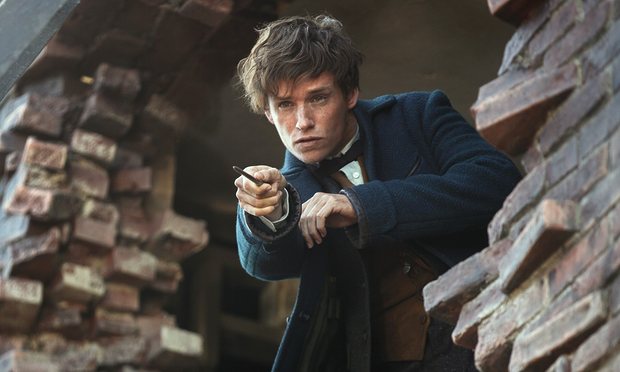
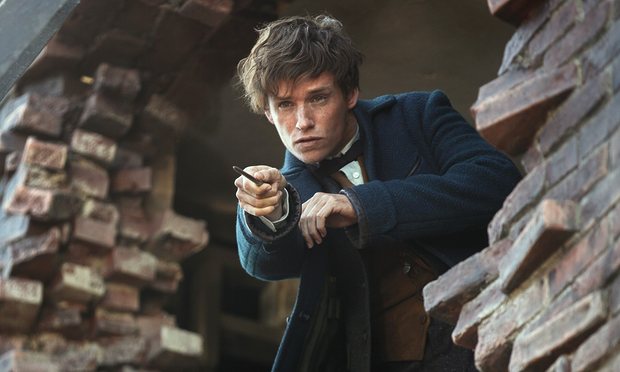
It is so good to be back in the Potterverse again.
This first of an expected five film series is true to the spirit of the world of Harry Potter; indeed, it is the first film with a screenplay from J.K. Rowling herself. But it departs from the Potter films in significant ways: it is the first story to be set in the past and the first to be set outside the UK. It takes place in 1920’s New York City.
It is also the first to center on adult characters, though a teenager and a child have featured roles. It has the best of both the familiar and the new, thanks to the experienced eye of director David Yates, who also directed the last four Potter films) and the score from James Newton Howard, echoing the Potter film’s theme.
Eddie Redmayne (“The Theory of Everything” and “The Danish Girl”) plays Newt Scamander, a shy wizard who arrives on Ellis Island with a briefcase that has some thrilling magical attributes. There’s a handy switch to make its contents muggle-worthy (though, as he will learn, in the US muggles are referred to as “no-majs,” pronounced no-maszh). It can contain many different kinds of fantastic beasts. And it is a portal to a sort of animal sanctuary Newt maintains for his beloved creatures, all of which will escape at least once to create chaos or save the day, sometimes both at once.
He arrives just as a group called Second Salem vows to eliminate anyone performing magic. The leader is a fervently fanatic woman named Mary Lou (Samantha Morton), who abuses her adopted children, especially her teenage son Credence (Ezra Miller, soon to be DC’s Flash on the big screen).
So MCUSA (pronounced mc-kusa), the Magical Congress of the United States of America, led by Seraphina Pickery (Carmen Ejogo) is especially concerned about doing anything that would bring them to the attention of the no-majs in any way, much less make them think that the wizards and witches are dangerous. And a rogue wizard named Grindelwald has been creating mayhem in both the wizard and muggle worlds.
Newt meets a no-maj, an amiable would-be baker named Jake Kowalski (a warm-hearted performance from Tony winner Dan Fogler) carrying a very similar-looking briefcase just as one of the fantastic beasts escapes from his own. The creature, who looks a bit like a duck-billed platypus, has an inconvenient habit of grabbing anything shiny or sparkly. By the time Newt has retrieved him, Jake has seen too much and is about to have his memory wiped when a variety of other mix-ups and adventures take him deeper into the world of magic. Soon, Jake and Newt team up, aided by a disgraced MCUSA investigator named Tina Goldstein (Katherine Waterston of “Inherent Vice”) and her mind-reading sister, Queenie (charmingly magnetic Alison Sudol, channeling Carole Lombard).
Newt is an utterly engaging character, a bit shy and tentative, but somehow we are not surprised to learn that he was expelled from Hogwarts — or that it was over the objection of a young faculty member named Dumbledore. As with all of the Potterverse films, the production design is enchanting, even the no-mag areas. The old-time New York settings, including a variation on a speakeasy, are gorgeously realized, with a depth of imaginative detail that makes us want to hit a pause button. The creatures range from grotesque to magnificent, and Newt’s constant affection for them all (like Hagrid) is endearing. The big confrontation has some real emotional heft, and Rowling keeps one of her best surprises to the end.
When is the next chapter coming? I’m ready! At least, after I watch this one a few more times.
Parents should know that this film includes extended fantasy peril, action, and violence, characters injured and killed, some disturbing images and scary creatures, and brief bodily function humor.
Family discussion: Which is your favorite creature? Why does Newt think that people find him annoying?
If you like this, try: the Harry Potter books and movies and “Labyrinth”
Posted on October 27, 2016 at 5:10 pm

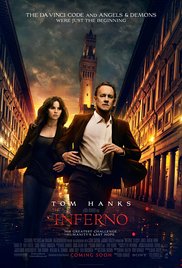
Dashing, globe-trotting symbology professor Robert Langdon (Tom Hanks) doesn’t work any harder at trying to prevent a global pandemic than Hanks and director Ron Howard work at trying to make the Dan Brown book into a movie. You can guess how Langdon’s effort works out. I’m here to tell you that the movie does not. Not even close.
Langdon wakes up, disoriented and with a gash on his head. As far as he remembers, he is still at Harvard but somehow he sees Florence out the window. He has no recollection of the past few days and the doctor (Felicity Jones) explains that he has temporary retrograde amnesia. Her name is Sienna. Conveniently, she speaks English — she is English — and several other languages, and even more conveniently she is a fan of his work because she “likes puzzles.” She attended one of his lectures when she was nine years old and has read all of his books with such devotion that she even mentions there is one she didn’t like much.
When an assassin dressed as a police officer starts shooting at them, Sienna grabs Robert and brings him, still in his hospital gown, to her apartment. Pretty soon, they are both on the trail of a puzzle that leads to an impending release of a virus that while wipe out 80 percent of humanity, put in place by a crazed zillionaire who had some very strong feelings about the problems of over-population, and who fell to his death in the prologue, but not before warning darkly that “Humanity is the disease; Inferno is the cure.”
Robert, still groggy, has to figure out how to stop release of the virus. But the clues are simply that that puzzling or interesting. Unlike The Da Vinci Code, where Brown put together a clever and intricate series of clues based on authentic history and art, this one is little more than chase scenes in iconic locations, alternating with yawn-inducing scenes people barking kill orders into headsets and staring intently into monitors.
We also get drearily Delphic pronouncements like “the truth can be glimpsed only through the eyes of death” and somber almost-adages like “the greatest sins in human history have been committed in the name of love,” squinting at Renaissance frescos, a mysterious group with the PAC-like name The Command Risk Consortium (“We are not the government; we get things done”), a stolen death mask of “Inferno” poet Dante Alighieri, and an absurd pause for a chat about missed chances and regret. Irrfan Khan provides an all-too-brief bright spot, and I would happily see an entire movie about his crisp and unflappable character. As for the rest, one action scene is underwater, but the rest of it drags so much it feels like it might be, too.
Parents should know that this film includes fantasy/action style violence with grotesque and disturbing images, theme of global pandemic, chases and extended peril with characters injured and killed, suicide, betrayal, some strong and crude language, and a sexual situation.
Family discussion: Who is doing the most to address the problems of over-population? Why is Dante especially appropriate for this story?
If you like this, try: “The Da Vinci Code”

Posted on October 20, 2016 at 5:47 pm
C| Lowest Recommended Age: | Mature High Schooler |
| MPAA Rating: | Rated R for some strong sexual material, language and brief violent images |
| Profanity: | Very explicit and strong language |
| Alcohol/ Drugs: | Alcohol, drugs |
| Violence/ Scariness: | Mostly offscreen violence including riots, domestic terrorism, characters injured and killed |
| Diversity Issues: | Reflects the biases of its era |
| Date Released to Theaters: | October 21, 2016 |
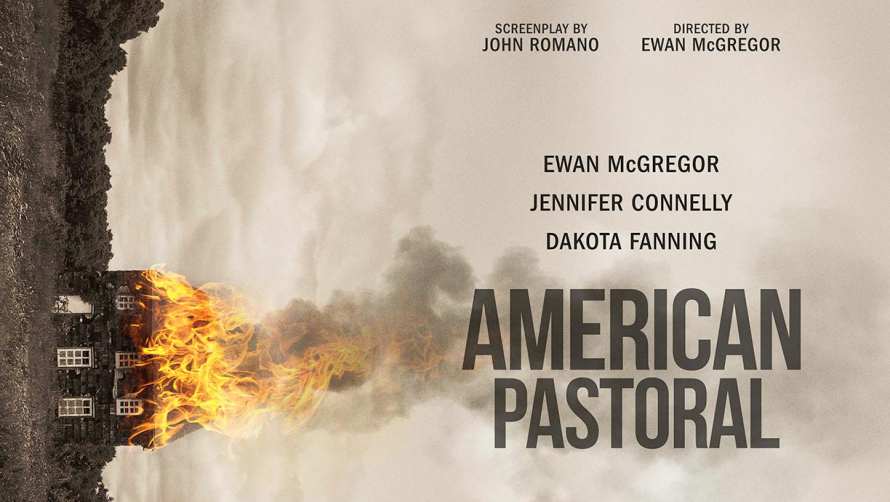
The first is the timing. The book was published in 1997, the first of Roth’s American trilogy, and it described the contemporary experience of people who had raised children in post WWII era of peace and prosperity, believing that they had given their children everything they were denied growing up during the Depression and war years, only to find that they raised a generation of angry teenagers who rejected the gifts they had been so proud to present. The dismay they felt is presented in the book as evidence of nobility of spirit; today, in the midst of another era of political polarization and resentment of the first generation as powerful a demographic as the baby boomers, it is difficult to see it as anything other than representing white male privilege.
The second is the inherent challenge of any adaptation of a work of fiction. It is impossible to replicate the experience of a novel, and this one, which depends so entirely on its voice, loses a great deal of its power in the translation to a visual medium. The framing story, with Roth representative Nathan Zuckerman (David Strathairn) attending a reunion and hearing the story that will become the movie from an old friend, is entirely superfluous, missing the essential focus of the book on the limits to our ability to understand the lives of others, even those we think we understand. Zuckerman helpfully sums it up for us: “It’s getting them wrong that is living, getting them wrong and wrong and wrong and then, on careful consideration, getting them wrong again. That’s how we know we’re alive: we’re wrong.”
Zuckerman hears the story of “Swede” Luvov, the kind of golden boy that every high school has to have, the one who is effortlessly good at everything and so nice that you can’t even hate him for it. Swede was a superb athlete and young enough that he was drafted into the army near the end of WWII and just missed action. He returned to a hero’s welcome and married a beauty queen named Dawn (Jennifer Connelly), with the grudging approval of his parents because she was not Jewish.
And then he has the perfect life that his personal grace and talent and respect should earn. He and Dawn move to a house in the country and have cows. He takes over his father’s business, a glove factory, where they produce fine leather goods and treat their workers — mostly African Americans — well. He and Dawn have a beautiful blonde daughter named Merry and she loves them and their bucolic, pastoral life. Everything makes sense.
And then nothing makes sense. Merry (now played by Dakota Fanning) becomes an angry teenager and is enthralled by the protesters against the Vietnam War (and the patriarchy, and pretty much everything else her parents represent). She bitterly accuses: “You’re just contented middle class people.” He helplessly replies, “Some people would be happy to have contented middle class parents.”
She disappears after a post office is bombed. Swede and Dawn are devastated. He cannot stop looking for her. Dawn has a breakdown.
They all try their best, but the result is static and off-key. We are supposed to admire Swede’s decency, but the movie is slanted so precipitously in his favor that even McGregor’s palpable sincerity cannot obscure the film’s smug misogyny. The men are decent, sympathetic, patient, and virtuous. Most of the women are needy, unstable, and sexually provocative. As a child Merry asks for a kiss on the lips and then confesses that she always goes too far. These women should be happy with whatever the men want to give them. They mostly exist merely to disappoint or betray the men in their lives, and sometimes the other women, too.
Or, they are one-dimensional saints. Samantha Mathis (good to see her as always) has a brief scene as a member of the community who is philosophical after a devastating loss. Vicky (“Orange is the New Black’s” Uzo Aduba) is Swede’s top manager in the glove factory. Though Aduba is excellent, the role is limited to a bland loyal subordinate.
When there are riots outside the factory following the murder of Martin Luther King, Vicky helps Swede hang a banner out of the window that reads: Negroes Work Here. Instead of Zuckerman’s meditation on how the people who spend so much of your life envying end up having less enviable lives than your superficial, incurious assessment contemplated, it would have been much more telling to explore the world of a man who thinks that employing African Americans in a glove factory should protect him from the consequences of the system that has for so long tilted in his favor.
Parents should know that this movie includes very explicit sexual references and situations, very strong language, domestic terrorism and murder, riots, alcohol, and drugs.
Family discussion: What do we learn from the framing story at the reunion? What should Merry’s parents have done differently, either before or after the bombing?
If you like this, try: “Goodbye Columbus,” “The Human Stain,” and “Indignation,” also based on books by Philip Roth