Trailer: Roald Dahl’s “The BFG”

Trailer: Roald Dahl’s “The BFG”

Posted on December 12, 2015 at 8:00 am

Roald Dahl’s book about The BFG (big friendly giant) is coming to theaters, directed by Steven Spielberg and with a script from “E.T” screenwriter Melissa Mathison. (It has a bit of an “E.T.” feel to it, don’t you think?)

Related Tags:


Based on a book Fantasy Trailers, Previews, and Clips
The Big Short

The Big Short

Posted on December 10, 2015 at 6:16 pm

A
Lowest Recommended Age: High School
MPAA Rating: Rated R for pervasive language and some sexuality/nudity
Profanity: Constant very strong and crude language
Alcohol/ Drugs: Drinking, smoking
Violence/ Scariness: Fraud, corruption, economic upheavals
Diversity Issues: None
Date Released to Theaters: December 11, 2015
Date Released to DVD: March 15, 2016
Amazon.com ASIN: B0177ZM3LO
Copyright 2015 Plan B Entertainment

Director Adam McKay is so obsessed with the 2008 financial meltdown that he inserted a series of charts and graphs and statistics about it over the closing credits of the silly buddy-cop comedy, The Other Guys. Yes, there was a villain played by Steve Coogan who was up to some financial jiggery pokery, but only the most careful viewers of that film could have deduced that what McKay, best known for raunchy Will Ferrell slob comedies, secretly yearned for, as Michael Caine might say, was to blow the bloody doors off the Wall Street bankers who treated the American economy like a bull treats a china shop.

We’ve had sober documentaries like The Flaw and Oscar-winner Inside Job and the superb drama Margin Call, all outstanding, insightful, and illuminating and essential companion pieces to this movie. But “The Big Short” has several advantages in telling the story. First, by giving us someone to root for, however imperfect the heroes of this story are, it keeps us emotionally connected to the story. Second, because it is in most respects a comedy, McKay has a wider range of tricks on hand to make us understand what happened. This fierce, fiery rant of a film is going to make you understand that the people we entrusted with our economic stability were truly despicable and truly stupid. It is funny and infuriating and then funny again and then, when he tells you that the bad guys went to jail and the big banks were broken up — no, just kidding, they weren’t — it is monumentally infuriating.

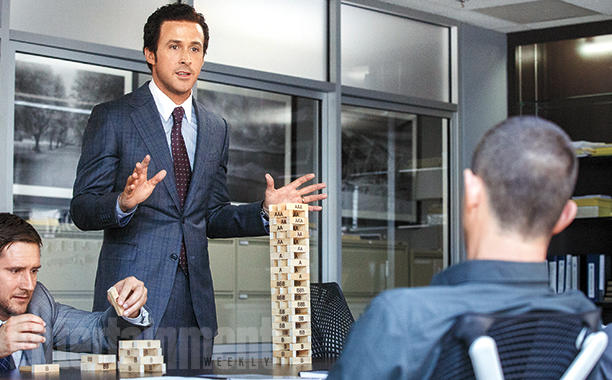
I’ll add a footnote below to give my own very short explanation of what happened.* (And one thing they got wrong.** Pretty much everything else is literally right on the money.) Or, you could listen to Margot Robbie talk you through it, as she sips champagne in a bubble bath. Yes, McKay knows what gets people’s attention and he uses Robbie and other celebrities to come in and explain the parts that the bankers intentionally did their best to obfuscate, using words guaranteed to put everyone to sleep so they could pick our pockets a little while longer. Ryan Gosling also serves as a guide, playing a real-life insider who saw that the mortgage-backed securities were going to tumble down like a Jenga tower.

The real-life acronym used by the bankers during this period was IBGYBG, which stood for “I’ll be gone; you’ll be gone,” meaning that if they could just keep passing the hot potato of economic Armageddon going around the circle a couple more times to collect the fees, they could get out before it all came tumbling down. And many of them did. As Michael Lewis notes in the the book that inspired this film (subtitled The Doomsday Machine), and, if you don’t remember anything else, remember this: the heroes of his book, the small group that bet against the bankers, made fortunes. But so did the people who lost that bet. Everyone on both sides of these deals made a lot of money. Everyone else across the country lost a lot of money, jobs, and homes.

As noted, Lewis’ book and McKay’s movie (the Oscar-winning script is co-written with Charles Randolph of the underrated “Love and Other Drugs”) wisely allow us to enter the story via the scrappy little group of misfit toys who figure out that the game is cooked, that it can’t stay that way, and that there has to be a way to bet against the other side. This grown-up Bad News Bears bunch (two of them barely qualifying as grown-ups) have a couple of things going for them. First, they are skeptics. Actually, they are cynics. They assume everyone is lying to them and just about everyone is cheating them. Michael Burry (Christian Bale), who insists on being called Dr. Michael Burry (he’s a neurologist-turned investment manager) and Mark Baum (Steve Carell) are both men who were already inclined to be skeptics and then faced terrible pain and loss that disabused them of the sense that life was fair. Jamie Shipley (Finn Wittrock) and Charlie Geller (John Magaro), two young partners literally running an investment firm out of a garage, had made almost $30 million finding unseen risks but were so naive about Wall Street that they did not know what the requirements were for being able to trade as an institution and not as an individual. These guys were all outsiders. (All names are fictional except for Burry.)

The second thing they had going for them was that they were not just willing to do their homework; they insisted on it. While the money gusher was going, no one else wanted to check the math (and no one was getting paid to do so). But, in some of the most entertaining moments of this riotously entertaining film, these guys who did not believe what they were told, went to check it out. Burry unpacked the securities to examine each of the hundreds of mortgages they contained to see if they were as secure as promised. They were not. Baum’s colleagues (Rafe Spall and Hamish Linklater) went to Florida to see the homes that were mortgaged. They were abandoned. Baum’s guys spoke to the mortgage brokers who happily explained that they preferred to give mortgages to people who had no possible means of paying them. (Max Greenfield is superbly sleazy in this role.) “They’re not confessing,” one of Baum’s partners says in amazement. “They’re bragging.”

By the time a stripper explains to Baum that she has mortgages on five houses and a condo and has been assured she can refinance when her adjustable rate jumps up, he begins to see the potential in betting that these securities will fall as people like this cannot pay the mortgages. When he goes to a convention of financial types working in this field (Byron Mann is almost deliciously corrupt as the arrogant and ethically vacant Mr. Chau), he knows he is right.

At the same convention, Shipley and Geller are jubilant when they are able to make a big bet against the bankers. And then they get a reality reminder from their their mentor, played by co-producer Brad Pitt. He could not take the corruption of Wall Street any more and left for a life somewhere between disaster prepper and artisanal farmer, wearing a face mask when he goes to town and urging everyone to get colonics. He met the young investor when they were walking their dogs. He reminds Shipley and Geller not to be so happy. When they win big, it will be because the economy is collapsing, causing real, devastating pain.

This is an outstanding film, with sensational performances by a brilliant ensemble cast. It is one of the best of the year and the most important as well.

Parents should know that this film includes constant very strong and crude language, vulgar sexual references, strippers, nudity, and extreme widespread fraud and corruption.

Family discussion: What made just these men able to see what so many other people did not? How did they verify their analysis? Will it happen again?

If you like this, try: the book by Michael Lewis and documentaries about the financial meltdown including “The Flaw” and “Inside Job” as well as feature films “99 Homes” and “Margin Call”

*Here’s what happened, without the jargon or the bubble bath. As you see at the beginning of the movie, Lewis Ranieri, now one of the wealthiest people in the world, came up with the idea of essentially crowd-funding mortgages. He took lots and lots of mortgages, bundled them into bonds, and let big institutional investors, like pension funds, buy them. It was a great investment for them because pension funds need a safe and secure source of income to pay retirees and these were safe and secure — much more than stocks — because people almost never defaulted on their mortgages and because so many mortgages were bundled up together that even if some did default it would have almost no impact. These bundles of mortgages were so popular that the banks ran out of safe and secure mortgages to put into bonds. And so, they started pushing mortgage brokers to issue more mortgages, and that meant giving mortgages to people who would not otherwise have qualified. (Some people will tell you that the government was at fault for pushing home ownership on people who could not afford it. They are wrong. Most of the pressure was coming from people who wanted to buy mortgages, not people who wanted to buy houses.) So, the formerly safe and secure bonds started filling up with less and less safe and secure mortgages. And the people responsible for differentiating the risk of the bonds, including the rating agencies, decided to just keep rating and selling the new, less secure securities as though they were exactly the same as the earlier ones. All of the “formulas” (sometimes called “algorithms” or “models”) used to justify this were bunk. Imagine it this way: there’s a vineyard that makes superior wine that everyone wants to buy and there are strong legal and economic incentives to buy it. But you only have so many grapes, so you start watering it down, still selling it at the same price, and getting the people who rate wine to continue to give it the same rating. Then you run out of water so you start blending it with turpentine, and all of your projections show that it is just as good and will still sell just as well so you price it that way and assume there is no risk.

Here’s the important part: everyone at every part of this conveyer belt of increasingly risky securities all being treated as though they were not risky was being paid based on the number of transactions, not the quality of the transactions, a sort of very big, very expensive game of tag, where there was never any “it” until finally “it” was everyone.

**Actually, because of the immense lobbying power of the bankers (see 13 Bankers: The Wall Street Takeover and the Next Financial Meltdown) the SEC had no authority to regulate these mortgage-backed securities. The agency that should have had jurisdiction was the Commodities Futures Trading Commission. When then-Chairman Brooksley Born suggested that they might look into some kind of oversight, Congress and the then-Treasury Secretary made sure she could not. Also, there are post-employment restrictions that prevent SEC staff from going to work for the people they supervise.

Related Tags:


Based on a book Based on a true story Comedy Drama DVD/Blu-Ray Pick of the Week Satire
In the Heart of the Sea

In the Heart of the Sea

Posted on December 10, 2015 at 5:36 pm

Copyright 2015 Village Roadshow

Herman Melville’s Moby Dick is a brilliant novel about humanity, nature, obsession, power, and pretty much everything else, with a lot of technical information about whaling thrown in for good measure and metaphor. Nathaniel Philbrick’s acclaimed book about the tragic real-life whaling expedition that inspired Melville to write Moby Dick is In the Heart of the Sea: The Tragedy of the Whaleship Essex. This film is director Ron Howard’s uneven attempt to give that story the mythic force of Melville’s tale (itself never adequately adapted for film).
Like Moby Dick, this is a story of man against nature, not just the powerful animals man tries to trap and kill but of man against the animalistic elements of his own nature. That is represented, as it so often is, by the conflict between two men. The captain of the Essex is George Pollard (Benjamin Walker). He and everyone on the shop know that he is captain only because he comes from a high-born shipping family. The first mate is Owen Chase (Chris Hemsworth, with his “Rush” director), resentful of Pollard because he was promised the captain job and knows he is more qualified.

On the first night out, Pollard makes a point of cruelly describing Chase’s father’s time in prison to establish his superiority — and his willingness to use humiliation as a management tactic. In his desperation to establish his superiority, he does not realize that it makes him look thuggish and scared. It certainly does not inspire respect or loyalty. But Chase is determined to make it work. This time, if he meets his quota, he has it in writing that his next voyage will be as captain.

The whalers are under enormous pressure. Whale oil powers the world of the 1820’s (there is a clumsy hint that the world may be shifting to fossil fuels). Whaling ships go to sea for years at a time, traveling across the Atlantic to kill whales, extract the blubber, and melt it down.

Ships — whether on water or in space — are ideal settings for stories because they are isolated from the society at large. Everything is heightened because there is no way to leave and no recourse for support or appeal. But that intensity and drama is dissipated here with a useless framing story as author Melville (Ben Whishaw) tries to get the ship’s only survivor (Brendan Gleeson) to tell him what happened. The connection is awkwardly positioned against Moby Dick‘s narrative voice and unforgettable Job-like status as the sole survivor who can carry the story and the survivor character’s sympathetic wife is a distraction and her scenes suggest after-the-fact re-shoots.

Melville was wise to reshape the story. This version has gorgeous scenery, a moving score by Roque Banos, and superb special effects, but the power of the images is undercut by a story that tries to carry more meaning than it can hold.

Parents should know that this is a whaling saga with constant and intense peril and violence including fire, guns, storms, starvation, murder, cannibalism, and sinking ship, many characters injured and killed, brief strong language, and drinking and alcoholism.

Family discussion: Why did Pollard embarrass Chase on the first night out? What were the biggest differences between Pollard and Chase in the way they treated the men? Do you agree with Chase’s “abominable” decision?

If you like this, try: “The Perfect Storm” and Melville’s Moby Dick

Related Tags:


Action/Adventure Based on a book Based on a true story
Brooklyn

Brooklyn

Posted on November 25, 2015 at 5:22 pm

Copyright 20th Century Fox 2015

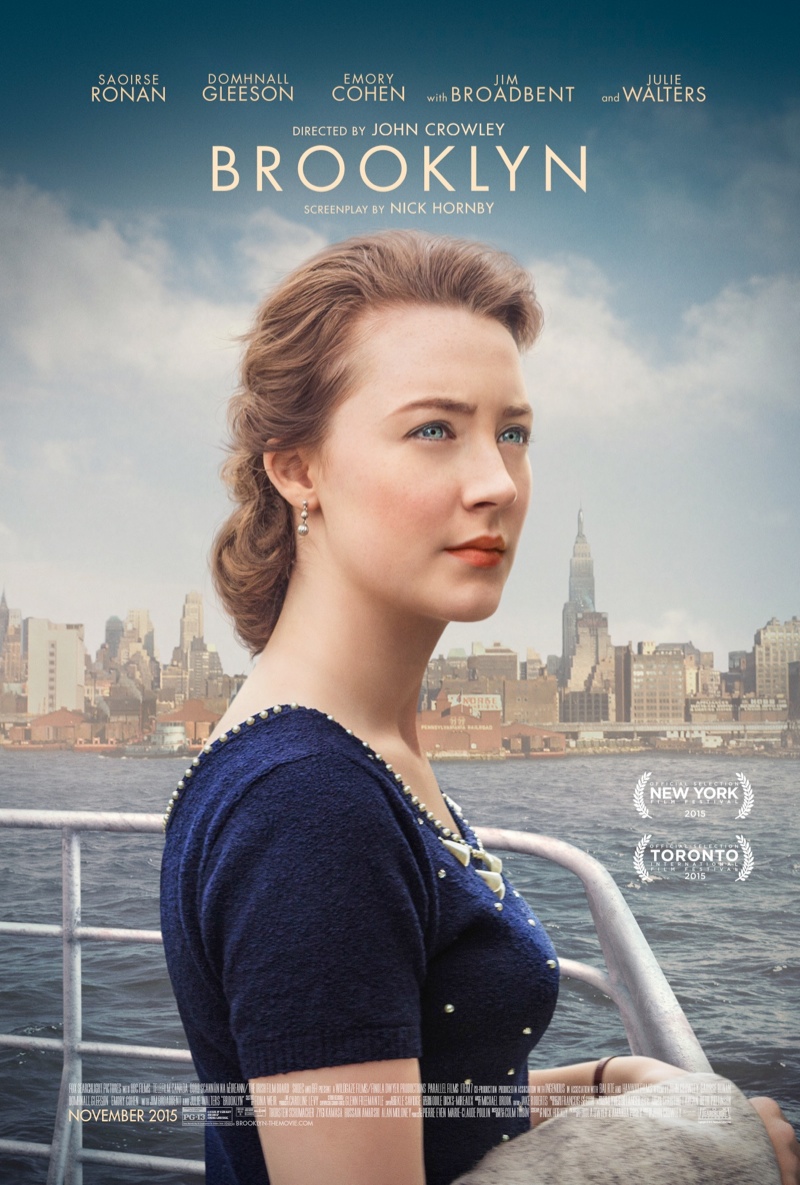
“Brooklyn,” based on the book by Colm Tóibín, is exquisitely lyrical, the story of a young woman who immigrates from Ireland to New York in 1952. She is sad, homesick, and lonely at first, then just as she begins to feel at home she is called back to Ireland.

Movies can show us monsters and aliens and explosions but none of that will ever have the quiet power of Saoirse Ronan in close-up. The breathtaking intimacy of being so close to her face, her sky-blue eyes, the lift of her chin, is a story in itself. For once, the Irish-raised actress is using her own accent, and the lilt of it is pure and poetic.

She plays Eilis (pronounced EYE-lish), who lives with her mother and sister Rose in a small town. Rose has helped her make arrangements with a priest in New York (Jim Broadbent) for an apartment and a job. Eilis loves her family. But she is stuck in a part-time job working for a shrew in a grocery store. Ireland in the post-WWII years has little to offer her by way of love or work. And so she takes a voyage. The reason she is the only one at dinner the first night out is revealed when she gets very, very sick. But a sympathetic roommate helps her through and advises her about how to pass muster at Ellis Island — to act like an American, which means looking confident.

Eilis moves into an all-Irish boarding house, owned by the formidable Mrs. Keough (Julie Walters), a sharp-eyed but not unkind woman who can tell the difference between the simpering giggles of the other girls and the shy but steady Eilis. Soon Eilis is working at a department store, where the complexities of the transactions (payment sent to a central location via vacuum tube) and inventory are not as challenging as learning to chat pleasantly with the customers. It is an amusing change from the store in Ireland, where the owner barked at someone for wanting shoe polish on a Sunday, and “Mad Men’s” Jessica Paré is excellent as the manager.

Eilis slowly begins to feel at home.  Ronan’s performance is precise and sensitive.  She shows, not tells us how Eilis begins to bloom through taking some bookkeeping classes and meeting a nice guy, an Italian boy named Tony (the piercingly sweet Emory Cohen).  There is believable magic in their sweetly developing relationship.

And then, there is a tragedy at home and Eilis has to go back to Ireland.  But is that her home anymore?  Can she fit into her old place?  Does she want to?

Director John Crowley is a careful observer, and every moment rewards careful observation from us.  A yawn in church.  The faces of the people at the dock saying goodbye to their emigrating family members.  The look on Eilis’ face as she struggles to tell Tony how she feels — it is a wonder, and one of the year’s best films.

Parents should know that this film includes a non-explicit sexual situation, sexual references, some strong language, and a sad death.

Family discussion: Did Eilis make the right choice? Why or why not? Who was most helpful to her?

If you like this, try: “In America,” another story of Irish immigrants in New York

Related Tags:


Based on a book Date movie Drama Romance
Carol

Carol

Posted on November 24, 2015 at 5:54 pm

Copyright 2015 Weinstein Company

The most romantic movie of the year is “Carol,” based on a novel by Patricia Highsmith, the author of Strangers on a Train and The Talented Mr. Ripley. But Carol, her second novel, was originally published under another title and under another name. It was semi-autobiographical, it was the story of a lesbian relationship, and, unlike the rest of the very limited literature about lesbians at the time, it was not a tragic story. It was almost four decades before Highsmith acknowledged that she was the author.

There is some irony, then, in the idea that this film, depicting a story that was so controversial in the repressed “love that dare not speak its name” mid-century time when it was written is for that very reason ideally suited to depict a romance that is so rich and resonant. Now, when writers complain about how difficult it is to come up with believable ways to keep their characters from having sex in the first act (Stephenie Meyer had to make her male character a vampire for that reason in the Twilight series), making this love affair doubly forbidden by making the couple both women in the conformist 1950’s is the ultimate depiction of the anxious giddiness of being on the brink of falling in love.

The longing. The hesitation. The ecstasy of feeling seen. The harrowing insecurity of feeling seen. The exquisite torture of it all.

This is all gorgeously portrayed in every detail on the screen. Director Todd Haynes, working with an outstanding team of designers and director of photography Edward Lachman tells the story with each setting and camera angle and the flawless performances of the two lead actors, Cate Blanchett in the title role as a wealthy woman in the midst of a divorce and Rooney Mara as Therese, a young shopgirl and would-be photographer.

The intricacy, the precision, and the delicacy of the storytelling allows us to experience the relationship along with the two women. It wisely avoids the usual lazy shortcuts to indicate attraction: the “You love this obscure thing? I love the same obscure thing!” conversation or the montage over a pop song. Instead, the conversational topics are mundane and the responses are not especially witty or incisive. But what we see is that they are good enough for Therese and Carol, and that pulls us in.

Haynes skillfully makes sure that the relationship never seems predatory, even though Carol is older, sophisticated, and wealthy and Therese is young, inexperienced, and vulnerable. Therese herself admits she is so unsure of herself she can hardly figure out what to order for lunch. Haynes and his stars never allow the relationship to seem anything but equally chosen. Even a scene where Carol tries out some make-up on Therese avoids the usual “makeover” trope. When she tells Therese to touch the perfume to her pulse points, we can feel both sets of pulses flutter. The dialogue is often oblique, but its meaning is always true-hearted.

Parents should know that this film includes sexual references and an explicit situation, nudity, some strong language, drinking, smoking, and discussions of divorce, adultery, and custody.

Family discussion: What do we learn from the questions Therese asked Richard? How does this movie illustrate what one character calls the difference between what people say and what they really feel?

If you like this, try: “Far from Heaven” and “Strangers on a Train”

Related Tags:


Based on a book GLBTQ and Diversity Romance
THE MOVIE MOM® is a registered trademark of Nell Minow. Use of the mark without express consent from Nell Minow constitutes trademark infringement and unfair competition in violation of federal and state laws. All material © Nell Minow 1995-2026, all rights reserved, and no use or republication is permitted without explicit permission. This site hosts Nell Minow’s Movie Mom® archive, with material that originally appeared on Yahoo! Movies, Beliefnet, and other sources. Much of her new material can be found at Rogerebert.com, Huffington Post, and WheretoWatch. Her books include The Movie Mom’s Guide to Family Movies and 101 Must-See Movie Moments, and she can be heard each week on radio stations across the country.

Website Designed by Max LaZebnik