
Brooklyn

Brooklyn

Posted on November 25, 2015 at 5:22 pm

Copyright 20th Century Fox 2015

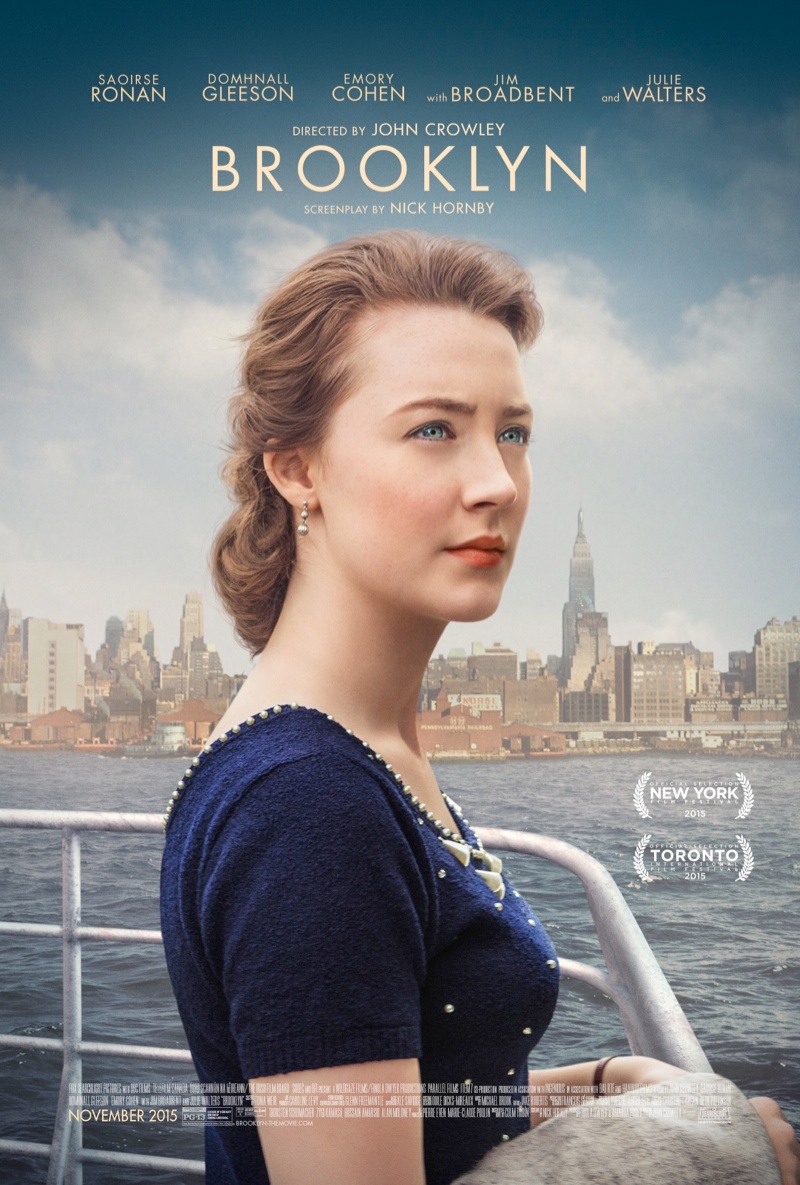
“Brooklyn,” based on the book by Colm Tóibín, is exquisitely lyrical, the story of a young woman who immigrates from Ireland to New York in 1952. She is sad, homesick, and lonely at first, then just as she begins to feel at home she is called back to Ireland.

Movies can show us monsters and aliens and explosions but none of that will ever have the quiet power of Saoirse Ronan in close-up. The breathtaking intimacy of being so close to her face, her sky-blue eyes, the lift of her chin, is a story in itself. For once, the Irish-raised actress is using her own accent, and the lilt of it is pure and poetic.

She plays Eilis (pronounced EYE-lish), who lives with her mother and sister Rose in a small town. Rose has helped her make arrangements with a priest in New York (Jim Broadbent) for an apartment and a job. Eilis loves her family. But she is stuck in a part-time job working for a shrew in a grocery store. Ireland in the post-WWII years has little to offer her by way of love or work. And so she takes a voyage. The reason she is the only one at dinner the first night out is revealed when she gets very, very sick. But a sympathetic roommate helps her through and advises her about how to pass muster at Ellis Island — to act like an American, which means looking confident.

Eilis moves into an all-Irish boarding house, owned by the formidable Mrs. Keough (Julie Walters), a sharp-eyed but not unkind woman who can tell the difference between the simpering giggles of the other girls and the shy but steady Eilis. Soon Eilis is working at a department store, where the complexities of the transactions (payment sent to a central location via vacuum tube) and inventory are not as challenging as learning to chat pleasantly with the customers. It is an amusing change from the store in Ireland, where the owner barked at someone for wanting shoe polish on a Sunday, and “Mad Men’s” Jessica Paré is excellent as the manager.

Eilis slowly begins to feel at home.  Ronan’s performance is precise and sensitive.  She shows, not tells us how Eilis begins to bloom through taking some bookkeeping classes and meeting a nice guy, an Italian boy named Tony (the piercingly sweet Emory Cohen).  There is believable magic in their sweetly developing relationship.

And then, there is a tragedy at home and Eilis has to go back to Ireland.  But is that her home anymore?  Can she fit into her old place?  Does she want to?

Director John Crowley is a careful observer, and every moment rewards careful observation from us.  A yawn in church.  The faces of the people at the dock saying goodbye to their emigrating family members.  The look on Eilis’ face as she struggles to tell Tony how she feels — it is a wonder, and one of the year’s best films.

Parents should know that this film includes a non-explicit sexual situation, sexual references, some strong language, and a sad death.

Family discussion: Did Eilis make the right choice? Why or why not? Who was most helpful to her?

If you like this, try: “In America,” another story of Irish immigrants in New York
Related Tags:


Based on a book Date movie Drama Romance
Carol

Carol

Posted on November 24, 2015 at 5:54 pm

Copyright 2015 Weinstein Company

The most romantic movie of the year is “Carol,” based on a novel by Patricia Highsmith, the author of Strangers on a Train and The Talented Mr. Ripley. But Carol, her second novel, was originally published under another title and under another name. It was semi-autobiographical, it was the story of a lesbian relationship, and, unlike the rest of the very limited literature about lesbians at the time, it was not a tragic story. It was almost four decades before Highsmith acknowledged that she was the author.

There is some irony, then, in the idea that this film, depicting a story that was so controversial in the repressed “love that dare not speak its name” mid-century time when it was written is for that very reason ideally suited to depict a romance that is so rich and resonant. Now, when writers complain about how difficult it is to come up with believable ways to keep their characters from having sex in the first act (Stephenie Meyer had to make her male character a vampire for that reason in the Twilight series), making this love affair doubly forbidden by making the couple both women in the conformist 1950’s is the ultimate depiction of the anxious giddiness of being on the brink of falling in love.

The longing. The hesitation. The ecstasy of feeling seen. The harrowing insecurity of feeling seen. The exquisite torture of it all.

This is all gorgeously portrayed in every detail on the screen. Director Todd Haynes, working with an outstanding team of designers and director of photography Edward Lachman tells the story with each setting and camera angle and the flawless performances of the two lead actors, Cate Blanchett in the title role as a wealthy woman in the midst of a divorce and Rooney Mara as Therese, a young shopgirl and would-be photographer.

The intricacy, the precision, and the delicacy of the storytelling allows us to experience the relationship along with the two women. It wisely avoids the usual lazy shortcuts to indicate attraction: the “You love this obscure thing? I love the same obscure thing!” conversation or the montage over a pop song. Instead, the conversational topics are mundane and the responses are not especially witty or incisive. But what we see is that they are good enough for Therese and Carol, and that pulls us in.

Haynes skillfully makes sure that the relationship never seems predatory, even though Carol is older, sophisticated, and wealthy and Therese is young, inexperienced, and vulnerable. Therese herself admits she is so unsure of herself she can hardly figure out what to order for lunch. Haynes and his stars never allow the relationship to seem anything but equally chosen. Even a scene where Carol tries out some make-up on Therese avoids the usual “makeover” trope. When she tells Therese to touch the perfume to her pulse points, we can feel both sets of pulses flutter. The dialogue is often oblique, but its meaning is always true-hearted.

Parents should know that this film includes sexual references and an explicit situation, nudity, some strong language, drinking, smoking, and discussions of divorce, adultery, and custody.

Family discussion: What do we learn from the questions Therese asked Richard? How does this movie illustrate what one character calls the difference between what people say and what they really feel?

If you like this, try: “Far from Heaven” and “Strangers on a Train”

Related Tags:


Based on a book GLBTQ and Diversity Romance
The Hunger Games: Mockingjay Part 2

The Hunger Games: Mockingjay Part 2

Posted on November 19, 2015 at 5:52 pm

MPAA Rating: Rated PG-13 for intense sequences of violence and action, and for some thematic material
Profanity: Some mild language
Alcohol/ Drugs: Social drinking
Violence/ Scariness: Constant and intense peril and violence, guns, explosions, arrows, mines, zombie-like creatures, many adult and child characters injured and killed
Diversity Issues: Diverse characters
Date Released to Theaters: November 20, 2015
Date Released to DVD: March 21, 2016
Amazon.com ASIN: B0189HKE5Q

Copyright Lionsgate 2015

Can we all just agree that from now on we’ll try to keep it to one book/one movie? This final entry in the Hunger Games series will give the fans what they’ve been waiting for. It’s faithful to the book and it’s perfectly fine. But part 4 is not as good as part 3 and I am not persuaded that it needed to be a separate film.

Jennifer Lawrence is still very much the Girl on Fire and still the heart and soul of the entire series as Katniss Everdeen, whose archery skills, heart, and integrity inspire a rebellion.

Those qualities also make her a double target, wanted by both of the opposing forces. Dictator President Snow (Donald Sutherland) wants to get rid of her. But the leader of the rebel group, President Alma Coin, wants to use her for propaganda purposes. As soon as Katniss recovers from the injuries she suffered in part 3, she is back in the field, not so much to fight as to appear to fight, with a camera crew following along.

Also at the end of part 3 we saw that Peeta (Josh Hutcherson), who was tortured by Snow’s “Peacekeepers,” is now convinced that it is Katniss who is the enemy. Even the gentle Prim Everdeen (Willow Shields) cannot reach him.

Katniss is deeply conflicted. She has pretended to be in love with Peeta to win the Games and is so disconnected from her feelings she has no idea whether she loves him or not, or, if she is, if he will ever be himself again. Her old friend Gale is in love with her and she does not know how to respond to him, either. While she is passionately committed to bringing down President Snow, she is not willing to go along with the tactics President Coin believes are necessary. She finds it hard to trust anyone, even herself. The abrasive Johanna Mason (Jenna Malone, a refreshing break from the earnest doggedness of just about everyone else) reminds her that some people say what they mean.

All Katniss is certain of is that President Snow must die and she wants to be the one who kills him. So she and a group of rebel soldiers (don’t get too attached — they’re mostly red shirts) set off with one map showing where the mines and traps have been laid out and, for each of them, a capsule of poison to kill themselves in case of capture.

The middle section of the film is more FPS video game than story as the group faces one diabolical threat after another and it becomes numbing, even comedic as we go from guns and traps to a toxic inky flood and then some zombie-esque creatures, as though it is not just President Snow but author Suzanne Collins who wants to make sure no possible destructive force is overlooked.

There is a brief respite at the home of Tigris (a slinky and imposing Eugenie Bonderant, a woman who has been surgically modified to resemble a jungle cat. Like “Ender’s Game,” another story with very young heroes, the climax does not come where you think, in a manner that allows Katniss to evade genuine resolution of the moral quandaries of ends and means.

Director Francis Lawrence (no relation to Jennifer) has steered this big, unwieldy ship of a story safely into harbor. If he erred on the side of satisfying the books’ fans over those who might come to the story first on screen, that is understandable. But it means that at least half of the relief at having it resolved will be that no one is planning a part 5.

Parents should know that this film includes intense, extended, and sometimes graphic peril and violence with many adult and child characters injured and killed, as well as references to torture, guns, explosions, murder, chase scenes, themes of dystopia and tyranny.

Family discussion: Could the rebels have won without Coin’s decision? Was it worth it? Why are Snow’s forces called Peacekeepers?

If you like this, try: the other films in the series and the books by Suzanne Collins

Related Tags:


Based on a book DVD/Blu-Ray Pick of the Week Fantasy Series/Sequel Stories about Teens

Stephen King’s “Misery” — Now on Broadway with Bruce Willis and Laurie Metcalf

Posted on November 15, 2015 at 3:26 pm

Stephen King’s novel about a deranged fan who captures her favorite author became the film Misery, with an Oscar-winning performance by Kathy Bates.

Now it has been adapted for live theater, with a Broadway production starring Bruce Willis and Laurie Metcalf.

Related Tags:


Based on a book Live Theater
THE MOVIE MOM® is a registered trademark of Nell Minow. Use of the mark without express consent from Nell Minow constitutes trademark infringement and unfair competition in violation of federal and state laws. All material © Nell Minow 1995-2026, all rights reserved, and no use or republication is permitted without explicit permission. This site hosts Nell Minow’s Movie Mom® archive, with material that originally appeared on Yahoo! Movies, Beliefnet, and other sources. Much of her new material can be found at Rogerebert.com, Huffington Post, and WheretoWatch. Her books include The Movie Mom’s Guide to Family Movies and 101 Must-See Movie Moments, and she can be heard each week on radio stations across the country.

Website Designed by Max LaZebnik