
HBO: Frances McDormand in Olive Kitteridge
Posted on November 1, 2014 at 7:00 am
Olive Kitteridge
Posted on November 1, 2014 at 7:00 am
Olive Kitteridge
Posted on October 18, 2014 at 3:59 pm

Posted on October 9, 2014 at 5:59 pm
B+| Lowest Recommended Age: | High School |
| MPAA Rating: | Rated R for language and drug content |
| Profanity: | Very strong language |
| Alcohol/ Drugs: | Drinking, including teen drinking, drug dealing |
| Violence/ Scariness: | Gangster-style violence, sad death, suicide |
| Diversity Issues: | Diverse characters |
| Date Released to Theaters: | October 10, 2014 |
| Amazon.com ASIN: | B00KSPL01K |

Sometimes an honest, crusading, investigative reporter uncovers corruption and deceit and the result is triumph, a Pulitzer Prize, humiliating resignations and criminal convictions of the guilty and an Oscar-winning movie starring Robert Redford and Dustin Hoffman. And sometimes, instead, the result is killing the messenger. Gary Webb was a passionate, dedicated journalist at the San Jose Mercury News who managed to infuriate not only the CIA but his far bigger journalistic rivals. He uncovered a story no one much wanted told and no one much wanted to hear. Jeremy Renner plays Webb in this effort to give him his due.
Although it is set in the mid-90’s, director Michael Cuesta gives the film a 70’s paranoia, one man against The Man vibe that harks back to “The Parallax View,” “All the President’s Men,” “Z,” and “Serpico.” Renner, who also co-produced, brings his coiled energy and electric physicality to Webb, making journalism seem like a full-contact sport. His Webb is a guy who runs up the courthouse steps like Rocky. We see him early on, walking to his desk in the paper’s outpost near the state capital, going past the grand, imposing signs marking the areas occupied by the big national daily papers to his modest little corner. He’s a small fish in a very big ocean. But he has enormous determination, integrity, a sense of something to prove, and a healthy ego.
And then he gets the lead of a lifetime. A beautiful woman (Paz Vega), the girlfriend of a drug dealer, has some information for him that sounds preposterous. She says he “sold drugs for the government.” Seven tons worth. And it leads to the discovery that the government, specifically the CIA, is funneling money to the Contras in Nicaragua by underwriting the drug trade that is pouring crack into the poorest areas in the inner cities. “National security and crack cocaine in the same sentence — does that not sound strange to you?” And there’s a warning. “My friend, some stories are just too true to tell.”
The problem with writing about bad things done by powerful people is that they will use their power to attack whoever is trying to expose them. “Good investigative reporting ruffles feathers.” Sometimes the creature sporting those feathers will use its claws. To use a neologism from the movie, they will “controversialize” whoever is putting their reputations at risk. Webb was not perfect. He had enemies. At first, his newspaper celebrates his journalistic coup. But when his bosses are put under pressure, they buckle. Soon the once-superstar reporter is exiled to Cupertino. Without the support of his family and the chance to do the work that defines him, he has nothing to hold onto.
The story is still a murky and complicated one, despite post-credit updates on revelations confirming Webb’s reporting. Renner is a magnetic presence and he makes Webb’s passion for telling the story honestly and exposing the dishonesty of others almost palpable. Webb’s scenes with his children are especially touching, though it is too bad to see the talented Rosemary DeWitt relegated to a dull “don’t work so hard, don’t take risks” role. A scene near the end at an awards dinner has an emotional punch. Renner’s performance has enormous integrity, illuminating the murky compromises and betrayals he exposes and the ones that get the better of him as well.
Parents should know that this film has very strong language, drugs, drug dealing, and gangster violence, as well as tense family confrontations.
Family discussion: Who is doing the work that Gary Webb did today? Has the CIA become more accountable as a result of his work? Do we still kill the messenger?
If you like this, try: “Serpico” and Dark Alliance: The CIA, the Contras, and the Crack Cocaine Explosion
Posted on October 9, 2014 at 5:50 pm
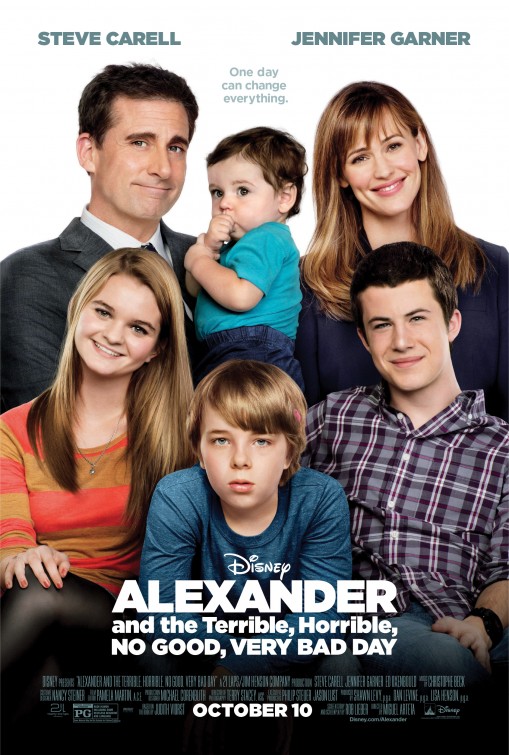
We’ve all had them. Some days, nothing goes right. The classic children’s book from Judith Viorst
In this version, Alexander is about to turn 12, and, as I am pretty sure everyone will agree, that is the age when the most excruciating bad days happen.
In a nod to the original, Alexander (Ed Oxenbould) wakes up on his last day of being eleven with gum in his hair. He trips over the sprinkler in front of the girl he likes Becky (Sidney Fullmer), and later sets her lab notes on fire in science class. It looks like no one will be going to his birthday party because the most popular boy in his class is having a party the same night — with a trampoline and frozen yoghurt cart. To make things worse, everyone else in his family seems to be having nothing but wonderful, beautiful, all-good, very-great days. His mother (Jennifer Garner) is about to get a promotion at the book publishing company for her good work on a book for toddlers about potty training. His father (Steve Carell), a stay-at-home dad since losing his job as an aerospace engineer, has a promising job interview.
His brother Anthony (Dylan Minnette), is about to get his driver’s license and take his dream girl to the prom. “Hashtag blessed,” he smiles, telling the family there’s a rumor that he and his girlfriend will be crowned Prom Duke and Duchess. And Alexander’s sister Emily (the terrific Kerris Dorsey of “Ray Donovan” and “Moneyball”) is starring as Peter Pan in the 8th grade play (in a movie that is both cheeky and charming, the song she sings in the play is not from the stage version that starred Mary Martin but from the Disney animated version, which definitely deserves a family viewing — with one caution for some insensitive racial and gender humor). Alexander also has a baby brother who gets a lot of attention just by being adorable. Everyone’s happiness just makes Alexander feel more isolated and miserable.
That night, Alexander makes himself a birthday sundae at midnight and as he blows out a candle, he can’t help wishing that everyone in the family would know what it was like to have a terrible, horrible, etc. etc. day. And the next day, everything goes wrong for everyone. Catastrophically wrong. Cataclysmically wrong. Monumentally wrong. And, yes, hilariously wrong. Don’t think too hard. This day would have to be about 72 hours long, and there’s no way some of these disasters could be fixed so easily. Just go with the goofy fun. There’s a lot of silliness and slapstick, and some gross-out bodily function humor, but the kids in the audience roared with laughter and both kids and adults loved the way the family stayed — most of the time — optimistic and warmly supportive of each other. There are delightful appearances by Dick van Dyke as himself and Jennifer Coolidge as the driver’s license examiner who shares Anthony’s terrible, horrible test drive. I especially got a kick out of the way the movie pays tribute to the book version of Alexander’s wish to be far away from his terrible, horrible, etc. by going to Australia. (In a coincidence, the real-life actor who plays Alexander is in fact Australian, though his American accent is impeccable.)
It does not have the gentle lyricism of the classic book, but it is a warm-hearted story that is less about bad days than it is about good families.
Parents should know that this film includes some bodily function humor and schoolyard language, comic peril and violence (no one hurt), accidental ingestion of too much cough syrup with attendant consequences, family chaos
Family discussion: Which family member had the worst day? What was your worst day and why? What’s the best thing to do on a bad day?
If you like this, try; the book by Judith Viorst and the two short DVD versions, and all three versions of “Freaky Friday”
Posted on October 5, 2014 at 12:01 am
“Left Behind” is being marketed as Christian entertainment, but it does not qualify in either category.
It is far inferior to the modestly budgeted but sincere straight-to-DVD starring Kirk Cameron, based on the blockbuster best-selling book series by Tim LaHaye and Jerry B. Jenkins
With a musical score that sounds like the music you are stuck with on hold waiting for tech support and cheesy special effects, it feels like a low-budget disaster film from the 1970’s. There was laughter throughout the theater in one scene where a plane crashed in a parking lot because the stock footage used for the explosion was so clumsily inserted. And when Nicolas Cage plays a pilot on a plane in trouble, it is a huge disappointment that we only get one brief outburst. What is the point of putting the Cage rage-monster in a film if he doesn’t blow his top? Instead he just alternates between moping and steely determination, not his strengths.
But the real failure here is the hollowing out of the storyline. It is a sad irony that a movie intended to warn about the dangers of soullessness is itself so empty. At the end of 2014, it turned up on most critics’ worst of the year lists.
Cassi Thomson (who plays a devout Christian on “Switched at Birth” and a Mormon on “Big Love”) is Chloë, who comes home from college to surprise her father on his birthday only to find out that he won’t be there. Her father is the heroically named Rayford Steele (Cage), and he is a pilot and he will be flying to Europe. She waits at the airport to say goodbye to him before he leaves, and rescues a handsome television reporter named Buck Williams (Chad Michael Murray, in the film’s best performance) from a woman who tries to warn him of a coming Biblical catastrophe. Then Chloë sees her father walking to the gate with a flight attendant. There is something about the way they are leaning toward each other that indicates a close relationship. Chloë is devastated. It turns out Buck is on Ray’s plane, and Chloë gives him a message for her father.
Suddenly, when the plane is over the Atlantic and Chloë and her brother are at the mall, people disappear, taken out of their clothes. The rest of the film is Ray in the plane and Chloë on the ground, trying to figure out what has happened and why and what to do next.
The book and the original film had provocative notions of how current world events were playing into the predictions contained in Revelations. There were characters who represented the forces of evil and there were characters trying to make sense of what it meant to be left behind. This version has none of that. There is the thinnest gloss of faith-based content, as though the filmmakers are afraid of offending a mainstream audience. Even worse, it appears they assume that the faith-based audience is so loyal they will not care about cardboard characters, clumsy dialog, painful attempts at humor involving a little person, and poorly-staged action scenes. I hope that the success of well-made faith-based media this year will make it impossible for the filmmakers here to complain that the criticism of this film, which showed up on most of the 10 worst lists of 2014, is based on bias.
Parents should know that this film has a great deal of peril and violence, discussions of infidelity, sad losses, drinking and drugs, and some disturbing images.
Family discussion: What separated those who were taken and those who were left behind? What would you have written on the ticket envelope Chloë asked Buck to deliver?
If you like this, try: the original film with Kirk Cameron and the book series