Peter Pan, the boy who would not grow up, has been enchanting children and their families for more than a century now. This week’s live broadcast of the Broadway musical version starred Alison Williams and Christopher Walken. And next year we’ll see Hugh Jackman as Blackbeard in “Pan,” which looks like a prequel that will tell us how Peter Pan and the Lost Boys made it to Neverland and how Hook (Garrett Hedlund) became Captain Hook.
Cheryl Strayed (Reese Witherspoon) adds the name of the author, Emily Dickinson, to the quote she has inscribed in a journal for hikers kept at her entry point on the Pacific Coast Trail. And then she adds her own name as well. It is her own name in a very real sense as she was not born with it and it was not her husband’s name. It was a name she chose from a dictionary at the end of her marriage as the name she wanted to go on with, a name for going above her nerve.
Copyright 2014 Fox Searchlight
Strayed was lost. Her mother Bobbi (a glowing Laura Dern), the “great love of (her) life,” died of cancer. Her husband Paul (“Newsroom’s” Thomas Sadoski) was loving and supportive but Strayed fell into a self-destructive death spiral, obliterating herself through “detached” sex with strangers and substance abuse that ultimately included shooting heroin. She and Paul recognized their divorce with matching tattoos to keep some part of the idea of permanence connecting them. And then, with nowhere else to go, she decided to take a walk, more than a thousand miles. It was a chance to reconnect with something she knew she loved to do and to get away from the bad choices she was making. The Chinese proverb says that the longest journey begins with a single step. Strayed wanted to take those steps between her old life and whatever was ahead, to begin to feel an un-obliterated life.
Her 60 pounds of equipment filled a backpack called The Monster. She did not practice putting up her tent or using her stove before she left. She was scared, and soon she was also hungry. She had brought the wrong fuel for her stove. A burly farmer driving a tractor gruffly agreed to give her a ride to some food, and then told her he was bringing her back to his house. She looked at him, trying to figure out if he was planning to attack her, hoping he was not. He was not. The farmer and his wife were kind and generous with her. She got the right fuel, and, a few stops later got some advice about getting rid of some of her load, down to burning each night the book pages she had finished reading. Plus, she didn’t really need all those condoms, did she?
Strayed’s book became an international-bestseller, so poetic and inspirational Oprah rebooted her Book Club to endorse it. Like other memoirs combining real and spiritual/emotional journeys, what makes it work is the narrator’s voice. This is as much an internal story as an external one. Screenwriter Nick Hornby (“High Fidelity”) and director Jean-Marc Vallée (“Dallas Buyer’s Club”) understand that this is not a travelogue, though there is some stunning scenery. It is about Strayed thinking back through her chaotic, messy life through the experience of putting one foot in front of the other on her way to a place called The Bridge of the Gods. As she thinks back on her life, we begin to understand the context for this trek at the same time that she does. As we expect from Hornby, there are some great song choices, too.
Strayed’s adventures and encounters along the way resonate with her memories. The farmer is not the only potential danger. The film understatedly but clearly shows how any woman in any sort of wild has to constantly calculate the threat level of the men she encounters. And, in a scene where Strayed comes across another hiker taking a bath in a lake, we get something we rarely see in films, a woman appraising, or maybe just appreciating, a male body. This is a character moment for Strayed, who as we see, has been too impulsive in sexual encounters. But here, she stands back and just savors the moment on its own, owning it without having to do anything about it. “I’m lonelier in my real life than I am out here,” she says.
Feeling your feelings can be painful. Strayed loses toenails and, at one point, her shoes. There are angry, raw patches of skin where The Monster digs into her. She thinks through painful memories of her mother’s illness, her father’s abuse. She remembers being inconsiderate of her mother, a woman who was thrilled to get a chance to go back to school, to think and question and learn. And for the first time, she begins to understand what her mother said about putting yourself in the line of beauty. Just because some things are terrible doesn’t mean everything is. “This has the power to fill you up again if you let it,” someone tells her.
Witherspoon gives a performance of quiet vulnerability and courage. In some ways, as producer as well as star, this was as daunting an undertaking for her as the hike was for Strayed. There was a real risk of making it a glamorized, soapy star vehicle. But as producer and actor, she gives this story the film it deserves.
Parents should know that this film includes explicit sexual references and situations and nudity, substance abuse, references to domestic abuse, and very strong language.
Family discussion: What do you think the quote means and why did Strayed use it to begin her hike? What does it mean to say that wounds come from the same source as power?
Rated PG-13 for intense sequences of violence and action, some disturbing images and thematic material
Profanity:
Mild language
Alcohol/ Drugs:
None
Violence/ Scariness:
Intense peril and violence with hundreds of deaths, grisly scenes, torture
Diversity Issues:
None
Date Released to Theaters:
November 21, 2014
Date Released to DVD:
March 6, 2015
Amazon.com ASIN:
B00PYLT0OW
Copyright 2014 Lionsgate
It seems no different at first. While the second in the “Hunger Games” series ended with the surprise last-minute rescue of heroine Katniss Everden (Jennifer Lawrence), and the even bigger surprise that insider Plutarch Heavensbee (Philip Seymour Hoffman) was secretly helping to organize a rebellion against the fascist dictator President Snow (Donald Sutherland), we begin this first half of the final installment with Katniss gripped by anxiety and terror, listening to the voice of someone we cannot see, calling her “Miss Everdeen,” which sounds respectful, even deferential, but still delivering orders. Is this more of the same? Just another version of the world of Panem where the thinnest gloss of rhetoric about ideals and values is used to disguise the vilest abuse, corruption and even genocide.
No, this is District 13, thought to have been exterminated, but in reality literally driven underground, as much as 40 stories down, as they work to find a way to overthrow President Snow’s totalitarian regime. They are led by Alma Coin (a somber Julianne Moore), President of the rebel forces. Coin can be abrupt, but it is a manifestation of urgency and decisiveness, not dictatorship. Snow dresses in spotless white, surrounded by lush white roses, and the capital city of Panem is a riot of garish, decadent colors. District 13 is all in gray, looking a bit like Janet Jackson’s “Revolution” video, evoking its uniformity in dedication to its goal and seriousness of purpose. Coin is not cynical, but she is realistic, constantly establishing priorities, understanding the consequences but willing to pay the price.
Coin and Heavensbee believe Katniss is what they have been waiting for, a symbol who will communicate to the other districts that the time has come for rebellion. She is the Mockingjay, named for the distinctive birds creation through genetic manipulation mating with natural species. Katniss is a figure whose sacrifice and resilience lend her enormous national credibility. She was made into a celebrity by Snow through the original Hunger Games.
Now Coin wants to use that as a weapon against Snow’s regime. They try to make a “propo” (propaganda) video with CGI effects, but realize that Katniss is too honest to be effective unless she is telling the truth. So, they take her to see what has happened to her home community in District 12. It has been reduced to rubble, with an enormous pile of skeletons of those who died there. And so Katniss is able to produce the outrage and resolve Coin’s forces are looking for in the video.
Katniss agrees to serve as symbol, on condition that the rebel forces rescue the Hunger Games competitors who were left behind, and pardon them for whatever they have done. She believes Peeta (Josh Hutcherson) is dead, but then he appears on a televised broadcast hosted by Caesar Flickerman (Stanley Tucci), the game show emcee with the sepulchral smile. Her joy turns to horror as she hears him plead for her to stop any opposition to Snow. Has he been tortured? Does he know something she does not?
That seems more likely as the initial attempts at rebellion result in enormous losses, including the firebombing of a hospital. With support from Haymitch (Woody Harrelson), now reluctantly sober, and Effie (Elizabeth Banks), whose adjustment to live without wigs, make-up, and fashions that would make Lady Gaga say “too much” provides much of the film’s comic relief, Katniss struggles with PTSD and with the painful moral dilemmas of asking others to risk their lives for a cause that may be doomed.
The series is a respectful adaptation of the books, but its real strength is not the writing of Suzanne Collins but the performance of Jennifer Lawrence, who is to the film all that Katniss is to the rebellion and more. Once again, Katniss is the heart of the story and Jennifer Lawrence is the heart of the film. In a plot that has her devastated and horrified much of the time, she manages to give a performance that is moving but never an atom out of control. Her conviction and presence is what anchors the film and makes the wildest absurdities of the storyline work. While I am not in favor of splitting the book in two just to double the box office, this version skillfully finds a story arc that comes to a satisfying conclusion while making us eager to see what happens next.
Translation: Brutal dictatorship relying on military force, bombing (including bombing unarmed civilians), shooting, executions, hundreds injured and killed, disturbing images including wounded civilians and piles of skeletons, torture (off screen), some teen kisses
Family discussion: What made Katniss the best choice to symbolize the rebellion? Why was it necessary to have a symbol? Why did President Snow refuse to use the word “rebel?”
If you like this, try: the first two “Hunger Games” films and “The Maze Runner”
Rated R for language including some crude references, and violent content
Profanity:
Strong and crude language
Alcohol/ Drugs:
Drinking
Violence/ Scariness:
Riots and brutal attacks on rioters and rebels, torture
Diversity Issues:
A theme of the movie
Date Released to Theaters:
November 14, 2014
Copyright 2014 Open Road Films
First-time writer/director Jon Stewart has made a remarkably assured film about the imprisonment and torture of Iranian journalist Maziar Bahari It is an absorbing drama that is at the same time the story of a very specific individual and a thoughtful consideration of contemporary geopolitics that avoids stereotypes or jingoism. This not only makes it a better story; it elevates the level of discourse without preachiness.
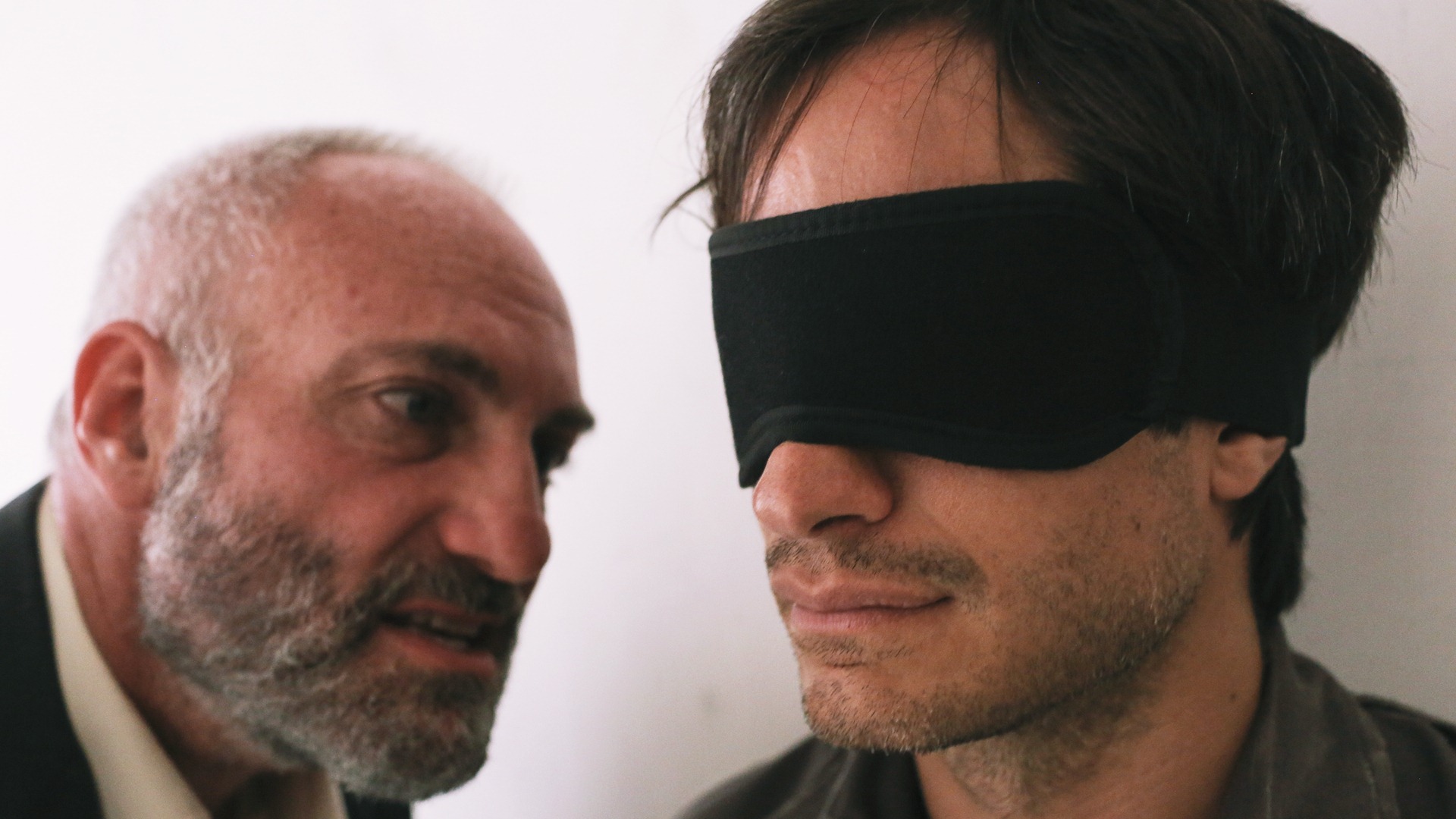
Bahari (a superb Gael Garcia Bernal) was working for Newsweek when he returned to Iran to cover the election in 2009. He knew the dangers of posing a threat to the government in Iran. His father and sister both died in prison as accused enemies of two different regimes. And now, as he filmed the protests over the disputed election victory of Mahmoud Ahmadinejad and the “Dish University” maintained by dissidents, he knows he is putting himself and his subjects and sources at risk. It is possible he does not consider the risks posed by his decision to be interviewed by “The Daily Show,” where he jokes about being a spy.
He is asleep at his mother’s home when officials arrive to take him to prison. It is disturbing and shocking that he is neither disturbed or shocked. While his mother (Shohreh Aghdashloo) bravely snaps at the man who orders her to wear a headscarf, Bahari is calm and polite.
Stewart wants us to understand the pressure that Bahari’s interrogator (Danish actor Kim Bodnia) is under. Stewart shrewdly introduces us to the man who smells of rose water as he is on the phone to his family, and showing us that he is just one link in a chain of oppression and bureaucracy. And he is not afraid to use cinematic touches to show us what is going on in Bahari’s mind. We see a face reflected on the walls as he walks through the streets. Later, in prison, he has conversations with his father and sister. They seem real to us, but they are not hallucinations. They are just visual embodiments of Bahari’s thought processes or fantasies has the weeks in solitary confinement turn into months, with no contact from the outside world. These memories of his family members who were also imprisoned help him stay strong. They even help him briefly outsmart Rosewater, as he fabricates a series of sexual encounters to describe in questioning, his “specialist” (interrogator) listening in horrified fascination, Bahari having, for once, the upper hand.
Stewart wisely also keeps us confined with Bahari, not telling us more than he knows about efforts to get him out of prison. When we finally see archival footage of then-Secretary of State Hillary Clinton talking about the importance of having him freed, we share his sense of relief that the world knows what is going on and cares about it. The other prisoners have no such support. And yet, Stewart finds a way to end on an image of hope that circles back to origins of the film itself. In moving out from behind the “Daily Show” desk, he is inviting us, as he has and as Bahari has, to shift from observer to participant.
Parents should know that this film includes some mature material: riots, abuse and torture (not graphic), some sexual references, and some strong language.
Family discussion: In what way did Maziar use his imprisoners’ weakness? What were their most effective tactics and what were his?


 ,
,  , and
, and  , and another 2014 film about a real-life woman on a long, long walk,