The Theory of Everything

Posted on November 13, 2014 at 5:31 pm

A-
Lowest Recommended Age: High School
MPAA Rating: Rated PG-13 for some thematic elements and suggestive material
Profanity: Some mild language
Alcohol/ Drugs: Drinking, smoking
Violence/ Scariness: Serious, debilitating illness, tense confrontations
Diversity Issues: Disabled character
Date Released to Theaters: November 14, 2014
Date Released to DVD: February 16, 2015
Amazon.com ASIN: B00QFSIIFK
Copyright 2014 Working Title Films

We have seen many film biographies of great individuals (mostly men). But we have seen almost no films, fact-based or fictional, about great marriages. And we have certainly never seen any films about great marriages that end up with the couple married to other people. But that is what this is.  It is the story of a “marriage of true minds,” an equal partnership in every way, with two very intelligent and committed people working as hard as they can to be the best they can for one another.

And they are portrayed by two people of enormous talent, with both Felicity Jones and Eddie Redmayne giving performances of enormous depth and understanding.  Of course Redmayne has the showier, awards-bait role, and he is meticulous in Hawking’s physical decline. In his previous films like “Les Miserables” and “My Week With Marilyn,” Redmayne has shown a gift for the sensitive, doe-eyed young hero.  But as Hawking, he shows a shrewdness and wit we have not seen from him before, even at the end, when Hawking has just one cheek muscle he can control.  There is never a hint of stunt-ishness.  It is always about the character whose mind is perhaps even freer to roam the farthest reaches of the universe and of human comprehension as his body is failing and he is completely physically dependant.

The luminous Jones matches him every bit of the way as Jane Hawking ages and as she grapples with finding a way to continue to relate to her husband as an adult and an equal while caring for him.  She is also a scholar in her own right who wants to do her own work, while somehow caring for her children and her husband, an intellectual supernova who is becoming an icon.

The screenplay is based on the book by Jane Hawking, the first wife of the scientist many people think of as the greatest mind of our generation, the physicist Stephen Hawking, best known for his appearances on “The Big Bang Theory” and his mega-best-selling book for the lay audience, A Brief History of Time. (The book’s purported status as the most-bought but least-read best-seller has inspired the “Hawking Index.”) And so we get a rare glimpse into what it was like from the point of view of the “wife of.”

Jane met Stephen when they were both students.  They had very little in common.  He was studying physics. She was studying Spanish poetry.  He was an atheist.  She was a churchgoer and believer.  He was disorganized, not socially adept or at least not interested in fitting in.  She was a natural rule-follower and very comfortable in social situations.  There was never anything conventional about their encounters or conversations.  

And yet, they felt the kind of pull that is better described by poetry than physics, the kind that seems to mean that only the similarities matter.  She smiles, “I like to time travel. Like you.”

And then Hawking is given the devastating diagnosis of motor neuron disease (ALS), with a life expectancy of perhaps two years of calamitous decline of all muscles.  “Your thoughts won’t change,” he is told, “but eventually no one will know what they are.”

Hawking’s father warns Jane away.  “This will not be a fight.  This will be a heavy defeat for all of us.”  But Jane is resolute.  She is determined that they will get married and they will fight.  They get married, with him leaning heavily on a cane.  They have two children.  And he loses muscular control, more every day.  Each downward ratchet is wrenching, but ultimately he has to give up walking and move to a wheelchair as eventually he will have to give up speech and learn to operate a computer with one muscle in his cheek to have it speak for him.  Adding insult to injury, it will be with an American accent.

In the meantime, he is transforming our understanding of the universe and our place in it, and then turning those theories upside down and starting over as he attempts to synthesize the two areas of physics into one simple, elegant, beautiful formula that will explain how it all fits together.  

Screenwriter Anthony McCarten and director James Marsh (“Project Nim”) show deep understanding and extraordinary sensitivity in conveying with small, intimate details what is going on in this marriage.  Hands reach casually across a dinner table while two of the people at the table watch, just a slight tightening of the muscles around the eyes or mouth revealing what it is like to see it be so easy for other people.  They can love each other despite his awful knowledge of being a burden while resenting the healthy. And despite her equally awful knowledge of his humiliation in being a burden. We see the combined beauty and soul-destroying relentlessness of being a caretaker.  

They try to keep relating to each other as a couple, not as patient and nurse.  They have another baby. That is joyous but it is more work and more of a reminder of how little he can do as a parent. He is in many respects more dependent than the children. And Jane is exhausted.

Jane’s mother (Emily Watson) has some advice.  She tells Jane to sing in the church choir.  “That is the most English thing anyone has ever said,” Jane replies, but she goes, and as soon as we see the handsome young choir leader, just widowed, (Charlie Cox of “Stardust” as Jonathan), we know there is going to be trouble.  Jonathan, at a loss in his grief, offers to be of help to the family.  He is kind and understanding but he is also healthy and in a beautifully poignant scene at the beach, he runs with the children while Hawking’s wheelchair sinks into the wet sand.

Jonathan and Jane develop feelings for each other.  Hawking and his new nurse Elaine (Maxine Peake) develop feelings for each other.  Perhaps it is because she never sees him as less than a version of himself that is long gone.  Perhaps it is just that he wants Jane to have a chance to be with a healthy man.  Perhaps he knows that there is some parallel universe where they are living happily ever after.  I’d like to think so.

Parents should know that this is a sad movie about a family dealing with a very serious disease.  There are some sexual references.

Family discussion:  Why did Stephen chose that moment to talk about God to Jane?  Why was it important to her?

If you like this, try: “A Beautiful Mind”

Related Tags:


Based on a book Based on a true story Biography Drama DVD/Blu-Ray Pick of the Week Romance

Rio Director and Pixar Artist Collaborate on a New Film: Timeless

Posted on October 18, 2014 at 3:59 pm

Copyright 2014 Armand Baltazar
Pixar artist Armand Baltazar has a forthcoming three-book children’s series called Timeless, about a world in which all time periods come together, and all nows are at the same time. A boy and friends from different time periods must rescue his father And it’s going to be a movie, too, directed by “Rio’s” Carlos Saldanha. Sounds wonderful!

Related Tags:


Based on a book

Kill the Messenger

Posted on October 9, 2014 at 5:59 pm

B+
Lowest Recommended Age: High School
MPAA Rating: Rated R for language and drug content
Profanity: Very strong language
Alcohol/ Drugs: Drinking, including teen drinking, drug dealing
Violence/ Scariness: Gangster-style violence, sad death, suicide
Diversity Issues: Diverse characters
Date Released to Theaters: October 10, 2014
Amazon.com ASIN: B00KSPL01K
Copyright 2014 Focus Features

Sometimes an honest, crusading, investigative reporter uncovers corruption and deceit and the result is triumph, a Pulitzer Prize, humiliating resignations and criminal convictions of the guilty and an Oscar-winning movie starring Robert Redford and Dustin Hoffman. And sometimes, instead, the result is killing the messenger. Gary Webb was a passionate, dedicated journalist at the San Jose Mercury News who managed to infuriate not only the CIA but his far bigger journalistic rivals. He uncovered a story no one much wanted told and no one much wanted to hear. Jeremy Renner plays Webb in this effort to give him his due.

Although it is set in the mid-90’s, director Michael Cuesta gives the film a 70’s paranoia, one man against The Man vibe that harks back to “The Parallax View,” “All the President’s Men,” “Z,” and “Serpico.” Renner, who also co-produced, brings his coiled energy and electric physicality to Webb, making journalism seem like a full-contact sport. His Webb is a guy who runs up the courthouse steps like Rocky. We see him early on, walking to his desk in the paper’s outpost near the state capital, going past the grand, imposing signs marking the areas occupied by the big national daily papers to his modest little corner. He’s a small fish in a very big ocean. But he has enormous determination, integrity, a sense of something to prove, and a healthy ego.

And then he gets the lead of a lifetime. A beautiful woman (Paz Vega), the girlfriend of a drug dealer, has some information for him that sounds preposterous. She says he “sold drugs for the government.” Seven tons worth. And it leads to the discovery that the government, specifically the CIA, is funneling money to the Contras in Nicaragua by underwriting the drug trade that is pouring crack into the poorest areas in the inner cities. “National security and crack cocaine in the same sentence — does that not sound strange to you?” And there’s a warning. “My friend, some stories are just too true to tell.”

The problem with writing about bad things done by powerful people is that they will use their power to attack whoever is trying to expose them. “Good investigative reporting ruffles feathers.” Sometimes the creature sporting those feathers will use its claws. To use a neologism from the movie, they will “controversialize” whoever is putting their reputations at risk. Webb was not perfect. He had enemies. At first, his newspaper celebrates his journalistic coup. But when his bosses are put under pressure, they buckle. Soon the once-superstar reporter is exiled to Cupertino. Without the support of his family and the chance to do the work that defines him, he has nothing to hold onto.

The story is still a murky and complicated one, despite post-credit updates on revelations confirming Webb’s reporting. Renner is a magnetic presence and he makes Webb’s passion for telling the story honestly and exposing the dishonesty of others almost palpable. Webb’s scenes with his children are especially touching, though it is too bad to see the talented Rosemary DeWitt relegated to a dull “don’t work so hard, don’t take risks” role. A scene near the end at an awards dinner has an emotional punch.  Renner’s performance has enormous integrity, illuminating the murky compromises and betrayals he exposes and the ones that get the better of him as well.

Parents should know that this film has very strong language, drugs, drug dealing, and gangster violence, as well as tense family confrontations.

Family discussion: Who is doing the work that Gary Webb did today? Has the CIA become more accountable as a result of his work? Do we still kill the messenger?

If you like this, try: “Serpico” and Dark Alliance: The CIA, the Contras, and the Crack Cocaine Explosion and more of the work of real-life reporter Gary Webb
Related Tags:


Based on a book Based on a true story Crime Journalism Movies -- format

Alexander and the Terrible, Horrible, No Good, Very Bad Day

Posted on October 9, 2014 at 5:50 pm

alexander_and_the_terrible_horrible_no_good_very_bad_day_ver2
Copyright Disney Studios 2014

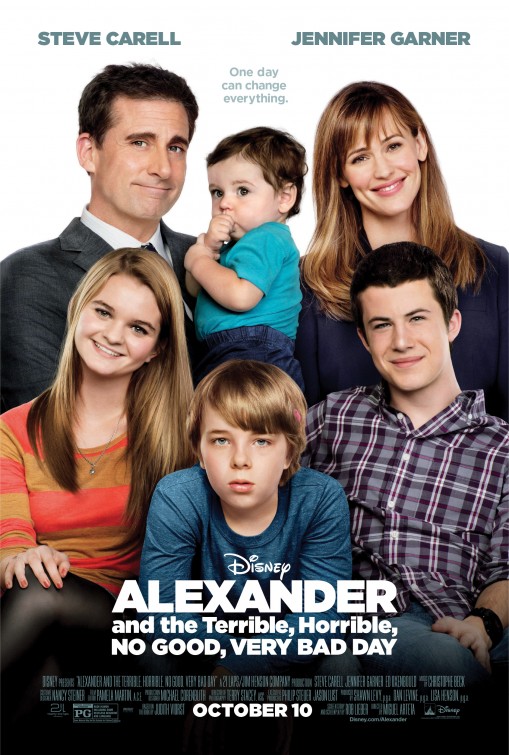
We’ve all had them. Some days, nothing goes right. The classic children’s book from Judith Viorst is about a little boy who wakes up with gum in his hair to a day that includes a dentist appointment, kissing on television, and losing his favorite marble down the bathtub drain has inspired a sweet and gently wacky comedy about an entire family having terrible, horrible, no good, very bad days, all at the same time.
Copyright Walt Disney Studios 2014

In this version, Alexander is about to turn 12, and, as I am pretty sure everyone will agree, that is the age when the most excruciating bad days happen.

In a nod to the original, Alexander (Ed Oxenbould) wakes up on his last day of being eleven with gum in his hair. He trips over the sprinkler in front of the girl he likes Becky (Sidney Fullmer), and later sets her lab notes on fire in science class. It looks like no one will be going to his birthday party because the most popular boy in his class is having a party the same night — with a trampoline and frozen yoghurt cart. To make things worse, everyone else in his family seems to be having nothing but wonderful, beautiful, all-good, very-great days. His mother (Jennifer Garner) is about to get a promotion at the book publishing company for her good work on a book for toddlers about potty training. His father (Steve Carell), a stay-at-home dad since losing his job as an aerospace engineer, has a promising job interview.

His brother Anthony (Dylan Minnette), is about to get his driver’s license and take his dream girl to the prom. “Hashtag blessed,” he smiles, telling the family there’s a rumor that he and his girlfriend will be crowned Prom Duke and Duchess. And Alexander’s sister Emily (the terrific Kerris Dorsey of “Ray Donovan” and “Moneyball”) is starring as Peter Pan in the 8th grade play (in a movie that is both cheeky and charming, the song she sings in the play is not from the stage version that starred Mary Martin but from the Disney animated version, which definitely deserves a family viewing — with one caution for some insensitive racial and gender humor). Alexander also has a baby brother who gets a lot of attention just by being adorable. Everyone’s happiness just makes Alexander feel more isolated and miserable.

That night, Alexander makes himself a birthday sundae at midnight and as he blows out a candle, he can’t help wishing that everyone in the family would know what it was like to have a terrible, horrible, etc. etc. day. And the next day, everything goes wrong for everyone. Catastrophically wrong. Cataclysmically wrong. Monumentally wrong. And, yes, hilariously wrong. Don’t think too hard.  This day would have to be about 72 hours long, and there’s no way some of these disasters could be fixed so easily.  Just go with the goofy fun. There’s a lot of silliness and slapstick, and some gross-out bodily function humor, but the kids in the audience roared with laughter and both kids and adults loved the way the family stayed — most of the time — optimistic and warmly supportive of each other. There are delightful appearances by Dick van Dyke as himself and Jennifer Coolidge as the driver’s license examiner who shares Anthony’s terrible, horrible test drive. I especially got a kick out of the way the movie pays tribute to the book version of Alexander’s wish to be far away from his terrible, horrible, etc. by going to Australia. (In a coincidence, the real-life actor who plays Alexander is in fact Australian, though his American accent is impeccable.)

It does not have the gentle lyricism of the classic book, but it is a warm-hearted story that is less about bad days than it is about good families.

Parents should know that this film includes some bodily function humor and schoolyard language, comic peril and violence (no one hurt), accidental ingestion of too much cough syrup with attendant consequences, family chaos

Family discussion: Which family member had the worst day? What was your worst day and why? What’s the best thing to do on a bad day?

If you like this, try; the book by Judith Viorst and the two short DVD versions, and all three versions of “Freaky Friday”

Related Tags:


Based on a book Comedy
THE MOVIE MOM® is a registered trademark of Nell Minow. Use of the mark without express consent from Nell Minow constitutes trademark infringement and unfair competition in violation of federal and state laws. All material © Nell Minow 1995-2026, all rights reserved, and no use or republication is permitted without explicit permission. This site hosts Nell Minow’s Movie Mom® archive, with material that originally appeared on Yahoo! Movies, Beliefnet, and other sources. Much of her new material can be found at Rogerebert.com, Huffington Post, and WheretoWatch. Her books include The Movie Mom’s Guide to Family Movies and 101 Must-See Movie Moments, and she can be heard each week on radio stations across the country.

Website Designed by Max LaZebnik