
The Hunger Games: Catching Fire

Posted on November 20, 2013 at 11:35 am

Capitol-Portraits-The-Hunger-Games-Catching-FireIn the second chapter of the three-book, four-movie series, Katniss Everdeen has gone from being a shy unknown with extraordinary skills to being an acclaimed superstar. The same could be said for the actress who plays the part. When Jennifer Lawrence was selected to play the heroine of the blockbuster novels by Suzanne Collins, she was barely out of her teens. She had scored an Oscar nomination for a small, independent film called Winter’s Bone that was seen by about the number of people listed in the credits of this film. And in between the first and second in the “Hunger Games” series, she won a leading actress Oscar for Silver Linings Playbook.

In this deeper, smarter, politically sharper, and more emotionally resonant follow-up, she returns to the dystopian world of Panem as Katniss prepares for her victory tour, following an unprecedented triumph at the titular competition.  Once a year, two teenagers are selected from each of the twelve districts to compete to the death in televised combat that the totalitarian government imposes in a gruesome simulacrum of an athletic contest that promotes dedication, talent, and integrity.  As the previous film ended, Katniss and Peeta (Josh Hutcherson) defied the authorities to come up with a way that they could both come out alive — by pretending to be in love and be willing to sacrifice themselves to be together.  This has made them very popular, and the dictator, “President” Snow (a nicely corrupt Donald Sutherland) wants to make sure that this popularity is extended on behalf of his regime and will not inspire any rebellious uprisings.  When his own granddaughter begins to braid her hair to be like Katniss, he knows that if he cannot control the young archer, he will have to destroy her.  However, as the new Head Gamemaker, Plutarch Heavensbee (Philip Seymour Hoffman) reminds him, he must be careful to get rid of her in a way that will discredit her, to make sure she does not become a martyr and inspire the rebels even more in memory than she already does.

Snow tells Katniss she has to persuade not just the fans but him that she is truly in love with Peeta or he will destroy her and her family.  She does her best, and cares for Peeta deeply, but her heart is still with Gale (Liam Hemsworth), who is hurt and jealous.

Plutarch decides to mount an all-star game, pitting previous champions of the Hunger Games against each other in a ramped-up competition.  And no skirting the rules with a romance this time.  Katniss and Peeta go back to the Capital for another dress-up extravaganza (costume designer Trish Summerville ramps things up with costumes that are a mash-up between “Project Runway’s” unconventional materials and fashion forward challenges and an acid trip.  Elizabeth Banks carries off the wildest of the attire better than anyone else could (with the exception of Barbie), and manages to give the outrageous Effie Trinket a little bit of compassion under the Kabuki-like makeup. And Katniss, known as the “girl on fire” thanks to the costumes designed by the stylist Cinna (Lenny Kravitz) gets a wedding gown extravaganza with an unexpected political overlay.

And then, the games begin, as before, with the same race to get supplies and weapons while avoiding attack and assessing possible alliances that by definition will be short-term.  Plutarch has some challenges of his own to keep the contestants off-balance and on the run.  With each “tribute” a previous winner, the odds are not in anyone’s favor.

Director Francis Lawrence (“I am Legend,” no relation to his star), taking over from Gary Ross, manages the large cast and complicated action well and screenwriters Simon Beaufoy (“Salmon Fishing in the Yemen”) and Michael Arndt (“Toy Story III,” “Little Miss Sunshine”) adapted the book deftly.  They balance the small, intimate moments, brief humor, and intense emotion with the grand sweep of the games, acknowledging the over-arching themes of honor, freedom, and courage but keeping the focus on the relationships.  It tells us everything that in the short training/assessment/sponsorship-seeking period before the Games begin, Katniss reaches out to the weakest and most vulnerable of the other contestants, helping them with no agenda for her own protection.

The other additions to the series are exceptionally well-chosen, too, especially Hoffman, as a man who knows more about “counter-moves” than we may suspect at first, Sam Claflin as the high-spirited, faun-like Finnick Odair, Jeffrey Wright and Amanda Plummer as the wonkiest participants, and Jena Malone, a fiery delight as the furious  Johanna Mason.  But it is Lawrence who steals the show again as Katniss.  Be sure to keep your eyes on her face in that last scene; it’s a lulu that will have you counting the moments until the next episode (now in production).

Parents should know that the theme of these books concerns a totalitarian dictatorship that forces teenagers to battle to the death in a very intense and disturbing “game.”  Many characters are injured and killed and there are scary surprises, graphic images, and disturbing threats. Many teenage and adult characters are beaten, injured, and killed, with knives, guns, whips, arrows, spears, poison fog, animal attacks, psychological abuse, and more. Characters abuse alcohol, there are drug references, and characters use some strong language. There is kissing and some implied nudity in public — nothing shown.

Family discussion: What did Plutarch mean by “moves and countermoves?” Why did the tributes hold hands? Why wouldn’t Gale leave?

If you like this, try: the first movie and the books by Suzanne Collins

Related Tags:


Action/Adventure Based on a book Drama Romance

The Book Thief

Posted on November 14, 2013 at 6:00 pm

The title character in “The Book Thief” is Liesel (Sophie Nélisse), a little girl in pre-WWII Germany.  We first see her on a train with her mother and dying younger brother.  The children were both going to be delivered to foster parents but Liesel and her mother stop along the way to bury her brother.  As the gravedigger leans over, a book falls out of his pocket.  Liesel picks it up.book-thief

Her new parents are the frosty Rosa (Emily Watson) and the gentle Hans (Geoffrey Rush).  At first, Liesel is so traumatized she cannot speak.  But Hans hears her softly singing Brahms’ lullabye to herself at night and coaxes her into talking to him by playing the song on his accordion.  When he finds that she cannot read, he uses her book to teach her.  She tells him it is hers, but “it didn’t used to be.”  That was not hard to guess; it is a book about digging graves.

Liesel is befriended by a friendly classmate named Rudy (Nico Liersch), an athletic kid who wants to race like Olympic champion Jesse Owens.  Around them, the rise of the Nazi party is evident in omnipresent banners and badges.  A school choir sweetly sings an anti-Semitic song.  Hans’ skills as a house and sign painter prove useful when someone has to remove the insults painted on his Jewish neighbor’s store.  Liesel becomes a book thief again when Hitler’s birthday is celebrated with a huge book burning.  It is less a theft than a rescue, the book smouldering under her coat as she hides it from Hans.  The book is The Invisible Man by H.G. Wells.

The impact of the Nazi regime literally hits home when Max (Ben Schnetzer) arrives.  Max’s father sacrificed himself to save Hans’ life in the first World War.  It is his accordion that Hans cherishes so dearly.  Hans and Rosa talk about whether they are prepared to take the risk of hiding Max, but they know they have no choice.  Max becomes very ill and as Liesel helps to nurse him back to health, they become very devoted to one another.  She “borrows” books (without asking) from the home of the wealthiest man in town to read to him.

The young Australian author Markus Zusak was inspired to write The Book Thief by a story he heard from his mother, who emigrated from Germany following World War II.  A teenage boy in her village ran to give bread to a starving man who was being herded with other Jews by Nazis delivering them to a concentration camp.  Both the man and the boy who tried to help him were whipped by the Nazis.  This story of the very best and worst of humanity gave him the idea of a story set in Germany during the Holocaust.

Addressing the Holocaust through fiction is a daunting challenge and this film does not always master it.  An uncertain sense of its audience makes it feel off at times, too simplistic for adults and too disturbing for young audiences.  An episodic structure seems meandering and unfocused.  Most problematically, the choice of Death as a narrator works better on paper than on film.  But Rush’s performance and some touching moments make this what is perhaps the best we can hope for in grappling with the incomprehensible — a part of a conversation, even a conversation about what does not work, that keeps us striving to honor the memory of those who suffered and to strengthen our resolve once again to conquor the fear and ignorance that caused it.

Parents should know that this film is set during the Nazi atrocities of WWII Germany.  There are many sad deaths and references to the Holocaust, racist and anti-Semitic comments, fighting, and some war-time violence.

Family discussion:  Is Liesel a thief?  Why did she read to Max when he was ill?

If you like this, try: the book, “The Story of Anne Frank,” and “The Devil’s Arithmetic”


Related Tags:


Based on a book Drama

Ender’s Game

Posted on November 1, 2013 at 6:35 pm

endersgame

Director Gavin Hood (“Tsotsi”) has skillfully adapted the Nebula and Hugo award-winning novel about a boy who leads an interplanetary battle against insect-like aliens, doing justice both to the fun of the sci-fi action and to the seriousness of the book’s themes.   The story has been adapted for film — Ender is several years older in the film than in the book and an extended and astonishingly prescient subplot about his siblings writing something resembling blogs and becoming highly influential political commentators has been dropped.  But it is very true to the spirit of the book and its characters and with special effects technology vastly beyond what was possible when the book was written, spectacularly realizes some of the book’s most thrillingly imaginative passages.

A memorable scene in Kevin Smith’s “Clerks” has its two slacker heroes arguing about one of the most rousing moments in the history of film, the destruction of the planet-destroying Death Star in the original “Star Wars.”  Randall points out that while the Jedi and the audience are cheering the explosion, they are overlooking the fact that the Death Star, still under construction, was not staffed with military but with independent contractors, who are at least arguably innocent bystanders in the conflict and unarmed.  In the middle of a raunchy comedy there is suddenly a more nuanced moral sensibility than is exhibited in the the usual big-budget sci-fi extravaganzas.

That is what makes the Ender’s Game series by Orson Scott Card so compelling.  The original book has been a worldwide best-seller for more than 20 years.  Like “Star Wars,” “The Matrix,” and other YA favorites, it is the story of a “chosen one” of extraordinary skill who takes on the oppressive and vastly powerful but corrupt enemy, and it is filled with exciting action.  But it also engages directly, thoughtfully, and sometimes provocatively with profound questions that are even more apt today than they were in the 1980’s: Should we sacrifice the interests of one person to benefit the rest of the world?   Should we stage a pre-emptive attack by an enemy that is not currently demonstrating aggressive behavior?  What is more important, the ability to win a battle or the ability to feel compassion or empathy?
The setting is at a time in the future when earth has successfully defended itself against an attack by an insect-like race of aliens called Formics and disparagingly referred to by humans as Buggers.  The effects of the war against the Formic were devastating, and the entire resources of the world have been turned to just one goal — seeing out the Formics and destroying them to make sure that they can never return to attack the humans.  They have determined that only a child has the reflexes, flexibility, and singleness of purpose to lead that attack.

All children are fitted to monitoring devices so that the military can see how they behave and find the likeliest candidates for military training.  Couples are strictly limited to no more than two children.  The Wiggins family is permitted a rare third because their son and daughter, while not suitable for training, show extraordinary ability.  The third is Ender Wiggins (“Hugo’s” Asa Butterfield in a considered performance of great dignity and focus), whose deliberate but savage attack on a school bully brings him to the attention of the commander in charge of training, Colonel Hyrum Graff (Harrison Ford, returning to space for the first time since the “Star Wars” trilogy).  Ender is brought to a space station for a series of training exercises called “games.”

A disagreement between Graff and Major Gwen Anderson (Viola Davis, once again speaking on behalf of humanity) is one of the film’s clearest statements of the moral conflict it lays out.  Anderson wants the training to do what is best for Ender.  Graff wants it to do what is best for humanity, and if that means inflicting the kind of trauma and encouraging the kind of brutality that will make Ender a better commander, he is willing to make that trade-off.  Of course it is out of the question to consult Ender or his parents.  Card wisely makes it clear that there are two questions here.  One is whether the ends ever justify the means.  The other is who should decide what ends or means to consider.

The games are fascinatingly constructed and the battles in the weightless chamber with freeze-ray weapons are absorbing and immersive.  It gets more exciting when a new teacher with a fabled history and an impressive Maori face tattoo (Ben Kingsley) takes over.  The climactic battle is as dramatic as we hope, but it is a remarkable twist and a surprising coda that bring depth and meaning to the story.


NOTE: In real life, author Card has demonstrated hateful homophobic bigotry that has led some people to call for a boycott of the film.  Here is my view: I believe that the principles of courage, integrity, compassion, empathy, and service to others that “Ender’s Game” promotes are essential values.  While I regret that the author’s ugly and bigoted statements show that he himself is still struggling to learn the lessons of his book, I agree with the poet Don Marquis that “an idea is not responsible for the people who believe in it.” The best of his vision should be shared with young people in the hopes that the next generation will transcend some of the biases of the previous ones.

Parents should know that this film includes extended sci-fi violence and peril with characters injured and killed, themes of interplanetary genocide, brief mild language, theme of child soldiers and moral conflicts, and bullies.

Family discussion: What does it mean to win “the right way”? Was Graff or Anderson right about the best way to treat Ender?

If you like this try: The book and its sequels by Orson Scott Card and the “Star Wars” movies starring Harrison Ford.

Related Tags:


Action/Adventure Based on a book Science-Fiction Stories about Teens

12 Years a Slave

Posted on October 17, 2013 at 6:15 pm

A-
Lowest Recommended Age: Mature High Schooler
MPAA Rating: Rated R for violence/cruelty, some nudity and brief sexuality
Profanity: Constant use of racial epithets, sexual references
Alcohol/ Drugs: Drinking and drunkenness
Violence/ Scariness: Intense and disturbing violence including rape, murder, whipping, and abuse, disturbing and graphic images
Diversity Issues: A theme of the movie
Date Released to Theaters: October 18, 2013
Date Released to DVD: March 3, 2014
Amazon.com ASIN: B00G4Q3NDA

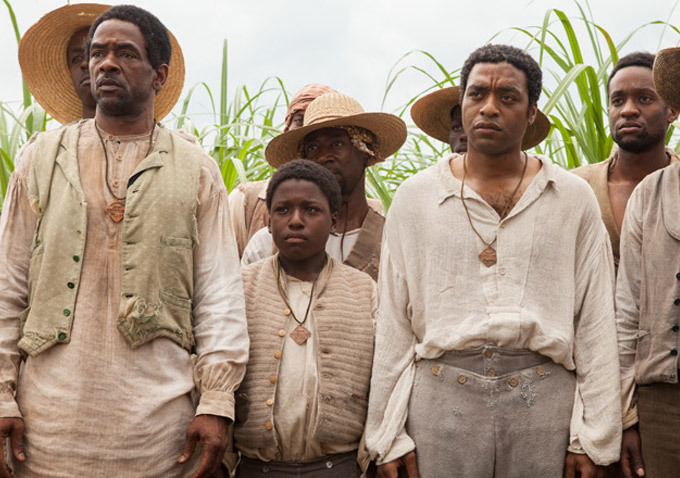
12-years-a-slave-2Watching “12 Years a Slave” is a shattering experience. It shatters any remaining illusions of gracious, chivalrous, Southern plantation life in the pre-Civil War era.  They were based on the late 19th century myth-making from the children of slave-owners in a toxic effort to disguise the reality that the South was fighting to preserve a system of virulent racism fueled by the economics of plantation life. It shatters cherished notions of the first principles underlying the founding of this country.  The man who wrote the revolutionary words that “all men are created equal” was a part of this atrocity. It shatters all previous depictions of slavery.  By comparison they seem cartoonish and fraudulent, from “Gone With the Wind” to “Django Unchained,” more about the time they were made than the time they depicted. And, like all great films, it shatters our previous notions of what was possible on screen, with performances so vivid and compelling they seem to break through every boundary, between us and them, between then and now, between actor and audience. In one audacious moment, Solomon Northrup (Chiwetel Ejiofor), a free man sold into slavery, looks into the distance, eyes filled with ineffable suffering and loss, and then turns to face us, looking into the eyes of those who are looking at him, bringing us further into his world.

This is different because it is a rare story of pre-Civil War South told from a black person’s point of view. It is based on Northrup’s book, written after he returned to his family.  It is the story of slavery from a man who experienced it, and who knew what it was like to live as a black man who was not just free but better educated and more successful than most people of any race in his community. In that sense, it is a story told from inside the system of our country’s greatest shame.  In another sense, it is presented by outsiders, director Steve McQueen (British) and stars Ejiofor (the British son of Nigerian immigrants) and Lupita Nyong’o (born in Mexico, raised in Kenya, educated in the US).  They tell us Northrup’s story — and ours — without being tied to the way we prefer to tell ourselves what our history is and means.

Northrup is a successful musician, happily married with two adored children and respected by both white and black members of his community in New York State.  He accepts a job playing with some circus performers (Scoot McNairy and “SNL’s” Taran Killem) in Washington, D.C., where slavery is legal.  They drug him and sell him to a slave dealer (Paul Giamatti).  Without his papers, he cannot prove he is a free man.  Soon he is renamed Pratt and transported to Louisiana, where he is sold first to a comparatively benevolent man (Benedict Cumberbatch), but then, when he gets into a fight with the overseer (an oily Paul Dano), he is re-sold to a brutal man who prides himself on being an n-word-breaker (Michael Fassbender).  Northrup loses more than his family, his liberty, his name, and his freedom.  He loses his very self; he is told early on that if the white people know he can read and write, it will create more trouble for him.  Indeed, when he tries to be helpful by suggesting a better system for transporting the crop, he earns the gratitude of his master but incurs the jealousy of the white boss.  The only way to survive is to pretend to be the sub-human the owners need them to be to continue to hold onto their bigotry.

This movie makes clear the poisonous, psychotic twisted mind that can accept or even justify the idea that one person can buy and sell another.  Over and over, we see the slaveholders at the same time acknowledging and denying the humanity of the people they think they own.  A female slave sobs because her children have been sold and she will never see them again.  The woman of the plantation, briefly sympathetic, says, “Poor woman.”  But then, immediately after, “Your children will soon be forgotten.”  Slaves are included in family worship services (though not seated with the family).  But their souls are never acknowledged; they are categorized as livestock.

There are terrible beatings.  There is torture and rape.  Slave children run and play, laughing, ignoring the man who is almost choking to death as punishment. There are property identification chains slaves must wear if they go off the property, like something between a hall pass and a dog tag.  There is a slave who has made her peace with what she has done to get better treatment — and with what she now does to other slaves.

Instead of the lush orchestral score usually underlying period films or the melancholy flute and drum usually heard in Civil War films, Hans Zimmer has created spare, edgy music that is bleak without being maudlin.  McQueen’s approach is sure and direct and the script by John Ridley is ably structured and thoughtful.  Nyong’o’s gives performance of exquisite grace and heart-wrenching dignity.  But the center of the story is Northrup.  Ejiofor is sure to get an Oscar nomination for a performance of unparalleled depth and eloquence.

Parents should know that this film includes very graphic and disturbing images of slavery, with rape, murder, and abuse, brutal whipping and atrocities, nudity, sexual references and situations, constant racial epithets, drinking and drunkenness.

Family discussion: What was the significance of the early scene in Mr. Parker’s store?  How does this story differ from other movie depictions of the pre-Civil War South?  Why did Northrup join in the singing of “Roll, Jordan, Roll?”

If you like this, try: book by Solomon Northrup, “Amistad,” American Experience: The Abolitionists, and Roots

Related Tags:


Based on a book Based on a true story Drama DVD/Blu-Ray Pick of the Week Epic/Historical
THE MOVIE MOM® is a registered trademark of Nell Minow. Use of the mark without express consent from Nell Minow constitutes trademark infringement and unfair competition in violation of federal and state laws. All material © Nell Minow 1995-2026, all rights reserved, and no use or republication is permitted without explicit permission. This site hosts Nell Minow’s Movie Mom® archive, with material that originally appeared on Yahoo! Movies, Beliefnet, and other sources. Much of her new material can be found at Rogerebert.com, Huffington Post, and WheretoWatch. Her books include The Movie Mom’s Guide to Family Movies and 101 Must-See Movie Moments, and she can be heard each week on radio stations across the country.

Website Designed by Max LaZebnik