The Founder

The Founder

Posted on January 19, 2017 at 5:40 pm
Copyright 2016 TWC

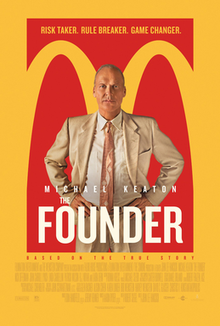
McDonald’s began as a hamburger stand in San Bernardino, California, the idea of two brothers, Dick and Mac McDonald, who brought to food what Henry Ford brought to cars: ultra-efficient assembly-line production: consistent, reliable, and scalable. But McDonald’s, the worldwide “billions and billions served” fast food franchise phenomenon with the iconic golden arches was the creation of the man who put “founder” on his business cards, Ray Kroc.

Balzac famously said that behind every great fortune there is a crime, and this story of one of the great disruptive forces in 20th century business shows us the vision, the passion, the triumph and the heartbreak behind it. Michael Keaton is well cast as Kroc, a struggling salesman who listens to motivational tapes about the importance of persistence — a more significant factor, according to the lectures, than ability or resources.

Kroc is on the road trying to sell milkshake machines to restaurants. He calls his secretary for messages. A prospect says no. A bill collector wants to be paid. And some hamburger stand in California wants to buy six. Kroc is sure that is a mistake. No one has ever wanted more than one. He calls and speaks to one of the McDonald brothers. He can hear the activity in the background. And the order gets upped to eight. Kroc has to go see it for himself.

The McDonald brothers (John Carroll Lynch and Nick Offerman) welcome Kroc warmly, proud to tell their story and show off their innovations. In one of the movie’s highlights, they explain the trial and error and meticulous planning that led to their operational and conceptual innovation. They had three brilliant insights. First, they got rid of the inessentials: no wait staff, no plates to wash or break, and they limited the menu offerings to the items that were most often ordered. You want chicken — go somewhere else. They got rid of the cigarette machine and jukebox and thus got rid of the undesirable customers, teenagers and others who come to hang around instead of those who eat and leave. That left busy families, who appreciated the wholesome atmosphere and utter consistency and reliability. Second, they streamlined production, again reinforcing consistency and reliability and attracting families. One more difference to appeal to families: no waiting. Food was delivered almost instantly. Indeed, when on his first visit Kroc received his food neatly packed in a bag seconds after placing the order, he looked at it confused and asked, “What’s that?” The McDonald brothers realized they were not just providing customers with food; they were providing them with something even more precious: time.

The third brilliant insight created some conflict with their new partner after Kroc persuaded them to put him in charge of franchising. For the McDonald’s, money was not the top priority. They valued, well, values.

It is instructive that there are several points throughout the film where someone explains that McDonald’s is not about hamburgers. All of the other answers are right in their own way, along with many others. This is a rare film that looks at what it takes to create a globally dominant business, and what it costs as well.

Parents should know that this film includes one f-word, some predatory business behavior, illness, and marital strain and divorces.

Family discussion: How many things other than hamburgers did people say the business of McDonald’s really was? Why did Kroc call himself “founder?” Who was right, the brothers or Kroc, and why?

If you like this, try: “Tucker: The Man and his Dream” and “Joy”

Related Tags:


Based on a true story Biography Drama
Patriots Day

Patriots Day

Posted on January 12, 2017 at 5:28 pm

Copyright 2016 CBS Films

Writer/director Peter Berg and actor/producer Mark Wahlberg have now made their third film in a row on the same theme: real life stories of everyday people showing exceptional courage and dedication in the direst and most tragic circumstances. “Lone Survivor” was the story of a disastrous Navy SEAL operation. “Deepwater Horizon” was the story of the BP oil rig explosion. Now “Patriots Day” is the story of law enforcement from the terrorist attack at the Boston Marathon to the killing and capture of the brothers responsible.

In all three films, Berg takes a story we know — or think we do — and creates a gripping, tense drama centered on a man who exemplifies American values of decency and integrity and shows exceptional ability to rise to the occasion. Wahlberg is a perfect choice to play those roles, and here he gives grace and dignity to the role of Tommy Saunders, a composite character based on the Boston cops who were on the ground when the bombs exploded, oversaw triage to manage the crowd and oversee emergency services and then tracked down the people responsible in just 19 hours.

And as in the earlier films, Berg’s focus is not on the people making the big policy decisions but on the people who are dealing with the consequences. He begins a brief but vivid chance to get invested in some of the key players just before Boston’s annual Patriots Day race, including some of the participants who will later be injured and Saunders, unhappy about being assigned to the race and struggling with a bad knee. Everything is the usual benign chaos until suddenly it becomes terrifying and catastrophic as the bombs explode near the finish line and no one knows what happened, who caused it, or whether more attacks are coming, with an anxious score by Trent Reznor and Atticus Ross, as Saunders and the other cops have to try to figure out what is going on, surrounded by severely injured people and panicked crowds — and, probably, somewhere, the bombers.

The minute-by-minute procedural section is engrossing, with territorial squabbles and conflicting priorities involving the police force and the FBI. The injured people may have crucial information the cops need right away but they also have injuries that need treatment right away, treatment that could make it difficult or impossible for them to talk or remember. The press insists on releasing photos of possible suspects despite law enforcement’s concerns that it could impair the investigation. And what do you do when a key witness insists on a lawyer, or decides to leave the police station? One of the most powerful scenes in the film is the interrogation by a hijab-wearing FBI agent of the wife of one of the suspects, an incendiary performance by “Supergirls” Melissa Benoist. The film does not take a position on the abandonment of Constitutional rights in an emergency with perhaps hundreds of life at stake; it just presents it as the immensely complex problem with no right answer that it is.

And then, with ultimate respect, it concludes with footage of some of the real heroes. That’s the crying part, as it should be.

Parents should know that the theme of the film is a real-life terrorist attack with many characters injured and killed and some graphic and disturbing images of bodies and wounds; also very strong language, some bigotry, and some drug use.

Family discussion; How did social media affect the way this attack was investigated? What does this movie have in common with the two other fact-based stories from the same director and star?

If you like this, try: “Lone Survivor” and “Deepwater Horizon”

Related Tags:


Based on a true story Drama
Hidden Figures

Hidden Figures

Posted on December 23, 2016 at 9:15 am

Copyright 20th Century Fox

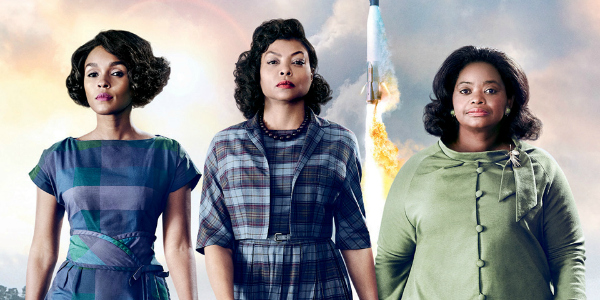
The sign on the office door said, “Colored Computers.” That was not a reference to IBM’s Big Blue or to a machine of any kind. In the early days of the space race at NASA, computers were people doing all of the complex, unprecedented math calculations by hand, and the “colored” computers were the African-American women who had more talent, more dedication, more integrity, despite less pay, less credit, and less resources than their colleagues. Twice marginalized, as women and as African-Americans, they were heroically dedicated, capable, and resilient. Their story, unknown until the book by Margot Lee Shetterly, is beautifully told in this heartwarming, inspiring film.

Katherine Johnson (Taraji P. Henson), Dorothy Vaughan (Octavia Spencer), and Mary Jackson (singer Janelle Monáe, “Moonlight”) are stopped by a highway patrolman on their way to their office at NASA. They get out of the car, expecting the worst. In his own way, the white patrolman expects the worst, too. This is Virginia, just a few years after the state shut down the entire school system to avoid complying with the Supreme Court’s decision in Brown v. Board of Education. This is the same era depicted in “Loving,” the true story of the couple who challenged Virginia’s laws prohibiting marriage for people who were not of the same race.

This was also the era of the space race. President John F. Kennedy famously said, “We choose to go to the moon. We choose to go to the moon in this decade and do the other things, not because they are easy, but because they are hard, because that goal will serve to organize and measure the best of our energies and skills, because that challenge is one that we are willing to accept, one we are unwilling to postpone, and one which we intend to win, and the others, too.” But there was another reason to go to the moon. The Soviet Union was ahead of us in space exploration, and beating them had huge symbolic, morale, and political value.

And that meant that something was more important than the deeply institutionalized racism and sexism of the era — ability. These women and their colleagues were simply too good to be overlooked. And to contribute all that they were able, that meant removing some obstacles and indignities. It was not until Johnson’s boss (Kevin Costner) exploded because she was not at her desk when he needed her that he learned she had to go a quarter of a mile to the “colored” bathroom in another building. And it was her vital importance to the project, not any commitment to inclusion or justice, that led him to insist on change. John Glenn (a likable performance by “Everybody Wants Some!!‘s Glen Powell) refused to get on the rocket ship that would make him the first person to orbit the earth until Johnson personally verified the calculations.

Henson, Spencer, and Janelle Monáe are clearly thrilled to have roles of such significance and depth and honor their characters with performances of wit and subtle charm. When Jackson has to go to court for the opportunity to take the evening classes at a segregated local high school that will qualify her for an engineering degree, when Vaughan decides to teach herself computer programming to make sure that the first-ever mainframe being installed at NASA does not make her work obsolete, when Johnson explains that it may be unprecedented to have a woman in the top-level meeting but it is also unprecedented to send a man to the moon, we see the power of their intellect and the steel in their souls. A light-hearted girl’s night shows us the support they gave each other and how much it meant to each of them.

Johnson, Jackson, and Vaughan plotted a course for NASA to put men into space. They also plotted a course for all of us to do things because they are hard, because they are important, because we can do better.

Parents should know that this movie includes extensive portrayal of the racial and gender prejudice of its time, along with smoking and social drinking and some language.

Family discussion: Why did the women in this film continue to be so loyal to a system that constantly disrespected them? Why did Dorothy Vaughan want to learn how to use the IBM machine? What do you think of her reply to Vivian Michael?

If you like this, try: “The Right Stuff” and “The Dish”

Related Tags:


Based on a true story Drama Gender and Diversity Race and Diversity
Bleed for This

Bleed for This

Posted on November 17, 2016 at 5:44 pm

Copyright Sony 2016
Copyright Sony 2016
We watch sports for the skill.

We love sports for the heart.

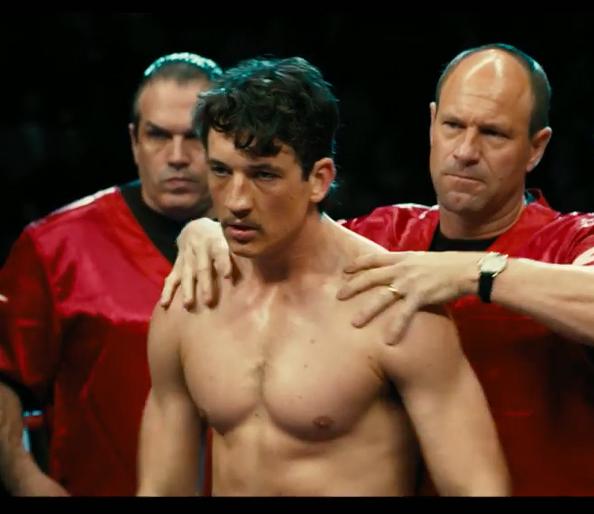
Sports stories give us heroes whose determination and courage is constantly tested. The athletes who face those challenges — who live for those challenges — can help us understand and face our own. Vinny Pazienza was a great boxer, but what made him heroic was not his skill in the ring or his unprecedented wins in three different weight classes. It was his comeback from injuries he got in a deadly car crash, including a broken neck so severe that it was not clear whether he would ever walk again. He was given the choice between spinal fusion that would guarantee that he could walk but would prevent him from getting back in the ring, or six months in a Torquemada-style halo contraption literally screwed into his skull, where the slightest bump could paralyze him forever but, if everything went perfectly he might regain enough mobility to fight again, he chose the halo. He ended up resuming his training — against the advice of his doctors — and removing the halo after three months, then returning to boxing. Let me put it this way: knocked down worse by life than by any opponent in the ring, he was up by 9.

For his first film in more than ten years, writer/director Ben Younger (“Prime,” “Boiler Room”) tells the true story of one of the greatest comebacks of all time. Miles Teller, himself a survivor of a serious car accident, plays Pazienza, known as Vinnie Paz. We first see him sweating out the last few minutes before a weigh-in, swathed in plastic wrap, on a stationary bike, determined to make weight so he can still qualify as a lightweight. He just makes it, stripped down to a thong. That night, instead of getting some rest, he stays up most of the night playing blackjack and having sex. But the next day, he wins.

Vinnie loves his fights. After each one, he’s ready for the next. His mother listens from the next room, holding her rosary and lighting candles as his sister watches the fights on television. But his father (Ciaran Hinds) is literally in his corner, urging him on and arguing with his fight promoters. Vinnie switches to a new trainer, Kevin Rooney (Aaron Eckhart), who has a sometime drinking problem but who has taken fighters all the way to the top. Kevin persuades him to stop trying to qualify for the junior welterweight class and put on some extra weight to fight as a junior middleweight. Things go pretty well until the car accident.

And that is how he learns who he is. Vinnie has never stopped for anything and nothing has stopped him. He worked hard at boxing, but never considered why or whether it mattered to him. Literally and metaphorically immobilized, he discovers that the combination of recklessness and determination gives him a way to get back in the ring.

Teller is one of the best young actors working today, and he makes Vinnie’s physicality real. His chemistry with Eckert gives what could be yet another boxing story hold our attention, even without the usual romance. Younger makes the family scenes of a rowdy middle class Italian vibrant — you can almost smell the oregano. And the story of resilience and redemption is always welcome, especially when it is as well told as it is here.

Parents should know that this film includes very strong language, brutal fight scenes, and graphic and disturbing images including a fatal car accident, surgery, and other medical procedures. Characters smoke and drink, including alcohol abuse.

Family discussion: Who helped Vinnie the most? Why did fighting matter so much to him?

If you like this, try: “The Fighter” and “Creed”

Related Tags:


Based on a true story Drama Sports
Loving

Loving

Posted on November 10, 2016 at 5:21 pm

A-
Lowest Recommended Age: Middle School
MPAA Rating: Rated PG-13 for thematic elements
Profanity: Racist epithets
Alcohol/ Drugs: Some alchohol
Violence/ Scariness: Racism, some shoving, child hurt in accident
Diversity Issues: A theme of the movie
Date Released to Theaters: November 11, 2016
Date Released to DVD: February 6, 2017
Amazon.com ASIN: B01LTHZK2U

Copyright 2016  Focus
Copyright 2016 Focus
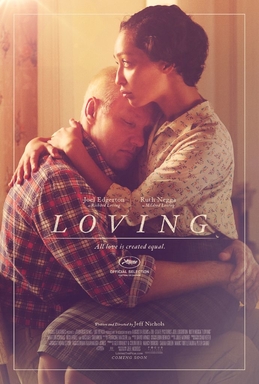
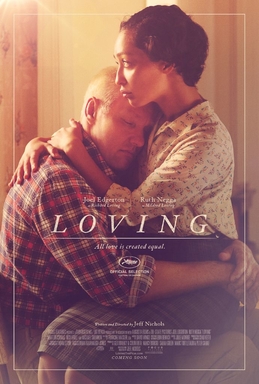
We don’t have to see how they met. We don’t have to see how he worked up the courage to ask her out or their first misunderstanding, or watch her try on different outfits before their big date. “Loving,” written and directed by Jeff Nichols (“Midnight Special,” “Mud”) brings us into the story of Richard and Mildred Loving (Joel Edgerton and Oscar nominee Ruth Negga) as they have a very short, very simple, but very meaningful conversation. She pauses, and we can see on her face that she does not know how he will react and is perhaps afraid to hope. Finally, she says it: “I’m pregnant.”

There is a pause, only a few seconds but it feels much longer. Finally he says only, “That’s great.” But it is clear that he is overjoyed that their love has created a child and he is fully committed to her. And it is clear, too, that they are not fully aware of the ramifications of having a child when the mother is black, the father is white, and the Commonwealth of Virginia, which shut down its entire school system just four years earlier in response to the Supreme Court’s Brown v. Board of Education decision, prohibits marriage or cohabitation between people of different races specifically because it does not want mixed-race children to be born.

Washington D.C. allows inter-racial marriage, so they are married there in 1958, and return home.  One night the sheriff crashes into their home as they are sleeping in their bed, their marriage license on the wall, and arrests them.  The judge suspends their sentence only if they will agree to leave the state and never return together.

They live with family in Washington, and raise three children.  But Mildred wants to go home. Nichols conveys the Edenic quality of the countryside they love. The Civil Rights movement has begun, so she writes to Attorney General Robert Kennedy to ask for his help.  He puts her in touch with the American Civil Liberties Union, a nonprofit that protects Constitutional rights. Two idealistic, if inexperienced, young lawyers (Nick Kroll and Jon Bass) want to take their case to the Supreme Court, which can invalidate all 16 state miscegenation laws.

Nichols keeps the legal stuff at the edges of the story. His focus is on the Lovings and their community, and the film is brimming with small, beautifully realized, evocative details. A dinner scene shows how completely Richard is accepted as a part of Mildred’s family. But we also see a frank conversation where a black man tells Richard that they may be alike, but Richard can “fix” his problem with the bigoted law by leaving Mildred while there is nothing they can do to “fix” theirs.

Richard’s mother, a midwife, only needs a few words to let Richard know that she did not give the police any information about where the Lovings were (and to let him know she was not entirely happy about the marriage, though she treats Mildred with kindness). We see a baleful glance from a defeated white competitor in a car race that could indicate the source of the complaint to the sheriff.

We see Richard’s careful, capable hands stirring mortar and laying concrete blocks and Mildred caring for the children and sitting at the kitchen table to write to the Attorney General. And, in a re-creation of the famous photo in LIFE Magazine by Grey Villet (a nice cameo by Nichols regular Michael Shannon), we see their quiet pleasure in each other as they laugh at the “Andy Griffith Show” episode about Aunt Bee’s pickles. He may need a lawyer to tell the nine old men on the Supreme Court he loves his wife. We see it in every frame.

Parents should know that this film depicts historic racism with some offensive epithets. The movie also includes a childbirth scene and an (off-screen) accident involving a child.

Family discussion: If you could take a case to the Supreme Court, what would it be?  What do we learn about the Lovings from seeing them with their families?

If you like this, try: the documentary “The Loving Story

Related Tags:


Based on a true story Drama DVD/Blu-Ray Pick of the Week Features & Top 10s Race and Diversity Romance
THE MOVIE MOM® is a registered trademark of Nell Minow. Use of the mark without express consent from Nell Minow constitutes trademark infringement and unfair competition in violation of federal and state laws. All material © Nell Minow 1995-2026, all rights reserved, and no use or republication is permitted without explicit permission. This site hosts Nell Minow’s Movie Mom® archive, with material that originally appeared on Yahoo! Movies, Beliefnet, and other sources. Much of her new material can be found at Rogerebert.com, Huffington Post, and WheretoWatch. Her books include The Movie Mom’s Guide to Family Movies and 101 Must-See Movie Moments, and she can be heard each week on radio stations across the country.

Website Designed by Max LaZebnik