Rated PG-13 for war violence, language, suggestive material, and thematic elements
Profanity:
Some strong language
Alcohol/ Drugs:
Drinking and drunkenness, drug references
Violence/ Scariness:
Wartime violence
Diversity Issues:
Diverse characters
Date Released to Theaters:
June 9, 2017
Date Released to DVD:
September 11, 2017
Copyright 2017 Bleeker Street
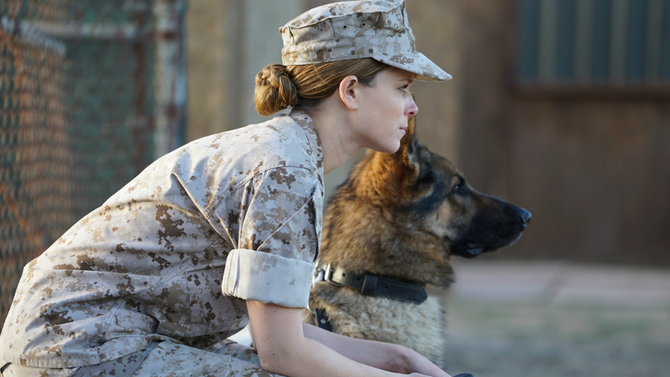
Devastated by the loss of a close friend, fired from a dead-end job, without any sense of worth or meaning, a young rural New Yorker enlists in the Marines and learns about honor, loyalty, and purpose, and finds unconditional love, too.
What makes that familiar story less familiar in this fact-based retelling is that the Marine in question is a woman and the love story is with her partner, a German Shepard.
Kate Mara is both vulnerable and determined as Megan Leavey, who was lost until she joined the Marines and got assigned to the K-9 division of military dogs trained to sniff out bombs and guns. Leavey had two tours of duty alongside Rex until they were blown up together by a bomb. The most significant part of her recovery came from a renewed sense of purpose in fighting for the chance to give Rex a home when he could no longer work.
The film, which has some dramatic (and romantic) heightening, shows Leavey being fired by a supervisor who tells her, “You don’t connect with people very well.” Her mother (Edie Falco, terrific as always) does not want her to go into the military but has nothing else to offer. After basic training, she gets drunk with friends and is sentenced to clean up the dog kennels. That is the moment when a part of her wakes up. Instead of resisting what she does not want, for the first time there is something she does want.
The Leavey equivalent in the K-9 corps is Rex, a handsome German shepherd described by the veterinarian as “the most aggressive dog I’ve ever treated.” The woman who does not connect with people very well is a perfect match for the dog who does not connect with people very well, either.
Leavey wants to become a part of the K-9 program, but in order to qualify she has to meet some very tough standards for her skills and behavior. She makes it in and the training includes learning how to bandage a wounded dog, a powerful reminder of the risks ahead.
The story has four distinct chapters: Leavey before the Marines, her training and getting to know Rex, their deployment, and her efforts to bring him home so she can care for him in his last months. Director Gabriela Cowperthwaite and star Mara wisely keep the focus on Leavey’s spirit-enlarging journey. Cowperthwaite is a documentarian (“Blackfish”) and brings a low-key naturalism to the storytelling, and Mara is excellent in revealing Leavey’s growing sense of confidence and purpose. “We were injured in Iraq,” she says, simply, compellingly. They are both wounded warriors and their best path to healing is to be together.
Parents should know that this film includes wartime violence with guns, bombs, explosions, characters injured and killed, drinking and drunkenness, strong language, sexual references and a non-explicit situation.
Family discussion: What was it about the dog corps that made Megan want to qualify to be a part of it? Why did Gunny give her a chance?
Rated PG-13 for violence, disturbing images, brief strong language and some nudity
Profanity:
Brief strong language
Alcohol/ Drugs:
Alcohol, smoking
Violence/ Scariness:
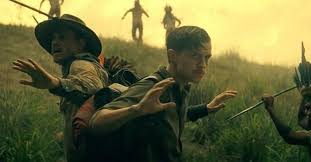
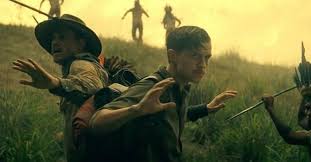
Peril and violence including WWI battles and attacks by indigenous people
Diversity Issues:
Class, race, and culture issues a theme of the movie
Date Released to Theaters:
April 21, 2017
Date Released to DVD:
July 10, 2017
Copyright Amazon Studios 2017
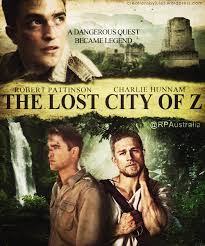
From the early 19th to the early 20th century, the British Empire exemplified a spirit of adventure, devotion to duty, and confidence bordering on hubris that led to extraordinary achievements like the Oxford English Dictionary and the arrogant imposition of colonialism around the world. All of that is in this true story of Percy Fawcett, an officer in the British Army whose eight trips to South America in search of ancient ruins inspired characters in books by H. Rider Haggard and Arthur Conan-Doyle (The Lost World) (both friends of Fawcett’s) and in movies like “Raiders of the Lost Ark.” Basically, if the hero wears khakis as he slashes through the jungle, he owes something to Percy Fawcett.
Writer/director James Gray based the screenplay on the book by David Gann and the letters of Fawcett and his wife, and shaped the story to make it more accessible, turning eight trips into three and reflecting a more contemporary understanding of race and gender. That is notable in Nina Fawcett’s attempt to insist that she should accompany her husband on an expedition and in the treatment of the natives, who are portrayed with dignity and agency, and treated as such by Fawcett.
He also helps us understand the pressures of the era that helped to motivate Fawcett’s journeys. The unlimited opportunities of the uncharted jungle were especially compelling. In addition to giving him the chance to earn money for his family, a major discovery would allow him to return to England in triumph and overcome the disgrace his father had brought to the family name. We first see him outracing his fellow officers, showing us his skill and determination. When he has the opportunity to go to Bolivia to map the country’s boundaries — to protect the British business interests in South America — he does not want to leave his family but he is eager to escape the restrictions of Edwardian social class. “He’s rather unfortunate in his choice of ancestors,” one character sneers.
On the mapping expedition he hears about a place where there are artifacts of a prehistoric civilization and he is determined to find it and come home in triumph. He teams up with the loyal and capable Henry Costin (Robert Pattinson, unrecognizable behind a thick beard).
On his second visit, he brings along a veteran explorer, James Murray (Angus Macfadyen), who had been with Shackleton on his expedition to Antarctica, which turns out to be a very bad decision. But it is also the final proof for Fawcett that class and reputation are not determinative. On the third trip, after Fawcett’s return to military service in WWI, he brings his once-estranged son (Spider-Man Tom Holland) and reaches a new understanding and reconciliation.
Gray ably conveys the curiosity and wonder of the journeys and the passions that impel the adventurers. Pattinson’s performance is especially thoughtful and Hunnam does well, especially in an impassioned speech to the skeptics at the Royal Geographical Society and in showing us how his journeys change his views of himself and his world, perhaps inspiring us to imagine our own.
Parents should know that this film includes extended peril and violence including wartime battle scenes, sad deaths, some graphic and disturbing images, native nudity, brief strong language.
Family discussion: Why did Percy keep returning to his search? What did he learn from his experience with Murray?
If you like this, try: “The Man Who Would be King,” “The Lost World,” “Mountains of the Moon,” and the books by H. Rider Haggard and Arthur Conan-Doyle inspired by Fawcett’s adventures
Interview: Writer/Director James Gray of “The Lost City of Z”
Posted on April 12, 2017 at 3:55 pm
James Gray wrote and directed the adventure movie “The Lost City of Z,” based on Percy Fawcett, the real-life explorer who inspired fictional characters from Indiana Jones to the swashbuckling heroes of books by Arthur Conan Doyle and H. Rider Haggard. The movie stars Charlie Hunnam, Robert Pattinson, and Sienna Miller. Gray and his crew had to re-create the arduous journey through the South American rainforest; while they had better technology than Fawcett’s group, they also had to bring along all of the equipment to make the film.
In an interview, Gray talked about the directors who inspired him — and why he had to make some different choices than the ones in their classic films.
It’s 100 years after the events in the film. Tell me how you approach dealing with issues of gender and race that acknowledges the realities of its era without distracting us unnecessarily?
Wow, that’s a heavy one. How did I deal with it, well, with great difficulty and with kid gloves. It’s one of the advantages we have and it’s not about judging the characters, that’s not really what I’m saying but a more global view, a more…how do I say this? A more progressive view, a more open view hopefully of the ideas of gender, class and ethnicity that has to be part of the film. And I felt that if I could make a movie in the style of let’s say David Lean, who I revere, but bring, dare I say this, a more advanced or different approach to the politics of it — for example,”Lawrence of Arabia he has Alec Guinness playing an Arab which is absurd today.
So, I felt that that was the way that I could do something different from what Mr. Lean did. And in the case of something like an “Apocalypse Now,” as great as I think it is, and I think it is the greatest, there certainly aren’t any women in it of any importance. A Playboy playmate is pretty much the only woman in the whole movie. So, I felt that it was important that I give everybody a sort of fair shake at the narrative and that everybody’s existence would be entirely independent. So, Sienna Miller’s character has her own hopes and dreams and that the film acknowledges those desires. And the indigenous people of South America would be independent and not demand a white male European view of the world to exist. People talk about what they call the Magical Negro in movies where this African-American character has all these magical qualities throughout which is in its own way deeply racist. My ambition was to do something the opposite of that, which was that the indigenous people of Amazonia would function in a way that was entirely free from any need for the white man.
And really the approach was to try and bring a certain dignity and humanity to every single person in the movie. And so, I’ve tried to think of it in those terms.
For me one of the most intriguing characters in the film was Murray, the veteran of the Shackleton expedition to the Antarctic but a terrible problem for Fawcett.
In the book he goes on I think it’s eight trips, so I had to condense that to three. When I approached it I thought, “Okay if it’s three trips, each trip has to have a different meaning.” The first trip is about the exposure to his obsession and how the obsession settles in and what it becomes and what it starts to mean for him. The second trip with Mr. Murray would have to be about how he saw the trip in the beginning as cementing his position not only in society but in history and really it was an act of ego to bring Mr. Murray along. He was going for glory and he thought Murray would bring an incredible luster. Murray’s ethical bankruptcy is in a way Fawcett’s fault because he chose Murray to go with him. That was the price he paid for wanting that because Murray is the lie of one class’s superiority over the other. Murray is the person who’s “Oh look how much wealth I have.” He’s a man of means and prestige and yet he’s a fraud.
So, Murray was a lesson for Fawcett really that the measure of a man has nothing to do with class or rank. That was what I thought the whole trip meant. He had to learn that and the third trip was his atonement for his neglect. It became a much more spiritual experience for him because he was able to enjoy it with his son. On the third trip he could achieve a measure of transcendence because he had already been through the second trip with this person who showed him that the search for glory and class validation was a bankrupt position.
Were you able to read some of Percy’s own journals?
I sure did. In addition to the Grann book I read Exploration Fawcett which is a compilation of his journal entries along with some editorializing by his son Brian that was put out many years later. I’m sure there is some embellishment from Brian, who was anxious to validate his father’s journeys but I’m sure it still had a bunch of Percy’s actual words still in them. I tried to adhere to Fawcett’s own words in as many places as possible. That Royal Geographical Society speech that he gives, which is about a seven and a half-minute long scene in the center of the movie is almost entirely his actual words. I read his letters too, back and forth to his wife and Charlie Hunnam and Sienna Miller did too. That was actually the best window into who those people are that we could have found. And I think it was necessary work.
Did you feel in a way as you were filming in South America that you were re-experiencing some of what he experienced? Did you learn what he went through just from being there?
Probably not because I’m nothing like Fawcett. I’m a wimp and I was only there for four months and he was in it for years. He didn’t have GPS and he didn’t have a bed at night to sleep in. I had clothes with special coating so I didn’t get bitten by anything. It must’ve been unbelievably difficult and I can’t understand how he did it. I mean we were there only four months and one crew member got malaria and two people got dengue. Somehow he marched to the jungle multiple times in the eight trips he went on that’s really about 20 years’ worth of living.
What would have happened if he found the City of Z?
Perhaps if he had found it, it would have been kind of anticlimactic for him. We have a real-life example of this in Hiram Bingham, who discovered Machu Picchu but his life had to have another act. He became a Senator. And I feel like if Fawcett had found some city in the jungle he would’ve looked at it for about twenty minutes and thought, “This is totally amazing. What the hell do I do now?” So much of what it was about for him was about the need to escape.
What is it that you think drives people to become explorers, to go past what is on a map?
There are noble qualities to exploration, there really are. There is an unending curiosity, there’s a remarkable drive, there is a stunning courage but there are also darker, less noble, aspects to it. One is the need to escape confronting what it means to be a person living in this world. I think that Fawcett’s whole need for exploration was in part a need to get out, a need to get away from what was very obviously a situation that was punishing to him. The father was a terrible alcoholic and was a gambler. He destroyed not one but two family fortunes. It shamed the family. So Fawcett was trying to escape from Victorian England and the cruelty of that world that seemed so punishing. And I think part the need for exploration is just to get out.
Rated PG-13 for thematic elements, disturbing images, violence, brief sexuality, nudity and smoking
Profanity:
Some strong and bigoted language
Alcohol/ Drugs:
Drinking, smoking
Violence/ Scariness:
Wartime and holocaust violence involving humans and animals, characters injured and killed, rape of a young girl (off-camera), sexual abuse
Diversity Issues:
A theme of the movie
Date Released to Theaters:
March 30, 2017
Copyright Scion Films 2017
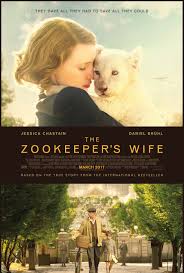
Jessica Chastain is luminous in the real-life story of Antonina Zabinski, a Warsaw zookeeper, who, with her husband and son, saved the lives of Jews during the Holocaust. Director Niki Caro (“Whale Rider”) brings her love of the natural world and her gift for telling stories of courage and triumph over bigotry to give us a timely reminder that the direst circumstances can inspire the greatest acts of courage and generosity. It also reminds us that there are still new stories to be discovered, even in a period of history that has inspired hundreds of films and thousands of books.
The movie opens on scenes of Edenic paradise. Antonina looks lovingly at her sleeping son — and at the baby lions sleeping beside him. She leans over and holds his foot, but it is the lion cubs she nuzzles. We then see her opening the zoo for the day, riding her bicycle through the magnificent Belle Epoque zoo, with the young camel loping along behind her, lovingly greeting each of the creatures. We will later learn that she is a refugee from Russia, and her childhood hardships left her more willing to trust animals than people. Animals trust her, too. Her skill at “whispering” even the most frightened and frightening wild thing will prove essential once Germany invades Poland.
Antonina is married to Jan (the Belgian actor Johan Heldenbergh), and the zoo is in every way their home. They live on the premises, but it is more than that. There is no distinction between the rooms they live in and the rest of the zoo. Animals wander in and out of the house and Antonina feels that the animals are her treasured guests — that is the term she uses.
And then Germany invades Poland, and the zoo is destroyed. A German zookeeper, Lutz Heck (Daniel Brühl of “Rush” and “Captain America: Civil War”) offers to take the best of the surviving animals to his zoo in Berlin, promising to care for them and return them after the war. Later, as an officer in the German army, he returns to shoot the animals left behind. The Jews of Warsaw are moved into the Warsaw ghetto. Antonina and Jan figure out a way to smuggle some of them out of the ghetto, and soon they are living in underground cages once used to house animals. Once again, Antonina refers to them as her guests, and each night, after the patrol has gone home, she has music and serves food on elegant trays to remind them that there is still civilization in the midst of madness and kindness and courage in the midst of brutality and terror.
It would be easy to mistake the gentleness of Caro’s approach as not sufficiently harrowing to convey the horrors of the Holocaust, especially after the Oscar-winning “Son of Saul.” But that would be wrong. Caro, who made a film about sexual predation in “North Country,” understands that an unwanted touch of a hand or coming a few millimeters too close can feel soul-destroying, especially when it is misunderstood by someone whose trust and respect mean everything. She understands that a drawing, a bunny, a chance to create, a moment of sympathy can begin to heal a ravaged heart, and she presents Antonina’s story with as much grace and humanity as Antonina showed her guests.
Parents should know that this movie takes place during WWII and the Holocaust, and there are disturbing and violent images including scenes of bombing, the Warsaw uprising, and execution of Jews. A young girl is raped (off-screen) and a woman faces a sexual predator. There is some bigoted language and human and animal characters are injured and killed.
Family discussion: How did Antonina’s love of animals help her in taking care of her “guests?” Why was it important to her to treat her “guests” to gracious entertainment in the evenings? What should she have said to her husband about Heck?
“When We Rise” was written and created by Academy Award-winning screenwriter Dustin Lance Black. This mini-series event chronicles the real-life personal and political struggles, setbacks and triumphs of a diverse family of LGBT men and women who helped pioneer one of the last legs of the U.S. Civil Rights movement, from its turbulent infancy in the 20th century to the once unfathomable successes of today. Starring in the mini-series are Guy Pearce (“Memento,” “L.A. Confidential”) as LGBT activist Cleve Jones, Mary-Louise Parker (“Weeds,” “Angels in America”) as women’s rights leader Roma Guy, Rachel Griffiths (“Brothers and Sisters,” “Six Feet Under”) as her wife, social justice activist Diane, Michael K. Williams (“Boardwalk Empire,””The Wire”) as African-American community organizer Ken Jones and Ivory Aquino as transgender-activist Cecilia Chung.