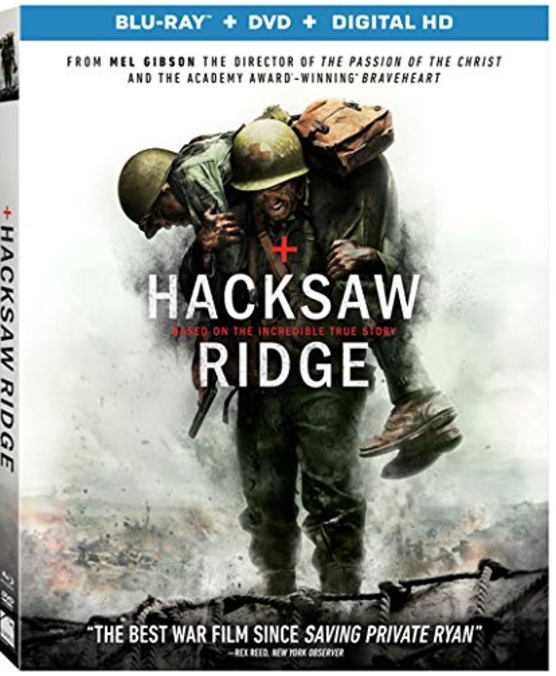
I have a copy of the Oscar-nominated “Hacksaw Ridge” to give away! Andrew Garfield plays Desmond Doss, a conscientious objector who served in WWII as a medic and personally saved more than 70 soldiers in one of the bloodiest battles of the war.
To enter, send me an email at moviemom@moviemom.com with Hacksaw Ridge in the subject line and tell me your favorite branch of the military. Don’t forget your address! (US addresses only). I’ll pick a winner at random on March 3, 2017.
Rated PG-13 for some language including racial epithets and a scene of sensuality
Profanity:
Some strong language including racist epithets
Alcohol/ Drugs:
Social drinking
Violence/ Scariness:
Peril, threats, violence including street fight
Diversity Issues:
A theme of the movie
Date Released to Theaters:
February 10, 2017
Copyright Harbinger Pictures 2016
In Shakespeare’s “A Midsummer Night’s Dream,” Lysander says, “aught that I could ever read/Could ever hear by tale or history/The course of true love never did run smooth.” It may just seem that way because the most enduring loves are those where challenges bring the couples together instead of tearing them apart. To quote Shakespeare again, this is the love that “looks on tempests, and is never shaken.” “A United Kingdom” tells the true story of a love that triumphed over the most intense opposition from both families and at least three countries.
Seretse Khama (David Oyelowo of “Selma” and “Queen of Katwe”) is studying law in post-WWII London when he meets Ruth (Rosamund Pike of “Gone Girl”) and they are instantly drawn to each other. They share a love of jazz music and a passionate commitment to the public good. Before they realize what is happening, they are deeply in love. Seretse explains that he is not just another law student; he is heir to the throne of his country, and his uncle is acting as Regent until he returns. He asks Ruth to take time to think about marrying him but she does not need time to think.
Even though they have already experienced some unpleasant, even threatening responses to their relationship, they believe that their good intentions and mutual devotion can overcome any obstacles. They will see that post-war optimism about a new era of tolerance and mutual commitment to continuing the progress toward freedom tested more intensively than they could have imagined.
Ruth’s sister is sympathetic, but she correctly predicts that their father “will hate him on sight. He is cleverer than him and he is black.” And indeed, he says, “You may deserve a life of insults and shame, but what about us? I can’t see you again.”
And then they go to Botswana, where his uncle and the community see his marrying a foreigner and a commoner as a betrayal, calling into question his loyalty and his ability to understand them. Has his time in London caused him to abandon the ways of his people?
And might his uncle have other reasons for wanting to stay in power?
The British government, in the form of the wonderfully condescending Jack Davenport (“Pirates of the Caribbean”), is even more disturbed. They have important business and political interests in the region, particularly in the adjoining country of South Africa, which is in the middle of adopting the 20th century’s most viciously racist laws, known as Apartheid.
Director Amma Asante (“Belle”), the British-born child of Ghanaian parents, has a sure sense of the worlds she is depicting. The Botswanans and their land are portrayed as respectfully and “normally” as the Londoners, with no sense of quaint or lesser “otherness.” And while the culture is not entirely equal (apparently only men vote), the female characters, including Seretse’s sister, have dignity and agency. This is a true love story, not just between Seretse and Ruth, but between the filmmakers telling this story and the people and the country where it is set.
Parents should know that the theme of the movie concerns an interracial marriage that was objected to by both families and their governments. There are some scenes of peril including racist street thugs, some strong language including racial epithets, and a sexual situation.
Family discussion: How did Ruth prove her sincerity to the Botswanans? Why did the British government intervene?
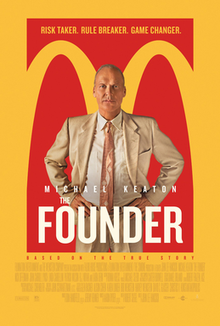
McDonald’s began as a hamburger stand in San Bernardino, California, the idea of two brothers, Dick and Mac McDonald, who brought to food what Henry Ford brought to cars: ultra-efficient assembly-line production: consistent, reliable, and scalable. But McDonald’s, the worldwide “billions and billions served” fast food franchise phenomenon with the iconic golden arches was the creation of the man who put “founder” on his business cards, Ray Kroc.
Balzac famously said that behind every great fortune there is a crime, and this story of one of the great disruptive forces in 20th century business shows us the vision, the passion, the triumph and the heartbreak behind it. Michael Keaton is well cast as Kroc, a struggling salesman who listens to motivational tapes about the importance of persistence — a more significant factor, according to the lectures, than ability or resources.
Kroc is on the road trying to sell milkshake machines to restaurants. He calls his secretary for messages. A prospect says no. A bill collector wants to be paid. And some hamburger stand in California wants to buy six. Kroc is sure that is a mistake. No one has ever wanted more than one. He calls and speaks to one of the McDonald brothers. He can hear the activity in the background. And the order gets upped to eight. Kroc has to go see it for himself.
The McDonald brothers (John Carroll Lynch and Nick Offerman) welcome Kroc warmly, proud to tell their story and show off their innovations. In one of the movie’s highlights, they explain the trial and error and meticulous planning that led to their operational and conceptual innovation. They had three brilliant insights. First, they got rid of the inessentials: no wait staff, no plates to wash or break, and they limited the menu offerings to the items that were most often ordered. You want chicken — go somewhere else. They got rid of the cigarette machine and jukebox and thus got rid of the undesirable customers, teenagers and others who come to hang around instead of those who eat and leave. That left busy families, who appreciated the wholesome atmosphere and utter consistency and reliability. Second, they streamlined production, again reinforcing consistency and reliability and attracting families. One more difference to appeal to families: no waiting. Food was delivered almost instantly. Indeed, when on his first visit Kroc received his food neatly packed in a bag seconds after placing the order, he looked at it confused and asked, “What’s that?” The McDonald brothers realized they were not just providing customers with food; they were providing them with something even more precious: time.
The third brilliant insight created some conflict with their new partner after Kroc persuaded them to put him in charge of franchising. For the McDonald’s, money was not the top priority. They valued, well, values.
It is instructive that there are several points throughout the film where someone explains that McDonald’s is not about hamburgers. All of the other answers are right in their own way, along with many others. This is a rare film that looks at what it takes to create a globally dominant business, and what it costs as well.
Parents should know that this film includes one f-word, some predatory business behavior, illness, and marital strain and divorces.
Family discussion: How many things other than hamburgers did people say the business of McDonald’s really was? Why did Kroc call himself “founder?” Who was right, the brothers or Kroc, and why?
If you like this, try: “Tucker: The Man and his Dream” and “Joy”
Writer/director Peter Berg and actor/producer Mark Wahlberg have now made their third film in a row on the same theme: real life stories of everyday people showing exceptional courage and dedication in the direst and most tragic circumstances. “Lone Survivor” was the story of a disastrous Navy SEAL operation. “Deepwater Horizon” was the story of the BP oil rig explosion. Now “Patriots Day” is the story of law enforcement from the terrorist attack at the Boston Marathon to the killing and capture of the brothers responsible.
In all three films, Berg takes a story we know — or think we do — and creates a gripping, tense drama centered on a man who exemplifies American values of decency and integrity and shows exceptional ability to rise to the occasion. Wahlberg is a perfect choice to play those roles, and here he gives grace and dignity to the role of Tommy Saunders, a composite character based on the Boston cops who were on the ground when the bombs exploded, oversaw triage to manage the crowd and oversee emergency services and then tracked down the people responsible in just 19 hours.
And as in the earlier films, Berg’s focus is not on the people making the big policy decisions but on the people who are dealing with the consequences. He begins a brief but vivid chance to get invested in some of the key players just before Boston’s annual Patriots Day race, including some of the participants who will later be injured and Saunders, unhappy about being assigned to the race and struggling with a bad knee. Everything is the usual benign chaos until suddenly it becomes terrifying and catastrophic as the bombs explode near the finish line and no one knows what happened, who caused it, or whether more attacks are coming, with an anxious score by Trent Reznor and Atticus Ross, as Saunders and the other cops have to try to figure out what is going on, surrounded by severely injured people and panicked crowds — and, probably, somewhere, the bombers.
The minute-by-minute procedural section is engrossing, with territorial squabbles and conflicting priorities involving the police force and the FBI. The injured people may have crucial information the cops need right away but they also have injuries that need treatment right away, treatment that could make it difficult or impossible for them to talk or remember. The press insists on releasing photos of possible suspects despite law enforcement’s concerns that it could impair the investigation. And what do you do when a key witness insists on a lawyer, or decides to leave the police station? One of the most powerful scenes in the film is the interrogation by a hijab-wearing FBI agent of the wife of one of the suspects, an incendiary performance by “Supergirls” Melissa Benoist. The film does not take a position on the abandonment of Constitutional rights in an emergency with perhaps hundreds of life at stake; it just presents it as the immensely complex problem with no right answer that it is.
And then, with ultimate respect, it concludes with footage of some of the real heroes. That’s the crying part, as it should be.
Parents should know that the theme of the film is a real-life terrorist attack with many characters injured and killed and some graphic and disturbing images of bodies and wounds; also very strong language, some bigotry, and some drug use.
Family discussion; How did social media affect the way this attack was investigated? What does this movie have in common with the two other fact-based stories from the same director and star?
If you like this, try: “Lone Survivor” and “Deepwater Horizon”
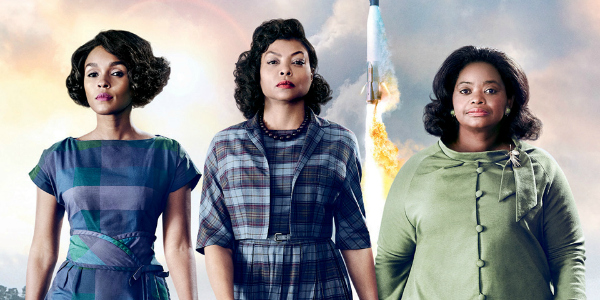
The sign on the office door said, “Colored Computers.” That was not a reference to IBM’s Big Blue or to a machine of any kind. In the early days of the space race at NASA, computers were people doing all of the complex, unprecedented math calculations by hand, and the “colored” computers were the African-American women who had more talent, more dedication, more integrity, despite less pay, less credit, and less resources than their colleagues. Twice marginalized, as women and as African-Americans, they were heroically dedicated, capable, and resilient. Their story, unknown until the book by Margot Lee Shetterly, is beautifully told in this heartwarming, inspiring film.
Katherine Johnson (Taraji P. Henson), Dorothy Vaughan (Octavia Spencer), and Mary Jackson (singer Janelle Monáe, “Moonlight”) are stopped by a highway patrolman on their way to their office at NASA. They get out of the car, expecting the worst. In his own way, the white patrolman expects the worst, too. This is Virginia, just a few years after the state shut down the entire school system to avoid complying with the Supreme Court’s decision in Brown v. Board of Education. This is the same era depicted in “Loving,” the true story of the couple who challenged Virginia’s laws prohibiting marriage for people who were not of the same race.
This was also the era of the space race. President John F. Kennedy famously said, “We choose to go to the moon. We choose to go to the moon in this decade and do the other things, not because they are easy, but because they are hard, because that goal will serve to organize and measure the best of our energies and skills, because that challenge is one that we are willing to accept, one we are unwilling to postpone, and one which we intend to win, and the others, too.” But there was another reason to go to the moon. The Soviet Union was ahead of us in space exploration, and beating them had huge symbolic, morale, and political value.
And that meant that something was more important than the deeply institutionalized racism and sexism of the era — ability. These women and their colleagues were simply too good to be overlooked. And to contribute all that they were able, that meant removing some obstacles and indignities. It was not until Johnson’s boss (Kevin Costner) exploded because she was not at her desk when he needed her that he learned she had to go a quarter of a mile to the “colored” bathroom in another building. And it was her vital importance to the project, not any commitment to inclusion or justice, that led him to insist on change. John Glenn (a likable performance by “Everybody Wants Some!!‘s Glen Powell) refused to get on the rocket ship that would make him the first person to orbit the earth until Johnson personally verified the calculations.
Henson, Spencer, and Janelle Monáe are clearly thrilled to have roles of such significance and depth and honor their characters with performances of wit and subtle charm. When Jackson has to go to court for the opportunity to take the evening classes at a segregated local high school that will qualify her for an engineering degree, when Vaughan decides to teach herself computer programming to make sure that the first-ever mainframe being installed at NASA does not make her work obsolete, when Johnson explains that it may be unprecedented to have a woman in the top-level meeting but it is also unprecedented to send a man to the moon, we see the power of their intellect and the steel in their souls. A light-hearted girl’s night shows us the support they gave each other and how much it meant to each of them.
Johnson, Jackson, and Vaughan plotted a course for NASA to put men into space. They also plotted a course for all of us to do things because they are hard, because they are important, because we can do better.
Parents should know that this movie includes extensive portrayal of the racial and gender prejudice of its time, along with smoking and social drinking and some language.
Family discussion: Why did the women in this film continue to be so loyal to a system that constantly disrespected them? Why did Dorothy Vaughan want to learn how to use the IBM machine? What do you think of her reply to Vivian Michael?
If you like this, try: “The Right Stuff” and “The Dish”