Trailer: Nick Nolte and Robert Redford Hike the Appalachian Trail in “A Walk in the Woods”
Posted on August 17, 2015 at 3:38 pm
Writer Bill Bryson came back to the US after 20 years in Great Britain and decided to reacquaint himself with his home country by walking the Appalachian Trail. And he took along a friend, or maybe a friend-ish, a cranky guy who was the only one who would come along, primarily because he had nothing else to do. In the grand tradition of other hiking sagas like Wild: From Lost to Found on the Pacific Crest Trail
— but much funnier — he wrote A Walk in the Woods: Rediscovering America on the Appalachian Trail. Now it’s a movie with Robert Redford and Nick Nolte.
“Show Me a Hero” is a new miniseries on HBO from David Simon (“The Wire”) and Paul Haggis (“Crash”), starring Oscar Isaac (“Inside Llewyn Davis”). It is the story of racial, class, and political tensions in 1970’s Yonkers, New York, based on the book of the same name by Lisa Belkin about a young mayor named Nick Wasicsko who struggled to get his constituents to accept a federal order to place low-income housing in a middle class community.
The title comes from F. Scott Fitzgerald, who said, “Show me a hero and I’ll show you a tragedy.” Wasicsko’s story did not end well. Maybe telling it now will help his idealistic vision come closer to reality.
Behind the scenes:
Simon and Haggis spoke about the show on CBS This Morning:
Bryan Cranston plays Dalton Trumbo, the brilliant screenwriter whose experiences during the McCarthy era inspired some of the greatest movies ever made about freedom. Trumbo was blacklisted but continued to write screenplays by having them attributed to “fronts,” men who were hired to take credit for them. During this period, two of his fronts were awarded Oscars, which were later re-presented to the man who was truly responsible for them.
Rated R for language throughout, strong sexuality/nudity, violence, and drug use
Profanity:
Constant very strong and crude language, racist and homophobic terms
Alcohol/ Drugs:
Drinking, drugs, drug dealing
Violence/ Scariness:
Violence including guns, fights, riots, sad deaths
Diversity Issues:
A theme of the movie
Date Released to Theaters:
August 14, 2015
Date Released to DVD:
January 18, 2016
Amazon.com ASIN:
B013P0X16Q
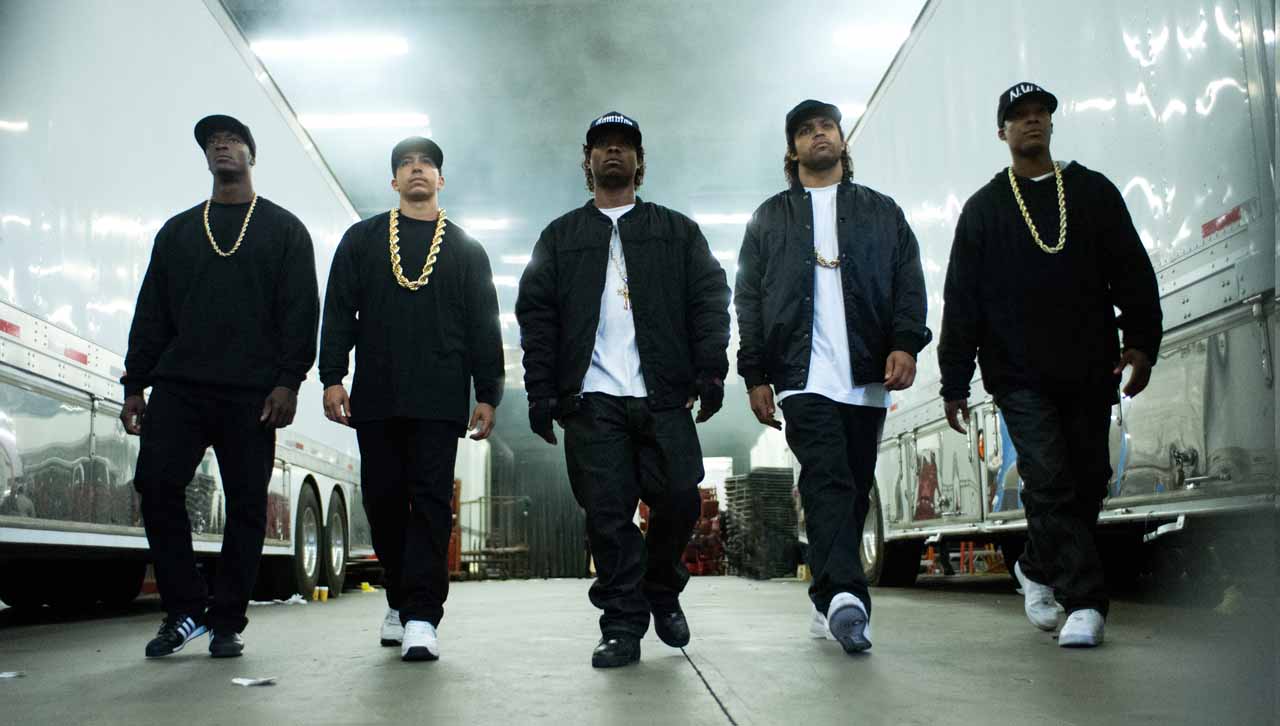
Copyright 2015 Universal“What does NWA stand for?” asks Jerry Heller (Paul Giamatti), who is offering to become the manager of a new rap group from the Compton area of Los Angeles. “No Whites Allowed?”
“No,” Eric “Eazy-E” Wright answers: “N**** Wit Attitude.”
NWA liked to think of itself as speaking truth to power, a CNN of oppressed minorities. When the Detroit police force told them that they would be arrested for obscenity and inciting violence if they performed their notorious “F*** the Police” in concert, they performed it. And they were arrested. When they were accused of glamorizing drugs and violence, they said they were journalists, reporting what they saw. They had a lot of attitude, a lot of anger, and a lot of ambition. They were savvy about what we might call branding. When their song “F*** the Police” got them a warning letter from the FBI, Eazy understood that it was the best possible publicity to present them as rebels being attacked by the Man, marketing money could not buy.
Much of the story is familiar from every other musical biopic you’ve ever seen plus every single episode of “VH1: Behind the Music.” 1. Talented young people from a marginalized community are told that their music is neither good nor commercial. “If you find the next Bon Jovi, call me,” says one label executive as he walks out of their performance. 2. And then they find their audience. They become successful beyond their wildest dreams. 3. And then they discover that fame and money present their own challenges, including fights over money and the direction of the business. But this biopic, produced by the original members of NWA is unexpectedly sweet, even tender, presented with affection and perspective. (Perhaps this is the reason the film omits the genre’s most frequent cliche, the scenes of family members complaining that the musical superstars are not spending enough time at home.)
The script is sharp, often funny, and compelling. When a kid on a school bus taunts a thug in a nearby car, the thug boards the bus at gunpoint to tell the kids to treat him with respect — and stay in school. “We just got a motivational speech from an OG ,” says O’Shea Jackson, soon to be Ice Cube.
It has one of the best ensemble casts of the year and all of the performances are superb. But a considerable percentage of the movie’s power comes from its timing. While the events it depicts occurred three decades ago, it could easily be referring to the current headlines about police abuse and the virulent persistence of racism throughout American society. The footage of Rodney King being brutally attacked is chilling because it shows us where NWA’s anger came from and reminds us of how little progress we have made. More chilling than the attitude from NWA is the way that the constant trauma from the community and the society around it have created a particular kind of ambition. This first generation born after the heyday of the Civil Rights movement does not want promises or the traditional idea of progress. They are not about passive resistance and sit-ins. They are not looking for a seat at a segregated lunch counter. They want to tell their stories. And their contempt for the system is so deep that they show no interest in activism or putting their money back into the community.
Jason Mitchell gives a star-making performance as Eazy-E, the fearless and canny co-founder of NWA who started Ruthless Records with money he made dealing drugs. O’Shea Jackson, Jr. plays his real-life father, better known as Ice Cube, who created the lyrics for many of the group’s biggest and most influential pieces. And Corey Hawkins is Dr. Dre, master of the turntable. The movie is well over two hours and never seems long, but with that running time there should have been space for more about the creative drive. We see the guys writing in notebooks and there is a funny scene with Eazy as a last-minute substitute Dre has to show how to get on beat for their first recording. But we never get a sense of what it feels like to create these songs or to perform them before thousands of fans or how they felt about the complaints that their lyrics were misogynistic. Later we glimpse Ice Cube working on the screenplay for “Friday,” the first film from this movie’s director, F. Gary Gray. But we do not learn that it would be even more influential in Hollywood than NWA was in music. Instead, we get an admittedly very funny call-out to that film (“Bye, Felicia“). And we get fan service scenes re-creating Eazy’s pool parties and spouse service scenes like Cube meeting Nicole. There are two other members of the group we learn very little about.
There is still room for a more objective NWA story as cultural and political history. At middle age, Dr. Dre, Ice Cube, and Eazy’s widow are not as clear-eyed about their own history as NWA was in calling themselves citizen journalists, matching the harshness and brutality around them with the force of their rap. But this is a compelling story with a message as vitally important now as it was during NWA’s brief recording career, with plenty of attitude and then some.
Parents should know that the film includes very strong and crude language, drug dealing, smoking, drinking, wild parties, nudity, sexual references and situations, sad deaths, peril and violence, and archival footage of police brutality and riots.
Family discussion: Was NWA right to perform their song in Detroit? Do you agree that they are journalists? Should there be limits on song lyrics that are profane or bigoted?
If you like this, try: the documentaries about A Tribe Called Quest and Tupac Shakur and the music of NWA



 about a young mayor named Nick Wasicsko who struggled to get his constituents to accept a federal order to place low-income housing in a middle class community.